Search

kafkaestblog

It is a whirlwind in here

Tag

writing

Reality & Imagination – It Looked Familiar

9615874-an-aged-statue-of-an-angel-holding-a-harp-stock-photo-wings

THE REALITY: (from REALITY)

While away on a trip I had cause to walk the grounds of a Catholic college. I did this often as it was a large and peaceful place to wander. There were some paths, some gardens, some benches, wide playing fields and even a stroll beside a river. A peaceful retreat from the city (though I enjoyed the city).

I did meet one ancient priest telling his beads (there was a ‘retirement’ residence also present) who gave me a jovial ‘good day’. He was walking the paths through the trees (as was I) and eventually settled on a bench (as  I did not). I kept through the trees, which were really planted in individual copses. enjoying refuge from the sun. The trees seemed to be all pines, with full and tightly packed branches. As I went through one such group of firs I looked between the trees. There was a statue on the other side, so I circled and went up to it. As I approached I was overcome with the oddest feeling of familiarity, though I knew I could never had been there before. It also did not have any of the attendant feelings of deja vu.

And then.

And then I realized what it was. It was a scene I had created for my two ‘Satan’ novels, where a central character has the statue of an angel within a copse of firs in his back yard. Where he had a ghostly encounter of a dearly loved but harshly departed friend. My novel has an angel statue and reality had the Virgin Mary. But, still . . .

I’ve written of many real places which I have visited, but none took me so aback as this.


THE ART: (from THERE HAS BEEN A SIGHTING)

Mr. S. unexpectedly takes her arm, and begins to lead her along a winding, flagstone path. She has never seen such large pieces of the stone, and they glisten as if polished.
The path skirts a small stand of black spruce before it continues to the river. He stops her at the mouth of a gravel walkway leading through the trees.
“Let’s pop in here.”
“Your little acre of the Black Forest?”
“Hardly an acre.”
“Precision.” Breeze laughs. “Whatever would my father think of you?”
“Does any father think well of any man when his daughter is concerned?”
“Probably not.”
“No,” agrees Mr. S. “So not to worry.”
“He would think even less of someone leading his daughter down the garden path,” observes Breeze.
“That would be before he saw what I am about to show you.”
Mr. S. holds her arm tightly, and guides her onto the gravel walk. It leads directly to the base of a tree, then makes an abrupt curve between the largest of the spruce.
One of the boughs is so low Breeze ducks her head. She has the sensation of being in the midst of a forest, for the heavy branches obscure the surroundings.
“If I may be permitted a moment of drama.”
Mr. S. covers her eyes and speaks softly.
“Will you turn to your right, and take a few steps?”
Even though he had asked, Breeze is startled as he gently eases her forward, and she feels a slight urge to resist him. Her steps are more cautious than the gravel walkway demands, and the press of his body is noticeable. She counts her footsteps under her breath. She is surprised when they stop at half a dozen, and he quickly removes his hand.
“She’s beautiful.” Breeze stares, open-mouthed.
“Yes.” Mr. S. is pleased. “I think so, too.”
“An angel in the woods.”
“The angel of peace.” Mr. S. walks her around the statue. “Not at all bad for a knockoff.” He pauses behind the wings.
“A knockoff?”
“A reproduction.” He puts his foot on the pedestal, and leans forward. “I don’t really know how old it is. Certainly last century – possibly before.” He points to the blue folds. “I’ve had the paint cleaned and touched up. Is it too garish?”
“It … it stands out.” Breeze hunts for a word. “Let’s call it vibrant.”
“They said it was probably close to the original colour.” Mr. S. walks around the statue and again halts beside Breeze. “Since she stands in so much shade, it’s for the best she stands with lots of colour.”
“Do you believe in angels?”
“I’ve just had a night-long fight with Satan. I have to believe in angels.”
“Does she have a name?” Breeze leans forward to inspect the angel’s outstretched hand.
“I’ve never given her one.”
“That’s one of your suspicious half answers.” Breeze grins.
“When Mother Ursula spoke to her, she called her `Pet’.”
“Pet?”
“`How are we today, Pet?’ `You got a soaking last night,
Pet’.” Mr. S. glances at the statue’s face. “That sort of thing.”
“Oh.” Breeze also decides to look at the angel’s face. “It’s not what you’d call a Christian name.”
“Ursula would get a laugh out of that.” Mr. S. smiles slightly. “And so would the angel.” He turns toward Breeze. “And so do I.” He takes her hand. “Which is probably your intent, so I won’t again slip into the past tense when talking about Ursula.”
“She’s not dead yet.”
“Her living will gives the machines seventy-two hours.” Mr. S. looks at the angel. “I suspect it’s a wry Christian reference.”
“So if she rises on the third day, we won’t be surprised.”
“You have more optimism than even the Sisters.” He glances at her. “And they tend the machines.”
“Machines have their place.”
“Yes.” Mr. S. releases her hand. “But so does death.”

DE

(image) http://bigpreviews.123rf.com/images/bwf211/bwf2111105/bwf211110500086/9615874-An-aged-statue-of-an-angel-holding-a-harp–Stock-Photo-wings.jpg

“Say Cheese!”

the-wheel-ready-for-cracking

(image) https://3wheeledcheese.files.wordpress.com/2012/09/the-wheel-ready-for-cracking.jpg

Thank you reality!

In my historical novel trilogy about onion farmers, which stretches  from the 3rd Century to the present day, I have my main characters, the Cannara family from Italy, invent an “onion cheese”.

In the second part of the trilogy, I have the Cannaras take some of this cheese on a trading voyage to China. Theses voyages could last well over a year. I have them forget some of the rounds of their cheese, and they makes a return voyage. To their surprise, the Cannaras find that the length of travel and the motions of the ship have produced superior cheese. This they sell at a high profit.

Immediately following is a current news article about some cheese found on a ship that sank 340 years ago.

Below that is an excerpt from my novel, China Lily.

DE

~~~~~~~~~~~~~~~~~~~~~~~~~~~~~~~~~~~~~~~~~~

Wednesday July 27, 2016

340-year-old cheese discovered at shipwreck site and, man, does it stink

A dairy product, believed to be cheese, has been discovered at the wreck site of The Kronan. The Swedish warship sank before a battle with the Danish/Dutch allied fleet in 1676.

A dairy product, believed to be cheese, has been discovered at the wreck site of The Kronan. The Swedish warship sank before a battle with the Danish/Dutch allied fleet in 1676. (Kalmar County Museum)

Listen 5:22

Divers exploring a sunken 17th-century gunship from Sweden say they have discovered what they believe to be cheese.

“The smell and the texture of the material really points in that direction,” Lars Einarsson tells As It Happens guest host Helen Mann.

“I don’t know if anyone is going to taste it.” – Lars Einarsson

Einarsson, the marine archeologist who heads up The Kronan Project, thinks that the cheese smells like a mix of yeast and Roquefort.

“When it was opened the first time, it was really overwhelming, in a positive way. It was smelling ‘live,’ as opposed to dead organic material, which doesn’t smell very nice. It seemed to be alive.”

The material was found in a tin at the wreck site of The Kronan, the largest ship of its time. It sank in 1676 in the Baltic Sea, which helped preserve the cheese all these years.

The Baltic Sea is a ideal for preservation of the cheese, according to Einarsson. The low salinity, along with the fact that the ship sank in clay, helped seal the pewter canister away like a time capsule waiting to be opened.

lars

Lars Einarsson is a marine archeologist and director of The Kronan Project. (Lars Einarsson)

When asked if anyone would dare bite into the 340-year-old cheese, Einarsson paused.

“I don’t know if anyone is going to taste it. We are quite optimistic about getting an analysis of the chemical makeup of the product though.”

The cheese has been sent to a lab and Einarsson hopes to have the results of what exactly they have within a month. He adds that it may wind up on display some day.

“If it’s possible in terms of preservation, we’ll definitely [put it on display.] But first of all, we have to safeguard the material.”

http://www.cbc.ca/radio/asithappens/as-it-happens-thursday-edition-1.3699151/340-year-old-cheese-discovered-at-shipwreck-site-and-man-does-it-stink-1.3697365?cmp=rss

~~~~~~~~~~~~~~~~~~~~~~~~~~~~~~~~~~~~~~~~~~~~~~~~~~~~~~~~~~~~~~~~~~~~~~

~~~~~~~~~~~~~~~~~~~~~~~~~~~~~~~~~~~~~~~~~~~~~~~~~~~~~~~~~~~~~~~~~~~~~~

Excerpt from China Lily:

Just as he did on his last two voyages, Cepa will also bring a few wheels of the onion cheese back to Europe. He has established an authentic pedigree, with the local bishop stamping a date on the sealing wax of the cheese. Assuming there has been no damage by seawater (which has happened to a few of the wheels); the “onion cheese” has such renown the Cannara’s joke that they can almost sell it for its weight in gold.

The “ocean cheese” came about through an accident. On the first voyage Cepa had taken, some of the wheels of onion cheese had been swamped by seawater. The storm was so rough their wax had gotten chipped and cracked. Cepa instructed that they just be thrown overboard. However, before that happened, other crew members shifted cargo and the cheese was shoved into a corner and hidden. Other goods, purchased at different ports, kept obscuring the cheese. When they returned to Europe the cheese wheels were revealed. In the process of throwing them into the harbor, Cepa discovered a half dozen wheels in the middle had not actually been damaged.

A couple of months later, when the Cannaras decided to cut open one of the wheels, they found the cheese had acquired a piquancy and an oddly smoother texture. Speculation was that the motion of the ship, the salt in the air, and the additional years of ageing made the essence of onion permeate the cheese more broadly.

Cepa tried half the wheel on the extended family. The other half he proportioned out to the three medicinal bathing lodges the Cannaras owned, scattered through the foothills of the Alps. He had thought of just using it in Cannara taverns, or even as a supplement to the mid-meal at some of their businesses. The response he received from both the family and patrons of the spas changed his mind.

Even though the onion cheese had been touted for its “medicinal properties” at the spas, and promoted as an “oriental delicacy” elsewhere, the enthusiasm with which it generated proved that everyone reveled it its taste. Cepa was well-aware that part of the family lore concerned an Enaiy of centuries ago who had tried making cheese under water. He wondered if there was any part of the process that might be similar to the sea voyage. Perhaps the amount of additional time was part of her attempt, or bring rocked by the waves. He had no idea if the Cannara’s current recipe for onion cheese had anything to do with her underwater process.

His “ocean cheese” had been so well received that the Cannara family put a small sample on display to taste. Then they began to auction it off. Because most of those who used their spas were wealthy, or nobles, or rulers of the church, members of this social strata had already heard of the cheese. It was as rare as spice. It only appeared in small quantities every few years. Having no way to calculate a production cos, the Cannaras started at the base price for their regular onion cheese. Those of wealth and appetite took care of the rest.

Second Bananas And Also-Rans Complete The Picture

20152bcollage

My onion novel, CHINA LILY, spans decades. My main family, the Cannaras, travel the globe (of their time, which is the Fourteen hundreds). Lots of time on ships. Lots of time on horseback.

In their distant locations over their diverse times they meet different people. These people fill the chapters they are in, but then they are gone. They are really secondary characters to the novel, but nothing could be accomplished without them. In their own time frame they are front-and-center.

This same situation happened in my *thriller*. The time frame was much different (squeezed into a few days). And the location was one city until near the end. But the nature of the immediacy and the surprising twists of plot and the intense action called upon the use of many secondary characters. They were figuratively press-ganged into action. They did their bit and were not called upon again. Louie-the-dog was to be a secondary character with a ‘walk on’ part. He stayed.

I am having a growing fascination for these secondary characters. They have to be developed within paragraphs instead of chapters. Their dialogue and thoughts have to be concise and unique from the start. They possess a freedom of action the main characters do not have. They are not loaded down with baggage. They are a challenge to write and difficult to rein in. They are generally saucy and rarely ponder their lot. Yet they must be real and not just plot devices. They have to be taken at face value and accepted quickly. They must stand out in the background.

A novel of only secondary characters – hmmmm . . .

DE

[image] https://3.bp.blogspot.com/-vZSuKHVPTpI/VsNpi-m3ekI/AAAAAAAAU7I/8JA_0K9LM_g/s1600/2015%2Bcollage.jpg

Franz Kafka Turns Words To Gold On The Golden Lane

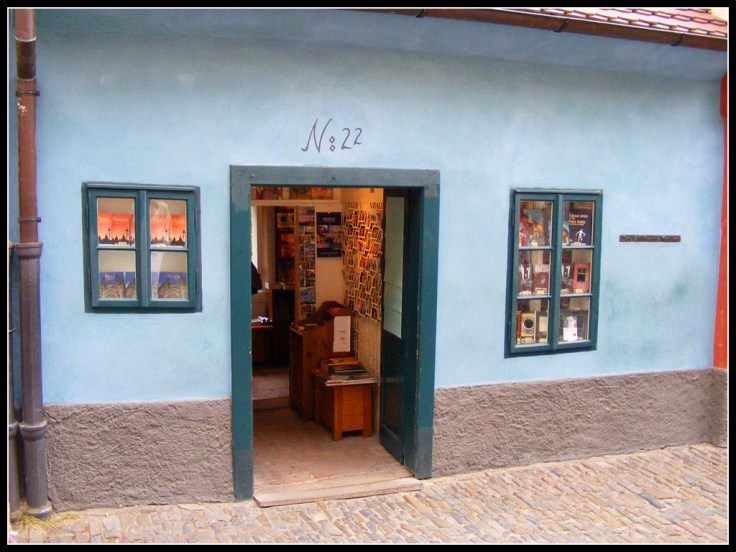
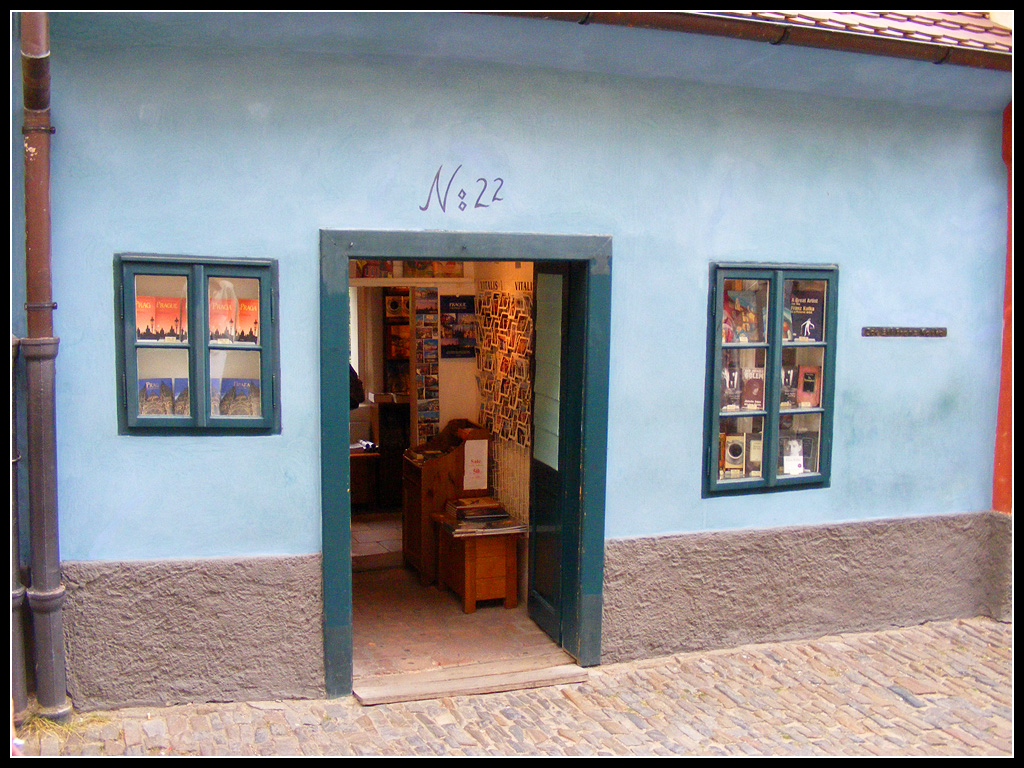
3848764367_a7b9e65ed5_o

[Kafka’s house on The Golden Lane]

A burrow offers security and comfort.  Kafka found both in his sister’s tiny house on the Golden Lane.

The Golden Lane is a narrow, dead-end yet massively historic lane, hugging an interior wall of the huge Prague Castle. Centuries ago the small buildings along the lane housed workers of the Castle, including some resident alchemists. Thus the name.

Ottla – Kafka’s sister – had rented it so she could spend time with her lover, and not be bothered by parents and comments. Her lover was not only a Christian, but he was soon going to leave to fight in World War I. Time was precious. However, she rarely had opportunities to use it other than the weekends, so she offered Franz the use of the tiny house for most of the time. And use it he did, though he never stayed the night.

Through fall, winter and spring Kafka wrote a whole book of short stories there. For a single block of time, it was one of his most creative periods.

When I visited, under the Communist rule of the time, it had been converted to a book store. Of course (which he would have appreciated) there were no books by Kafka for sale. Today he is displayed in the windows.

It was only when I went thorough the small rooms, and looked out the window into The Stag Moat, that I realized how important the house would become in Kafka In The Castle, my novel about Kafka. It was cozy – even with the space cramped by tourists. It had been little altered. I could easily imagine Kafka looking through the same glass and walking through the same doorways. No doubt stooping because he was tall. Research met reality.

One of the last stories Kafka wrote, during his final year in Berlin, was called The Burrow. A version exists and is published, though a longer version is supposed to be among his ‘missing’ papers. In it a tiny animal keeps incessantly burrowing to keep away from an enemy. A vague noise convinces the animal to burrow deeper. Yup – that’s Kafka.

DE

(image) https://farm3.staticflickr.com/2645/3848764367_a7b9e65ed5_o.jpg

Author Interviewed About Elephant And Writing

Dale Estey – The Elephant Talks to God

by

What is your most recent book? Tell us a bit about it.

The Elephant Talks to God is a book of short stories where my Elephant takes his queries and comments directly to God. God not only listens (as God does to us all) but enters into conversation with the Elephant, answering his questions. The stories eventually ended because the Elephant began asking questions the author could not answer. This book is not typical of my novels, the first being a Fantasy set in World War Two and published on two continents, the second a Thriller leading to my first translated work.

Tell us about yourself.

I am from Atlantic Canada, where I have lived all my life. My mother was a British War Bride and my father came from United Empire Loyalist stock. The Estey ancestry goes back to medieval Italy and the House of D’Este. I am interested in, and directed by, all this heritage. I have been writing for over thirty years.

What inspired you to write this book?

My mother gave me an elephant figurine as part of a Christmas gift. While struggling for a subject for a short story, I looked around my room and stopped at the elephant. It was to be a one-off story. The Elephant (and God) had other ideas.

How did you choose the title?

I wanted the most straight-forward title of such a weighty character and subject matter.

How did you know you wanted to be a writer? How did you get started?

I had no interest in writing, books, reading or any of the arts until Grade Eleven. Within the space of a week (for no obvious reason – I say that God cuffed me on the back of the head) I started writing “funny” short articles. The first of them which I remember (and it may indeed be the first) was about a classroom pencil sharpener which chewed up my pencil. I would do one or two of these funny articles a month. They started to get published in the regional newspaper, The Daily Gleaner.

Do you have any writing rituals?

My writing rituals slide around and some disappear over the years. The bulk of my manuscripts are done long hand with a BIC black ink pen. I usually write in the morning. I use binders and write on alternate lines on both sides of the page. I do now write thriller/adventure books on the computer, for I find that medium enhances the speed of such stories.

How do you come up with the names for your characters?

When stuck for a character’s name, I go to a Gazetteer. Most of the time the character appears with name intact. I have three novel manuscripts where the central character has no name but just initials.

Did you learn anything from writing and publishing this book? What?

Every day I write I learn something about writing. The Elephant showed me I can sustain humour.

If you were doing it all over again, what would you do differently?

I know what I should have done differently, but I doubt I would do it. I would have concentrated more on the career aspect, promotion and name recognition. But that might mean I would have written one less novel. Not worth the trade-off.

What types of books do you like to read? Who are your favorite authors? Why?

I prefer reading books where all the elements (character, plot, description, philosophy) blend seamlessly. Writers whom I enjoy who accomplish this are John le Carré, Thomas Mann, Thomas Hardy, Mavis Gallant, Alan Bennett, Robert Hass, Alice Munro, Saul Bellow.

Are you working on your next book? What can you tell us about it?

I am working on a thriller centred around NATO. Internet chicanery is at the core of the intricate plot. One central character is a guard/attack dog named Louie. His name came from a real dog I heard being called to in a dog park. Louie is a Cane Corso.

What is the best advice you could give other writers about writing or publishing?

*BEST* advice for a writer – write regularly. Work time into a schedule to make it possible to write a number of times a week – same time/same place if possible. Publishing venues are so broad these days that it is best to take a long time and study them all. Then chose an avenue that is comfortable (and understandable).

Who is the perfect reader for your book?

Perfection is over-rated. Enter my books and you won’t be disappointed.

Where can readers learn more about you and your book?

http://DaleEstey.com

Amazon.com

http://books.google.com/books/about/The_Elephant_Talks_to_God.html?id=Cj5sAAAACAAJ

https://www.facebook.com/profile.php?id=100000411133160

http://twitter.com/#!/DaleEstey

Interview at:

http://www.sellingbooks.com/

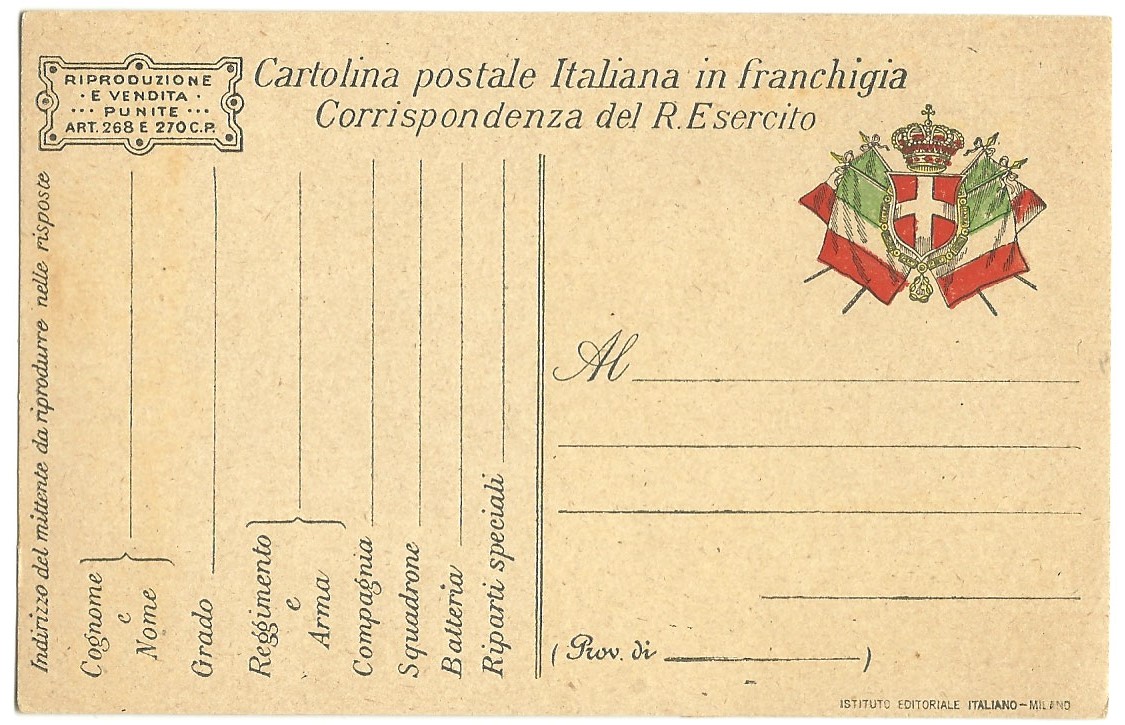
Postcards From The Past Without Pictures

ww1postcards02


Dear Eustice:

My mind confronts so many intangible truths that you sometimes seem – or is it just hope on my part – to be my only peg of reality. Have you noticed that whenever we finally believe we know the reason for something which happens, it often occurs that the real reasons are exactly the opposite of what we supposed. Everything walks a line – as narrow as those upon this page – between profound revelation and mindless absurdity. As I look through my window, the shadows cast through the trees on the next building, take the shape of a French poodle carrying a parasol. Is even Nature absurd?

Yours,

Margot
~~~~~~~~~~~~~~~~~~~~~~~~~~


Dear Margot:

Nature is nothing but reality, only the intangible can be absurd. As I’ve said too many times (and why do I repeat myself yet again) you spend too much effort – and wasted effort, for how can it be other – on futile quest and query. The only truth to be found is in sour milk or pleasant fornication – these things are real, these things exist. Absurdity is kittens playing or the Prime Minister’s latest speech. These things we look at with amusement or contempt – we know not to expect much from either. Quit you silly endeavours and join the world which surrounds you, not the one which your head surrounds. All important answers can be found between someones legs.

Yours,

Eustice


~~~~~~~~~~~~~~~~~~~~~~~~~~~~~~~~~~


Dear Eustice:

Ideas and questions are what make us more than the rutting animals you seem to exemplify. I do not claim that I shall ever reach Plato’s perfect bed, but neither would I wish to remain in your oft-used and no doubt soiled one. We are meant (I am quite certain of this) to strive to new understanding, new revelations about ourselves and our place in this world. The sole function of our body is to be a vehicle for transporting our mind, and keeping it alive. My `quest and query’ as you put it (and, by the way, did you steal that phrase – it sounds like the title of one of those pretentious little magazines you read) is both proper and noble. I really do wish you would utilize the gifts given you, and not waste so much time in idle and – it must be said – repetitious pursuits.

Yours,

Margot


~~~~~~~~~~~~~~~~~~~~~~~~~~~~~~~~~~~~~~~


Dear Margot:

One of life’s meaner tricks is to allow us all a different set of beliefs. Cows, cats and dragonflies are content with their uniform outlook on life. Their needs are simple (if keeping alive can be called simple), and they eat, drink, keep warm, and yes, cheerfully reproduce with little thought of anything else. If you wish to assume there are greater endevours in this existence, then you should also assume that only saints and angels can fathom them, and not spend so much time on a chore for which you are not equipped. Grand thoughts may be fine for the likes of Plato, but my perfect bed will have three beautiful partners in it, who are completely willing to whatever I suggest. I think if you study our bodies more closely, you will see what it really is their function to produce. You could do with stimulation to more than just your mind.

Yours,

Eustice.

P.S. Moira sends her love


DE

(image) http://www.nzeldes.com/Miscellany/images/WW1Postcards02.jpg

Amazing History Of The Writing Life In The Ice House

My great friend and writing mentor, Nancy Bauer, as wise as the ears she writes about, once mentioned  the past on Facebook in regards to a Thanksgiving Day. One of the responses to her comment spoke about our mutual times with the fluid writing group in the gathering place fondly known as the Ice House.

That reminded me of this blog, which I wrote nearly six years ago. It is centred around the Ice House and the passage of time. I’m sure Nancy, who writes a weekly newspaper column and has, occasionally, some trouble thinking of topics, will allow me to modify and steal from myself.

~~~~~~~~~~~~~~~~~~~~~

I came across an announcement today about a memorial reading for the Canadian poet, Alden Nowlan. One of my claims to fame is being mistaken for Alden – sadly three years after he died. Perhaps I had had a rough night the night before. At any rate, at this memorial reading a number of the readers are known to me and come from my ‘era’. One of the things some of us shared was that we were members of the same writing group. This group met on Tuesday nights for two to three hours, reading and commenting on each others work. Save for one Master’s Thesis that I know of, not enough has been written about this long-lasted group. And much could be written. Many notables passed through the door and many eventually-established authors emerged.

Although the building where we met had the proper name of McCord Hall, it was in fact the very old converted Ice House of the University of New Brunswick. It had been turned fancy with wooden beams and high windows and a long impressive wooden table. The Ice House is in current use as I speak, designated as an English Graduate seminar room. There is even coffee.


Indeed, just recently I wrote a brief story about the Ice House for a CBC contest. It went, in its entirety:

When the august Ice House Gang was in its writing heyday at the University of New Brunswick, the saintly Nancy Bauer was looked upon as our revered Mentor. She was calm and fair, even to the untutored and raunchy. Once, while one of our more seamy members was reading out-and-out pornography, I began to rub my foot against her leg. A look of confusion crossed her face and then, with a voice etched in acid, she loudly announced: “That Estey is feeling me up under the table.”

 
I did not win.

However, perhaps the reason is because of the following. This is part of the description of the memorial reading for Alden:

Along with Nowlan, former University of New Brunswick professor Bob Gibbs was a member of the “Ice House Gang”, a group of faculty members and writers who would gather in an old stone hut on College Hill

Oh, and this is the Ice House itself.

McCord Hall
I know much is in the eye of the beholder, but…

DE

(image)
http://www.heritagefredericton.org/node/154

What do agents really want? — Peggy Riley

I don’t know if this is the eternal question of authors (maybe that question is ‘what do editors want?’) but there  is a lot of worthwhile information here. And I’m guessing agents in America want what their British counterparts want. More or less.

DE

Last weekend’s first Kent Festival of Writing, organised with WhitLit, offered a full day of workshops about different aspects of writing, from Julie Cohen’s on plotting with Pixar and building a character from a coin toss, to mine on the perils of editing. (I’ll blog more about that soon.) The day culminated in a panel with […]

via What do agents really want? — Peggy Riley

Re-Writing The Bible For Fun But No Profit

80d910b1114d4d787e41aaec2a3e03b7

(Image)https://s-media-cache-ak0.pinimg.com/736x/80/d9/10/80d910b1114d4d787e41aaec2a3e03b7.jpg

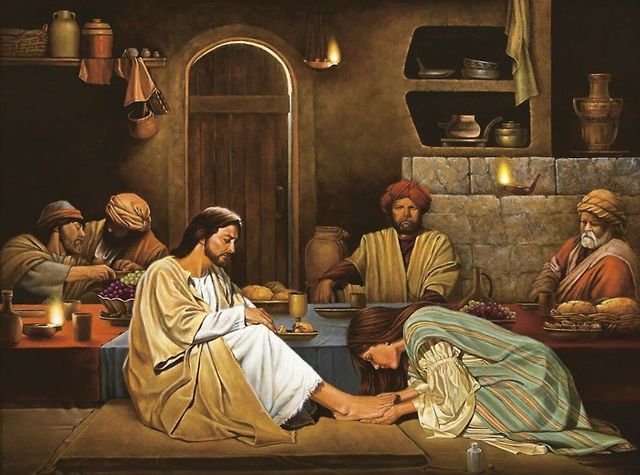
Some time ago I had an odd request – a very odd request, come to think of it – to re-write a portion of the New Testament. It is Luke 7 36-50, where Jesus is Anointed by a Sinful Woman. I was asked to write it from the woman’s point of view.

I met the man who made the commission at a Starbucks (his suggestion). He is a successful business man and owns and runs a professional corporation. He gave me the verses he wanted done and asked if I thought I would be able to do so. I said yes. I have the ability and the project intrigued me.  It would hold my interest.

He was not garrulous or forthcoming, and I refrained from asking him why he wanted this done. However, I did query the direction he might want the story to take. He was vague about that, also. A woman’s point of view. A woman of the times. I felt I pressed that issue strongly enough, even if I did not get much answer.

We discussed price. I told him what I thought such a project was worth. I explained it as an issue of time expended (even I wasn’t sure how much effort it would be). He agreed to an hourly price.

The end result is that he did not pay me. He disliked the finished story. I include the work and our email exchange at the end of the adventure. I wish he would have been as detailed in telling me what he wanted before the fact, instead of after.

~~~~~~~~~~~~~~~~~

Luke 7: 36-50
Jesus Anointed by a Sinful Woman
36 Now one of the Pharisees invited Jesus to have dinner with him, so he went to the Pharisee’s house and reclined at the table.
37 When a woman who had lived a sinful life in that town learned that Jesus was eating at the Pharisee’s house, she brought an alabaster jar of perfume,
38 and as she stood behind him at his feet weeping, she began to wet his feet with her tears. Then she wiped them with her hair, kissed them and poured perfume on them.
39 When the Pharisee who had invited him saw this, he said to himself, “If this man were a prophet, he would know who is touching him and what kind of woman she is—that she is a sinner.”
40 Jesus answered him, “Simon, I have something to tell you.”
“Tell me, teacher,” he said.
 41 “Two men owed money to a certain moneylender. One owed him five hundred denarii,[d] and the other fifty. 42Neither of them had the money to pay him back, so he canceled the debts of both. Now which of them will love him more?”
 43 Simon replied, “I suppose the one who had the bigger debt canceled.”
“You have judged correctly,” Jesus said.
 44 Then he turned toward the woman and said to Simon, “Do you see this woman? I came into your house. You did not give me any water for my feet, but she wet my feet with her tears and wiped them with her hair.
45 You did not give me a kiss, but this woman, from the time I entered, has not stopped kissing my feet.
46 You did not put oil on my head, but she has poured perfume on my feet.
47 Therefore, I tell you, her many sins have been forgiven—for she loved much. But he who has been forgiven little loves little.”
 48 Then Jesus said to her, “Your sins are forgiven.”
 49 The other guests began to say among themselves, “Who is this who even forgives sins?”
50 Jesus said to the woman, “Your faith has saved you; go in peace.”
I would like to see this story told form the sinner lady point of view.
****************************************
What I did.
The woman was a sinner. Everyone in the village knew this and everyone treated her accordingly. She would sleep with men for money, and thus was shunned. Except by those men who used her and paid her. But when they were done with her, they shunned her, too. Men are like that, selfish and deceitful. She has earned her money. They have earned her contempt.
The woman had reasons for being a sinner. Her parents were old when she was born and she was a chore to them. Not only a chore perhaps, but their affection was watered down. Their interest in her was always coloured with annoyance. She did not do what they wanted. She did not think as they thought. She had desires which had left them years before, so they did not think them important. And she was a girl – good only as bait for a man to marry. She was a burden.
However, she had a life to live. Her parents said she should thank them for her life. She said that instead she would blame them. She would look after herself if that was the way it had to be. She would use the tools that God gave her, just like a carpenter uses his tools to build. If there is no help from her parents; if her village looks down on her; if a man won’t marry her; well, she’ll set out on her own.
And she did.
It was not difficult to become a success at what she did. When with a man all she had to do was move her body and tell them lies. Praise them. Make those sounds they want to hear. Make then happy and she had a repeat customer. Keep the foolish secrets they seemed to insist telling her to herself. They trusted her as they used her. She used their stories for her own good. Learned where to purchase the best goods. Learned who to avoid. Make a bit of money on speculation. Even the cheapest grave digger when the time came for each of her parents. Be able to keep her parents house and even put some money away. What was a reputation compared to this?
It was from her clients that she first heard of Jesus. Yet another desert prophet full of crazy talk. The rabble seemed to love him. The Pharisees warned against him. He talked as if his words were the words of God. He seemed to give strange interpretations of the stories in the Bible. He seemed to think that more than just the rich were important. The men she was with laughed at that, but it was nervous laughter. There was something about this Jesus which troubled them, but also interested them. It was not usual that her client’s talk included references to God.
It was also from one of her clients – a Pharisee who liked to brag – that she learned Jesus was going to visit her village. The Pharisees were not happy with Jesus. They did not like what he was preaching. People are not equal. People need their leaders. Give people such ideas and they will be harder to control. So one of the Pharisees was going to invite Jesus to dine at his home.
The sinful woman decided she would attend the dinner. It was enough of a public event that she doubted she would be turned away. She wanted to hear what this Jesus had to say. See what he looked like. She knew about men and she was certain she could tell if he was to be trusted. And, men being men, she would bring him a gift. Nothing suggestive, just a jar of perfume to sooth him after his journey. She would present it to him if what she was hearing about him turned out to be true.
When she arrived at the house, and heard what Jesus had to say, she understood why the rich and powerful feared him. She knew the truth when men spoke it, because she heard it little enough. Jesus offered her comfort and asked for no favours in return.
She approached Jesus and kneeled at his feet, weeping. She was so affected by his compassion that her tears caused streaks through the dust on his feet. She wiped away at the tears with her hair, sobbing all the while. She then began to pour the perfume on his feet, rubbing the scented oils into his skin to relieve the ache of his walking.
Although the woman did not look up, she heard the condemnation coming from the Pharisee. She cowered lower beside Jesus’ feet and was prepared to be mocked and told to know her place. Forced from the house. Instead, Jesus remained seated and told a story. He asked who would love a moneylender more, one who had a huge debt cancelled, or one who had a small debt cancelled? The Pharisee replied that the one with the larger debt would have more love. Jesus agreed.
Then Jesus looked at the woman and smiled. He spoke to the Pharisee, and took the time to detail the actions of the woman since he arrived. He compared what the woman had done to the neglect of his host. She had paid attention to him, kissed his feet again and again, soothed him with perfumed oil after his walk, took the time to make him comfortable. The Pharisee had done nothing to put him at his ease. So if the woman was a sinner, then she deserved to have all of her sins forgiven, for she had done much for him. Her love was the greater, for she had overcome the greater sins, whereas the Pharisee, regardless of his fewer sins, had done nothing.
Jesus then forgave the sins of the woman, and told her to go in peace. And although this outraged the Pharisee and his guests, and made them question the authority of Jesus, the woman left the house cleansed.
Email Exchange (over ten days)
Hi, *****:
Let me know what you think of the story.
Dale
………………………
Did you receive the Bible story?
Dale
…………………………
I’m starting to wonder if I have the correct email address, though nothing is bumped back. Did you receive the story? I am wondering what your reaction is.
Dale
……………………………..
I’ll try this address and hope to get a response.
Dale
………………………………..
Hi Mr. Dale,
I expected the story to shed the light on the values and habits of Jewish community at the time of Jesus. I would elaborate on the social rejection to the sinners who does not conform with the social rules. I would not picture her as a community defiant person. I would highlight her struggle with her temptations & her religious and community values. I would illustrate how the teachings of jesus to invite the sinners to repent made a difference to her. I would imply how her humplness made the difference between her and Simon.
I do not think that the story delivered the massage that we discussed.

DE

Blog at WordPress.com.

Up ↑