Search

kafkaestblog

It is a whirlwind in here

Tag

writing

Taking A Vacation – But Not So Much

In a discussion about vacations today, I made the comment that I don’t consider I have had a vacation for forty years.  I doubt I was believed and, I’ll accept, it probably isn’t even true. But, when is a writer ever off? Ideas appear at will (not my will) and characters demand that attention must be paid. This can happen any day, and usually every day. This ain’t no complaint, as writer’s block is far worse.

Still, I think I’ll slip some blogs in that I have already done before. There may be no rhyme nor reason for my choices, but, this one came to mind because I think a character somewhat like The Gypsy Lady might have just appeared in my current manuscript. A totally different story and situation, but …

~~~~~~~~~~~~~~~~~~~~~~~~~~~~~~~~~~~~

gypsyviolin-graphicsfairy11

08 June 1917

A Gypsy confronted me today, and I was in the mood for a bit of sport. Her age was difficult to tell – certainly a decade older than me. In her swirl of shawls and dangling jewellery, heavy make-up on her face, she could almost have been in disguise. She peered at me with an intense sigh, attempting – I am sure – to penetrate my own disguise.

“You are a Jew,” she said.

“And you a Gypsy,” I replied.

She seemed pleased with my response, for her professional smile became real.

“You state the obvious,” she said. “As becomes a Doktor of Laws,”

I replied. “But to your eyes, do you not state the obvious?”

“Are you going to banter with a poor old Gypsy woman, instead of barter? That would make you suspiciously like one of us.” She said this with a growl in her throat.

“The Gypsy and the Jew,” I said, feeling the challenge which I so miss. “Perhaps an opera – but I think it’s been done to death.”

“They will try to do us all unto death,” she said harshly, and turned away.

I had the fear she was going to leave me without another word, but what she did was to spit fulsomely onto the street.

“They can’t kill us all,” I said, but I knew she heard the doubt in my voice.

She slowly faced me again.

“So. Even a Doktor of Laws can have hope. That is refreshing – but foolish.” She took my hand and felt my palm roughly with her thumb, although all the while her eyes never left my face. “You are going to travel.”

“Travel is a vague word. One can go on many types of voyage.”

“And reach many destinations,” she added, still holding my hand. “If you take away my vagueness, you take away my trade.”

“Then let me pay you for your services right now.”

This transaction would make her loose my hand, which is what I wanted most of all. She had frightened me, for her eyes and face were full of truth. I know the truth. I know it when it presents itself, stark and unobscured. I search out truth endlessly, yet still can flee at its approach. As in her eyes. But she gripped me more fiercely, and pulled my hand up.

“The coin, Herr Doktor.” Her voice was now soft. “The coin can wait.”

She at last lowered her eyes and looked closely at my palm. She rubbed the lines and whorls of my skin. She touched her finger to her lips, and spread the moisture along my hand.

“Your lifeline, Herr Doktor,” she took a quick look in my eyes, “of Laws. You deceive with the youth upon your face. Is that not so?”

“If your eyes stop at the mask, then no, the years have not etched themselves deeply.”

“Not on your face, Herr Doktor of Laws.” Her grip was intense. “But on your palm…” She hissed. “You will soon embark upon that final voyage.”

She released my hand, rubbed her fingers across her sleeve.

“But you will not go in haste. There will be many stops along the way.”

Suddenly her face was full of the most beautiful smile, and her laughter was genuine.

“I see you do not complain of vagueness now.” She held out her hand. “The coin, Herr Doktor of Laws. This time I have truly earned it.”

I dug deeply into my pocket, and feared that I may have overpaid her. But, perhaps, that is not possible.

DE

(image)thegraphicsfairy.com/wp-content/uploads/2012/10/GypsyViolin-GraphicsFairy1.jpg
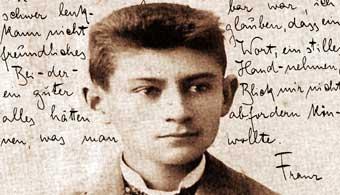
Kafka Uses The Internet To Prod Me Back To Work

livros-franz-kafka-espanhol-download-gratis-noticias

[Franz Kafka]

This is saying a lot for Kafka who, in truth, was not even much of a fan of the typewriter. But, he was a constant writer (even if he destroyed – it is estimated – 75% of what he wrote) and certainly expected any other author to be the same.

At any rate, coupled with a bit of travel, I had not written for ten days. It is possible that I have not gone that long a stretch for years. For the last couple of years I had been writing six days a week, rarely missing that amount. I think that in the last few months, writing an original novel and editing another on a daily basis did me in.

But, earlier this week, on the same day, I received the same article in an email and on Facebook. It was a short section of Kafka Diary entries. Real ones (I say this because I have written a novel where I fill in some *missing* Kafka diary entries). It was directed to writers, and commented about some aspects of writing. The one that leapt out at me was:

March 11  How time flies; another ten days and I have achieved nothing.It doesn’t come off. A page now and then is successful, but I can’t keep it up, the next day I’m powerless.

I generally think I can take a hint. And a hint given twice. And a hint from Kafka. And a hint given decades after he is dead, via a medium (pun intended) that Kafka would despise.

So – I took the hint.

A page a day since then.

And onward —>>>

DE


The Mask Of Death Leads To Sundry Places

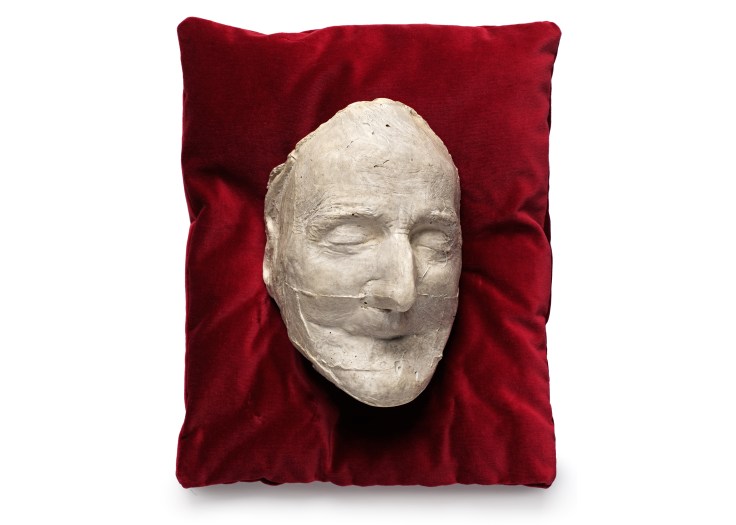
[Death Mask of the Duke of Wellington]wellington-death-mask

My two gals, Alison Alexandra and her friend, Amanda, are on a sea voyage. A voyage via a freighter, and not a cruise ship. They stop in the ports where the freighter stops, and they take visits of the town if they so desire.

On one of their times on shore, they decide to visit a Police Museum. One of the exhibits is a Death Mask of a hanged murderer. They take great interest in this, noting the repose of the face.

This incident is based on an event in my own life. I melded parts of my experience into my characters afternoon visit during their day ashore. This had not been on my mind when I started this particular chapter.
I once taught a workshop on Supernatural writing. For my workshop I took advantage to take my students on a field trip to see the death mask of a historically known poet. The death mask was conveniently on view in a display case in a near-by building.

None of them had even heard of ‘death masks’, let alone seen one. I invited them to

incorporate the idea into their writing exercises. Some did, some did not.

However, it’s possible this visit to Death elicited the following story from one of my students.

My student and her husband had purchased a new house. Cleaning and renovations eventually took them to the back loft area, which was piled high with decades of accumulated detritus from a long life.

They cleared out beds, and boxes and newspaper piles, and magazines, and bundles of clothes, and on and on. Near the end of this process, my student noticed a “clump of something” on one of the wooden beams of the loft.

Getting ladder and flashlight, her husband climbed to see what it was.

It was the end of a number of knotted bed sheets.

DE

Fame Helps Tie The Rope For Suicide

coiled-up-rope-with-hangmans-noose

Fame and suicide.

Suicide and fame.

The two flirt, and  consummate their relationship often enough to make others take note.

If someone gets everything they hope for,

or want,

or expect,

 there is not much left to live for. 

Boredom ties the rope.

There are other factors, of course. We can never know another person well enough to tell how they think or feel. The majority of famous people do not remove themselves from this earth. Indeed, a large number of them  relish the attention. More than mere success sent Virginia Woolf walking into the River Ouse. Ernest Hemingway had personal demons aplenty.

These days, Fame stalks those who are famous.

Although a famous author does not attract the attention of a famous entertainer, or sports figure, or politician, an author’s fame spreads beyond the usual world of books and readings and tours.

Fame guarantees attention must be paid. The media makes Fame supersede the reason for the fame. Fame is the elephant in the room, always poised to turn rogue.

Creating is difficult enough.

Creating is time-consuming enough.

Creating is isolating enough.

Fame magnifies all these things, and sometimes ignites an unrelenting blaze.

DE

(image)http://www.catholicmannight.com/wp-content/uploads/2013/03/Coiled-up-rope-with-hangmans-noose.jpg

Of An Age And Still Keeping On Trucking

ea31e6ab3e7ec52fc033935fe3c02d14

I wrote the previous blog  about Bertha Klausner a little over a year ago. I found it interesting (indeed, find it interesting), to have some connections to a more distant literary tradition – no matter how tenuous.

So, maybe I come close today, as I just had a response by another literary agent. I had no idea of his tenure in the fields of getting the written word published. Not that I still would not have sent the query letter.

Dear Dale,

Thank you for submitting your materials to *********** for review.  However, after considering them, we have decided that your project is not something we can successfully represent at this time.  At 85, *********** needs to be selective about the projects he takes on and he has more than enough on his plate.  But I wish you good luck finding representation and a publisher for this. 

All the best,

********* (assistant)


~~~~~~~~~~~~~~~~~~~~~~~~~~~~~~~~~~~~~~~

Eleanor Roosevelt,Upton Sinclair, Fidel Castro & Me

While reading some literary site about Amazon, I came across the fact that “Harriet Klausner, an esteemed Amazon reviewer who wrote more than 31,000 book reviews, died”. All power to her, thought I, that is quite a feat. However, I took more note of her last name, one I had not thought of for a long time. Eleanor Roosevelt,Upton Sinclair, Fidel Castro & Me

In my tenure as an author in the world, I have had four or five agents. And I am currently looking anew. At the far beginning of my time, before I was published, I had the New York agent Bertha Klausner – at the start of my career and near the end of hers. She started her agency before I was born and was working two months before she died in 1998 at the age of 96.

Back in those over the transom days, one stuffed typed pages into an envelope, sent them off with return postage on another envelope, and waited up to three months for a reply. And when it came back, you sent it out again. One of my envelopes went to the Bertha Klausner Agency.

However, when it came back, it had other people’s manuscripts in it, and (to my memory) little hand written notes politely saying no. Mistakes happen even at revered agencies, so I sent it all back explaining what had happened. She replied, with neither apology nor thanks, annoyed that mistakes do happen and adding, “Say, you must have something. Do you want to send it to me?” Which I did. Again.

As I said, communications were through slow mails (slow on her side, as with literary agents to this day).  I now assume she initially was both being polite, plus did see some promise in what I had. But after a year or so she said – in effect – ‘thanks but no thanks’, and I sent things to other agents, and eventually had my first novel sale by, indeed, sending it over the transom directly to an editor in New York, who purchased it.

I don’t think I knew that Bertha Klausner had such a stellar career until I looked her up. An agent for decades, she had famous names like Upton Sinclair, Israel J Singer, Eleanor Roosevelt and Fidel Castro. She even represented actor Basil Rathbone.

I imagine I would have become a lost tale.

DE

(image)https://s-media-cache-ak0.pinimg.com/564x/ea/31/e6/ea31e6ab3e7ec52fc033935fe3c02d14.jpg

When Writing Spooks Television

81-e23a9f4fb2887
I am currently writing a *perhaps* novel (that is, perhaps it will be a novel), though I suppose  I should find out if it is a novel since I just passed the 200 page point.

In my current project, following the escapades of Alison Alexandra (entitled Stones for short), my erstwhile activist, Alison Alexandra, is a passenger on a freighter (that takes a limited number of passengers) as it delivers goods from port to port.

I’ve done a fair amount of online research into these freighter cruises as I, myself, would much prefer such a trip over the very crowded (and expensive) Cruise Lines.  But, I will research anywhere that might help my cause. So, a couple of nights ago, on television, there was a documentary about the most recent, largest, and most extravagant Cruise Ship as yet built.

I was very interested in following its construction. I was also very interested in seeing how it was run, taking into consideration the thousands of people who had to be tended to. The delivery of provisions, the kitchens, and the massive amount of work necessary to clear out thousands of folk and then greet thousands of folk on the same day, was fascinating. Not a freighter by any standard, but basic principles were the same.

Then the documentary followed the ship on its first cruise.

Now, back to my reality. At the same time as writing original material about Alison Alexandra, I have been putting a hand-written manuscript of a novel finished a number of years ago into the computer. I do one thing in the morning, and the other in the evening. So far – no problems have arisen.

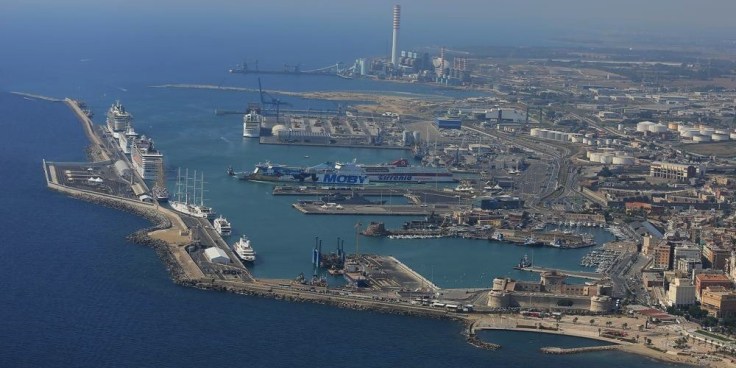
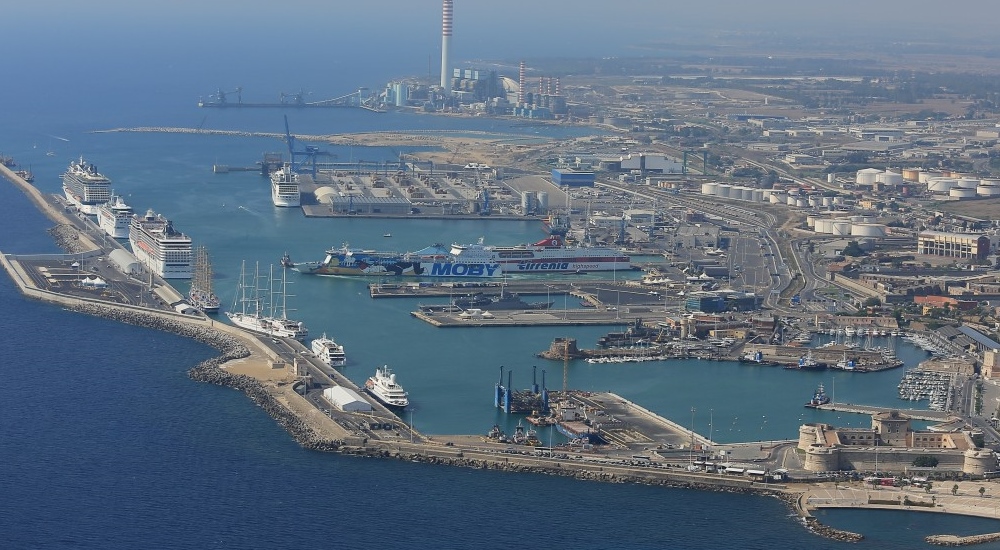
My hand-written manuscript is set in the 1300’s. The first part depicts a two year voyage from Italy to China and back. Both the voyage and events in China are described. And then, the arrival back to Italy. For four straight days, I have been transcribing the docking and aftermath of the ship at Civitavecchia, Italy. It is the closest seaport to Rome.

On television, before my eyes, after a day of writing, the Cruise Ship I had watched from inception to voyage, pulled into the port of Civitavecchia.

Maybe I should take a cruise.
 

DE

Civitavecchia (image)http://www.cruisemapper.com/images/ports/81-e23a9f4fb2887.jpg

Interview With National Radio Some Years Ago (But Most Answers Remain The Same)

symbole-of-trust


I came across a transcript of this at the end of last year. It’s not that I forgot it, but it took me some time to remember it.

~~~~~~~~~~~~~~~~~~~~~~~~~

1. What unique challenges do you face when writing about serious
non-fiction issues such as religion?

I WRITE about spiritual matters and leave religion to others. The spirit and its quests drive religion – religion just interprets. The biggest challenge I faced in THE ELEPHANT TALKS TO GOD is that the Elephant started asking questions I could not answer. Thus endeth the book.

2. You wrote The Elephant Talks to God in 1989. Why did you decide to
re-release it with the added stories rather than write a sequel?

THIS WAS the decision of the publisher, Goose Lane. When they approached me for a re-issue they were unaware of the additional stories. It was decided the marketplace would prefer one longer book over two shorter ones. Having just one book also reduced production costs, which in turn reduced consumer cost.

3. Why did you decide to become a writer?

“I WAS born like this, I had no choice, I was born with the gift of a golden voice.” This quote from Leonard Cohen sums it up. Not “born” this way exactly, but within one month in grade eleven I went from ‘no writing’ to ‘continually writing’. I have no explanation. I had no previous interest nor inclination toward the arts, or writing. I was not a reader, and only after university deliberately read such children’s classics as Black Beauty and Alice in Wonderland.

4. What books or authors have most influenced your life?

POSSIBLY P.G. WODEHOUSE was the most influential author in my formative period. I even sent him a fan letter and received a response. In university I experienced Franz Kafka, and I believe I have read everything of his in print. Much later I visited Prague to research a novel I have since written about him. There are reports of ‘missing’ stories and diaries of Kafka still in Berlin, which I would dearly love to find.

5. What, in your opinion, are the most important elements of good
writing?

SURPRIZE, HUMOUR and reality. ‘In context’ (it doesn’t matter what the genre) I want to be surprized by what is happening, yet fully believe in the reality created in the book. And somewhere, at least once, every character in every novel should make me laugh at least once.

6. What are you reading right now?

“WICKED” BY Gregory Maguire. His abilities as a writer astound me. I am a slow reader, and seemingly getting slower. Soon (?) to be read will be Alice Munro’s “The View from Castle Rock ” and John LeCarre’s “The Mission Song”, both requested Christmas presents. I also do a lot of research for my novels, and will embark upon histories of China in the near future.

7. What advice would you give to writers starting out?

I HAVE two steadfast rules, one put into rhyme. “When in doubt/take it out.” Regardless of the wonder of the poetic line, or the awe of the slice of dialogue, if you have any questions about its effectiveness, that is reason enough to remove it.
The other concerns the physical writing itself. At the end of your writing day, and you know what the next line of dialogue is, or the description you are going to write, or the next line of the poem – DON”T write them down. Start with them the next day, and you will quickly get back into the writing. I find this works 90% of the time.

8. Describe your writing process.

I’M A morning writer, roughly from 9:00 until 15:00. There’s a meal in there, and research and email and such, but I will generally complete two pages a day. I generally write seven or eight days straight and then take one off. At the start of a novel I have a well developed outline and characters, though I rarely write such things down. I find that at the end of a novel I spend an additional third of the writing time editing what is done. I usually complete a novel in two years.

9. Do you ever suffer from writer’s block? If so, how do you overcome
it?

THREE MONTHS of writer’s block during my second novel has (so far) been my experience with this curse (knock knock knock on wood). I sat at the desk literally for hours per day attempting to continue. I think I wrote five paragraphs in that time. I know of no way to overcome it other than attempting to write each day. My number two tip in question #7 will help in avoiding writer’s block.

10. Naturally, most writer want as many people as possible to read
their work. Who did you have in mind when you were writing this book,
the “believers” or the “non-believers”?

BRITISH PUBLISHER Joseph Dent introduced “Everyman’s Library” in the early 1900’s (which is now published by Penguin Random House UK). As my mother was from England and my father was a proud UEL, there were many of these books when I was growing up. Everyman’s Library had a motto at the beginning of each book:        “Everyman, I will go with thee/and be thy guide,/ in thy most need/ to go by thy side.”     This is what came to mind when thinking of who I write for. I did not write for either believers or non-believers. I wrote for everyone, and my job is to make them accept that the The Elephant believes. 

DE

The House Of Kafka – Now Picture Perfect

1331728884316e067a8fa1b029edac249de7ca0d2d

House No. 22 on The Golden Lane is situated in the Prague Castle. It is so called because in the 16th Century, the Emperor had a number of Alchemists trying to make gold. They were housed on this lane.

Kafka did not really live in this tiny house on this narrow lane – his sister did.

And she did not really live in this tiny house on this narrow lane – she rented it so she could have a place to meet her lover in secret.

The secret was necessary because her lover was a Christian.

So the house was vacant most of the time.

Enter Kafka. He  started to go there (at the suggestion of his sister) so he could have a place to be alone. Otherwise he would be with his parents, which was not conducive to either his (nor his sister’s) desires.

He never stayed the night, but was there most evenings for months. He wrote a whole book of short stories in his book The Country Doctor  while there.

I set a third of my novel about Kafka in this tiny house.
I’ve visited it.
Peered from the windows.
Looked up the stairs.
Ducked in the doorway.
When I was there while the country was still under Communist control, it was a book store.
But – Kafka being Kafkaesque long after death – none of his books were displayed.

From Kafka In The Castle

27 November 1916

Should I comment upon my unique and strange surroundings – this tiny house of Ottla’s. Not shared with a fiancée, but a sister. This place would not do for Felice, it is too small and too spare and too far from the heart of the city. But I feel secure against the winter. Up here in the castle.

As with all the tiny houses on Alchemist Lane, this one has its history of the quest for gold. Thus I fit right in, for I am after such purity.

29 November 1916

I like these walks up and down from the castle. I am surprised – and surprised because I am surprised. Perhaps I will sometime stay overnight, but I doubt it. It is Ottla’s house, and she should keep possession in appearance as well as fact. I impose as it is, which may be the right of an older brother, but not my wish. If it weren’t for Ottla, my life would be bleak beyond what I could bear.

27 December 1916

Ottla says I am staying here too late into the night. But she is implying more. I am certain she is soon to tell

me that I should stay in her tiny house all night. Sleep here. Have things prepared and ready so I could go directly to the office in the morning. But the office must be more than just distance from this place.

30 January 1917

What a storm. The storm of the year, perhaps. It was with difficulty that I came here today, and this might be the night when I shall actually stay. This tiny house, once it’s warm, is a perfect refuge. The winds howling along the Stag Moat, throwing snow at the window behind me, can easily put one back into Medieval times. Might someone have been where I am now – not with pen and paper – but tools and flasks, and elusive gold?  With questions and a quest?

DE

(image)https://rail.cc/img/loc/1/1331728884316e067a8fa1b029edac249de7ca0d2d.jpg

Alison Alexandra Knocks Hell Out Of Her High School Reunion

janis-joplin-high-school-reunion-1-735x413

So, Alison Alexandra is invited to go to her 20th high school reunion. Because of a few years as a fashion model, she is deemed the “most famous” of her class.

The author wonders who she is going to meet. And what is going to happen. Alison Alexandra demands more than ordinary. Through sundry meetings and back story (told in the present), these folk end up at her table.

Big Stakes Gamble – at the time of her high school tenure, he was a Motor Mechanics teacher. He is retired and now runs the only B&B in town. Alison Alexandra takes accommodation in his establishment. They decide to go to the reunion together. When they arrive, there is a name tag for her, but not for him. Alison Alexandra makes him wear her name tag. There are comedic results. {Also, in all this, the author found out name tag is two words}.

Betty Dragger – a fellow graduate of Alison Alexandra’s who was once married, but has pointedly reverted to her birth name. She carries her own bottle of olives to adorn her drinks of gin.

Ed Keen – he attended the high school only one year. But that happened to be the year his father was imported into the town to shut down the major employer. He has even fewer pleasant memories than does Alison Alexandra, who was (to quote her) “Bored shitless.”

Lee (short for Louise) Keen – wife of Ed, who has never been in the town before. She can ask questions and fill back story. She has no trouble holding her own with four people who share something she hasn’t.

The author did not know who was going to be sitting at this table.

Ya know – he had a hell of a good time.

DE

Blog at WordPress.com.

Up ↑