Search

kafkaestblog

It is a whirlwind in here

100 Years Ago Love Goes So Terribly Wrong For Kafka

dopis_felice

When I wrote my novel, Kafka In The Castle, filling in all of Kafka’s missing diary entries,  after a few months of writing, I found something very interesting. The day/month/year I was writing about, mirrored the day/month/year in which I was writing.


For example, if the 03 of July was a Friday in my writing year, it was also Friday, 03 July in 1917.


It was an exciting surprise, and made (I think) for more immediate writing.

When Kafka became so ill he he took leave from his employment, he stayed with his sister Ottla in a village, hours from Prague. The following recounts the visit of his fiance,Felice.


Here is 23 &24  September from Kafka In The Castle.

~~~~~~~~~~~~~~~~~~~~~~~~~~~

23 September 1917

The trials of Felice. The trials of Franz. As they are put together in this obscure little village – with animals and harvest and the clatter of waggons without.

Because of the war, her train journey an ordeal of thirty hours. Only to reach this destination. This lover who doesn’t … “even have the grace to love another.”

That is something F. can understand.


24 September 1917

The two days Felice spent here a trial of misery. A trail of misery. Even – I suspect – when she slept.

It is fortunate that I am ill, for it lets her see me in life, the way I am in spirit. The`me’ she would have to fight against. The `me’ which is always opposed to her.

We shared quiet meals, grateful and annoyed by Ottla’s constant chatter. As good a hostess as possible to this strange, sullen couple.

Ottla must have been thankful that her chores took her away as often as they did. I had no such excuses, yet could offer nothing in their place.

F. and I were truly left to each other, and any thoughts she might still have about us getting married must surely be removed.

When we did talk, it was about the change in seasons, the harvest (she took an interest), her work in Berlin. About my health when I seemed to tire (my weariness not all caused by being sick).

We rarely held hands on our walks – just briefly, in the minutes as we returned.

The few kisses were perfunctory.

Not even for memories of things past.
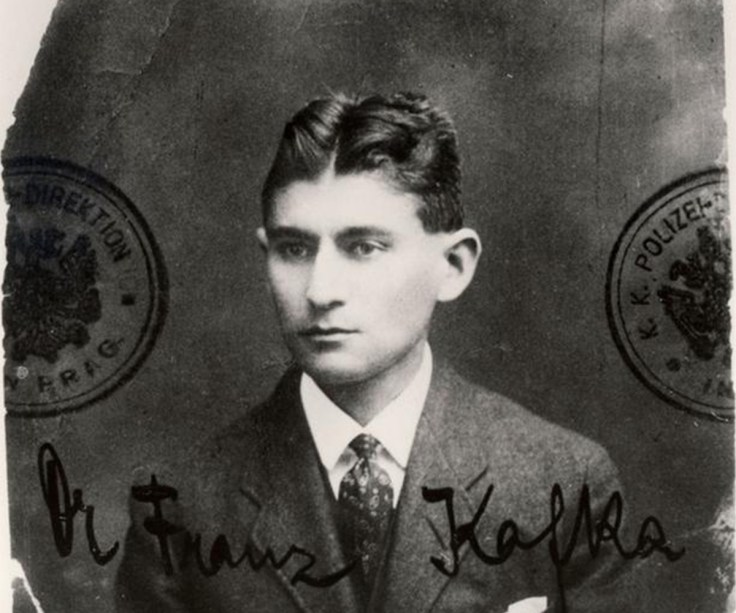
A Birthday Day l00 Years Ago Via Kafka And Me

kafka_main1
When I wrote my novel, Kafka In The Castle, filling in all of Kafka’s missing diary entries, I found something very interesting a few months into it. The day/month/year I was writing about, mirrored the day/month/year in which I was writing.
For example, if the third of July was a Friday in my year, it was also Friday, 03 July in 1917. It was quite an exciting surprise, and made (I think) for more immediate writing.
However, 19 September 1917 was already filled in by Kafka, and I had nothing to do.
Here is Kafka’s actual entry, abridged.
DE
~~~~~~~~~~~~~~~~~~~~
19. (September 1917) Instead of telegram: “Very welcome station Michelob is excellent Franz Ottla” I wrote a farewell letter, and once again strongly oppressed agonies.
Farewell letter however, is ambiguous, as my opinion.
 
It is the age of the wound, more than its depth and proliferation, which constitutes its painfulness.
To be torn up again and again in the same wound canal, the countless wound operated again treated.
 
The fragile moody void essence – a telegram swaying, a letter directs it, animated it, the silence after the letter makes it dull.
 
The game of the cat with the goats. The goats are similar: Polish Jews, Uncle Siegfried, Ernst Weiß, Irma
 
Various but similar strict inaccessibility of the creator Hermann (who has now gone away without a supper and salutation, the question is whether he will come tomorrow), of Fraulein, the Marenka.
Basically, they are oppressed on the other side, as in front of the animals in the stable, when they are asked for something and they follow astonishingly.
The case is only more difficult here, because they seem so often accessible and quite understandable.
 
It is always inconceivable to me that almost anyone who can write is able to objectify the pain in pain.
For example, in misfortune, perhaps with the burning misfortune, and to tell someone in writing: I am unhappy.
Yes, I can go beyond it, and in various pranks, depending on the gift, which seems to have nothing to do with the misfortune, simply or antithetically, or with whole orchestras of associations.
And it is not a lie at all, and does not nurture the pain; it is simply a graceful excess of the forces at a moment when the pain has visibly exhausted all my powers to the ground of my being, which he scrapes. What is the surplus?
 
Letter to Max. Liar, vain, comedic.

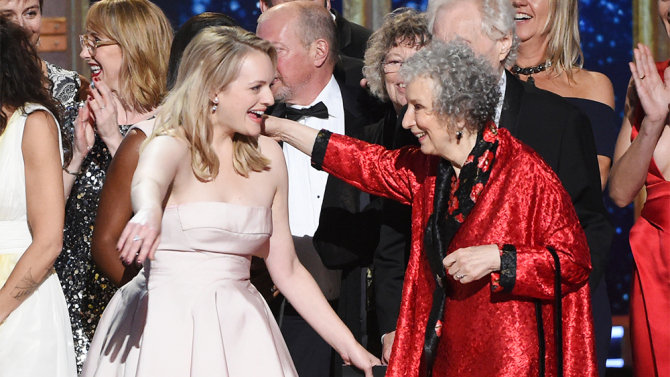
Margaret Atwood And I – Not A Handmaid’s Tale, But A Tale Nevertheless

Elisabeth Moss,Margaret Atwood

It was not my intent to piss off Margaret Atwood.

The opposite, in fact. I wanted her to know she was an inspiration.

She was giving a reading at the University of New Brunswick in my student days. I attended, but there was quite the gathering and she was whisked away at the end. However, I overheard there was a ‘gathering’ in her honour. Invitation only, of course. Academia and literati.

I crashed the party (that was the term used by the professor who clapped his sturdy hand upon my shoulder but – happily – did not thrust me into the night).

But Ms. Atwood was kept deep in many a learned conversation and I had no opportunity to converse. I did, however, overhear where she would be spending next afternoon – the historic University Observatory.

Next day I knocked upon the Observatory door.

It was not a cheerful Margaret Atwood who answered, and answered with alacrity.

She asked my name.

She asked my business.

And she asked how the hell I knew where she was. She had stolen the day to do some writing. Some ‘real’ writing, in this window-of-opportunity grudgingly offered on the book tour.

At least I was there to praise Atwood and not to bury her with some essay question.

Nor had I a manuscript to hand to her.

I might not have garnered a smile, but her curt thank you was reward enough.

For me, at least.

DE

(image) https://pmcvariety.files.wordpress.com/2017/09/elizabeth-moss-margaret-atwood-handmaids-tale-emmy-win.jpg?w=670&h=377&crop=1

Almond Crusted Sole

This almond crusted sole is covered in almonds, sesame seeds, and coriander, adding texture and flavor to the delicate fish. More at PBS Food.
The result is a filet that has a variety of crunchy and crispy textures with rich nutty flavors that accentuate the umami in the fish

Source: Almond Crusted Sole

World’s greatest crematorium to be completed soon for funeral of Thai King

The cremation of Thai King Bhumibol Adulyadej or Rama IX is due to take place on 26 October. The King died almost a year ago on 13 October 2016 at the age of 86, having spent seven decades on the throne and was deeply loved throughout Thailand. It is common practice in Thailand’s Royal Family…

via World’s greatest crematorium to be completed soon for funeral of Thai King — Royal Central

100 Years Ago: Kafka On The Move from “Kafka In The Castle”

cgwaytuxiaasez_

[The Swiss Girl]

12 September 1917

Max came to the station with me this morning, which was kind of him.

He was not in as good spirits as was I, for he does not have the joy of escaping Prague to assuage our parting.

I obviously did not help matters when I pointed to the two men carrying my things, and said that they could be carrying my coffin.

He did not even attempt a forced smile.

Or force an attempted smile.

My possessions were bundled into the baggage car, and I was prepared to be folded away there too.

But they allowed me a compartment, and as we parted, I shook the empty hand of Max.


13 September 1917

This might even be the type of place for the Swiss girl. Unfettered – perhaps singing.

I’ve had the strongest desire to be with her this morning.

Maybe I had a dream.

The strongest desire to contact her – regardless of what we promised.

But – after all these years – I probably could not find her, even if I tried.

And I have no idea who I might find if I succeeded. Not the girl of memories.

And who, anyway, would she find?

What look would cross her face and still her song?

Because – I have become me.

DE

The Script I Wrote For Star Trek

ea_tng25_logo

Can I use the word eons when talking of Star Trek? Considering the time travel that often enveloped them, why – yes, I can.

So, eons ago, I wrote a script for Star Trek, The Next Generation. Memory says (and I’ve been told my memory is not up to light speed), this was the only television series that asked for, and actively used, scripts from writers outside their own stable. They used one script per season from these submissions. So I submitted.

I had a response from Lolita Fatjo.  It gave me some quiet thrill to see her name among the STTNG credits at the end of each show. I believe she was classed under “Pre production”. I also thought she had a real nifty name. I note she currently still has dealings with Star Trek, helping to facilitate Star Trek Fan conferences and arranging appearances by some of the Star Trek stars.

I did not have an abundance of communication with Ms. Fatjo (I liked to think of her as Lolita). I think I got a package of information about the type of thing they wanted for a script.

Memory says there was a desire to have a main plot line concentrating on just two or three of the main characters. There was to be one additional sub plot. There were arcs to accommodate the commercials. I believe they hoped for some humour. And timing, of course, all was timed to the exact minute.

I followed directions and wrote a script and put it into the format and sent it off. I had two further dealings with Lolita.

One told me they had received the script.

The other – so deliciously close to the end of the season – was to tell me they would not be using it.

The script was called The Minstrel.

In it, an alien had a musical instrument (I think a horn, but it might have been strings) that would play tunes attuned to whoever he was talking to. It had other properties, but I think I’ll keep them tucked away. You never know – there is a new show. Anyway, the Minstrel would interact (per act) with the Star Trek characters. Revelations were forthcoming. Not too many special effects (which was something else Lolita requested).

I received no cheques nor writing credits from this foray into television land. But not all was lost.

I was writing my script in tandem with a friend who was writing her own script. News of our endeavours made the local writing circuit, and we were interviewed on regional radio.

From that we were asked to speak to a couple of writing classes and even invited to an alternate world fan club to give a reading.

We boldly went.

DE


Writer Zombie Meme Takes A New Twist

40cf4e788d01c8cc4ef12bcc6f3abf4d

I’m not sure why people approach me on the street with the conviction I’m a writer. This has happened a number of times, out – as they say – of the blue. When I ask why they think so, they become defensive. I have learned just to say ‘yes’ and let the conversation meander from there.

Of course, when I give readings or lectures or talks, it is to be expected that I’m a writer. That’s why I’m there. Even if I don’t wear a name tag (which I dislike with passion). I believe I’ve learned not to read too long (regardless of the great material), but I can chat and answer questions about writing until the cows come home to roost. Clichés with a twist a speciality.

In addition to being narrowed-in on as a writer, I have been mistaken for dead authors. In this situation I do believe I must make some comment. For the sake of the dead as well as myself. Although I believe I can still make a good impression as a person who is alive, even here I have run into trouble. A taxi driver did not want to believe that the writer he mistook me for was dead.

“I never heard that,” said he.

“It’s true.”

“Are you sure?”

“He’s been dead for years.”

“You look just like him.”

“Not in his present state,” said I.

The taxi driver did not find me humorous.

A few days ago, however, a new wrinkle was added to my apparent Zombie life.

I was sitting on a park bench,waiting for a bus and watching the bustle of the city pass by. A man of middle years, puffing on a Vapour, settled on a bench across from me. After a few additional puffs, he stated – not asked –

“You’re a writer.”

“Because I’m using a pen?” (which I was, though I was fiddling with sums)

“Who did you write for?”
“Write for?”
“Between 1959 and 1966.”
“What do you mean, ‘who’?”
“Where would I have seen you?”
“Do you know who I am?”
“You know what I mean.”
“I wrote for some newspapers back then.”
“No – not that.”
“But that’s what I did.”
“When you worked for Hemingway.”
“Earnest Hemingway?”
“I’ve read his books?”
“Oh.”
“You edited his books.”
“I did?”
“You were his editor.”
“I would have been too young to be able to do that.”
“What book did you like?”
“Of Hemingway?”
“You know – which one?’
“I’d guess The Old Man And The Sea.”
“People say that. They’re wrong!”
“They are?”
“It’s a terrible book.”
 
To prove there is a God, my bus arrived.
DE

The Funeral Ends For A Dead Princess

From Being Famous:

He wonders where Diana is.

If the whole context of this service is correct, and her Spirit Everlasting is afloat in some other world, does she have the slightest interest in these proceedings? Do you care what is on the plate after you have eaten the meal?

Is it – as he hopes – an all new wonderful adventure?

ST is returned to the present by the familiar words of The Lord’s Prayer. He is actually reciting  “Give us this day our daily bread” before he realizes what he is doing.

Stopped in place and time.

He could be a child again (perhaps he is) wondering what `trespasses’ are. He could be the aware young man, wondering why God would have a penchant to lead us into temptation. And he could be as he now is, wondering if this was the only way for a troubled young woman to be delivered from evil.

ST is fully attentive to the final hymn, and The Commendation of the Dead to the Lord.

He suspects it is an all-or-nothing package: that Diana and Jesus and God are present and appreciative to what is happening around him; or that he and everyone else are just singing and praying to the empty rafters. He fears his faith has skidded to the unstable foundation of hope.

The cortege prepares to leave the Abbey. Although the choir sings as the procession slowly moves to the west end of the church, it is really silence which hangs over this vast array of people. Again the casket with its ruptured body wend their way down the aisle, the flower arrangement an almost dull glow in this final, sombre setting.

“Weeping at the grave creates the song.”

Or so the song goes.

Then there is the final minute.

The minute of silence.

Observed by the Nation.

Observed by ST.

Observed -perhaps- as a minute’s pause in the enormous expanse of Eternity by a dead princess.

(image)http://www.westminster-abbey.org/__data/assets/thumbnail/0006/90933/Diana-fun-1997-outside-72.jpg


Blog at WordPress.com.

Up ↑