Search

kafkaestblog

It is a whirlwind in here

Category

Prague

Does Hope In Life Cloud The Reality Of Death?

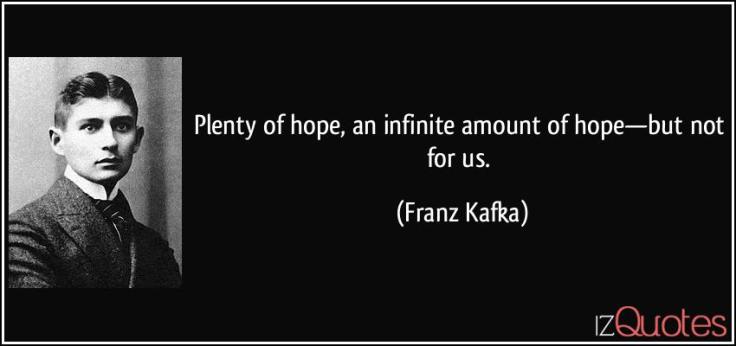
quote-plenty-of-hope-an-infinite-amount-of-hope-but-not-for-us-franz-kafka-242320

An Excerpt from my Kafka In The Castle, where I fill in all of his missing diary entries. Perhaps because the summer heat is getting to him, his patience is thin with those whose hope outstrip the realities of life and – particularly – death.

~~~~~~~~~~~~~~

17 June 1917

I am told that you can’t lose people, that “…they will always be with you in memory.” Max is heavy with this type of comment – as if the hand of sentimentality brushed off his coat before he set out on each day.

Both the intelligent and the slow of wit seem to be struck dumb by this nonsense. Emotion, I suppose  – hope, I suppose – has no place for reason among its folds. But, if you can not touch, or have expectation of being touched, then the people and places are as gone as yesterday.

There is no way to travel back, and the future beckons with only an empty gesture and a hollow laugh. Bowing low at the open doorway to usher you in, but the room is empty. And will remain ever so.

When they are no longer there to hold their hand out to you – well, then they are no longer there.


(image) https://izquotes.com/quotes-pictures/quote-plenty-of-hope-an-infinite-amount-of-hope-but-not-for-us-franz-kafka-242320.jpg

When They Poured Across The Border / I Was Cautioned To Surrender ~ L Cohen

ctm-0806-canada-us-border

I crossed the border yesterday, in this time of Pandemic. On an intercity bus. Restricted to nine passengers. At least I had a seat to myself.

The last time I crossed a border under threat of reprisal was decades ago. I entered (and left) Czechoslovakia (as it was then called) by train. I had gone to Prague to follow the footsteps of Kafka. Then the concern of authorities  was all about smuggling. Dire consequences that could put you in prison. And, on my way back out of the country, I was subject to a random search. Open my luggage, and spread what items the soldier decreed upon the seat and aisle, as he poked and prodded. He took interest in an object ( I forget what it was) which quite quickly could be seen to be a commercial souvenir. Thankfully. My careful packing had then to be shoved helter-skelter back into my luggage. Better a jumble than a jail.

So, crossing the border in the same country in this time of Pandemic was not as filled with anxiety, though anxious I still was. Although travel restrictions are being loosened and (at least in this neck of the woods) the Curve is being flattened,

Death stalks the Land / and keep washing your hands.

I did change my seat once, because a passenger changed seats to “have a better view”. That seat was across the aisle from me.

I was handed a form to fill out by the bus driver at a transfer station (nearly empty of people) to give to the border guards if they asked. Apparently they did not ask for it all that often. Where are you coming from/where are you going to. Name. Full address. Reason for travel. Do you have any symptoms?

So, with mask in place (well … a lot of the time  – though always when off the bus) I had a reasonably pleasant trip on a reasonably pleasant day. Lots of elbow room. There was an hour’s delay at the actual border. When it was the turn for the bus, no officer actually did board to check us out. Or take our forms. However, the driver handed his PA microphone out the window so the officer could tell us that: “Anyone breaking the fourteen (14) day quarantine upon arrival was subject to a $1,000 fine.”

I’ve got thirteen (13) days left.


[image] https://cbsnews2.cbsistatic.com/hub/i/r/2018/08/06/8ae2e881-5500-4b09-876f-e1cf5bdecaad/thumbnail/1200×630/bda4ff327e62a7e92030aad7cc2e1693/ctm-0806-canada-us-border.jpg

Kafka As A Jew At Work

In Kafka In The Castle, I fill in the ‘missing’ diary entries from Kafka’s real diary. He either did not fill in these days himself, or he destroyed them. There are some estimates that Kafka destroyed 70% – 80% of everything he wrote. 

23 January 1917

The Director talked to me today. About not having sufficient people to run the Institute, and the other shortages caused by the war. And he asked my advice.

And I gave him good ideas – pointed the way. I do know my strengths – although far more familiar with my weaknesses.

And as the Director talked to me, he looked at me. In the eyes – as he so often does.

But he did not see me.

Not the I which I carry around inside myself. Not the K.

He saw an adequately dressed government official, Herr Doktor of Law, a Jew (I think he really does not mind), who knows well the operations of the Worker’s Accident Insurance Institute for the Kingdom of Bohemia in Prague. Has, indeed, risen to the rank of Deputy-Secretary.

And that is who responded to the conversation. Made comments  Smiled at the Director’s dry humour.

I watched this Jew with interest, and his act was flawless.


Kafka Never Slept In This Prague Hotel

hotel-century-old-town

When I visited Prague to research my novel, Kafka In The Castle, I went to many of the places that were part of  Kafka’s life. One such place – the small house where he wrote a whole book of short stories – became a setting for a third of my novel.

However,the building where he was employed, The Workers’ Accident Insurance Institute for the Kingdom of Bohemia in Prague, I only saw at a distance across a Square. It was not a happy place for Kafka, though he was very successful at his employ, and rose to an administrative position of importance. It was not really much of a setting for my novel.


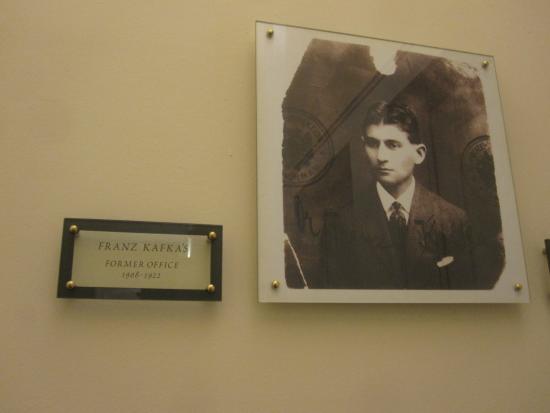
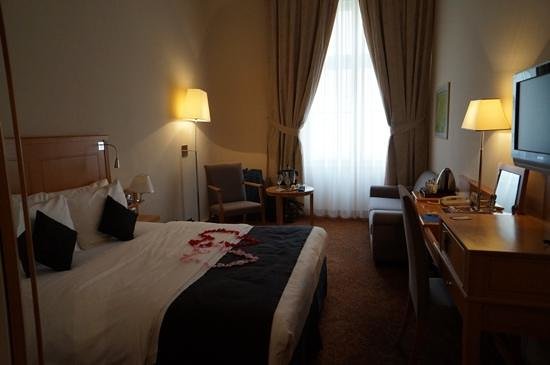
That building is now a fancy hotel, and Kafka’s office is a room for rent. It is even designated The Franz Kafka room, and contains mementos. It is where I plan to stay when next I visit. I hope there is not a long list of folk wishing to spend the night there, too. It even includes a restaurant named after his fiancée, Felice.


Following is some information about the hotel, and some photos of the room.

~~~~~~~~~~~~~~~~~
The hotel is situated in the heart of Prague, next to the Old Town Square, where the famous medieval astronomical clock is mounted on the southern wall of the Old Town City Hall. The Neo-Baroque building was built in the 19th century by Alfonse Wertmuller, a famous architect in Prague. It was formerly the office of the Workers’ Accident Insurance of Kingdom of Bohemia, where Franz Kafka worked as an insurance clerk from 1908 to 1922. His spirit can still be felt in the hotel, as his bronze bust welcomes guests in the lobby in front of the majestic stairs.
hotel-century-old-town
room
~~~~~~~~~~~~~~~~~~~~~~~~~~~

In addition, this is one of the few diary entries I wrote, set in his office building,

 
Excerpt from Kafka In The Castle

16 February 1917

There was a commotion at the office today. It was late morning, and from far below, coming up the stairwell, I could hear a voice bellowing: “Doktor Kafka. Doktor Kafka.” It was a terrible voice, full of blood and darkness.

I got from my desk and went to the door. There were other voices, trying to calm, saying: “He can’t be disturbed.” But the voice was louder, more horrible, close in the corridor.  “Doktor Kafka – for the love of God.”   My secretary wanted me to stay inside, hoped the man would just move along the corridor until the police were summoned.

But – I was curious; the man had my name, and his voice was … terrified.

I opened the door and stood in front of it.  “I’m Kafka,” I said. The man lunged at me, and went to his knees.  “Doktor Kafka?” he said.  “Yes, I’m Kafka.” He reached out, grabbing for my hand.  “Jesus, Jesus, for the love of Jesus – they say that you’ll help me.”

He was a heavy man, and looked as if he had the strength to pull off doors, yet the tears burst from his eyes.  “I can get no work. I fell from a bridge, and my back is twisted and in pain.” He slumped against the wall, looking at my eyes.  “I have a family, Doktor Kafka. A baby not a year old.”  “You were working on this bridge?” I asked.  “Yes.” His voice slid down his throat. “I was helping repair the surface.”  “Then you deserve your insurance. Why can’t you get it?”

He straightened up, and tried to stand. “I have to fill in papers; the doctor can see no wounds; the foreman said I drank; because my brother is a thief, I am not to be trusted.” I held out my hand, and he slowly stood. “I’m telling you the truth, Doktor Kafka.”

“If that is so,” I said, “you’ll get the money due you.”  “I’m so tired,” he said.

I gave instructions to those standing around – no other work was to be done until this man’s case was decided. I took him to my office, where he sat.

He sat – practically without a word – for five hours. I summoned a prominent doctor to look at him. The doctor prodded, and the man screamed. Officials from his village were telephoned. I helped him with the details on the forms. His truth was in his pain. He left our stony building with money in his hand, and his worth restored.

The people who assisted me had smiles on their faces.

A man had needed their help.

Kafka Dreams A Dream In Place of A Dream

franz-kafka-statue-prague
A dream of dreams
Is a dream confused.
 
Do you wake up
Into another?
 
Do you blend
Into reality?
 
Do you pick up
Where you left off?
 
Or leave off
Where you joined?
 
If it’s not making sense,
Is there sense to be made?
 
Did Kafka have the answer.
Or was Kafka the question?
(Image)www.npennydreams.com/wp-content/uploads/2016/10/Franz-Kafka-statue-Prague.jpg

Kafka Had A Father For Life

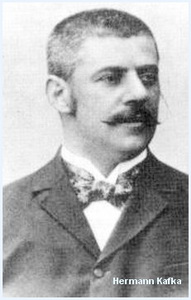
hermann-kafka1

In Kafka In The Castle, I fill in the ‘missing’ diary entries from Kafka’s real diary. He either did not fill in these days himself, or he destroyed them. There are some estimates that Kafka destroyed 70% – 80% of everything he wrote. 

Kafka’s father gets a bad (and unwarranted) rap from Kafka and history. Hermann Kafka was emotionally distant, and devoted his life to his business (at which he was very successful). But he did this as much for his family, as for any other reason. He had come from hardship, poverty and want, and he wished different for his children. As long as they didn’t get in his way.

++++++++++++

01 January 1917

              There was a cloud caught in the branches of a tree today, outside my parents home. Or so it appeared. I got up from the cot and went to tell Ottla, but she was clearing the kitchen, tending to the dishes.

So I was radical, unthinking – driven by haste – and told the only one not consumed by labour. I told my father.

“In the trees?” he asked.

I propelled him from his chair, thrusting the papers aside. He followed me, and I could see the surprise on his face.

“Where?” he asked; and I pointed out the window. “But I see nothing.”  

“Oh, you have to lie on the cot.”  

“On the cot?”  

“And with your head just so.”

I pushed him onto it, and he lay, looking sideways.

“But you are right,” he said.

I thought, because of the holiday, he might be humouring me, but then I saw that his jaw hung open, and his face was astonished.

Does the boy never grow, that he can feel so good to be vindicated by his father?

If Kafka Welcomes Spring, Can Summer Be Far Behind?

4807642892_042ac4d5f9_z

In Kafka In The Castle, I fill in the ‘missing’ diary entries from Kafka’s real diary. He either did not fill in these days himself, or he destroyed them. There are some estimates that Kafka destroyed 70% – 80% of everything he wrote.

~~~~~~~~~~~~~~~~~~~~~~~~~

08 April 1917

I seem to end in the most absurd situations. This afternoon, before Sunday dinner, Ottla took me away for some gardening. Rooting around in the earth, with the frost barely gone. Only Ottla could find such a plot of ground in Prague, or expect me to grub about in it like some hungry animal.

It was obviously some sort of communal land – such places are popular during this war. There were even families at work. Children also. One small boy was caught between his interest in the garden, and his desire to be a small boy. And what a dilemma it was. He’d work in the ground for awhile, following the example of his mother, then suddenly race around, exploring like a small boy. He came over to Ottla and me, and hunkered down beside us. He shook his head with a sigh of exasperation, and reached over to put his hands on mine. “Mummy says that’s wrong,” and with great patience and determination, began to show me how to prepare the earth. I thought there could be no better proof to Ottla of how inept I was.

I followed the movements of his hands, and between us, we dug quite a hole. At last the little fellow stood, obviously satisfied. “I go now,” he said, and ran away to see some other entertaining oddity. Ottla hadn’t laughed for fear of offending the boy, but she didn’t show such restraint when we were finally alone.

It fell to me to find the flowers.

Such things prove God’s sense of humour, for I have no interest or understanding for flowers. There was a fellow at university who could talk about flowers for hours. Otherwise, he was quite pleasant to be with. So it seems a joke that I would find them, between a pile of rubble and the wall of a house.

I had been exploring, much as the little fellow had done. In fact, he was running past when I found them, so I showed him also. They were white, with frail leaves close to the ground. Quite nondescript. But the boy was fascinated. He put his face close, although he didn’t touch them.

“Can I tell Mummy?” He obviously thought they were my flowers. “Yes,” I said, and he ran to get her. She followed him as he chattered all the way, and then she too hesitated, looking at me cautiously. “Perhaps your wife would like to see them,” she suggested. It took a moment to realize she was referring to Ottla. The flowers had become my possession. “Yes,” I said, “And tell anyone you like.”  “The first flowers of Spring,” she said, and she went to tell the others, taking care to stop at Ottla first.

Tiny white flowers.

I can still not believe the looks upon their faces, as they crowded around. Even the children were silent.

The relief they showed.


(Image)https:/farm5.staticflickr.com/4122/4807642892_042ac4d5f9_z.jpg
Kafka In His Writer’s Burrow For World Book Day

87348a86cd918068ad4e09c1b813c3cf

A burrow offers security and comfort, and Kafka found both in his sister’s tiny house on the Golden Lane.

Ottla – his sister – had rented it so she could spend time with her lover and not be bothered by parents and comments. Her lover was a Christian and ready to go to war. Time was precious.

However, she rarely had opportunities other than the weekends, so she offered Franz the use of the tiny house for most of that time. And use it he did, though he never stayed the night.

Through fall, winter and spring Kafka wrote a whole book of short stories. For one single block of time, it was one of his most creative periods.

When I visited, even under Communist rule, it had been converted to a book store. Of course (which he would have appreciated) there were no books by Kafka for sale. Today he is displayed in the windows.

It was only when I went thorough the small rooms, and looked out the window into The Stag Moat, that I realized how important the house would become in my novel about Kafka. It was cozy – even with the space cramped by tourists. It had been little altered and I easily imagined Kafka looking through the same glass and walking through the same doorways. No doubt stooping because he was tall. Research met reality.

One of the last stories Kafka wrote, during his final year in Berlin, was called The Burrow. A version exists and is published, though a longer version is supposed to be among his ‘missing’ papers.

In it, a tiny animal keeps incessantly burrowing to keep away from an enemy. A vague noise convinces the animal to burrow deeper, and deeper, and deeper.

Something Kafka himself attempted to do.

(image)https://i.pinimg.com/736x/87/34/8a/87348a86cd918068ad4e09c1b813c3cf.jpg

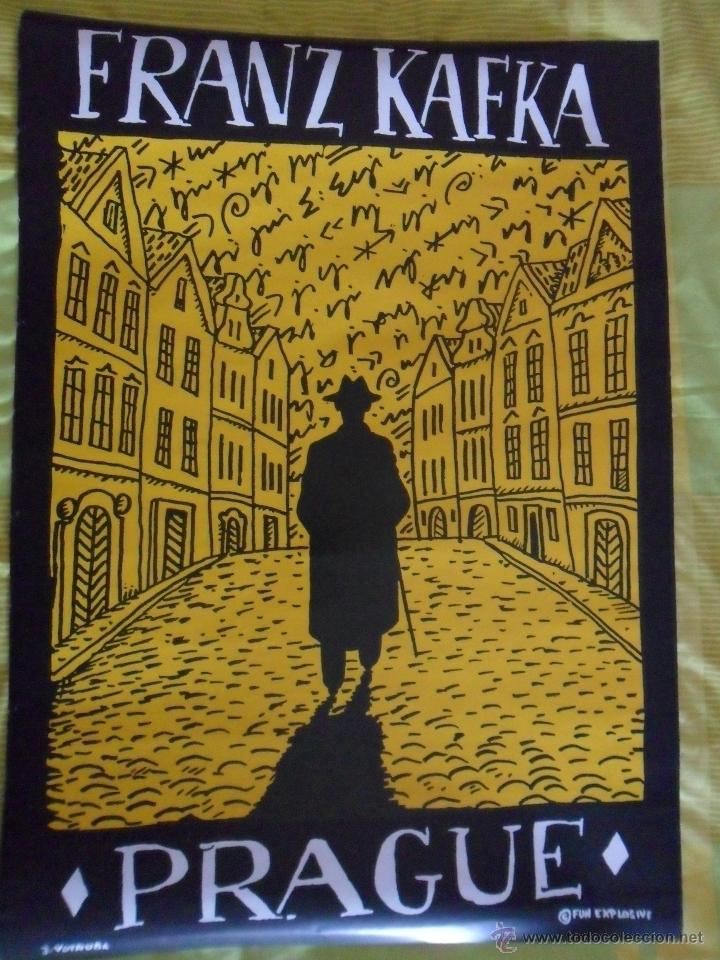
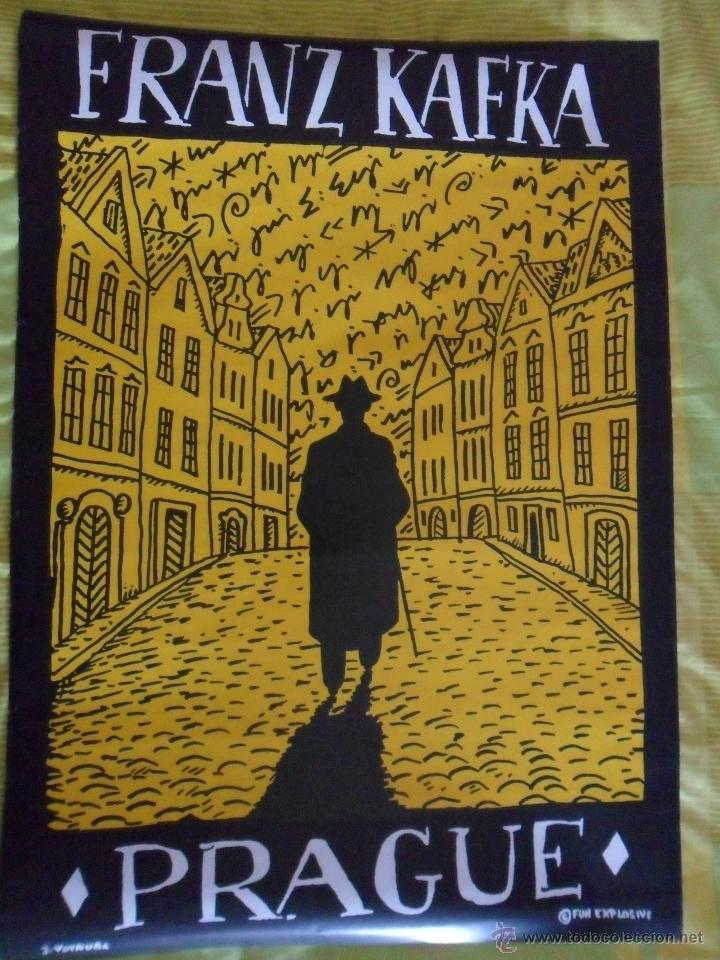
New Year & Kafka Meet In Prague

40061270

In Kafka In The Castle, I fill in the ‘missing’ diary entries from Kafka’s real diary. He either did not fill in these days himself, or he destroyed them. There are some estimates that Kafka destroyed 70% – 80% of everything he wrote.

~~~~~~~~~~~~~~~~~~~~~~~~~

31 December 1917

The end of the year. The end of a love. The ebb of a life. Even the Empire can not last much longer.


01 January 1918

It is strange how we are expected to wake up on a Tuesday morning – just as any Tuesday morning – and be full of hope because it’s the first day of some arbitrarily appointed year.

I walk the streets and it is still Prague.

(image)https://cloud10.todocoleccion.online/coleccionismo/tc/2013/11/19/12/40061270.jpg

Blog at WordPress.com.

Up ↑