Search

kafkaestblog

It is a whirlwind in here

Tag

writing

It Was NOT The Person From Porlock On The Phone

wendys-poutine-0-0

My elevator pitch for my current work, There Was A Time, Oh Pilgrim, When The Rocks Were Not So Smooth is “In Xanadu, did Alison Alexandra / a stately pleasure dome decree”. Stolen whole cloth from Samuel Taylor Coleridge and his Kubla Khan.

So, I was startled awake this morning by a ringing phone. Just rang once. I have been attempting to write a dialogue between three characters in a pub concerning a dish of poutine. Although I did not exactly leap from my supine position to write the following, it was damn close.

I look upon the incident as a gift from the Backward Gods of writing.

~~~~~~~~~~~~~~~~~~~~~~~~~~~~~~~~~~~~~~

Excerpt from: There Was A Time, Oh Pilgrim, When The Rocks Were Not So Smooth

“I’ve not had that,” says Bridget. “What is it?”

“A heart stopper.” says Amanda.

“Pretty well,” agrees Alison Alexandra.

“They start with a big effing pile of French fries.”

“Excuse her French,” says Alison Alexandra.

“And then they pile on cheese curds and smother that with gravy.”

“Smother,” agrees Alison Alexandra.

“Then they check your pulse and let you go at it.”

“They don’t really do that,” says Alison Alexandra.

“Maybe not,” says Amanda. “But I bet they have a defibrillator handy.”

“Probably,” says Alison Alexandra.

“Well,” Bridget smiles. “It sounds as if a pitcher of draft will go real good with that.”


(image)https: //cdn0.vox-cdn.com/thumbor/6uyEgzZ9ByVTIyKBCsu3gSNZaKM=/4×0:996×558/1600×900/cdn0.vox-cdn.com/uploads/chorus_image/image/39119842/wendys-poutine.0.0.jpg


Finding The Right Hole To Live In

prague-ruelle-or-1

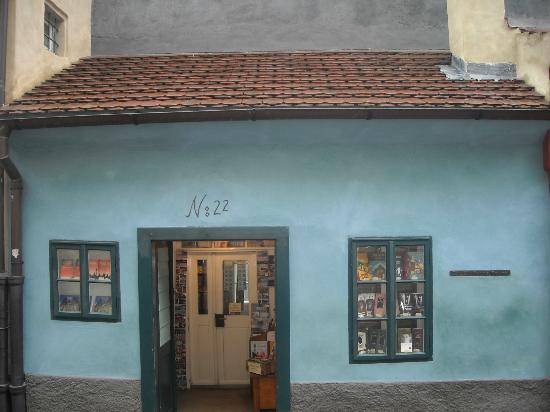
[Kafka’s Alchemist Lane “Burrow” with open door]

A burrow offers security and comfort.  Kafka found both in his sister’s tiny house on the Golden Lane.

The Golden Lane is a narrow, dead-end yet massively historic lane, hugging an interior wall of the huge Prague Castle. Centuries ago the small buildings along the lane housed workers of the Castle, including some resident alchemists. Thus the name.

Ottla – Kafka’s sister – had rented it so she could spend time with her lover, and not be bothered by parents and comments. Her lover was not only a Christian, but he was soon going to leave to fight in World War I. Time was precious. However, she rarely had opportunities to use it other than the weekends, so she offered Franz the use of the tiny house for most of the time. And use it he did, though he never stayed the night.

Through fall, winter and spring Kafka wrote a whole book of short stories there. For a single block of time, it was one of his most creative periods.

When I visited, under the Communist rule of the time, it had been converted to a book store. Of course (which he would have appreciated) there were no books by Kafka for sale. Today he is displayed in the windows.

It was only when I went thorough the small rooms, and looked out the window into The Stag Moat, that I realized how important the house would become in Kafka In The Castle, my novel about Kafka. It was cozy – even with the space cramped by tourists. It had been little altered. I could easily imagine Kafka looking through the same glass and walking through the same doorways. No doubt stooping because he was tall. Research met reality.

One of the last stories Kafka wrote, during his final year in Berlin, was called The Burrow. A version exists and is published, though a longer version is supposed to be among his ‘missing’ papers. In it a tiny animal keeps incessantly burrowing to keep away from an enemy. A vague noise convinces the animal to burrow deeper.

Yes – that’s Kafka.

DE

(image)https://www.avantgarde-prague.com/media/gallery/original/prague-ruelle-or-1.jpg

One Hundred Years Ago Kafka Returns To Prague


In my manuscript, Kafka In The Castle, I fill in his missing diary entries. One hundred years ago, to the day, he re-visited (in real life) the small house where he had been happy and productive.

~~~~~~~~~~~~~~~~~~~~~~~~~zlata-ulitzka

01 November 1917

The claws of Prague make fierce sounds when they tear into your flesh.


02 November 1917

I walked to Alchemist Lane this afternoon. It is not really a part of Prague – high and removed by its ninety-eight steps. A cold, clear day – much like the day a year ago when I accompanied Ottla on her mad little quest to see it. But not (as I had thought) for the first time. In fact, she had already rented it – something I’ve only learned these past few weeks. She had wished my approval, but she didn’t need my approval. I am glad of that.

It was strange entering the courtyards, and passing beneath the spires of the cathedral. But stranger still was to stand at the mouth of the Lane itself, and look along its length. I could have been away for years, or returning to resume yesterday’s thoughts. I felt both. It was if I were at the station, but not knowing if I were arriving on one train, or departing upon another.

The narrow lane was deserted, so I walked along its length slowly. There were new curtains on the windows of my little house. When I returned, I did pause before my old door, and glanced between the curtains to see that all of my furniture had been removed. Much as their owner.

(image)https://media-cdn.tripadvisor.com/media/photo-s/03/14/ea/f9/zlata-ulitzka.jpg

A Birthday Day l00 Years Ago Via Kafka And Me

kafka_main1
When I wrote my novel, Kafka In The Castle, filling in all of Kafka’s missing diary entries, I found something very interesting a few months into it. The day/month/year I was writing about, mirrored the day/month/year in which I was writing.
For example, if the third of July was a Friday in my year, it was also Friday, 03 July in 1917. It was quite an exciting surprise, and made (I think) for more immediate writing.
However, 19 September 1917 was already filled in by Kafka, and I had nothing to do.
Here is Kafka’s actual entry, abridged.
DE
~~~~~~~~~~~~~~~~~~~~
19. (September 1917) Instead of telegram: “Very welcome station Michelob is excellent Franz Ottla” I wrote a farewell letter, and once again strongly oppressed agonies.
Farewell letter however, is ambiguous, as my opinion.
 
It is the age of the wound, more than its depth and proliferation, which constitutes its painfulness.
To be torn up again and again in the same wound canal, the countless wound operated again treated.
 
The fragile moody void essence – a telegram swaying, a letter directs it, animated it, the silence after the letter makes it dull.
 
The game of the cat with the goats. The goats are similar: Polish Jews, Uncle Siegfried, Ernst Weiß, Irma
 
Various but similar strict inaccessibility of the creator Hermann (who has now gone away without a supper and salutation, the question is whether he will come tomorrow), of Fraulein, the Marenka.
Basically, they are oppressed on the other side, as in front of the animals in the stable, when they are asked for something and they follow astonishingly.
The case is only more difficult here, because they seem so often accessible and quite understandable.
 
It is always inconceivable to me that almost anyone who can write is able to objectify the pain in pain.
For example, in misfortune, perhaps with the burning misfortune, and to tell someone in writing: I am unhappy.
Yes, I can go beyond it, and in various pranks, depending on the gift, which seems to have nothing to do with the misfortune, simply or antithetically, or with whole orchestras of associations.
And it is not a lie at all, and does not nurture the pain; it is simply a graceful excess of the forces at a moment when the pain has visibly exhausted all my powers to the ground of my being, which he scrapes. What is the surplus?
 
Letter to Max. Liar, vain, comedic.

Margaret Atwood And I – Not A Handmaid’s Tale, But A Tale Nevertheless

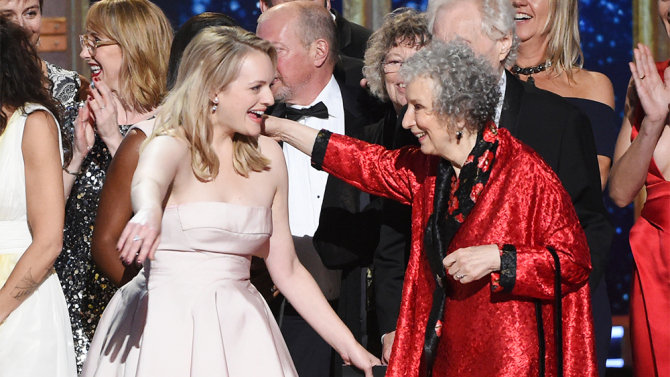
Elisabeth Moss,Margaret Atwood

It was not my intent to piss off Margaret Atwood.

The opposite, in fact. I wanted her to know she was an inspiration.

She was giving a reading at the University of New Brunswick in my student days. I attended, but there was quite the gathering and she was whisked away at the end. However, I overheard there was a ‘gathering’ in her honour. Invitation only, of course. Academia and literati.

I crashed the party (that was the term used by the professor who clapped his sturdy hand upon my shoulder but – happily – did not thrust me into the night).

But Ms. Atwood was kept deep in many a learned conversation and I had no opportunity to converse. I did, however, overhear where she would be spending next afternoon – the historic University Observatory.

Next day I knocked upon the Observatory door.

It was not a cheerful Margaret Atwood who answered, and answered with alacrity.

She asked my name.

She asked my business.

And she asked how the hell I knew where she was. She had stolen the day to do some writing. Some ‘real’ writing, in this window-of-opportunity grudgingly offered on the book tour.

At least I was there to praise Atwood and not to bury her with some essay question.

Nor had I a manuscript to hand to her.

I might not have garnered a smile, but her curt thank you was reward enough.

For me, at least.

DE

(image) https://pmcvariety.files.wordpress.com/2017/09/elizabeth-moss-margaret-atwood-handmaids-tale-emmy-win.jpg?w=670&h=377&crop=1

Taking A Vacation – But Not So Much

In a discussion about vacations today, I made the comment that I don’t consider I have had a vacation for forty years.  I doubt I was believed and, I’ll accept, it probably isn’t even true. But, when is a writer ever off? Ideas appear at will (not my will) and characters demand that attention must be paid. This can happen any day, and usually every day. This ain’t no complaint, as writer’s block is far worse.

Still, I think I’ll slip some blogs in that I have already done before. There may be no rhyme nor reason for my choices, but, this one came to mind because I think a character somewhat like The Gypsy Lady might have just appeared in my current manuscript. A totally different story and situation, but …

~~~~~~~~~~~~~~~~~~~~~~~~~~~~~~~~~~~~

gypsyviolin-graphicsfairy11

08 June 1917

A Gypsy confronted me today, and I was in the mood for a bit of sport. Her age was difficult to tell – certainly a decade older than me. In her swirl of shawls and dangling jewellery, heavy make-up on her face, she could almost have been in disguise. She peered at me with an intense sigh, attempting – I am sure – to penetrate my own disguise.

“You are a Jew,” she said.

“And you a Gypsy,” I replied.

She seemed pleased with my response, for her professional smile became real.

“You state the obvious,” she said. “As becomes a Doktor of Laws,”

I replied. “But to your eyes, do you not state the obvious?”

“Are you going to banter with a poor old Gypsy woman, instead of barter? That would make you suspiciously like one of us.” She said this with a growl in her throat.

“The Gypsy and the Jew,” I said, feeling the challenge which I so miss. “Perhaps an opera – but I think it’s been done to death.”

“They will try to do us all unto death,” she said harshly, and turned away.

I had the fear she was going to leave me without another word, but what she did was to spit fulsomely onto the street.

“They can’t kill us all,” I said, but I knew she heard the doubt in my voice.

She slowly faced me again.

“So. Even a Doktor of Laws can have hope. That is refreshing – but foolish.” She took my hand and felt my palm roughly with her thumb, although all the while her eyes never left my face. “You are going to travel.”

“Travel is a vague word. One can go on many types of voyage.”

“And reach many destinations,” she added, still holding my hand. “If you take away my vagueness, you take away my trade.”

“Then let me pay you for your services right now.”

This transaction would make her loose my hand, which is what I wanted most of all. She had frightened me, for her eyes and face were full of truth. I know the truth. I know it when it presents itself, stark and unobscured. I search out truth endlessly, yet still can flee at its approach. As in her eyes. But she gripped me more fiercely, and pulled my hand up.

“The coin, Herr Doktor.” Her voice was now soft. “The coin can wait.”

She at last lowered her eyes and looked closely at my palm. She rubbed the lines and whorls of my skin. She touched her finger to her lips, and spread the moisture along my hand.

“Your lifeline, Herr Doktor,” she took a quick look in my eyes, “of Laws. You deceive with the youth upon your face. Is that not so?”

“If your eyes stop at the mask, then no, the years have not etched themselves deeply.”

“Not on your face, Herr Doktor of Laws.” Her grip was intense. “But on your palm…” She hissed. “You will soon embark upon that final voyage.”

She released my hand, rubbed her fingers across her sleeve.

“But you will not go in haste. There will be many stops along the way.”

Suddenly her face was full of the most beautiful smile, and her laughter was genuine.

“I see you do not complain of vagueness now.” She held out her hand. “The coin, Herr Doktor of Laws. This time I have truly earned it.”

I dug deeply into my pocket, and feared that I may have overpaid her. But, perhaps, that is not possible.

DE

(image)thegraphicsfairy.com/wp-content/uploads/2012/10/GypsyViolin-GraphicsFairy1.jpg

Kafka Uses The Internet To Prod Me Back To Work

livros-franz-kafka-espanhol-download-gratis-noticias

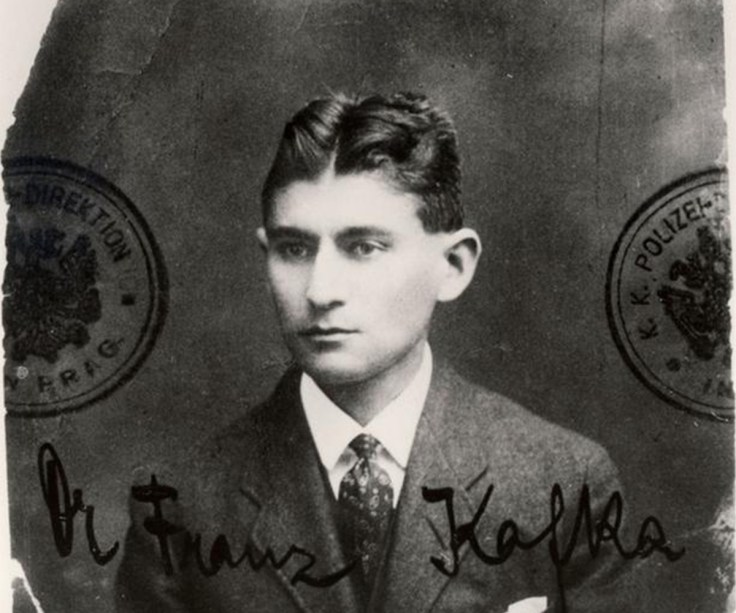
[Franz Kafka]

This is saying a lot for Kafka who, in truth, was not even much of a fan of the typewriter. But, he was a constant writer (even if he destroyed – it is estimated – 75% of what he wrote) and certainly expected any other author to be the same.

At any rate, coupled with a bit of travel, I had not written for ten days. It is possible that I have not gone that long a stretch for years. For the last couple of years I had been writing six days a week, rarely missing that amount. I think that in the last few months, writing an original novel and editing another on a daily basis did me in.

But, earlier this week, on the same day, I received the same article in an email and on Facebook. It was a short section of Kafka Diary entries. Real ones (I say this because I have written a novel where I fill in some *missing* Kafka diary entries). It was directed to writers, and commented about some aspects of writing. The one that leapt out at me was:

March 11  How time flies; another ten days and I have achieved nothing.It doesn’t come off. A page now and then is successful, but I can’t keep it up, the next day I’m powerless.

I generally think I can take a hint. And a hint given twice. And a hint from Kafka. And a hint given decades after he is dead, via a medium (pun intended) that Kafka would despise.

So – I took the hint.

A page a day since then.

And onward —>>>

DE


The Mask Of Death Leads To Sundry Places

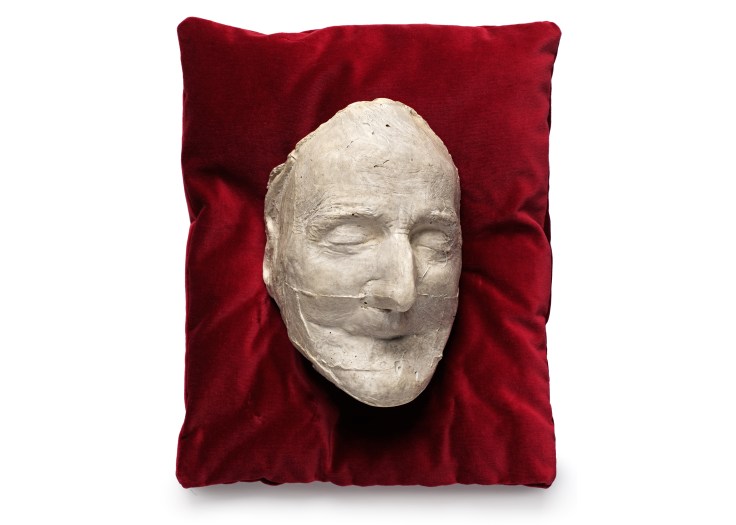
[Death Mask of the Duke of Wellington]wellington-death-mask

My two gals, Alison Alexandra and her friend, Amanda, are on a sea voyage. A voyage via a freighter, and not a cruise ship. They stop in the ports where the freighter stops, and they take visits of the town if they so desire.

On one of their times on shore, they decide to visit a Police Museum. One of the exhibits is a Death Mask of a hanged murderer. They take great interest in this, noting the repose of the face.

This incident is based on an event in my own life. I melded parts of my experience into my characters afternoon visit during their day ashore. This had not been on my mind when I started this particular chapter.
I once taught a workshop on Supernatural writing. For my workshop I took advantage to take my students on a field trip to see the death mask of a historically known poet. The death mask was conveniently on view in a display case in a near-by building.

None of them had even heard of ‘death masks’, let alone seen one. I invited them to

incorporate the idea into their writing exercises. Some did, some did not.

However, it’s possible this visit to Death elicited the following story from one of my students.

My student and her husband had purchased a new house. Cleaning and renovations eventually took them to the back loft area, which was piled high with decades of accumulated detritus from a long life.

They cleared out beds, and boxes and newspaper piles, and magazines, and bundles of clothes, and on and on. Near the end of this process, my student noticed a “clump of something” on one of the wooden beams of the loft.

Getting ladder and flashlight, her husband climbed to see what it was.

It was the end of a number of knotted bed sheets.

DE

Fame Helps Tie The Rope For Suicide

coiled-up-rope-with-hangmans-noose

Fame and suicide.

Suicide and fame.

The two flirt, and  consummate their relationship often enough to make others take note.

If someone gets everything they hope for,

or want,

or expect,

 there is not much left to live for. 

Boredom ties the rope.

There are other factors, of course. We can never know another person well enough to tell how they think or feel. The majority of famous people do not remove themselves from this earth. Indeed, a large number of them  relish the attention. More than mere success sent Virginia Woolf walking into the River Ouse. Ernest Hemingway had personal demons aplenty.

These days, Fame stalks those who are famous.

Although a famous author does not attract the attention of a famous entertainer, or sports figure, or politician, an author’s fame spreads beyond the usual world of books and readings and tours.

Fame guarantees attention must be paid. The media makes Fame supersede the reason for the fame. Fame is the elephant in the room, always poised to turn rogue.

Creating is difficult enough.

Creating is time-consuming enough.

Creating is isolating enough.

Fame magnifies all these things, and sometimes ignites an unrelenting blaze.

DE

(image)http://www.catholicmannight.com/wp-content/uploads/2013/03/Coiled-up-rope-with-hangmans-noose.jpg

Create a free website or blog at WordPress.com.

Up ↑