Search

kafkaestblog

It is a whirlwind in here

Tag

novel

Kafka And Harvest On The Farm 100 Years Ago

img_1683-1024x768

My novel, Kafka In The Castle, set in 1917, mimics the year I wrote it (two years in a row, actually). For instance, 10 October 1917 was a Tuesday. It was a Tuesday in the year I wrote it. So I share some of my fictional Kafka 100 years after the fact.

~~~~~~~~~~~~~~~~~~

10 October 1917

A rainy day which halted most of the harvest.

I thought there would be grumbling, and the kitchen filled with men drinking tea. But if I’m here long enough, I’ll learn.

I discovered that during harvest, most regular chores are put aside, so when some time appears, there is as much activity as ever. Plus, there is the additional anxiety over how long the produce will be delayed in the field.

I’m certain that Ottla looks out the window every ten minutes, and asks my opinion of the rain every half hour.

I have learned to look with my knowing farmer’s eye, and nod, and grunt.

So far Ottla never fails to laugh.

(image) https://cdn5.tenthacrefarm.com/wp-content/uploads/IMG_1683-1024×768.jpg

A Birthday Day l00 Years Ago Via Kafka And Me

kafka_main1
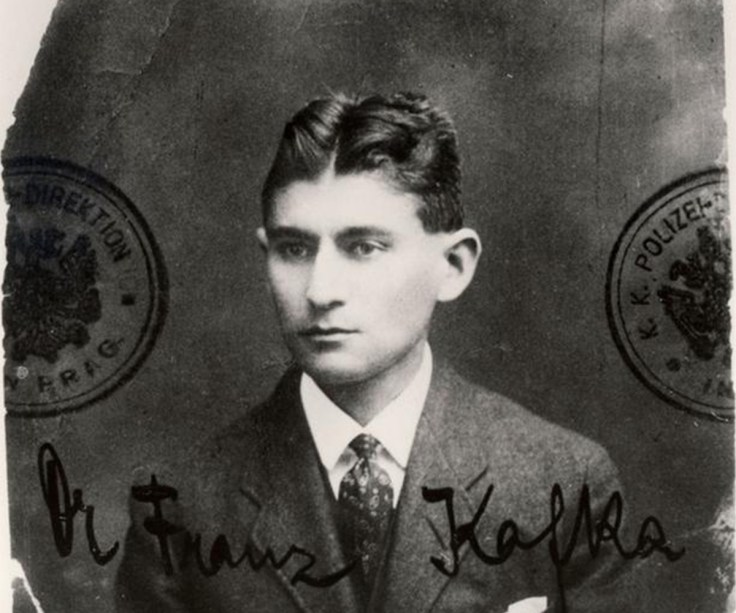
When I wrote my novel, Kafka In The Castle, filling in all of Kafka’s missing diary entries, I found something very interesting a few months into it. The day/month/year I was writing about, mirrored the day/month/year in which I was writing.
For example, if the third of July was a Friday in my year, it was also Friday, 03 July in 1917. It was quite an exciting surprise, and made (I think) for more immediate writing.
However, 19 September 1917 was already filled in by Kafka, and I had nothing to do.
Here is Kafka’s actual entry, abridged.
DE
~~~~~~~~~~~~~~~~~~~~
19. (September 1917) Instead of telegram: “Very welcome station Michelob is excellent Franz Ottla” I wrote a farewell letter, and once again strongly oppressed agonies.
Farewell letter however, is ambiguous, as my opinion.
 
It is the age of the wound, more than its depth and proliferation, which constitutes its painfulness.
To be torn up again and again in the same wound canal, the countless wound operated again treated.
 
The fragile moody void essence – a telegram swaying, a letter directs it, animated it, the silence after the letter makes it dull.
 
The game of the cat with the goats. The goats are similar: Polish Jews, Uncle Siegfried, Ernst Weiß, Irma
 
Various but similar strict inaccessibility of the creator Hermann (who has now gone away without a supper and salutation, the question is whether he will come tomorrow), of Fraulein, the Marenka.
Basically, they are oppressed on the other side, as in front of the animals in the stable, when they are asked for something and they follow astonishingly.
The case is only more difficult here, because they seem so often accessible and quite understandable.
 
It is always inconceivable to me that almost anyone who can write is able to objectify the pain in pain.
For example, in misfortune, perhaps with the burning misfortune, and to tell someone in writing: I am unhappy.
Yes, I can go beyond it, and in various pranks, depending on the gift, which seems to have nothing to do with the misfortune, simply or antithetically, or with whole orchestras of associations.
And it is not a lie at all, and does not nurture the pain; it is simply a graceful excess of the forces at a moment when the pain has visibly exhausted all my powers to the ground of my being, which he scrapes. What is the surplus?
 
Letter to Max. Liar, vain, comedic.

100 Years Ago: Kafka On The Move from “Kafka In The Castle”

cgwaytuxiaasez_

[The Swiss Girl]

12 September 1917

Max came to the station with me this morning, which was kind of him.

He was not in as good spirits as was I, for he does not have the joy of escaping Prague to assuage our parting.

I obviously did not help matters when I pointed to the two men carrying my things, and said that they could be carrying my coffin.

He did not even attempt a forced smile.

Or force an attempted smile.

My possessions were bundled into the baggage car, and I was prepared to be folded away there too.

But they allowed me a compartment, and as we parted, I shook the empty hand of Max.


13 September 1917

This might even be the type of place for the Swiss girl. Unfettered – perhaps singing.

I’ve had the strongest desire to be with her this morning.

Maybe I had a dream.

The strongest desire to contact her – regardless of what we promised.

But – after all these years – I probably could not find her, even if I tried.

And I have no idea who I might find if I succeeded. Not the girl of memories.

And who, anyway, would she find?

What look would cross her face and still her song?

Because – I have become me.

DE

The Funeral Ends For A Dead Princess

From Being Famous:

He wonders where Diana is.

If the whole context of this service is correct, and her Spirit Everlasting is afloat in some other world, does she have the slightest interest in these proceedings? Do you care what is on the plate after you have eaten the meal?

Is it – as he hopes – an all new wonderful adventure?

ST is returned to the present by the familiar words of The Lord’s Prayer. He is actually reciting  “Give us this day our daily bread” before he realizes what he is doing.

Stopped in place and time.

He could be a child again (perhaps he is) wondering what `trespasses’ are. He could be the aware young man, wondering why God would have a penchant to lead us into temptation. And he could be as he now is, wondering if this was the only way for a troubled young woman to be delivered from evil.

ST is fully attentive to the final hymn, and The Commendation of the Dead to the Lord.

He suspects it is an all-or-nothing package: that Diana and Jesus and God are present and appreciative to what is happening around him; or that he and everyone else are just singing and praying to the empty rafters. He fears his faith has skidded to the unstable foundation of hope.

The cortege prepares to leave the Abbey. Although the choir sings as the procession slowly moves to the west end of the church, it is really silence which hangs over this vast array of people. Again the casket with its ruptured body wend their way down the aisle, the flower arrangement an almost dull glow in this final, sombre setting.

“Weeping at the grave creates the song.”

Or so the song goes.

Then there is the final minute.

The minute of silence.

Observed by the Nation.

Observed by ST.

Observed -perhaps- as a minute’s pause in the enormous expanse of Eternity by a dead princess.

(image)http://www.westminster-abbey.org/__data/assets/thumbnail/0006/90933/Diana-fun-1997-outside-72.jpg


Cruise Ship Queen Mary 2 Heads Out To Sea

image

The larger-than-life cruise ship, Queen Mary 2, was in Halifax for the day, and departed this evening. It probably gets special attention because of its grandeur. Also, the Cunard Shipping Line, nominal owner of the ship, was the creation of a Halifax chap, Samuel Cunard, back in 1839. The Cunard Line is now folded into the Carnival empire, but that’s business.

As The Queen Mary 2 left, it was escorted by a Canadian Navy Coastal Defence Vessel – the HMCS Summerside, a harbour fire boat spraying arcs of water, and even a helicopter flew overhead. It took its time leaving.

I have written about the the launch of Queen Mary 2 in my novel Fame’s Victim. The main character of my novel, known as ST, is good friends with the actual Queen Elizabeth the Second, who launched the ship. ST and his lady friend, a famous actress whom he always refers to as Garbo (though she be not the actual Garbo) are on the maiden voyage of the Queen Mary 2. That chapter is below.

DE

(image)https://www.ctvnews.ca/polopoly_fs/1.2462900.1436552018!/httpImage/image.jpg_gen/derivatives/landscape_620/image.jpg

~~~~~~~~~~~~~~~~~~~~~~~~~~~~

Excerpt From Fame’s Victim:

“Your Majesty.”

ST extends his hand just as a volley of the extensive fireworks light up The Queen Mary 2 and the harbour side where she has just been launched. He flinches but the Queen does not.

“So much for the Queen’s weather.” The Queen points to the torrents pelting the dock. “It rains on my reign.”

“Yes, Ma’am.” ST hears Garbo’s barely repressed giggle behind him. “I believe you have not met – “

“This charming lady with the delightful sense of humour.” The Queen looks past ST. “No, I have not.”

ST takes a side step as Garbo extends her hand.

“Your Majesty.”

Garbo has been instructed that formal curtsies are not in fashion, but the actress in her makes her modified one very graceful. The Queen is obviously amused and pleased.

“We understand you both are on the maiden voyage to the United States.”

“Yes, Ma’am.”

“Is he attempting some sort of record, do you think?” The Queen points to ST.

“Ma’am?” Garbo is confused.

“The last flight of the Concorde and now the first voyage of QM2.” The Queen smiles. “It sounds to me like some type of Time muddle.”

“Ma’am.” Garbo giggles and ignores protocol by touching the Queen’s arm. “I don’t make theories about Time and he doesn’t try to act.”

“Very sensible.” The Queen looks from one to the other. “I don’t act either.”

There is another eruption of fireworks, and they look into the dark sky. The vibrant colours flash against the side of the ship and sparkle on the water’s surface.

“We had best go in.”

“Yes, Ma’am.”

Even before ST has agreed, ship’s crew and members of the Queen’s entourage have opened doors and produced umbrellas for the twenty second walk.

“I’m not sure what my grandmother would think of her namesake.” The Queen indicates that ST and Garbo walk beside her, which causes some manoeuvring as the Queen is using a cane because of her hip operation. “Perhaps a ship which dwarfs the Titanic would be beyond her comprehension.”

Three abreast confuses those in attendance though the ranks quickly settle into place. As they approach the doorway ST executes a couple of half steps so the women go through the entrance without crowding. He then quickly returns to his place.

“Mind you, Queen Mary would certainly appreciate the opulence.” There is a quick royal chuckle. “And she could tally the worth of each item to within ten pound, if not sometimes to the shilling.”

ST assumes the Queen would know the powers of her own grandmother, but he wonders if anyone could rightly cost the grandeur that surrounds them. He and Garbo will shortly be taking a tour of the high points while the Royal party will be given a different tour of other high points. He has been told that a complete tour of all the high points would take ten hours. A leisurely inspection will take three days of their trip if he so desires. It is a far cry from the Concorde where twenty minutes served the same purpose.

“My walking stick shortens my own look around.” The Queen smiles up at the couple. “However there is a Wedgwood Panel I have insisted upon. Do try to see it on your own – it graces a wall in Kings Court.”

“Yes. Ma’am.” ST answers with less enthusiasm though he will give it a close examination, as he will no doubt be queried the next time they meet.

The three of them now cross a wide and carpeted expanse where ship’s crew and invited guests line both walls. The Queen notes a decidedly younger crowd mingling together and glances at Garbo.

“Let’s work either side of the room. I would guess that section is more for you than me.”

“Yes, Ma’am.” Garbo blushes. “I’m sure they would be happy to see you.”

“Not ‘as happy’.” The Queen nods in their direction. “One knows one’s time and place.”

As Garbo approaches the now-applauding group, the Queen slows her pace, making ST do likewise. Her voice is low enough to make him lean closer to her.

“”You’ve been in the news.”

“Ma’am?”

“Hollywood sightings and Paris auctions and the trailing of Google.”

“Yes, Ma’am.”

“Welcome back.”

Down To The Sea In Ships On National Lighthouse Day

nova_scotia_-_cape_george_lighthouse

Cape George Lighthouse

Since it is National Lighhouse Day, let me celebrate.

I have enjoyed going to lighthouses, and have done so for years. If anything, I keep finding them more and more evocative. A number of years ago, from high cliffs over the Northumberland Straight, this is what I saw one afternoon from a lighthouse.

One old fishing boat:

One sleek new fishing boat:

One chubby fishing boat:

One fading green fishing boat:

One distant white sailboat under sail:

One close white sailboat under sail:

Two small outboard boats:

One tugboat pulling . . .

One rusting barge.

Happily, the Cape George Lighthouse is now listed as a Heritage Site by the government of Canada.

(photo)https://opto.ca/sites/default/files/pictures/featured_items/nova_scotia_-_cape_george_lighthouse.jpg

DE

~~~~~~~~~~~~~~~~~~~~~~~~~~~

I have also written a couple of chapters in one of my novels that were set in a lighthouse. This is a section of one of them.

Let the light shine.

 +++++++++++++++++++++++++++++++
Excerpt from: He Lives In The City / He Drives To The Country

“Well, Blaine, the place is as sturdy as the rock it’s on. Government inspected every spring. We even sat pretty through the Great Groundhog Day Gale in 1976, the worst storm in over a hundred years.”

Fred Gannet nudged Blaine to the huge windows. He pointed into the distance, although neither could see through the fog.

“Waves forty feet smashed up against us. We clocked winds at one hundred and thirty-seven miles an hour. We had the warning, so we got most of this battened down. Turned over my van, but I had it far from the cliff. Smashed out a window in the living room. I had a bitch of a time getting plywood over it. Lost power and phone of course, but everything here can run on emergency generator. And part of the roof lifted, but it didn’t do that much damage.” He jabbed his finger at the rain spattered windows. “This is a baby compared to that whore.”

He gave a whoop of a laugh, and took off his cap.

“Old George Crenshaw, he’s the keep on Goat Island, a mile square drop of nothing about eight miles further out to sea. Well, he took the brunt of that bitch, and we were all sure he was a goner. For hours after it passed, there was no boats could get through the waves, or helicopters through the wind. Even the radios were gone, and no one had talked to the old bugger for twelve hours.

“We kept trying and trying, and finally I heard his call letters, but real faint like. I turn my juice ’til the needle’s in the red, and I’m yelling, to find out how he is. You know the first thing any of us hear that old son of a bitch say?”     The large man’s body was actually shaking with laughter, something Blaine had rarely seen in anyone.

“Old George’s thin voice comes out of the radio, like a fart out of a ghost, and he says: `Well, boys, that was quite a breeze’.”

Taking A Vacation – But Not So Much

In a discussion about vacations today, I made the comment that I don’t consider I have had a vacation for forty years.  I doubt I was believed and, I’ll accept, it probably isn’t even true. But, when is a writer ever off? Ideas appear at will (not my will) and characters demand that attention must be paid. This can happen any day, and usually every day. This ain’t no complaint, as writer’s block is far worse.

Still, I think I’ll slip some blogs in that I have already done before. There may be no rhyme nor reason for my choices, but, this one came to mind because I think a character somewhat like The Gypsy Lady might have just appeared in my current manuscript. A totally different story and situation, but …

~~~~~~~~~~~~~~~~~~~~~~~~~~~~~~~~~~~~

gypsyviolin-graphicsfairy11

08 June 1917

A Gypsy confronted me today, and I was in the mood for a bit of sport. Her age was difficult to tell – certainly a decade older than me. In her swirl of shawls and dangling jewellery, heavy make-up on her face, she could almost have been in disguise. She peered at me with an intense sigh, attempting – I am sure – to penetrate my own disguise.

“You are a Jew,” she said.

“And you a Gypsy,” I replied.

She seemed pleased with my response, for her professional smile became real.

“You state the obvious,” she said. “As becomes a Doktor of Laws,”

I replied. “But to your eyes, do you not state the obvious?”

“Are you going to banter with a poor old Gypsy woman, instead of barter? That would make you suspiciously like one of us.” She said this with a growl in her throat.

“The Gypsy and the Jew,” I said, feeling the challenge which I so miss. “Perhaps an opera – but I think it’s been done to death.”

“They will try to do us all unto death,” she said harshly, and turned away.

I had the fear she was going to leave me without another word, but what she did was to spit fulsomely onto the street.

“They can’t kill us all,” I said, but I knew she heard the doubt in my voice.

She slowly faced me again.

“So. Even a Doktor of Laws can have hope. That is refreshing – but foolish.” She took my hand and felt my palm roughly with her thumb, although all the while her eyes never left my face. “You are going to travel.”

“Travel is a vague word. One can go on many types of voyage.”

“And reach many destinations,” she added, still holding my hand. “If you take away my vagueness, you take away my trade.”

“Then let me pay you for your services right now.”

This transaction would make her loose my hand, which is what I wanted most of all. She had frightened me, for her eyes and face were full of truth. I know the truth. I know it when it presents itself, stark and unobscured. I search out truth endlessly, yet still can flee at its approach. As in her eyes. But she gripped me more fiercely, and pulled my hand up.

“The coin, Herr Doktor.” Her voice was now soft. “The coin can wait.”

She at last lowered her eyes and looked closely at my palm. She rubbed the lines and whorls of my skin. She touched her finger to her lips, and spread the moisture along my hand.

“Your lifeline, Herr Doktor,” she took a quick look in my eyes, “of Laws. You deceive with the youth upon your face. Is that not so?”

“If your eyes stop at the mask, then no, the years have not etched themselves deeply.”

“Not on your face, Herr Doktor of Laws.” Her grip was intense. “But on your palm…” She hissed. “You will soon embark upon that final voyage.”

She released my hand, rubbed her fingers across her sleeve.

“But you will not go in haste. There will be many stops along the way.”

Suddenly her face was full of the most beautiful smile, and her laughter was genuine.

“I see you do not complain of vagueness now.” She held out her hand. “The coin, Herr Doktor of Laws. This time I have truly earned it.”

I dug deeply into my pocket, and feared that I may have overpaid her. But, perhaps, that is not possible.

DE

(image)thegraphicsfairy.com/wp-content/uploads/2012/10/GypsyViolin-GraphicsFairy1.jpg

Mother And Son In Thirteenth Century Europe

episode-of-the-child-crusade

Exercpt from: China Lily

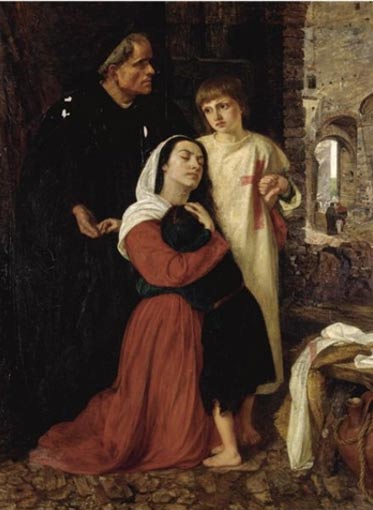
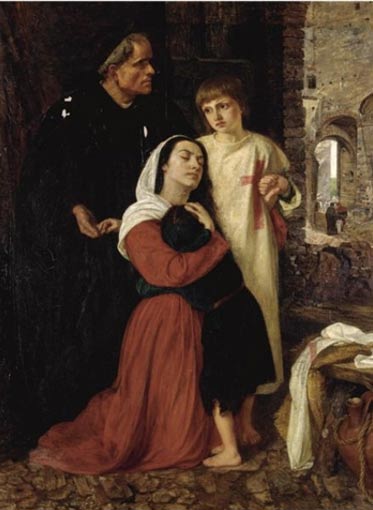
Matzerath’s mother rarely shared her thoughts with anyone. She is as elusive now as when he was a small boy being raised within the shadow of the religious buildings where she still works as a cook. Bishops and abbots come and go, and red-robed Princes of the Church make their visits, for which she must dress appropriately – but she remains. At least Matzerath assumes she is still there, though he has not been back for five years.

Matzerath is small in stature and taken to be younger than he is. At thirteen he is treated as seven. He allows this because he finds there are more advantages then penalties. He knows far more than is expected of him, and avoids many pitfalls through the guile no one expects he has. He also achieves more than is expected from him, and is given much leeway for a child. Had his real age been obvious, he would be perceived as dim-witted. Because he is thought of as a child, he is considered gifted.

Matzerath’s mother is aware of how her son is tolerated – she even encourages his guile. He is treated better than most children, whose father is absent months at a time sailing the North Sea.

Matzerath is also getting an education of sorts, which is generally restricted to the children of nobles and the wealthy. He has learned how to read and write, along with the rudiments of mathematics and geography. He also pokes his nose into the stables, and the smithy, and the carpenters, picking up their basic skills.

He follows his own mother with interest, and can chose, prepare and present many of the dishes she serves at the Monastery. For the notables at the cathedral, and other clergy, she is expected to produce more sophisticated fare. Matzerath has even acquired some of these skills, but a puny child is forbidden to appear near the high table. He does get to nibble the leavings but notes – as he also does at the Monastery – that very little is ever left.

Matzerath would have been content to stay in this arduous life seasoned with episodes of interest and learning, but his elusive nature is discovered by a visiting bishop.

The Bishop is a militant with evangelical frenzy. He is intent upon forming a Children’s Crusade to march to the Holy Land. Matzerath is not sure what this means, though he gathers it will offer an opportunity to leave the confines of the town and local villages where he has spent his life. His mother is better informed.

Even though the last Children’s Crusade happened generations ago, and the Church proclaims it was a wondrous act for the Glory of God, she is fully aware that most of the children never came back. And that the Holy Land is still lost to the grip of heathens. The murmurs from the Monastery and the high table reveal this bishop to be a renegade and unsound in judgment. His ‘new’ crusade is predicted to be a disaster. His abilities to lead it are a joke. However, he does have the ear of the Pope, and his family has much wealth to give to the Church.

Matzerath does not possess an abundant affection for his mother – not for anyone – but he realizes that regardless of the amount of work she extracts from him, she generally does what is best for him. He pays attention to her instructions and her observations and her warnings. She also encourages him to tell her what he sees and hears. As he becomes older, she also wants to know what he thinks about the things he sees. Matzerath realizes she is using him as a spy, but he does not mind. He knows his mother sometimes manipulates the information he brings for her own well-being, but these rewards also come to him.

Matzerath heeds the warnings his mother gives about some of the priests and monks and their interest in boys. He discovers this himself upon a couple of occasions, and even satisfies one priest just to see what it is like. He shares this with his mother because he knows she sometimes does the same.

DE

(image)http://www.ancient-origins.net/sites/default/files/Episode-of-the-Child-Crusade.jpg

Louie-the-Dog Dines Well After A Day With NATO

smiles6-2-1

An excerpt from: The Bonner Prediction

05:14:31 ZULU Time

“I’ll sweep the house.” Bonner puts the keys on the dining room table.

“That’s fastidious.” Bess looks at her watch. “It’s a quarter past one in the morning. Who’s going to visit?”

Bonner gives her a closer than usual look to make sure she is kidding. She winks and sets out to find dishes. He stops her with a hand on her arm.

“Are you familiar with NATO safe houses?”

“Nope – never been in one.”

“Don’t try to use the back door.” Bonner points through the kitchen. “It’s wired with explosives.”

“You call this a ‘safe’ house?’

“Makes it safer for us.” He removes his hand. “It will explode if someone aggressively attempts to break it down.” He smiles. “We can also detonate if from here, if necessary,”

“But this wasn’t your idea?”

“No – alas.” He starts away with his handheld. “But I approve.”

The house is conventional in its layout, ready for a family. She wonders if there are families any more. If these buildings have been relegated as guest accommodations, she doubts either diplomats or military travel with a family.

She removes the food from the containers and places it on dishes. As she puts them in the microwave Bonner passes with his electronic handheld. She thought he might give only a cursory search (no one can possibly know they are staying here) but – no. The walls, the light fixtures, the electrical outlets, the appliances, the taps, the windows, the doors are all given a sweep for tell tale signs of transmission. The doors are closed and their locks are tested. As with any place of sanctuary, every room can become a ‘safe’ room. If this dwelling is like others she has experienced, the windows can even withstand an RPG.

When Bonner is finished, he goes to the cupboards and removes napkins. On his way past the fridge he takes out a bottle of wine. He shakes his head disapprovingly.

“Screw top.” Bonner carries the wine and napkins to the table.  “Not the usual standards of NATO.”

“I was planning on Sprite.” She looks toward the kitchen as the microwave beeps. “NATO lives it up while we Swiss live in parsimony.”

“If NATO inclined towards having us live it up, they would have put us in more graceful accommodations.” Bonner twists off the cap. “At least it’s white.”

“Where’s the dog food?”

“They’re a tidy group. I bet food will be in the kitchen.”

As Bess takes the food from the microwave and hunts for plates, Bonner searches for dog food. Not only does he find a bag in the corner, together with a foil pack of dog treats, but there are two shiny, new, metal dog bowls – one for food, one for water. Bonner guesses that a member of the supply personnel is a dog lover and raided the stores of the guard dogs.

“How much?”

“Two scoops.” Bess is putting the salad into a bowl.

“What about treats?”

After.” She looks at him. “I bet you don’t have kids, either.”

“Nope.” Bonner puts two generous handfuls of food into the dish. “I’d make a lousy father.” He runs water from the tap then fills the other bowl. “There’s time.”

“Not that much time.” Bess takes their food to the dining table.

“Ouch.” Bonner has little interest pursuing this thread. He opens a cupboard and takes out two wine glasses. “Louie is fed and watered.” He carries the glasses to the table. “And now, soon to be us.”

Bess looks over to Louie. He is attentive to her, but also has side glances to the kitchen.  She waits until he is only looking at her, and then makes a hand gesture.

“Go.”

Louie is out of the room before Bonner can pick up the wine bottle. His claws clatter across the kitchen floor, quickly followed by crunching and the scrape of the dog bowl on wood.

“He’s not going to savour, is he?”

“Nope.” Bess takes her wine glass. She is about to take a drink but stops. She extends the glass toward Bonner. “It’s been a night.”

“But our wee family is safe to home.” Bonner clinks her glass. “Though Louie’s table manners could be more refined.”

DE

(image) http://www.madrivercanecorso.com/wp-content/uploads/Smiles6-2-1.jpg

Blog at WordPress.com.

Up ↑