Search

kafkaestblog

It is a whirlwind in here

An Ex-Con And A Biker Meet On A Bus

cropped-nscotian-nov-2014-dscf8122

There are all sorts and conditions of people who take the bus (myself included). A few years ago I made particular note of the two talkative folk who sat in front of me, one on either side of the aisle.

Directly in front was a handsome young man in his twenties. He had, that morning, just been released from penitentiary. He was on his way home. Across the aisle from him was a grizzled and bearded man in his mid-life who had never taken a bus ride before.

 They talked. I listened.

The convicted felon (a cheerful and polite fellow) had, with a partner, robbed a grocery store. Stole the safe. Got a lot of money (thousands in the double digits).

They got away with it.

However, some days later, his partner got a case of the ‘guilts’ and turned himself in.

And told what had happened.

His buddy, unplanned and unwanted, soon followed. Fourteen months.

The bearded fellow – never on the bus – had a host of motorcycles and vans, and travelled in them.  He took a header when he hit an empty pop bottle. He was a hippy from way back, and more or less continues to this day. Even the bus driver recognized the van he described, famous for its art work.

The former inmate revealed:

how to make ‘moonshine’ from unimaginable ingredients;

how to make money from ‘nicotene patches’ (by cutting them into strips and selling the contents);

how cigarettes behind bars cost $15 each.

Oh – yes – he also  lost his girlfriend because of his actions. “A BIG mistake,” he said.

I gotta admit, all this plus the beautiful scenery wiled away the time.

DE

(image)http://m-2tvextreme.com/wp-content/uploads/2014/12/cropped-NScotian-Nov-2014-DSCF8122.jpg

Gambas Al Ajillo (Garlic Shrimp)

[Elephant garlic. It’s milder than regular garlic, which means you can use a lot more of it before it becomes overpowering. It’s also a lot larger than regular garlic (think shallot sized cloves), so it’s much easier to peel and chop.]
Gambas Al Ajillo is perhaps one of the most popular tapas outside of Spain. Get this garlic shrimp recipe cooked in olive oil at PBS Food.

Source: Gambas Al Ajillo (Garlic Shrimp)

Notes And Observations And Verse For Friday 13th

friday13-planner-02

“I wish to state before this assembled multitude;

“before this packed house;

“before this captive audience;

“that I have every right

“(as much as each of you)

“to be here and represent my interests,

“my justifications

“and my associations,

“because I am a member in every day, and, perhaps

“even as the nights which are too cold

“and then the elevators, as they so often do – stop.

“You look askance.

“Indeed, you look at me in that manner

“that indicates that the corners of your eyes

“are full of mistakes.

“Which proves to me beyond and above

“- to heaven even,

“to the very Golden Gates where the various saints

“hang to the golden bars

“and swing to and fro in the Celestial breezes

“which cause clouds to scud across the sky,

“and there is barely time to think of a reply.”


DE

(image)http://www.livescience.com/images/i/000/050/583/original/friday13-planner-02.jpg?interpolation=lanczos-none&fit=inside%7C660:*

God And Death Kept Me From A Poetry Reading

emily-dickinson-because-i-could-not-stop-500x344

Admittedly I set out later than I should, but the poetry readings were to go from 7-9. Enough time for some of it. However, as I was a few blocks away from the harbour (yes, I was also going to stop by the harbour first) I heard Latin chanting.

I greatly enjoy Latin chanting, so imagine my surprise. It turned out there was a large tent set up in a parking lot beside the Roman Catholic cathedral. Six men were chanting a service for a small group. It seemed related (in some way) to the jazz festival happening in the city. They had mics and lights. I lingered by the  fence and listened. Evocative and effective.

However, I did feel I should go to the poetry readings, so off I went.

But I gave in to my temptation of visiting the harbour on the way. It was there, as I sat looking out to sea, that an elderly, white haired man struck up a conversation. A visitor who had arrived by train for a week of vacation.

The first vacation without his wife, dead these fourteen months.

She was eighty-four.

When he said this, he saw the look of surprise on my face.

“Bet you can’t guess my age,” said he.

I answered, with some truth, that I never answer that question.

“Eighty-one,” he said.

I granted I would have shaved a dozen years off his age.

“Married sixty years,” he said. Always had travelled with her. Always went by car. “But it wouldn’t be the same,” he said. So he took the train.

So – yes – I stayed to talk to him.

“Get up every morning to fill the day is my motto,” he said.

So I answered his questions about the islands, and if the helicopters flying overhead were military, and if all the ships needed the use of the tugboats we were standing beside, and was there somewhere close he could buy magazines, and how he got this real good travel deal through CAA, and how he talks to everyone.

“Is that really the ocean out there?” He pointed.

I nodded.

It was.

DE

(image)http://www.poetseers.org/wp-content/uploads/emily-dickinson-because-i-could-not-stop-500×344.jpg

Live Reading Tells The Tale of An Elephant

elephant-douglas-p-whitney-dpc

Dale Estey

Stacks Image 514

Dale Estey reads from his story collection, The Elephant Talks to God

Published by: Goose Lane Editions

Dale Estey’s published novels include the fantasy A Lost Tale and the thriller The Bonner Deception. He has two editions of humorous short stories, The Elephant Talks to God, which are appreciated by both young and old.
His manuscripts range from stories about Druids in the Passing Through Trilogy to Satan’s intrusion in the 9/11 destruction of New York. He has filled in the missing diaries of Franz Kafka; recounted the first person dementia of a serial killer; and explored the outrageous lifestyle of the Famous.
He currently switches his attention between writing the saga of a family of onion farmers from Fourth century Italy to revealing the machinations of a contemporary NATO thriller.
He prefers to travel by train, but embraces the computer age with passion. He is ever on the hunt for unique onion recipes.
Stacks Image 515

“Dale Estey’s The Elephant Talks to God is, first and foremost, a witty, satirical book about the relationship between mortals and an immortal creator.”
—Orson Scott Card

Listen to the Reading on this web site:
Time of Reading: 6:43

The Dream On The Night Train

11458140-railroad-track-switch-stock-photo-railway-tracks-train

The troubled night carries too many warnings of mortality to be ignored.

There are horses kept unfed in refrigerators, clambering to get free.

Some will be found emaciated.

Punishment will be meted in an ingenious and terrifying manner.

Flowers will turn to doorknobs.

Stooping to smell will reveal the pungent scent of fingerprints.

Dreams to befuddle Satan.

Fears not be wished upon a hated enemy.

The steps are steep.

The rooms without walls.

Pictures hang and grin with howling mouths.

What would be the fruit of seed tilled in these fields?

If that hunted figure, racing so slowly after the final train, is you,

Whose eyes watch the train?

DE

(image)http://previews.123rf.com/images/jerryb7/jerryb71111/jerryb7111100134/11458140-Railroad-Track-Switch-Stock-Photo-railway-tracks-train.jpg

Interview With National Radio Some Years Ago (But Most Answers Remain The Same)

symbole-of-trust


I came across a transcript of this at the end of last year. It’s not that I forgot it, but it took me some time to remember it.

~~~~~~~~~~~~~~~~~~~~~~~~~

1. What unique challenges do you face when writing about serious
non-fiction issues such as religion?

I WRITE about spiritual matters and leave religion to others. The spirit and its quests drive religion – religion just interprets. The biggest challenge I faced in THE ELEPHANT TALKS TO GOD is that the Elephant started asking questions I could not answer. Thus endeth the book.

2. You wrote The Elephant Talks to God in 1989. Why did you decide to
re-release it with the added stories rather than write a sequel?

THIS WAS the decision of the publisher, Goose Lane. When they approached me for a re-issue they were unaware of the additional stories. It was decided the marketplace would prefer one longer book over two shorter ones. Having just one book also reduced production costs, which in turn reduced consumer cost.

3. Why did you decide to become a writer?

“I WAS born like this, I had no choice, I was born with the gift of a golden voice.” This quote from Leonard Cohen sums it up. Not “born” this way exactly, but within one month in grade eleven I went from ‘no writing’ to ‘continually writing’. I have no explanation. I had no previous interest nor inclination toward the arts, or writing. I was not a reader, and only after university deliberately read such children’s classics as Black Beauty and Alice in Wonderland.

4. What books or authors have most influenced your life?

POSSIBLY P.G. WODEHOUSE was the most influential author in my formative period. I even sent him a fan letter and received a response. In university I experienced Franz Kafka, and I believe I have read everything of his in print. Much later I visited Prague to research a novel I have since written about him. There are reports of ‘missing’ stories and diaries of Kafka still in Berlin, which I would dearly love to find.

5. What, in your opinion, are the most important elements of good
writing?

SURPRIZE, HUMOUR and reality. ‘In context’ (it doesn’t matter what the genre) I want to be surprized by what is happening, yet fully believe in the reality created in the book. And somewhere, at least once, every character in every novel should make me laugh at least once.

6. What are you reading right now?

“WICKED” BY Gregory Maguire. His abilities as a writer astound me. I am a slow reader, and seemingly getting slower. Soon (?) to be read will be Alice Munro’s “The View from Castle Rock ” and John LeCarre’s “The Mission Song”, both requested Christmas presents. I also do a lot of research for my novels, and will embark upon histories of China in the near future.

7. What advice would you give to writers starting out?

I HAVE two steadfast rules, one put into rhyme. “When in doubt/take it out.” Regardless of the wonder of the poetic line, or the awe of the slice of dialogue, if you have any questions about its effectiveness, that is reason enough to remove it.
The other concerns the physical writing itself. At the end of your writing day, and you know what the next line of dialogue is, or the description you are going to write, or the next line of the poem – DON”T write them down. Start with them the next day, and you will quickly get back into the writing. I find this works 90% of the time.

8. Describe your writing process.

I’M A morning writer, roughly from 9:00 until 15:00. There’s a meal in there, and research and email and such, but I will generally complete two pages a day. I generally write seven or eight days straight and then take one off. At the start of a novel I have a well developed outline and characters, though I rarely write such things down. I find that at the end of a novel I spend an additional third of the writing time editing what is done. I usually complete a novel in two years.

9. Do you ever suffer from writer’s block? If so, how do you overcome
it?

THREE MONTHS of writer’s block during my second novel has (so far) been my experience with this curse (knock knock knock on wood). I sat at the desk literally for hours per day attempting to continue. I think I wrote five paragraphs in that time. I know of no way to overcome it other than attempting to write each day. My number two tip in question #7 will help in avoiding writer’s block.

10. Naturally, most writer want as many people as possible to read
their work. Who did you have in mind when you were writing this book,
the “believers” or the “non-believers”?

BRITISH PUBLISHER Joseph Dent introduced “Everyman’s Library” in the early 1900’s (which is now published by Penguin Random House UK). As my mother was from England and my father was a proud UEL, there were many of these books when I was growing up. Everyman’s Library had a motto at the beginning of each book:        “Everyman, I will go with thee/and be thy guide,/ in thy most need/ to go by thy side.”     This is what came to mind when thinking of who I write for. I did not write for either believers or non-believers. I wrote for everyone, and my job is to make them accept that the The Elephant believes. 

DE

And A New Year Begins – Or Does It?

astronomical-clock-prague

“Circles are the answer. Just look at any circle and you’ll see what I mean. Of course, no one else is to know about the circles. They must be very stupid if they can’t see something so obvious. Yet, you get hints, don’t you – all the time out there. And in your own life – the way things happen so you never get anywhere. Never change.

“The earth, of course, and the sun – well, that’s something you can see. Either way you look at it, the one goes around the other in a big circle that takes in the whole sky. And the earth and the sun and the moon are all round themselves – all circles in their own right. So you have circles which are going around in circles, if you get my meaning.

“And if you look out further – reach out into the universe as far as you can go – they tell us that everything is going around everything else. Smaller circles and elongated circles which take in such large distances that numbers become forgotten.

“Now, this means that everything, eventually, comes back upon itself. The beginning is really the end. That’s what most people would think – and that’s where they make their mistake. You see, things don’t start by beginning – they start by ending. It’s the end which comes first in a circle, so, instead of going back to where it started, it comes back to its end.

“That explains it.”

DE

(image)http://mowgli-adventures.com/wp-content/uploads/2016/07/Astronomical-Clock-Prague.jpg

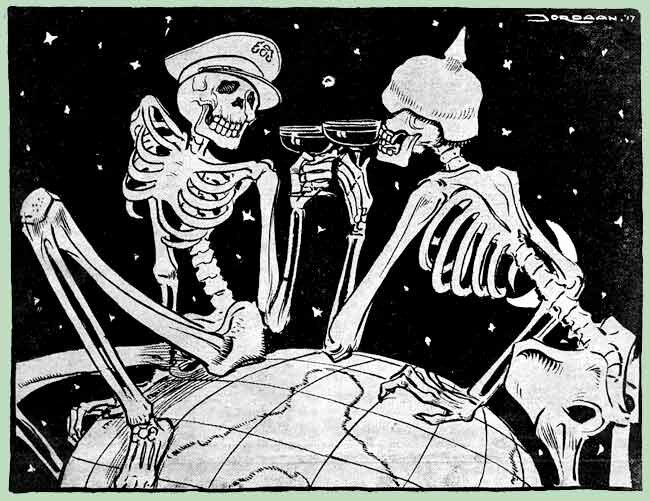
New Year, 1917, from “Kafka In The Castle”

voorpagina78


Excerpt from my novel: Kafka In The Castle

31 December 1916

The festivities down in the city are certainly subdued, which makes me one with the coming of the year.

There were a few shots fired into the air – which is a mockery, considering what is happening in the world. And some dismal fireworks.

Max wanted me at his party, but even he saw little point in celebration, and his entreaties were totally for form.

I understand form quite well – most of my life consists of doing the expected. Mouthing the proper words.

My letters to Felice have turned to such vehicles of propriety.

In such a way do all our days, and then our lives, acquire the necessary postmarks.


DE

(image)http://greatwar.nl/weekpictures/voorpagina78.jpg

Blog at WordPress.com.

Up ↑