Search

kafkaestblog

It is a whirlwind in here

A Woman Takes Control ~ From “Kafka In The Castle”

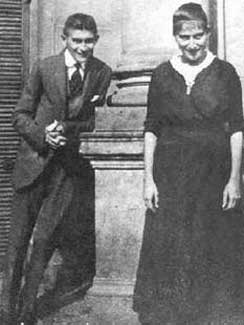
frank-with-ottla-his-favourite-sister

Franz and his sister, Ottla

16 December 1917

I think it possible the women conspire unbeknownst to themselves.

It was Ottla’s suggestion that I walk Fraulein G home after dinner. She stayed well into the evening. She was good company and we all enjoyed ourselves. We even read to each other – I selected some work by Max. He will get double pleasure from that, as he likes to entertain the young ladies himself.

She helped Ottla with the dishes, and some other clearing chores. Ottla then produced a bottle of schnapps – something I didn’t even know was in the house. I thought it possible Fraulein G had brought it (I’ve found she is capable of such a forward gesture) but I also noted it was the type which father prefers, so perhaps Ottla brought it from Prague. (And perhaps father will be recounting his stock with some confusion.)

Ottla encouraged the consumption of a couple of small glasses. I will not tell Max that the appreciation of his writings was enhanced accordingly.

As I walked Fraulein G home, I could not shake the feeling that something was expected of me. Something more than my company along the darkened road.

Was I to take her arm, or her hand, or even put my arm about her waist? I felt an element of encouragement for some such action, yet wondered where such a thing might lead.

Further, perhaps, than just the door of her house.

But, as the wind was lively, I chose to take her hand, and she then chose to walk closely by my side.

And the lips which murmured “Thank you” at her gate, and chose to brush my own, no longer called me “Herr Doktor”.

DE
(image)http://www.thecultureconcept.com/wp-content/uploads/2011/10/Frank-with-Ottla-his-favourite-sister.jpg

Hitler, Kafka, And Me

arton3192

I owe my life to Hitler, thanks to the Second World War, and my Canadian soldier father meeting my British War Bride mother.

I imagine it is too crass to say I have a soft spot for Hitler. I’ve studied his personal history, and know something of the man who was (admittedly) only a small part of the monster.

If he had been able to sell more of his paintings . . . who knows what might have happened?

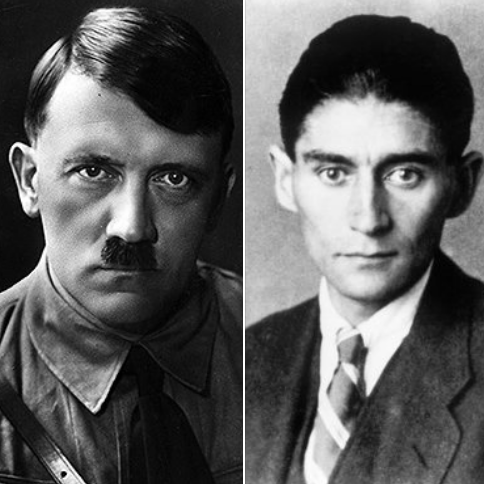
And, I even managed to track down a connection between Hitler and Franz Kafka. This possible meeting  goaded me to write a stand-alone short story about Kafka, in addition to my novel about his missing diaries.  In the short story Kafka is implored to join the Austrian army in WW I so he can kill ” . . . the man who will kill your sisters.”)

In reality, before Hitler came to power, he lived in Munich. In the apartment building where Hitler lived, a cousin of Kafka’s was also a resident.  Nothing is known as to whether the monster met the cousin. Or if Franz visited his cousin. Or if Franz Kafka met Adolf Hitler.

But it would be interesting, a challenge – and even fun – to have these two men (virtual teetotallers and vegetarians both) meet in a coffee house. Or an Art Gallery.

Kafka saw monsters everywhere he looked. Why not give him a real one?

DE

(image)http://oeuvresouvertes.net/IMG/arton3192.png

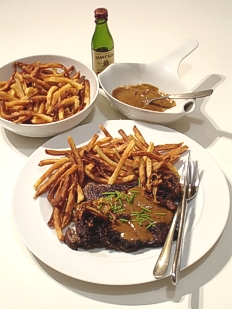
Gaelic Steak: Sauced with whiskey and heavy cream, the Celtic connection to prime beef | European Cuisines

Gaelic Steak

Ingredients:

2 8-10 ounce sirloin steaks at room temperature
1 teaspoon oil
1 tablespoon butter
1/2 cup Irish whiskey
2 1/2 cups heavy cream
Ground black pepper to finish

Pat the steaks dry with kitchen paper and season with pepper. Heat a cast iron frying pan or other heavy pan over high heat. When very hot, add the oil and butter. When the butter foams, add the steaks to the pan one at a time, and turn after 20-30 seconds to seal both sides. Lower the heat to moderate and complete cooking (3-4 minutes for rare, 4-5 minutes for medium, 5-6 minutes for well done). Leave each steak undisturbed on one side for half the desired cooking time: then turn. When finished, remove to warmed plates, and keep warm.

Add the whiskey to the cooking juices. Be careful if you are cooking with gas, as the whiskey vapor might catch fire. If it does, lid the pan immediately to stop the burning. Scrape the pan with a spatula to loosen the nice burnt bits and dissolve them and the meat juices into the whiskey. Allow to come up to a boil and reduce for a few minutes, stirring and scraping all the while.

Add the cream, lower the heat slightly, and allow to simmer for a few minutes and reduce further. Check the seasoning (you may find that you do not need salt for this dish: don’t just season it without checking). Having seasoned the sauce to taste, pour it over or around the steaks, as preferred, and serve immediately.

French fries / chips are a good accompaniment for this, as are fried mushrooms, and a fresh green vegetable like new peas.

Source: Sauced with whiskey and heavy cream, the Celtic connection to prime beef | European Cuisines

Of An Age And Still Keeping On Trucking

ea31e6ab3e7ec52fc033935fe3c02d14

I wrote the previous blog  about Bertha Klausner a little over a year ago. I found it interesting (indeed, find it interesting), to have some connections to a more distant literary tradition – no matter how tenuous.

So, maybe I come close today, as I just had a response by another literary agent. I had no idea of his tenure in the fields of getting the written word published. Not that I still would not have sent the query letter.

Dear Dale,

Thank you for submitting your materials to *********** for review.  However, after considering them, we have decided that your project is not something we can successfully represent at this time.  At 85, *********** needs to be selective about the projects he takes on and he has more than enough on his plate.  But I wish you good luck finding representation and a publisher for this. 

All the best,

********* (assistant)


~~~~~~~~~~~~~~~~~~~~~~~~~~~~~~~~~~~~~~~

Eleanor Roosevelt,Upton Sinclair, Fidel Castro & Me

While reading some literary site about Amazon, I came across the fact that “Harriet Klausner, an esteemed Amazon reviewer who wrote more than 31,000 book reviews, died”. All power to her, thought I, that is quite a feat. However, I took more note of her last name, one I had not thought of for a long time. Eleanor Roosevelt,Upton Sinclair, Fidel Castro & Me

In my tenure as an author in the world, I have had four or five agents. And I am currently looking anew. At the far beginning of my time, before I was published, I had the New York agent Bertha Klausner – at the start of my career and near the end of hers. She started her agency before I was born and was working two months before she died in 1998 at the age of 96.

Back in those over the transom days, one stuffed typed pages into an envelope, sent them off with return postage on another envelope, and waited up to three months for a reply. And when it came back, you sent it out again. One of my envelopes went to the Bertha Klausner Agency.

However, when it came back, it had other people’s manuscripts in it, and (to my memory) little hand written notes politely saying no. Mistakes happen even at revered agencies, so I sent it all back explaining what had happened. She replied, with neither apology nor thanks, annoyed that mistakes do happen and adding, “Say, you must have something. Do you want to send it to me?” Which I did. Again.

As I said, communications were through slow mails (slow on her side, as with literary agents to this day).  I now assume she initially was both being polite, plus did see some promise in what I had. But after a year or so she said – in effect – ‘thanks but no thanks’, and I sent things to other agents, and eventually had my first novel sale by, indeed, sending it over the transom directly to an editor in New York, who purchased it.

I don’t think I knew that Bertha Klausner had such a stellar career until I looked her up. An agent for decades, she had famous names like Upton Sinclair, Israel J Singer, Eleanor Roosevelt and Fidel Castro. She even represented actor Basil Rathbone.

I imagine I would have become a lost tale.

DE

(image)https://s-media-cache-ak0.pinimg.com/564x/ea/31/e6/ea31e6ab3e7ec52fc033935fe3c02d14.jpg

Coffee To Go – No Strings Attached

northern_shores_coffee_shop

I was standing in line in a coffee shop, waiting to place my order. I was third in line, the end in sight.

A voice came in my ear.

“Thanks, Man. It was kind of you.”

I turned, cautious and obviously puzzled. A clean-shaven and well dressed middle-aged man was not exactly in line behind me, but more to my shoulder.

“I appreciate the help.”

I didn’t feel overly anxious in the midst of a well-peopled coffee shop, but I was glad he didn’t look unhinged. I was wondering what obvious response to make: “Pardon me?” “I think you’re mistaken.” “Can I help you?” But then he spoke quickly.

“You helped me out back there.” He pointed to the street. “Up on the corner. You gave me money.”

I had had no such encounter, and was concerned that any sort of response might elicit offence. Plus, his stability now came into question.

“Wasn’t that you?”

“Sorry. You are mistaken.”

“Looks like you.”

“Then he’s a lucky fellow, whoever he is.”

This did get a laugh. Then, though I might have been expecting many things, I did not anticipate what he did next. He took out a gift card for the Coffee Shop we were standing in.

“Hey, can you give me $5 for this. A lady gave it to me earlier. It’s real.” We both moved forward as the line moved. “I don’t need coffee, but I need strings for my guitar. That’s how I make money on the street.”

As soon as he said this, I remembered someone playing a guitar across the street I had been on. There was no way I could tell if this fellow was him – but what are the odds?

“I can’t play without strings.”

I did not know at the time, nor do I know now, if this was a well-honed and practised routine to get some money. But it was only $5, I’d soon know if the card was real, and if it was a fraud I figured he’s earned $5.

So I gave him the $5.

“Thanks, Man. I swear it’s real. I play along here all the time. I can’t risk my reputation.”

A couple of minutes later I made my purchase. I used the card for part of it.

It was real.

DE

(image)http://champ.d.umn.edu/sites/champ.d.umn.edu/files/styles/hero_interior_710x326/public/umd_interior_home/northern_shores_coffee_shop.png?itok=SorWnqf6

History And Europe And Estey

0a Isabella d’Este, Giovanni Cristoforo Romano, 1500.

There is a tradition in “my” branch of the Estey family that we descend from the d’Este of Italy. The d’Este clan were rich and powerful and influential. They married well which – yes –  brought the infamous Lucrezia Borgia into the family when she wed Alfonso I d’Este, Duke of Ferrara.

My father had a reproduction of Alfonso’s sister, Isabella, readily at hand. Isabel was a name for at least one daughter in every generation of Esteys. Lucrezia attempted to befriend Isabella, but to no avail.

The town of Este is in Northern Italy, in the Veneto region, about a two hour car ride from Venice. It’s most recent population figure of two years ago was around 17,000. I have a special fondness for this part of Italy and have sprinkled references to it in some of my novels. Indeed, my whole historical onion trilogy is centred around a town in this area.

So, Este was certainly a destination when I travelled through Europe. And the surrounding area. Este was suitably medieval in tone, with its ruined Este castle and wonderful flower beds and bowers and stone bridge over river and walled town and as happily historic as all get out.

I looked to see how many Estes were in the phone book (a respectable number) but I didn’t phone anyone.  I would be more thorough and stay longer on another trip. I doubt there is any way to fix up that castle.

I enjoyed all of Italy that I visited (and the rest of Europe held no less enthusiasm from me). But to stick, as it were, around the old homestead, the most enjoyable places were Venice and Florence. I was most surprised to see cruise ships looming from the Venetian waterfront.

I sighed on The Bridge of Sighs – from such beauty to such terror those prisoners were lead. A stunning memory was boating on the Grand Canal at dusk and seeing rooms in a passing mansion ablaze with chandeliers.

Florence was my favourite. It is, of course, awash in museums and galleries and art art Art. To chose the one which stunned me most was  Botechelli’s Birth of Venus – and that’s saying a lot, considering. The Ponte Vecchio over the Arno lives up to all its billing. Alas, I bought no gold.

Also, a memory is walking along certain streets and assuming I was near riding stables because of the permeating smell. However, I was in the leather good quarter. There was also the ancient, wire mesh and gated elevator,the type I had only seen in movies, wheezing me aloft to my lodgings. And the lady who left her room key on my table after breakfast. And don’t get me started on the markets and the food. Don’t.

However, there is one golden memory which consists of neither history nor ancient art. This happened in Verona. I was walking along a busy street and looked into the interior of a news vendor. The building also had an array of paperback books. And there, looking back out at me, was my own novel, L’INGANNO BONNER, recently produced in an Italian translation. That was a most pleasant delight indeed.

DE

(image)http://www.isabelladeste.org/_/rsrc/1467897567813/isabella-deste/0a.PNG


When Writing Spooks Television

81-e23a9f4fb2887
I am currently writing a *perhaps* novel (that is, perhaps it will be a novel), though I suppose  I should find out if it is a novel since I just passed the 200 page point.

In my current project, following the escapades of Alison Alexandra (entitled Stones for short), my erstwhile activist, Alison Alexandra, is a passenger on a freighter (that takes a limited number of passengers) as it delivers goods from port to port.

I’ve done a fair amount of online research into these freighter cruises as I, myself, would much prefer such a trip over the very crowded (and expensive) Cruise Lines.  But, I will research anywhere that might help my cause. So, a couple of nights ago, on television, there was a documentary about the most recent, largest, and most extravagant Cruise Ship as yet built.

I was very interested in following its construction. I was also very interested in seeing how it was run, taking into consideration the thousands of people who had to be tended to. The delivery of provisions, the kitchens, and the massive amount of work necessary to clear out thousands of folk and then greet thousands of folk on the same day, was fascinating. Not a freighter by any standard, but basic principles were the same.

Then the documentary followed the ship on its first cruise.

Now, back to my reality. At the same time as writing original material about Alison Alexandra, I have been putting a hand-written manuscript of a novel finished a number of years ago into the computer. I do one thing in the morning, and the other in the evening. So far – no problems have arisen.

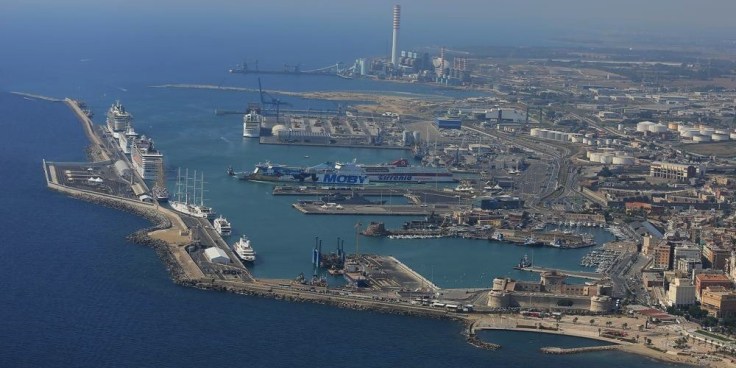
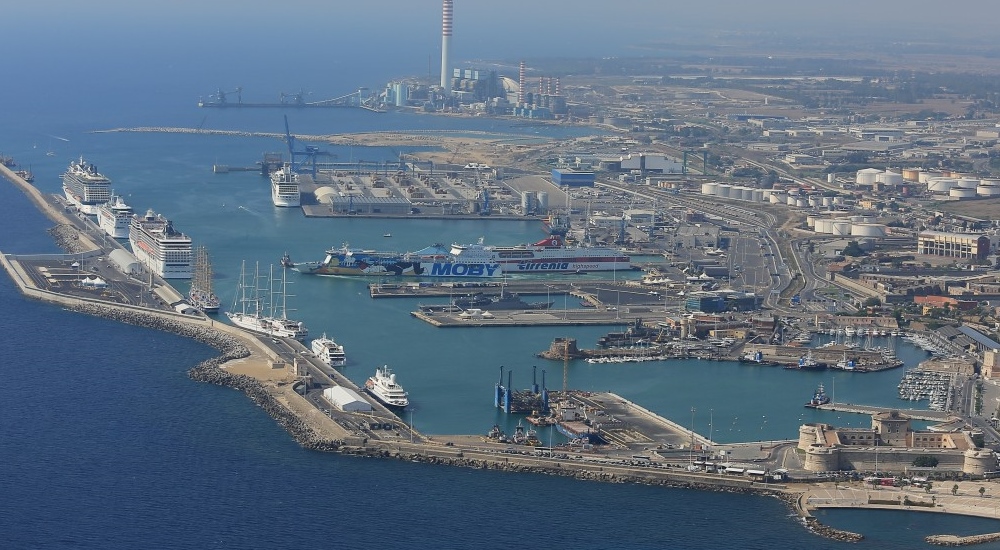
My hand-written manuscript is set in the 1300’s. The first part depicts a two year voyage from Italy to China and back. Both the voyage and events in China are described. And then, the arrival back to Italy. For four straight days, I have been transcribing the docking and aftermath of the ship at Civitavecchia, Italy. It is the closest seaport to Rome.

On television, before my eyes, after a day of writing, the Cruise Ship I had watched from inception to voyage, pulled into the port of Civitavecchia.

Maybe I should take a cruise.
 

DE

Civitavecchia (image)http://www.cruisemapper.com/images/ports/81-e23a9f4fb2887.jpg

Of Valentines And Kafka And Love

kafka33

Kafka and “lady friend”

Contrary to popular belief, Kafka had a very full love life. He was rarely without a lady friend during any part of his life. When one left, another soon took her place.

This is a part of a letter he wrote to Felice, the woman he was engaged to – twice. I think it fair to say that she was long-suffering. I would think that the sentiments Kafka expresses might have given her second thoughts. Perhaps that is partly why there were two engagements.

Think what one will about Kafka’s romantic abilities, he was a chick magnet. Right to the end. After his funeral his last lover had to be restrained from leaping into his grave to be with him.

~~~~~~~~~~~~~~~~~~~~~~~~~~~~~~~~~~~~~

11 November, 1912

Fräulein Felice!

I am now going to ask you a favor which sounds quite crazy, and which I should regard as such, were I the one to receive the letter. It is also the very greatest test that even the kindest person could be put to. Well, this is it:

Write to me only once a week, so that your letter arrives on Sunday — for I cannot endure your daily letters, I am incapable of enduring them. For instance, I answer one of your letters, then lie in bed in apparent calm, but my heart beats through my entire body and is conscious only of you. I belong to you; there is really no other way of expressing it, and that is not strong enough. But for this very reason I don’t want to know what you are wearing; it confuses me so much that I cannot deal with life; and that’s why I don’t want to know that you are fond of me. If I did, how could I, fool that I am, go on sitting in my office, or here at home, instead of leaping onto a train with my eyes shut and opening them only when I am with you?  … Franz

~~~~~~~~~~~~~~~~~~~~~~~~~~~~~~~~~~~~~~~~

While in the first year of his ‘love-of-a-lifetime’ affair with Felice Bauer,  he met “The Swiss Girl”. In his diaries she was only referred to as W. or G. W. They were together for ten days in a spa on Lake Garda.

She was a Christian. He was thirty, and she was eighteen. However the relationship (apparently sexually consummated) made a great impression on him for the rest of his life.

Research over the years  finally revealed who she is, and Google search even provides photos. Her name is Gerti Wastner.However, very little else (as far as I can find) is known about her.

Where did her life lead after an encounter with Kafka?

Here are some of Kafka’s actual diary entries about the incident.


~~~~~~~~~~~~~~~~~~~~~~~~~~~~~~~~~~~

20 October 1913

I would gladly write fairy tales (why do I hate the word so?) that could please W. and that she might sometimes keep under  the table at meals, read between courses, and blush f

22 October 1913.

Too late. The sweetness of sorrow and of love. To be smiled at by her in the boat. That was most beautiful of all. Always only the desire to die and the not-yet-yielding; this alone is love.

Translated by Joseph Kresh

~~~~~~~~~~~~~~~~~~~~~~~~~~~~~~~

And in the spirit of Valentine’s Day and Kafka, I’ll add a bit from my Kafka In The Castle

27 February 1917

A letter from F. I am beginning to think that we do not really see the people in front of us. F. has changed from a vibrant companion to a banal drudge. But, of course, she has not really changed. She is neither of these things, but rather a combination. She is a person living through her life, and what I see reflected are my wants and fears. I want F. to share my tiny house, but I am ever fearful she might say yes.

04 June 1917Sometimes – with F – a kiss could make me feel I was becoming part of her. And she into me. I retreated.

05 June 1917

Had I not retreated, I would have given up myself. This is what is expected from love. My thoughts and emotions would be continually extracted. I have no way to replenish them, so I would eventually be hollowed out. And I would collapse.

05 July 1917

I will meet Felice – it is what she wants. It is what must be done. She is coming to Prague, and will no doubt fit in perfectly. My parents approve of her – more, I suspect, than they approve of me. She’ll be insulted by this tiny house – it will be found wanting and crude. Some of those annoying qualities she hints about me.

DE
(image)http://madamepickwickartblog.com/wp-content/uploads/2010/07/kafka33.jpg

Onions And Eggs And A Cook On The High Seas

egg_png24

In my novel, China Lily, the good ship, The Pegasus, makes a voyage from Italy to China a number of years before Marco Polo. This is a taste.

~~~~~~~~~~~~~~~

The cook, Matzerath, was a thin and abrasive man from some vague Northland who was not a particularly good cook. His selection of dishes was limited, and his ability to make meals taste appealing was hit-and-miss. He would probably not have had much success in a village or a town, but he had abilities that made him sought-after aboard ships. He could make dishes – if not tasty, at least palatable – from the poorest of ngredients. He could feed many on scant provisions. And the crews he worked for rarely became ill from the food.

Cepa did not know what methods Matzerath used to achieve his ends. He did possess a chest of herbs and spices and dried plants, but they seemed to be used to either stop putrefaction or make putrefaction edible. He took as many onions from Cepa as he could, but the results were rarely rendered up in the taste of the dish. In many ways his skills were more of an apothecary or doctor, though he did not possess the temperament to acquire their knowledge.


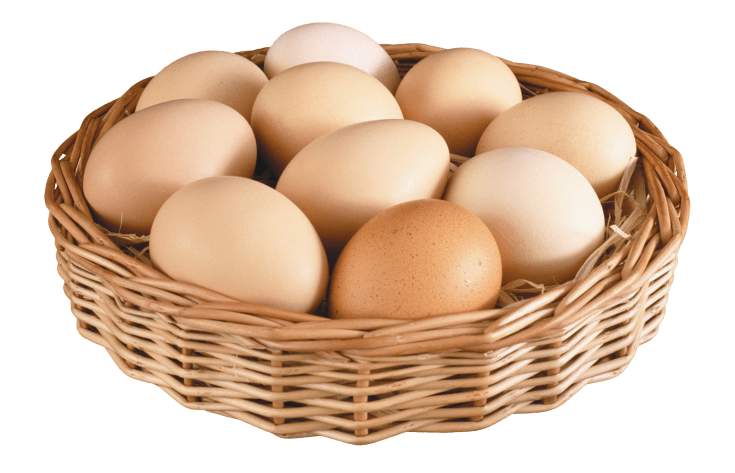
Matzerath did have one trick of the trade that continually amazed Cepa. He could take basic eggs and make a dish you could put down in front of a prince. Perhaps the opportunity to use eggs was rare enough that it interested him, or perhaps he just liked eggs.  At any rate, for a few days after they left any port, the crew was blessed with egg as part of their diet. Matzerath served them fresh, on their own, and also made omelettes and frittatas with them. He also – to make some last longer – boiled a number when their worth was near exhaustion.


He had an odd method of boiling eggs, to which Cepa became a party because Matzerath used onions. Not fresh onions or green shoots, but the outer layer of brown skin and some inked parchment into boiling water.  After a vigorous boil that leaves the eggs overcooked but more durable, the shells become a mottled brown colour. Cepa can’t tell if this is a deliberate decoration or a side effect. Matzerath did not seem a person concerned with beauty, but Cepa didn’t see how onions helped the boiling of eggs – they did not alter the taste. He queried Matzerath about the procedure, but the only answer he got was that was the way it was done ‘where he came from’.

DE

(image)http://pngimg.com/upload/egg_PNG24.png

Create a free website or blog at WordPress.com.

Up ↑