Search

kafkaestblog

It is a whirlwind in here

Category

manuscript

Jesus Walks At Easter

The Unicorn is mentioned eight times in the Holy Bible. The list is below.

When I have Druids, and their unicorns, go to Jerusalem in my novel A Lost Gospel, to make sure Jesus gets crucified, I feel I am on solid ground. And when one of my druids, Ogma,  has the following experience, I believe it is a symmetry of Biblical proportions.

Unicorns are mentioned in the following places of The Bible:

Numbers 23:22

God brought them out of Egypt; he hath as it were the strength of an unicorn.

Numbers 24:8

Deuteronomy 33:17

Job 39:9-12

Psalm 22:21

Psalm 29:6

Psalm 92:10

Isaiah 34:7

~~~~~~~~~~~~~~~~~~~~~~

From A Lost Gospel

“Are you lost?”

“No.”

Ogma was taken by surprise, but he did not turn toward the speaker. He had no desire to start a conversation, he just wanted to be left to himself.

“Yet you are a traveller to these parts.”

“Yes.”

Ogma knew only too well the interest local people had for strangers in their midst. It was an interest which could easily turn into suspicion. He was alone, and he did not want to have trouble in this unknown land.

“I had business in Jerusalem.” Ogma shrugged. “The desire came upon me to feel earth under my feet, not paving stones.”

“And you find yourself here.”

“I turned from the main road at a whim.”

“What did you in Jerusalem?”

“I do not intrude thus in your life.”  Ogma kept a steady gaze across the field, though he could not keep irritation from his voice.

“Yet you do intrude – for here you are.”

“If I’m on your land, I apologise. I thought it was a common road. There is no barrier in place to warn me otherwise.”

Ogma wondered if it was time to leave the way he had come, or to stay and talk. Despite the words spoken, the other man’s voice displayed no anger, or annoyance.

“Do you find no peace in Jerusalem?”

“I’ve had a troubled time in your grand city.”

Ogma suddenly realised he had things he wanted to say, which he could not discuss with the other druids. He finally turned to the man, wondering if he should explain further.

“By the Gods of eath!” Ogma stood back in fear. “This is not possible.”

“There are no boundaries to what is possible.”

“I saw them hang you up.”

“You saw flesh. And blood.”

“Then what do I see now?”

“More than a man of sorrows.”

“Glarus was right.” Ogma began to move further away, but stopped himself. “I’m not to fear you, or the change you bring.”

“Truth deserves acceptance, not fear.”

“Do you know of my burden?”

The other man raised his arm and pointed. Ogma turned to follow the outstretched hand. He saw the two unicorns standing close together among the trees.

“Have they brought me here?”

“They have led you to a place you sought yourself.”

“You know of Glarus.” Ogma stopped abruptly, and his voice lowered. “The gods I understand believe in trade. Take me instead of her.”

“You care so much?”

“I know the worth of things.” Ogma stared directly at the other man. “It is better to have her alive, than me.”

“No man knows his own worth.” Yeshua touched the small man, then held him close. “My father’s love does not barter.” He released Ogma with a smile. “Return to Jerusalem. You travel with companions.”

“The beasts accompany me?”

“Thou hast heard me from the horns of the unicorns.”


April Fool’s Joke (Except It’s True)

851150
I glean through many sources (some of them disparate) after information of which agents and which editors have purchased recent books that are similar to one of my manuscripts.
When I find someone I think will be compatible to some of my work, I research them. Then, if I think they would have a reasonable interest in my manuscript (and there can be a variety of reasons) I’ll send a query letter.
I prefer to go through this process of finding names a number of times in a row, instead of finding a compatible person, then immediately sending a query. So, when I find a person I plan to contact, I send this information to myself in an email. It can be weeks before I actually send a query to an agent or editor, and then it can be two or more months before I hear a reply.
Last week I came across the information that John le Carré has a new book coming out the end of this year. I adore John le Carré. This announcement unusually named both his agent and editor. I sent both to myself, and I imagine I would get to them in the next two or three weeks.
This morning, April 1st, I had notification of a rejection by an agent for my NATO Thriller. It was a refusal sent through the portal of the agency (which happens more and more). Since it was not an actual response by the agent, I had to go to my Sent file to see who I had sent the query to.
Uh-huh – it was the same agent as John le Carré. So, I actually got rejected before I sent the query.
Well – anyway – that’s how writers think.
(image)cdn.images.express.co.uk/img/dynamic/39/750×445/851150.jpg

“The Alexandra” Arrives In Port On Sea And On Page

msc-alexandra_9461374_75220.570x1140
I am four hundred pages into my new novel, There was A Time, Oh Pilgrim, When the Stones Were Not So Smooth. In the current chapter I am writing, my main character, Alison Alexandra, is getting a tour on the bridge of The Alexandra.
This is a real ship, and  I have researched the ship over the course of a week. Alison Alexandra wanted to go aboard solely because of its name. However, her expectations of the visit are disappointing, in part to find that real life can not necessarily equal the fantasy about it.


I have just seen, in my daily News of the Port, that The Alexandra is arriving in Halifax this afternoon at 15:00. I will be down on the harbour with my binoculars to see her arrive. However, I could actually stay home and see the ship, as it passes through The Narrows at the bottom of my street, on its way to the Fairview Container Terminal.
Perhaps that is what I will do tomorrow, with a coffee in hand, and watch The Alexandra depart.

Kafka In His Writer’s Burrow For World Book Day

87348a86cd918068ad4e09c1b813c3cf

A burrow offers security and comfort, and Kafka found both in his sister’s tiny house on the Golden Lane.

Ottla – his sister – had rented it so she could spend time with her lover and not be bothered by parents and comments. Her lover was a Christian and ready to go to war. Time was precious.

However, she rarely had opportunities other than the weekends, so she offered Franz the use of the tiny house for most of that time. And use it he did, though he never stayed the night.

Through fall, winter and spring Kafka wrote a whole book of short stories. For one single block of time, it was one of his most creative periods.

When I visited, even under Communist rule, it had been converted to a book store. Of course (which he would have appreciated) there were no books by Kafka for sale. Today he is displayed in the windows.

It was only when I went thorough the small rooms, and looked out the window into The Stag Moat, that I realized how important the house would become in my novel about Kafka. It was cozy – even with the space cramped by tourists. It had been little altered and I easily imagined Kafka looking through the same glass and walking through the same doorways. No doubt stooping because he was tall. Research met reality.

One of the last stories Kafka wrote, during his final year in Berlin, was called The Burrow. A version exists and is published, though a longer version is supposed to be among his ‘missing’ papers.

In it, a tiny animal keeps incessantly burrowing to keep away from an enemy. A vague noise convinces the animal to burrow deeper, and deeper, and deeper.

Something Kafka himself attempted to do.

(image)https://i.pinimg.com/736x/87/34/8a/87348a86cd918068ad4e09c1b813c3cf.jpg

Kafka Wants To Light A Fire – Well … Not Really

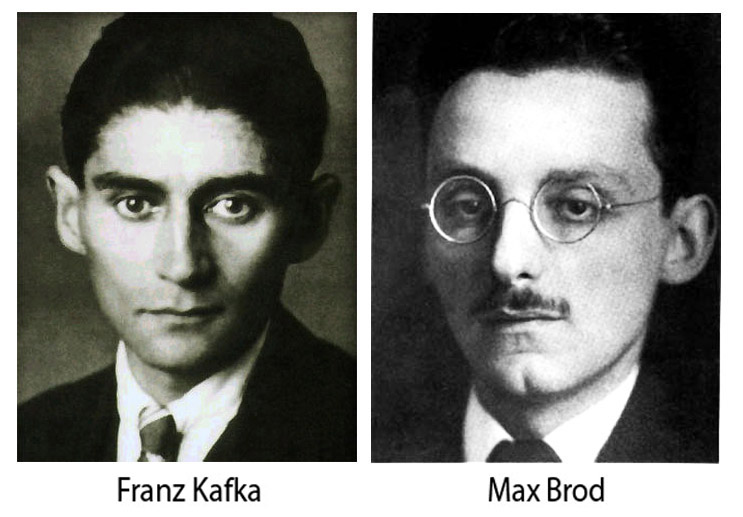
kafka-brod

Much is made – again and again – about Kafka’s famous request to his friend, Max Brod, that all his manuscripts be burned unread. That included all his fiction, all his letters, and all his diaries.  Consigned to the flames and removed from the earth.

Had this been done, most of the work for which Kafka is famous would never be known, for little was published during his life. His skewed yet realistic outlook on life, now famously known as Kafkaesque, would not be classed in every dictionary. A touchstone, known the world over, would have been lost. Kafka might, at best, been remembered as the man who wrote about the bug.

Brod gets a bum rap about defying Kafka’s direction to burn all his manuscripts. Yes, Kafka did indeed make this request of Brod. He apparently made it a few times, both verbally and in writing.  Each time, Bord told him outright he would not follow Kafka’s request. “It ain’t” – if I might slip into a vernacular the erudite Brod would ever use – “going to be me, chum.”

Another prominent time  Kafka refused to do something that he could have easily done himself, concerned his famous Letter To His Father. Instead of handing (or sending) the letter  to his father, he gave it to his mother to pass on, knowing full well his mother would not be part of causing such discord. And – in fact – his father never read the letter.

If Kafka really wanted all his manuscripts burned, he could have just as easily (indeed – more easily) done it himself. He certainly did burn much of what he wrote. Brod once found him doing it. It is estimated he burned 70-80% of his own work.

Kafka might have renewed his written request near the end of his life, but he made it to the one man whom he knew would not do it.

That was Kafka

Alison Alexandra Rubs Shoulders With The Golden Globes

theremin-moog20-20moderno

I have had a fascination with the musical instrument, the Theremin, for decades. A Theremin (named after its inventor) is an electronic musical instrument, invented in the 1920s-1930s, that is played not by touch, but by the movement of hands next to metal rods. It produces eerie sounds, something like a soprano at the top of her pitch.

For Christmas, someone I know got a Theremin as a present.  As sometimes happens in my current manuscript about Alison Alexandra, an event in my real life (regardless of how distantly related) will creep into Alison Alexandra’s life. She’s a gal open to many suggestions.

Now, had the present been a guitar or a clarinet, they would have held no interest for me. Although fine instruments both, they would have held no interest for Alison Alexandra, either. They are not exactly common, but neither are they exciting enough. Alison Alexandra has a bit of an edge to her.

But, because I already have some history with Theremins, and Alison Alexandra was embarking on a new chapter, it seemed to be a happy and musical experience.

So, I have done a more-than-usual research blitz on the instrument. Learning things I did not know. Listening to the surprising number of excerpts on the internet. But, as is often the case, also finding a number of contemporary references.

The Theremin was an instrument that fascinated a deceased author colleague of mine.

The son of a friend has actually made a Theremin.

The Theremin is used in the soundtrack of the British Television Mystery Series, Midsomer Murders.

And, most recently, a Theremin is used in the soundtrack of the movie The First Man. This movie has just won the Golden Globe for best Original Score.

Now, I’m not sure if Alison Alexandra is actually going to attempt to play the instrument,  but it certainly is going to hit some high notes in her life.

[Where to learn lots about the Theremin] https://www.carolinaeyck.com/theremin/

In The New Year, Kafka Ponders His Teen-age Lover

kafka-imagenes-una-vida-klaus-wagenbach-L-6

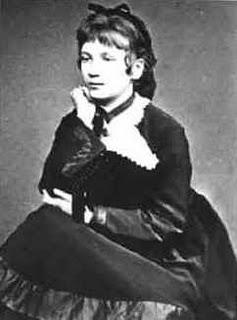
[Kafka’s teen-age lover, Gerti Wasner – The Swiss Girl]

In Kafka In The Castle, I fill in the ‘missing’ diary entries from Kafka’s real diary. He either did not fill in these days himself, or he destroyed them. There are some estimates that Kafka destroyed 70% – 80% of everything he wrote.

~~~~~~~~~~~~~~~~~~~~~~~~~

03 January 1917

I still have fantasies about the Swiss girl – although not the type one might suppose.

(My father says I already have too many fantasies, and that I deal with them “too long, and too often” – he is certainly right.)

I make a mixture of what I shared with the Swiss girl, and what I imagine we would be like today.

This is certainly more fantasy than not, for what would being together have done to us?

Done to her?

But in this tiny house – could she not join me? Be here by the window, as I write this?

She was so young, and such a girl.

But I fear that I was never such a boy.

Franz Kafka Ponders Death from “Kafka In The Castle”

2014-05-18-06-55-42

(Statue from the Kafka Museum, Prague)

07 June 1917

I wonder what my final thought will be – just before I die. I was moments away from death this afternoon, as I stepped unheeding onto the tram tracks. The motorman’s frantic bell made me leap. Had I been too slow, my last thoughts would have concerned where and when to take my vacation. Not very glorious last thoughts to possess.

But, had I the time granted to me, what would I chose to think about? Perhaps F. Perhaps the writing – I’d like to finish the novel. Would I torture myself thinking about father? Would I accept that my past – now that it was ending – was finally settled. Or would I instead – and this is what I really expect – be wondering what I was going to miss tomorrow?

Getting Published In New York In The Old Days

dcd6108316c09dd691350bacfd3261a3


Over The Transom

My friend Google tells me that “over the transom” is still a viable term. In this case it refers to a manuscript accepted by an editor submitted cold – perhaps even from the dreaded slush pile.

At any rate, my manuscript for A LOST TALE was accepted “over the transom”, and I was asked to New York to meet the editor. Although I had experienced and appreciated Montréal, Toronto, London, Berlin and other large cities by that time, I had not been to New York. Many events of that trip are memorable, but none more than my “lunch” with the editor.

The editor took me to a dark and trendy place for a late lunch. There were not many people there and, restaurant fiend though I am, the food was not my top priority. Discussion of “the work” and proposed changes was more on the menu for me.

As I sit across the table from my editor, I can not help but notice a man seated by himself beside the wall. He is tieless and shirtless and, though the lighting is dim, what there is reflects from his naked skin. He sits with a beverage and seems to hum to himself.

My editor is discussing both the menu and some confusion he perceives at the beginning of my novel. I note items on the menu unknown to me and am doubly confused.

The shirtless man at the other table increases the volume of his humming and eventually a waiter goes to him and has words. The shirtless man has words back, but they sound like gibberish. At my table the editor suggests something from the menu and I happily comply. There is wine.

Whilst I eat and listen to suggestions, the shirtless man is spoken to by two other waiters. As I (wisely) restrict myself to a second glass of wine, two uniformed policemen enter the restaurant and approach the shirtless man, whose gibberish had increased even more in volume. In the course of a few minutes three other uniformed police officers – one of them female  – arrive on the scene. They are now ranged around the shirtless man and his table. I finally tell my editor what is happening behind him and why I am not concentrating fully upon his suggestions. He turns around.

Two of the officers remove the table from in front of the shirtless man. Two others, one on each side of him, haul him to his feet. It is then that we see his shirtless state continues all the way to his naked feet. The female officer takes the tablecloth from the table and drapes it around him. The four male officers form a circle around the naked, shrouded man uttering his gibberish, and hustle him from the restaurant. The female officer picks up what appears to be a pile of clothes from beneath the table, and a pair of roller skates, and follows them.

I say to my editor that I have never seen anything like that.

My editor concurs.

Create a free website or blog at WordPress.com.

Up ↑