Search

kafkaestblog

It is a whirlwind in here

Category

history

Kafka Saves A Worker And His Job

s-l300

Franz Kafka  (in the daytime) was a government employee who looked after the welfare of workers for the Imperial government. He was on the side of the workers – among other things, he is credited with inventing the hard hat.

In my novel about him, Kafka In The Castle, he has an encounter with a worker who needs assistance. This is how he would react.

Excerpt from Kafka In The Castle


16 February 1917

There was a commotion at the office today. It was late morning, and from far below, coming up the stairwell, I could hear a voice bellowing: “Doktor Kafka. Doktor Kafka.” It was a terrible voice, full of blood and darkness. I got from my desk and went to the door. There were other voices, trying to calm, saying: “He can’t be disturbed.” But the voice was louder, more horrible, close in the corridor.  “Doktor Kafka – for the love of God.”   My secretary wanted me to stay inside, hoped the man would just move along the corridor until the police were summoned. But – I was curious; the man had my name, and his voice was … terrified.

I opened the door and stood in front of it.  “I’m Kafka,” I said. The man lunged at me, and went to his knees.  “Doktor Kafka?” he said.  “Yes, I’m Kafka.” He reached out, grabbing for my hand.  “Jesus, Jesus, for the love of Jesus – they say that you’ll help me.”  He was a heavy man, and looked as if he had the strength to pull off doors, yet the tears burst from his eyes.  “I can get no work. I fell from a bridge, and my back is twisted and in pain.” He slumped against the wall, looking at my eyes.  “I have a family, Doktor Kafka. A baby not a year old.”  “You were working on this bridge?” I asked.  “Yes.” His voice slid down his throat. “I was helping repair the surface.”  “Then you deserve your insurance. Why can’t you get it?” He straightened up, and tried to stand. “I have to fill in papers; the doctor can see no wounds; the foreman said I drank; because my brother is a thief, I am not to be trusted.” I held out my hand, and he slowly stood. “I’m telling you the truth, Doktor Kafka.”  “If that is so,” I said, “you’ll get the money due you.”  “I’m so tired,” he said.

I gave instructions to those standing around – no other work was to be done until this man’s case was decided. I took him to my office, where he sat. He sat – practically without a word – for five hours. I summoned a prominent doctor to look at him. The doctor prodded, and the man screamed. Officials from his village were telephoned. I helped him with the details on the forms. His truth was in his pain. He left our stony building with money in his hand, and his worth restored. The people who assisted me had smiles on their faces. A man had needed their help.

(image)https://s3.amazonaws.com/s3.timetoast.com/public/uploads/photos/8116639/s-l300.jpg?1478339017

The Smoke From Notre Dame

telemmglpict000194356479-xlarge_trans_nvbqzqnjv4bqwwijwh92gxexbhoiuogwc7yif0n6j3wamrlrqv6l0bi

The smoke from Notre Dame

Has crossed the ocean and

Settles on the pre-Easter snow

Of the front lawn.


It lies heavy.


It is full of Jesus (of course)

And the history of France

And the citizens of Paris

And the ash of ancient trees.


It smolders still.


It has the art of the ages

And the civilization of humanity

And the aura of the eons

And shards of blackened stained glass.


They admit no light.


The smoke from Notre Dame

Stirs in the wind

Gathers again into a shroud

Brushes tintinnabulation before it


And travels into history.


(image)https://www.telegraph.co.uk/content/dam/news/2019/04/15/TELEMMGLPICT000194356479-xlarge_trans_NvBQzQNjv4BqwwijwH92GxEXbhOiUOGwc7yif0N6J3waMRLrQv6l0bI.jpeg


When You’re Commander-in-Chief of The Armed Forces


ee45d9f61c0565960954885a7fa1c292-ww-history-military-history

Brigadier O’Donald decided that it would be a grand day to become Admiral of the Fleet – Lord High Admiral if he chose the hat with cockade and plume.

Nodding jauntily in the air, the plume put on an impressive display, as he either agreed, or disapproved, with a toss, or a shake, of his head. The dancing ostrich feathers would add a dashing air as he boarded his flagship and, with just the right mixture of stringent authority and well- tempered geniality, moved in imperious sweeps among the ranks of ratings on the aft deck.

He would, of course, be extra careful about the pitfalls awaiting a man with ornate dress sword and scabbard, among the steep steps and narrow companionways.


Wednesday was khaki day for Brigadier O’Donald.

It was the day set aside to remind him of the loyalty he must always retain from his men, for what was a leader without his troops? And as a treat – for really, the dull brown did not make for a very striking appearance – the would choose the tank commander’s uniform.

With its wide web belt and shiny black holster on the hip, flap unsnapped to reveal the butt of a wicked forty-five. And of course the black leather gloves, as befits a man at the controls of so much power, and the steel helmet polished to a mirror-shine.

The riding crop? Ah, the riding crop was debatable.


Today would have a parade. Massed men at attention with stiffly held rifles and fixed bayonets.

Brigadier O’Donald would have to choose carefully to represent his awesome power and responsibility. Cavalry boots are a must, raising half-way up the calf and resounding with silver spurs, steel-tipped toes and heels.

Then would come crisp black trousers, billowing majestically around the thighs, and kept up with a wide leather belt. He took care that each red stripe reaching the length of each leg was as straight as an arrow.

His blue tunic, he decided, would have only muted decorations and the minimum of gold braid entwined about his shoulders. He was – after all – a fighting general.


A civic reception is the time when Brigadier O’Donald would be on close display.

He believes he is at his most effective  when draped completely in white, save – of course – for his highly polished black dress shoes (and, in truth, he favoured white even here, but feared such footwear was a trifle effeminate). White is striking by itself, but well he knew it made the perfect background for his medals and decorations.

He has trouble deciding upon which colour sash to wear across his chest, but finally chooses the emerald-green – the reception is in the public gardens. He dons his silver-visored cap, and graces his bosom with the blue Clustered Palm of Valour; the diamond centered Star of Courage; the gold Pyramid of the Oaken Grove; and seven rows of bars and campaign medals.

There are no visiting Heads of State, so he need not be too brilliant.

(image)https://i.pinimg.com/736x/ee/45/d9/ee45d9f61c0565960954885a7fa1c292–ww-history-military-history.jpg

Letters Looking At Life From Here And There

1011505126

Dear Eustace:

My mind confronts so many intangible truths that you sometimes seem – or is it just hope on my part – to be my only peg of reality.

Have you noticed whenever we finally believe we know the reason for something which happens, it often occurs that the real reasons are exactly the opposite.

Everything walks a line – as narrow as those upon this page – between profound revelation and mindless absurdity.

As I look through my window, the shadows cast through the trees on the next building, take the shape of a French poodle carrying a parasol.

Is even Nature absurd?

Yours,

Margot

 
~~~~~~~~~~~~~~~~~~~~~~~~~~~~~~~~~~~~~~~~~~~~~~~~


Dear Margot:

Nature is nothing but reality, only the intangible can be absurd.

As I’ve said too many times (and why do I repeat myself yet again)

you spend too much effort – and a wasted effort, for how can it be other –

on futile quest and query.

The only truth to be found is in sour milk, or pleasant fornication.

These things are real, these things exist.

Absurdity is kittens playing, or the Prime Minister’s latest speech.

These are the things we look at with amusement or contempt – we know not to expect much from either.

Quit you silly endeavours and join the world which surrounds you.

Don’t enter the world that your head surrounds.

All important answers can be found between someones legs.

Yours,

Eustace


(image) https: //content.etilize.com/Original/1011505126.jpg

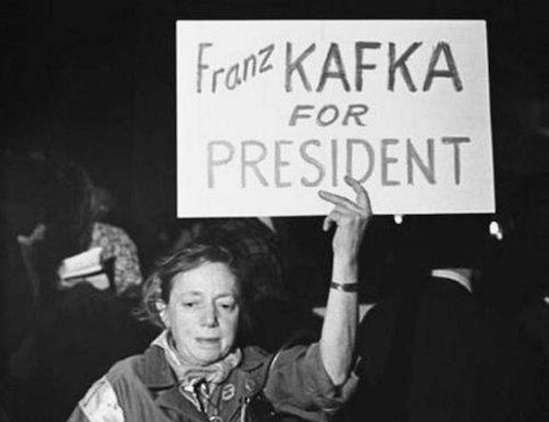
Trump And Kafka Walk Into A Bar

cf35889b7cbe1c1e99763f8b9cf64535_1484923461,

{I wrote this after Donald Trump was elected President of The United States of America. Many folk also looked at it after the glorious meeting in  Helsinki with Putin, Tzar of ALL The Russias. So – why not post an oldie but a goodie as the West’s democratic representative here on earth meets Kim Jong-un  – a Tzar in his own right – in Hanoi? Will it be Viet Nam all over again?}

~ Frank. Welcome to your world.

~ Thanks, DT. I’ve been living it all my life.

~ I’ve taken some pages out of your books, Frank.

~ I did try to get them burned.

~ You didn’t try too hard.

~ Well – no.

~ You know – neither did I.

~ I know. They all ran to your tune.

~ They did.

~ You were the Pied Piper of Havoc.

~ Worked like a charm, Frank.

~ Yes, DT – yes, it did.

~ They thought I was a bug.

~ Yes.

~ But I turned them into bugs.

~That you did, DT. And turned them against each other.

~ Yes.

~ And stood back, and watched.

~ Pretty well.

~ To the victor goes the spoils.

~ I was astounded – believe me.

~ And they keep making the same mistakes.

~ I know, Frank. I’d laugh if it wasn’t so funny.

~ The one-eyed man is King in the land of the Blind.

~ Yes, Frank – yes. But you know what?

~ What?

~ I’ve got great vision in both eyes.

(image) http://s3.amazonaws.com/ quietus_production/images/articles/21607/cf35889b7cbe1c1e99763f8b9cf64535_1484923461.jpg

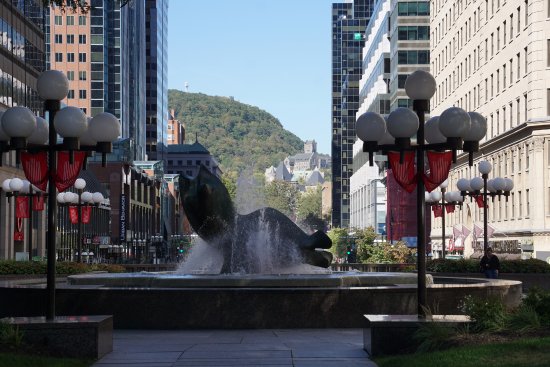
Going Up And Down In Montréal


fountain-titled-female

(Place Ville Marie)

At one time I shared a whole house with four other people. Two were in the process of becoming lawyers. I noted that most of their stories did not contain much whimsy. The following is a story one of the fellows told us. I, of course, make up the dialogue but, though fiction, it is based on his facts.

*********************

“I don’t mean to stare – I apologise. I’m not in the habit of doing this, but you remind me of someone. That has to sound like a line – the look on your face. But I’m not after ….

“Have you ever been in the train station at Place Ville Marie in Montréal? The escalators that come up by the Queen Elizabeth Hotel.  I had a lot of travel to get to work when I lived in Montréal, and made train and bus connection.

“No, thanks. I don’t want another.

“One morning – a Thursday – as I was going up the escalator, I saw a girl coming down from the street. She had short red hair – that’s the main reason I’ve been staring – and a green skirt with a white blouse. Coming down that escalator, with that wide space between us. She was looking at me the way I was looking at her – interest and excitement and whatever potential that leads to. We stared into each others eyes as we came level, and craned to look back as we passed.

“I guess I’ll have another of the same, after all.

“That was stupid enough. I should have jumped that barrier, or at least gone down after her. But I had a job, and was young, and things like that just don’t happen.

“Next morning, even though I was looking for her, and hoping so much, I couldn’t have been more shocked by a ghost when I saw that red hair. She had that same look – of shock.

“God, to be so unsure of what to do, and stupid to the ways of the world, and even to have that stabbing thought that it can happen again tomorrow. We stared and stared, you could almost feel electricity between us. At the top I waited as long as I dared, hoping she would come up. I had to get my bus, and just jumped it as it was pulling away.

“That was a Friday. I sweated through the weekend, full of grand plans about telling her to wait, or to come up to me, or yelling my phone number. She wasn’t there, of course, on Monday or any other day. I looked the rest of the summer, then it was back to university.

“I mean, to be given one chance like that and waste it. But two. I’ve never forgotten, even now with a wife and kids, I wonder what might have been. It can make my hands shake, seeing someone like you, and with too much drink in me.”

Alison Alexandra Rubs Shoulders With The Golden Globes

theremin-moog20-20moderno

I have had a fascination with the musical instrument, the Theremin, for decades. A Theremin (named after its inventor) is an electronic musical instrument, invented in the 1920s-1930s, that is played not by touch, but by the movement of hands next to metal rods. It produces eerie sounds, something like a soprano at the top of her pitch.

For Christmas, someone I know got a Theremin as a present.  As sometimes happens in my current manuscript about Alison Alexandra, an event in my real life (regardless of how distantly related) will creep into Alison Alexandra’s life. She’s a gal open to many suggestions.

Now, had the present been a guitar or a clarinet, they would have held no interest for me. Although fine instruments both, they would have held no interest for Alison Alexandra, either. They are not exactly common, but neither are they exciting enough. Alison Alexandra has a bit of an edge to her.

But, because I already have some history with Theremins, and Alison Alexandra was embarking on a new chapter, it seemed to be a happy and musical experience.

So, I have done a more-than-usual research blitz on the instrument. Learning things I did not know. Listening to the surprising number of excerpts on the internet. But, as is often the case, also finding a number of contemporary references.

The Theremin was an instrument that fascinated a deceased author colleague of mine.

The son of a friend has actually made a Theremin.

The Theremin is used in the soundtrack of the British Television Mystery Series, Midsomer Murders.

And, most recently, a Theremin is used in the soundtrack of the movie The First Man. This movie has just won the Golden Globe for best Original Score.

Now, I’m not sure if Alison Alexandra is actually going to attempt to play the instrument,  but it certainly is going to hit some high notes in her life.

[Where to learn lots about the Theremin] https://www.carolinaeyck.com/theremin/

In The New Year, Kafka Ponders His Teen-age Lover

kafka-imagenes-una-vida-klaus-wagenbach-L-6

[Kafka’s teen-age lover, Gerti Wasner – The Swiss Girl]

In Kafka In The Castle, I fill in the ‘missing’ diary entries from Kafka’s real diary. He either did not fill in these days himself, or he destroyed them. There are some estimates that Kafka destroyed 70% – 80% of everything he wrote.

~~~~~~~~~~~~~~~~~~~~~~~~~

03 January 1917

I still have fantasies about the Swiss girl – although not the type one might suppose.

(My father says I already have too many fantasies, and that I deal with them “too long, and too often” – he is certainly right.)

I make a mixture of what I shared with the Swiss girl, and what I imagine we would be like today.

This is certainly more fantasy than not, for what would being together have done to us?

Done to her?

But in this tiny house – could she not join me? Be here by the window, as I write this?

She was so young, and such a girl.

But I fear that I was never such a boy.

Kafka Aims At The New Year

gettyimages-2662796

In Kafka In The Castle, I fill in the ‘missing’ diary entries from Kafka’s real diary. He either did not fill in these days himself, or he destroyed them. There are some estimates that Kafka destroyed 70% – 80% of everything he wrote.

~~~~~~~~~~~~~~~~~~~~~~~~~

26 December 1916

The saints and the sinners can sometimes sing together.


27 December 1916

Ottla says I am staying here too late into the night. But she is implying more. I am certain she is soon to tell me that I should stay in her tiny house all night. Sleep here. Have things prepared and ready so I could go directly to the office in the morning. But the office must be more than just distance from this place.


28 December 1916

Another wretched letter to F. A response to anguish and accusation. Perhaps Ottla is only half right. Perhaps I should shut myself up into this hovel from morning to night and then night to morning. Let the snow pile to the rooftops, and become as hidden and secure as any mouse in its burrow. And if I dare push my snout through the snow to snuff at the air, they can all be standing with shovels at the ready to pile me in deeper. That would be best.

I can not take love, and I certainly can not give love. Not what is expected, and certainly not what is needed. To express what I feel is indeed like yelling through a mountain of snow. It is absorbed. It is deflected. It is diffused. By the time my love reaches the real world, it is a ghost which – although it can not be seen – can still cause a person to shiver. If I did not know that for a couple of times – especially with the Swiss girl in Italy – my love had possessed a body, I would bar the door forever.

(image)https://www.theneweuropean.co.uk/image/policy:1.5268806:1510056106/image/gettyimages-2662796.jpg?$p=692ce63

Create a free website or blog at WordPress.com.

Up ↑