Search

kafkaestblog

It is a whirlwind in here

Tag

war

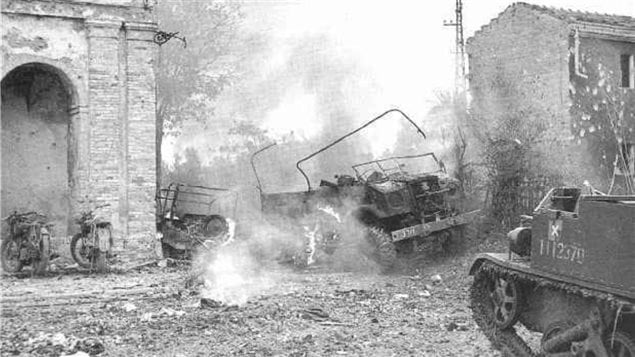
My Father, Byron Caleb Estey, Served In The Canadian Army For The Entirety Of The Second World War

151221_ce0h0_rci-m-burning_sn635

My father, Byron Caleb Estey, served in the Canadian Army for the entirety of the Second World War. He was 31 when he signed up, and was a decade or more older than most of the soldiers he served with. At the end of the war, he was offered an instant promotion from Corporal to Sergeant Major.

He declined. He had had enough.

He was with the 90th Anti-Tank Battery. He was the member of the crew who calculated the coordinates to aim the gun and destroy targets. He did this up through Sicily and Italy, except for those times when he grabbed his rifle to shoot at soldiers shooting at him.

I imagine I could write pages repeating the anecdotes he told – and maybe some day I will. He didn’t talk all that much about the war, and when he did, I’d guess 80% of his stories were humorous. The other 20% were not.

I regret not discussing his war experiences more with him, but he did not encourage it. I once asked how close he got to the German soldiers. He said, close enough to kill them.

He hated Germans and Japanese all of his life. I understand that this is not the way of most soldiers. They mellow. They come to understand that soldiers on the other side were doing a job, just as they were. My father was not one of these. Those 20% of his stories explained his attitude to me.

He fought in – arguably – the most horrific and bloodiest battle in the war, the Battle of Ortona over Christmas week of 1943. He marched over piles of bodies, and crawled over piles of bodies. Such were the details he would tell. He didn’t speak of his feelings, or use words like “horror”.

On Remembrance Day he would march in the community parade. He rarely lingered for a meal or beer or camaraderie at The Legion. He did not seem affected by the memorial event, and did not talk any more or less about his experiences just because it was 11 November.

Because his tales were more funny than not, I’ll close on what might have been his last funny story.

At his death, the Royal Canadian Legion wanted to conduct a small ceremony at the funeral parlour. They requested that his medals be pinned to his chest. But, the medals could not be found. This was odd, because they were important to him, and he always wore them for the Remembrance Day parade.

It is excessive to say that the whole house was searched – but not by much. Drawers, shelves, boxes, closets, clothes, were repeatedly searched. Nothing. The Last Post was played over a Veteran with no medals.

Months later, when the house was being sold and possessions were being removed, his clothes were searched before being given away. In the side pocket of a jacket he never wore were the medals, all spiff and shiny.

He would have smiled at that.

Dale Estey

Will Kafka Slip/Slide His Way Through May?

In Kafka In The Castle, I fill in the ‘missing’ diary entries from Kafka’s real diary. He either did not fill in these days himself, or he destroyed them. There are some estimates that Kafka destroyed 70% – 80% of everything he wrote.

~~~~~~~~~~~~~~~~~~~~~~~~~

22 May 1917

          There was even some snow. 

         They spoke of it at the office. Further down the river some snow and thunder together. 

               Hysteria traced the words of one man, who claimed he had good information – which he could not reveal – that the enemy has a great machine which can control the weather. That is how they are going to win the war. Freeze us in May, and destroy all our crops. 

                “And where are these giant weather engines?” somebody asked. 

                “In France,” was his reply, but he said it with such hesitancy that I knew it was a guess. 

                 “No machine could cause us trouble from that far away,” said another, and there was laughter before work resumed. 

                  Laughter without a touch of mirth.

DE

Remembrance Day In Canada With The Jervis Bay

The major Remembrance Day Service is held in a hockey arena. Which I don’t like. So we found – in walking distance – a service at a small naval memorial/park with a Cenotaph. The park was in honour of the naval ship, The Jervis Bay.

HMS Jervis Bay

83rd Anniversary Nov.5 1940-2023

http://www.hmsjervisbay.com/.

I’ll stab at 400 – 500 folk there. Cars parked as far as ten minutes away. Raggle-taggle group of cadets. Trumpet player who had no trouble with the high notes.

Two good ole boys near us who looked as if they had been hauled from a brawl at the local tavern – but they had their poppies.

Sweet li’l kidlets.

MC who made old, old jokes and had to be corrected a few times about the Order of Service. And had to ask if anyone was present who might lay the wreath of the government or city or …
He chuckled over the one guy who volunteered a number of times: “We’re puttin’ ya to work today.”
A train whistle in the distance that gave a loooong blast for 11:00 (though it was a couple of minutes out of sync).


And TOTAL silence for the two minutes of silence.

Then home we went to watch the Service from Ottawa, with the Governor General, Prime Minister, Silver Cross Mother, Military Pipes & Drums, marching Military Contingent, and interviews with two sharp-as-tacks Veterans in their late nineties.
Best of both worlds.

DE

Wagner And Putin Walk Into A Bar / Then History Takes A Turn

~ I’m singing at your funeral, Putty.
~ I made you what you are.
~ Götterdämmerung, baby.
~ You are my creature!
~ Always be afraid of Frankenstein.
~ I made you, and I can destroy you.
~ That’s what they all say.
~ You were my cook, for God’s sake.
~ So I know about blood and guts.

~ You are such a little man.
~ I wouldn’t throw stones over that, Putty.
~  I’ll crush you!
~ With what? I’m the only army you really have.
~ You were just here to get Ukraine.
~ Ukraine is lost. *Your* army saw to that.
~ I am the new Tsar of All The Russias.
~  I’ll give you some time, Putty, to get out.
~To where?”
~ Don’ know.  Don’t care.

До свидания! / Do svidaniya!

D UEL

Kafka Takes A “Mistake” Train To Prague As The War Begins To End

In Kafka In The Castle, I fill in the ‘missing’ diary entries from Kafka’s real diary. He either did not fill in these days himself, or he destroyed them. There are some estimates that Kafka destroyed 70% – 80% of everything he wrote.

Franz Kafka did not shy away from writing horror, and you are forwarned.

14 February 1918

              The grip of evil showed tenfold times the horror.

               The train to Prague – late and slow because it had made a stop in Hell.

              “A mistake train,” said the Stationmaster. “But we had no other choice because of the shortages.” I looked through the windows, and hesitated. “There may be no other train today, if it’s Prague you want.” He rubbed off the chalkboard with the spittle on his finger. “No evening train. Perhaps there will be something after mid-night.” He wiped his hand on his soiled jacket. “Perhaps not.”  “You do not even dare look into the compartments,” I said. “And yet you expect me to enter.”

     “I’ve seen worse.” He wrote down a new time, and his hand did not shake. “In the dark of the night, these trains come through.” He put the stubby piece of chalk back into his coat pocket. “But -no. I don’t get used to it.” He looked in my direction, his face as expressionless as before. “I would advise you to try the coaches after the engine. Most of them there can at least sit up.”

     His advice was good.

     That is where the other civilians were clustered. Huddled – almost literally – away from the sounds and the stench. And they readily made room for me, moved even closer together so they could add me to their number. In my suite and tie, overcoat and hat, I was a Godsend of normality. The gentlemen nodded, and the ladies tried to smile. But then the train started, with its usual jumble of jolts, and the moaning which followed turned their faces blank and ashen.

     One of the soldiers, across the aisle behind me – a Hungarian captain with a weeping bandage obscuring his neck – gulped and slid to the floor. I looked around for a doctor, or an orderly, but there were none. I went back and placed him – as best I could – onto his seat. He mouthed some words – he obviously couldn’t speak – and I patted his hand. Further back still, I saw an Austrian corporal grabbing and grasping over his head. I went to him, and smelled the blood before I saw it. One leg ended in a jagged stump of bandages, the other ceased inches below the hip. He kept grasping at the air even as I steadied him, and he finally seemed to realize I was there. He made motions toward his mouth, gesturing with both hands. “Have you got a fag for us, Sir?” he said, and I realized what his movements had meant. “You’re bleeding,” I began, but he smiled with a finger to his lips. “Don’t tell them, Sir. Don’t tell them. A cigarette is all I need. I’ll keep quiet. I confessed that I didn’t smoke, but a voice behind me spoke with a shrill deliberateness. “I have some – a box of them.” I turned, and it was one of the men I had been sitting with. The soldier held out his hand, and I changed places with the man. “I’m going to find help,” I said. “It won’t do any good,” replied the man, lighting the cigarette. “We’ve tried.” Terror was trapped in his eyes. “You shouldn’t go any further.”

     And I should have listened to him.

     I can not – or perhaps, even now, I dare not – reveal the monsters which I saw. For that is what these men had become, by no choice of their own. Terrifying, repulsive creatures who were more frightening the more human they appeared. One man had his arm melted into his side by and explosion. Another had his ribs piercing through his chest. And what flame can do to faces. The last cars had sacks of dead – too many for the coffins. And any official, any officer, any nurse I met, would only say that they’ll be tended to in Prague.  Treated.  Looked after.  The best care available. 

     And I remembered something from my childhood – a saying perhaps even from my parent’s parents: “A dead man doesn’t care what suit he’s buried in.”

     But I did not tell them this.

Wagner And Putin Walk Into A Bar

~ I’m singing at your funeral, Putty.
~ I made you what you are.
~ Götterdämmerung, baby.
~ You are my creature!
~ Always be afraid of Frankenstein.
~ I made you, and I can destroy you.
~ That’s what they all say.
~ You were my cook, for God’s sake.
~ So I know about blood and guts.

~ You are such a little man.
~ I wouldn’t throw stones over that, Putty.
~  I’ll crush you!
~ With what? I’m the only army you really have.
~ You were just here to get Ukraine.
~ Ukraine is lost. *Your* army saw to that.
~ I am the new Tsar of All The Russias.
~  I’ll give you some time, Putty, to get out.
~To where?”
~ Don’ know.  Don’t care. До свидания! / Do svidaniya!

D UEL

Halifax Explosion Anniversary 9:04:35 AM

I just stood out on the steps in front of my home, waiting for the ship horns in the harbour to sound in memory of the explosion. A beautiful, clear, crisp morning. The explosion happened 06 December 1917.

I live a fifteen minute walk from the exact spot where the ship the Mont-Blanc exploded, causing the biggest man-made explosion ever created, other than the Atomic bombs dropped during the Second World War

1782 people were killed, a few of them at the bottom of my street. 9000 were injured. A large portion of the city of Halifax was destroyed.

At 9:04, as I stood in the sun, the ships in the harbour sounded their horns. There was a cascade of sound,. Most were deep and booming, some more abrupt, a few – by comparison – made me think of piping voices. I was most startled by the ship directly across the water at the bottom of my street. There are rarely any ships berthed this far along the harbour, but it was delivering fuel to a Power plant. It does not do this often in a year. So I was startled. A modest touch of fear.

And then I came in and wrote this.

DE

Once A Soldier, Always … My Father And Remembrance Day

My father, Bombardier Byron C Estey, Service Number G4094: Units: 1st Anti Tank Regiment: 90th Anti-Tank Battery, served in the Canadian Army for the entirety of the Second World War.

He was 31 when he signed up, and was a decade or more older than most of the soldiers he served with. At the end of the war, he was offered an instant promotion from Corporal to Sergeant Major. He declined. He had had enough.

He was with the 90th Anti-Tank Battery. He was the member of the crew who calculated the coordinates to aim the gun and destroy targets. He did this up through Sicily and Italy, except for those times when he grabbed his rifle to shoot at soldiers shooting at him.

I imagine I could write pages repeating the anecdotes he told – and maybe, some day, I will. He didn’t talk  much about the war and, when he did, I’d guess 80% of his stories were humorous. The other 20% were not.

I regret not discussing his war experiences more with him, but he did not encourage it. I once asked how close he got to the German soldiers. He said, close enough to kill them.

He hated Germans and Japanese all of his life. I understand that this is not the way of most soldiers. They mellow. They come to understand that soldiers on the other side were doing a job, just as they were. My father was not one of these. Those 20% of his stories explained his attitude to me.

He fought in – arguably – the most horrific and bloodiest battle in the war, the Battle of Ortona over Christmas week of 1943. He marched over piles of bodies, and crawled over piles of bodies. Such were the details he would tell. He didn’t speak of his feelings, or use words like “horror”.

On Remembrance Day he would march in the community parade. He rarely lingered for a meal or beer or camaraderie at The Legion. He did not seem affected by the memorial event, and did not talk any more or less about his experiences just because it was 11 November.

Because his tales were more funny than not, I’ll close on what might have been his last funny story.

At his death, the Royal Canadian Legion wanted to conduct a small ceremony at the funeral parlour. They requested that his medals be pinned to his chest. But, the medals could not be found. This was odd, because they were important to him, and he always wore them for the Remembrance Day parade.

It is excessive to say that the whole house was searched – but not by much. Drawers, shelves, boxes, closets, clothes, were repeatedly searched. Nothing. The Last Post was played over a Veteran with no medals.

Months later, when the house was being sold and possessions were being removed, his clothes were searched before being given away. In the side pocket of a jacket he never wore were the medals, all spiff and shiny.

He would have smiled at that.

Putin and Stalin Walk Into A Bar

~ Vlad, you murderous whore.

~ Josef, you cold, cruel killer.

~ Greetings and conquest be upon you.

~  My people are letting me down.

~ Oh – and a Happy Birthday!

~  You remembered.

~  Well, the way you’re going . . .

~  Yes?

~ It will be your last.

~ You think Ukraine can defeat me?

~ If it walks like a duck . . .

~  They are an army of pissants.

~  And quacks like a duck . . .

~  They survive on American guns.

~  And swims like a duck . . .

~  They were lucky to sink ships.

~  Vlad, listen to Uncle Joe.

~ Yes?

~  You are going to have to duck.

~ The Russian people will defend me.

~  Vladimir Vladimirovich Putin.

~ Yes?

~ Tzar Pretender!

~ Yes?

~ I know the Russian people.

~  Yes.

~ I slaughtered them by the millions.

~ Yes.

~ Enjoy your birthday – while you can.

DE  BA.  UEL

Blog at WordPress.com.

Up ↑