Search

kafkaestblog

It is a whirlwind in here

Tag

novel

Eating Fine Food In 13th Century China

In my novel, China Lily, my main characters, Cepa Cannara and Matzerath, are on a year-long trading voyage from Italy to China on the good ship The Pegasus, thirty years before Marco Polo did the same. In this segment, they have a meal with their host, Lu-Hsing.

~~~~~~~~~~~~~~~~~~~

delicious-oyster-omelette

“You boys are in the Port of Zaitun.” Lu-Hsing speaks in an authoritative tone. “Fish a speciality.”

“There must be something else.” Matzerath points. “Look at all the cooks.”

“No soup?”

“Pah!”

“Trouble-making Round Eyes.” Lu-Hsing points to a wok near the end of the aisle and starts to walk. “We’ll try there.”

“What does he have?” Cepa falls into step behind Lu-Hsing, followed by Matzerath.

“Oyster omelette.”

“Eggs?” asks Matzerath.

“As many as you want.”

“That will take a big pan.”

“He can use a high-sided wok.” Lu-Hsing pretends to whisk something in a wok. “Plop it right onto a plate.”

“We don’t have dishes.” Cepa suddenly realizes the fact. “We haven’t been back to The Pegasus all day.”

“Lu-Hsing share you his.” He barks an order at the cook, then turns back to Cepa. “Stay right here. I’ll get them from my table.”

Cepa and Matzerath stand and watch the cook. Cepa notes he is using wood and not the black rocks for his fire. Some oil is dropped onto the metal and immediately sizzles. The cook holds up his hand and extends his fingers; one, two, three, four, five.

“Will you want some?”

“God – yes.” Matzerath nods.

Cepa holds up five fingers and the cook grins. He takes an egg in each hand and hits them together. The upper shell is flipped off and they pour into the wok. He repeats the gesture and the eggs land on top of the others. The last egg is dispatched on the metal rim of the wok and added to the rest before a hint of cooking has begun. The cook then begins to whisk and slide the eggs along the side of the wok before Matzerath has time to make a comment.

“I’d like to see you do that on The Pegasus,” says Cepa.

“I break eggs all the time.”

“I know.” Cepa laughs. And we eat the shells to prove it.”

The cook now twists and shakes the wok by its two handles over the fire. The eggs slide up and along the sides, then settle more thickly near the bottom. With a grin and a twist of his hands, the cook turns the wok right over. The eggs start to slide out with a couple of drops hissing into the fire. Matzerath’s mouth falls open as the cook rights the wok so quickly that the eggs drop right back into it, now cooking on the other side. The cook puts the wok back on the fire.

“Bet you can’t do that,” says Cepa.

“Just once.” Matzerath laughs. “But the whole ship was heaving at the time.”

The cook begins to nudge the eggs together with a spatula. With his other hand he sprinkles a few drops of brown liquid. Then he adds some coarsely chopped shoots of a green onion.

“Hah!” Matzerath slaps Cepa on the shoulder.

After a quick swirl of these ingredients the cook plops in a bowl of small oysters. He takes his time with these, spacing them with deliberation over the quickly cooking eggs. Then – with a flourish – he scoops up a handful of flower blossoms and sprinkles them over the whole bubbling mixture.

“What are those?” Matzerath peers into the wok.

“Chrysanthemums.”

“We’re eating flowers?’

“When in Rome …”

The cook adds a further dash of the brown liquid and then folds the eggs neatly in half. He flips the whole omelette to the center of the wok and sprinkles a palm full of spring onion – this time finely chopped – over of the still-bubbling omelette. He presses the onion in place with his spatula then removes the wok from the fire.

“Timing is everything.”

The voice startles them both. They turn to see Lu-Hsing standing behind them, holding a large platter. He barks instructions to the cook, speaking too quickly for the two men to understand.

“Stick to ribs – make you happy.”

The cook divides the omelette in half and slides it onto the platter. He then takes the wicker top off a steamer and starts to add heaping ladles of red rice along the sides of the platter.

“What’s that?” Matzerath sounds suspicious.

Hong  qu mi.”

“You can see its rice,” hisses Cepa.

“But it’s red.”

“Fermented with yeast.” Lu-Hsing scoops some into his palm and eats it.’”Looks good. Tastes great.”

DE

(image)http://www.funnymalaysia.net/wp-content/uploads/2015/09/delicious-oyster-omelette.jpg

Oktoberfest In Munich/München – Let The Beer Flow

Germany Oktoberfest Opening

Chapter One of Fame’s Victim:


UM PA PA! UM PA PA!

Tuba sounds assail ST as he forges through the clogged streets and packed alleys of Munich during these last hours of Oktoberfest. This, and the thousands upon thousands of revealers apparently heading to his own destination.

ST  worries what will happen when he reaches the Kafer’s Wiesnschanke tent. Because it is situated on the very edge of these huge Oktoberfest fairgrounds, ST is in one of his impeccable disguises. However but will it prove so effective (as it is proving now), that he will be unable to gain entry? Without immediate entry and quick access to his reserved table, he is not going to get to his waiting bottle of Glen Grant scotch.

ST has never had to deal with this problem. He uses camouflage to get from one private destination to another, and always has the luxury of removing his disguise in the comfort of some bath or bedroom. Here, he will have to prove who he is in one public place, so he can get out of another public place.

ST passes the Hofbrauhaus, with still a long way to go. He regrets he consented to spend these last two hours of the week deep in the gemutlichkeit of Bavarian sausages, chicken and beer – horse-drawn wagons of which trundle past even as he aims unerringly for Kafer’s Wiesnschanke tent.

This dramatic scene is foreign to him, though he supposes he is no longer foreign. It is through his inheritance of vast tracts of land and chattels along the coast of the North Sea (to say nothing of the interesting pockets of real estate and apartments still being revealed across the face of Europe, America, Australia, and the Bahamas) that his special invitation to this evening arrived. And the obligation to attend.

The acres of vibrant lighting cast a multi-hue glow across ST. He notes his roughly-shaped beard (one of three dozen – each cropped differently), takes on such bizarre colouring that he doesn’t remember what it really looks like. He probably could have gone without disguise and passed unmolested. That is what his hosts had told him, but he has had such assurances before.

Under a set of flashing amber and yellow lights, ST looks at his watch. The crowd is slowing him, and he should have used another entrance, instead of the broad way through the tents. He tries to get closer to the edge of the crowd, but the edge in an ever-moving mass is difficult to find. It is analogous to the boundaries of Space/Time, which he can never actually discern either. ST rarely gets such a chance to put his world-famous theories to a practical test. Head up and elbows to the ready, he begins a vigorous forward thrust. This attitude alone is enough to make more people give way, plus he is not without practiced skill at dodging and pirouetting among crowds.

As ST advances the garish lights become more extreme, and he has difficulty distinguishing the various tents. The one he wants is in the upper corner, and supposedly not easy to miss. But it is also one of the smallest (holding slightly over 2000), and for all he knows it may get lost in this absurdist hurly-burly. He may succumb to this incredible throng, and get carried away on its tide to the more boisterous Spatenbrau, or whisked back to the very beginning of his trek at the Hippodrom.

In an attempt to fit in, when ST first arrived at the fairground he had purchased one of the large gingerbread cookies, which so many people are wearing around their necks. This is now proving a mistake, for it keeps bumping back and forth across his chest. As he has never actually seen anyone eating the damn things, he hesitates to take this course of action. On the other hand he is concerned that if he just tries to remove it from his neck, the cord might get tangled in his fake beard.

ST clamps a hand over the cookie as if he was taking an oath, and continues through the noisy revelry. He is just passing the Winzerer Fahndl tent and thus is not far from his destination. A turn to the right and some more well placed elbows, and he might be able to arrive in another five minutes.

Just as ST can lose Time when he attempts to track it, equation by equation, through the vast quadrants of his computer programs, so it begins to elude him here. The overwhelming chore of Oktoberfest becomes surprisingly addictive. Although he still wants his scotch and reserved place at table, he looks longingly at the Winzerer Fahndl tent with a desire to enter. As he stares overhead at the amusement park rides, he wonders if he would find them as thrilling as the screaming participants indicate they are. ST is even tempted to gravitate to the nearest thundering band, and settle in close to the tubas. Perhaps he might risk an inquisitive munch of his over-large gingerbread cookie.

These thoughts put him in a better frame of mind as he eases himself into the slowly moving crush. He gets behind a trio of husky teen-agers, and lets them unknowingly clear a path.

It seems their goal is to sample beer from each of the fourteen tents, but so far their boisterous gung-ho remains good-natured and useful. ST keeps just the right distance behind the three so he is not considered a part of their group, yet manages to glean the benefit of their passage. Much as the stern of a ship glides through the wake of the prow.

When he comes within sight of his own goal at Kafer’s Wiesnschanke, he wonders if his trio of outriders is going to steer in its direction. An argument can be made that it is next on the list of any pub-crawl, but the youths are loudly debating the merits of either the Sportschutzen or Lowenbrauu.

ST has the temptation to clap them boisterously on their shoulders and invite them to his more rarefied destination. His popularity with youth is particularly high right now, as he appears to be quite the rebel with his contention that the year 2000 is not the Millennium. This is not his desire, but who is more going to be asked all the questions about this momentous event than the expert on Space/Time?

Even his obvious equation – obvious to ST, at least – that if someone owes you $2000, you are not going to be satisfied in only getting $1999 back – has become an imbedded catch phrase in nearly every article now written about the Millennium. It has even become a refrain in a contemporary pop song.

ST starts to hum “Don’t Shortchange Us”, having no fear of ever being heard over the din of Oktoberfest. The decision as to whether or not he will befriend the teen-aged trio is made for him as they abruptly link arms and make a wide swing toward the Lowenbrau tent. ST may be mistaken about the sound of his own voice, for the trio of teenagers breaks out in a thundering rendition of the refrain to “Don’t Shortchange Us”. They create a wide path through the packed revelers, many of whom applaud and join in.

ST soon proves to be exceedingly incautious. He raises his voice to match any in the crowd. He is no singer (although he did agree to appear in the music video, campily disguised as a gesticulating Einstein), and if anyone pays him particular attention, it is because his rendition is so bad.

As the teenagers wheel toward the Lowenbrau, ST is again

strangely attracted to follow. However, he can readily picture the chaos which might ensue if he is recognized. Even such a friendly swarm as this can turn dangerous just through enthusiasm. Enclosed space and intoxicated people lead to too many varied conclusions. ST continues on his way, quickly buoyed by the thought of Glen Grant and the opportunity to sit. As with many public functions, ST is actually expected to do very little. No speech, a moderate amount of glad-handing, and he fulfils his obligations. He is no entertainer – which he could quickly prove if he started singing – and Oktoberfest is no place for a learned report about Space/Time.

Kafer’s Wiesnschanke seems not to be a `tent’, but a permanent wooden structure, with lattice at the front. There is outdoor seating, and strings of lights along the peak of the roof. At this time of night guests to the interior are handpicked. No one has given him an invitation or a code word, or any such means of identification. He has not had to prove who he is for so long that he really doesn’t know of any way other than the removal of his disguise. He could show his passport or driver’s license, but the photo displayed doesn’t display him.

People sitting outside give him a once-over, just as they do to all the crowds washing by. Oktoberfest is a people-watching event, but at this time of night, after a festival of beer, there is a sameness and a tiredness to their actions. He has no reason to fear a close scrutiny. ST walks briskly through the seated people and approaches the main entrance. Waiters and waitresses come and go through the door, liter mugs of beer held aloft. There is a small table to the left, and a man wearing a hat sits on a stool behind it. This is obviously the person whose scrutiny ST must meet and pass. He prepares a firm handshake, and a brief explanation of who he is.

From the corner of his eye he sees a figure approach. From its size and build it appears to be a woman, but she is wearing a Harlequin costume and holding a Venetian Sun Mask in front of her face. The gold (it looks like real gold) mask is attached to a long, slender stick, and the hand holding the stick is gloved.

Gloved hand, stick, gold mask and harlequin-attired body all lean toward him. ST is tempted to back away, but an exotic perfume reaching his nostrils is too enticing. He is sure his own disguise will not reveal his identity, so he affixes his fake beard smile.

“Psst.”

This sound hissed in his direction seems to be a woman’s voice. Perhaps he is to be asked the time or offered some cut-rate passage to the giant Ferris Wheel. Both have already happened this evening. Some response seems expected and ST decides to resort to his rusty German.

“Bitte?”

The eyes blink behind the mask and an irrepressible giggle is barely muffled by a gloved hand.

“Annie’s crackers. That better be you.”

“Garbo?” ST takes a surprised step back.

“I was about to take a bite from your cookie.” She removes her mask. “If that wasn’t you, I would have either made an enemy  or a friend I don’t want.”

“What are you – ?”

ST can’t tell if he is more surprised by the presence of his lover, or by the fact he didn’t recognize her. As he ponders he hastily pushes her hand so the mask is once again in front of her face. What they both don’t need is the exposure of the beautiful, young movie star. For if she is recognized, will ST be far behind?

“You don’t want to look at me?”

“I don’t want others looking at you.”

“Mmmm.” Garbo steps close and rubs against him. “Jealous?”

“No more than usual.”

This generates a snort from Garbo and a thwack over ST’s head with the mask. She still finds it hard to accept he doesn’t get jealous, even about the explicit love scenes in her last couple of movies.

“Then what?”

“Garbo.” ST leans toward her. “We’ll lose our concealment.”

“If we’re being so secretive, don’t call me that in public.”

ST realizes even he is affected by their disguises, for otherwise her pet name would not have been uttered. Garbo is very particular that this name is for his use alone.

“But we’re not even supposed to be in public.” He looks around at the mass of revelers. “I’m here because – ”

“I arranged it.” Garbo giggles again.

“You what?”

“Do you know … ” She lowers her voice, making her words barely audible through the mask. “You look surprised, even through that beard.”

This is a dig at his array of beards. She is far more comfortable with the recognition she receives. ST assumes this difference between them is partly due to her age, and partially because of her business. But he is not above retaliation.

“Who’s wearing the mask?”

“I’m supposed to be a surprise.” Garbo shakes her head, deliberately making the bells on her Harlequin cap jingle. “You are already on the agenda.”

“Let’s not stray off topic.” ST reaches forward and flicks one of the bells. “What do you mean you arranged it?”

“You were asked to come here, because I asked them to ask you …” She jingles the bells again. “… to come here.”

“Garbo!”

His voice rises as the name-not-to-be-used spills into the night. ST avoids a hit on the arm and puts his mouth next to her ear.

“Garbo.” Her name is now spoken slowly but quietly. “Why did you do such a thing?”

“To get you out of the mansion.” Her lips are close to his ear, but she is not whispering.

“I’m rarely there.” ST sounds as puzzled as he feels. “You know I’m even thinking of selling – ”

“Are you this literal with Space/Time?” Although Garbo doesn’t shift her head, she does lower her voice. “Your boundaries aren’t narrow there.”

“Space/Time has no boundaries.”

“I know that.” Garbo pretends to pull on his beard. “Even though you don’t preach – you do teach.” Her hand reaches for the large cookie around his neck, and she grabs that instead.

“You have to get out more.”

“To Oktoberfest?”

“Where better?” She gives the cookie a solid tug. “Doesn’t time stop here?”

“The beer stops at eleven.” ST smiles, and it is not lost in his beard. “That’s all I know.”

“You’ve become too wrapped up in the Millennium.”

“Fighting the `fake’ Millennium.”

“Whatever.” Garbo lets the cookie swing and hit his chest. “It comes to the same thing.”

“Get me started on the Millennium, and I might preach.”

ST raises his finger, about to point with exaggeration and begin some elaborate theory. However, he remembers where they are and realizes such a joke would fall flat. Instead, he puts down his hand, and shrugs his shoulders.

“Let’s get this over with.”

“Mr. `Life-of-the-party’.” Garbo shakes her own finger. “You need to sing and schunkel.”

“Schunkel?”

“Hook your arms with those of your neighbors, and weave back and forth while singing lustily.”

“I don’t plan to sing – lustily or not.”

“Oh, yes you do.” Garbo links her arm through his, and starts to pull him toward the entrance. “Timely or not.”

She maneuvers ST past the man sitting at the table, and aims for a large, dirndl-encased woman standing at the far side of the door. She has the girth to block the whole doorway by herself, and ST has some hope that she will stop them.

“Remember – you’re with me.”

Garbo chuckles as she says this. When they are a few steps away from the door she lowers her mask and smiles that smile which charms millions. Even though the woman must have been expecting them she looks surprised, and then delighted. She makes a little bow, then opens her arms as if to embrace them.           “Wellcommen. They will be so pleased. The mayor keeps sober until you arrive.”

“That’s asking a lot.” Garbo replaces the mask in front of her face, and tugs ST toward the interior. “We have not expected such a sacrifice.”

“Why not?” ST directs the bearded question toward her ear. “I’ve kept myself without lubrication so I can appear here in fine form.”

“But you have me to get intoxicated on.” Garbo pushes him through the door. “You don’t need vile alcohol.”

“But there is going to be some, isn’t there?”

“Annie’s crackers – it’s Oktoberfest.” She pulls him forward. “It’s a feat you’ve managed to stay sober this long. Now it’s time for your reward.”

ST likes the thought of a reward so he snuggles closer, pressing his pelvis against her wondrous ass, encased in its very tight Harlequin pants. She shoves back, which she knows is only encouragement, then reaches and takes his hand.

“You wait until later.”

“Will it be better, later?”

“Depends if you drink too much.”

“You always sober me up.” ST links his arm through hers. “Schunkel, you say?”

“Don’t start singing.” She jingles her bells again.

“`Don’t shortchange us…'” He raises his voice with each word, making Garbo pull him off balance.

“Life of the party,” she hisses. “Not the death of singing.”

He stumbles slightly, making him fit in with most of the other patrons. Then he follows Garbo toward a table that is obviously the depository of dignitaries.

ST knows city officialdom will be involved, but he is unprepared for a mayor in crossed suspender short leather pants, complete with his massive chain of office. Others, whom he supposes are aldermen and various strata of bureaucracy, are also historically attired. They look as suspiciously in his direction.

“Garbo?” His hiss is in the high register.

“Keep your beard on.”

“You promise there’ll be Glen Grant.”

“Annie’s crackers.” She touches the mouth of her Venetian mask. “I’m going to want some, too.”

A functionary rises from the table, ready to approach them with a scowl.

“C’mon,” pleads ST. “Let him chase us away.”

“Too late for that.” Garbo holds her mask further from her face, glancing at him as she whispers. “Besides, it might come in handy to have the city fathers being fatherly toward you.”

“Why? So I can get a parade?”

“With a team of horses to pull you through the streets.”

“We’ve been together two years.” ST puts a hand on her shoulder. “You know I want nothing like that.”

“What you want, and what you need … ” Garbo brushes his forehead with a jester’s bell. “I obviously have yet to teach you the difference.”

Garbo turns toward the table of officials and lowers her mask. The grim face of the dignitary ready to bar their way changes in a second, replaced with a broad smile. He holds out his hand to shake, though obviously debating whether or not to give her a hug. The temptation is great, and the occasion offers a license to such familiarity. Garbo avoids the situation by holding her mask out between them, and pointing toward ST.

The official stops momentarily, the smile trapped on his face. He is confused, wondering if he is being introduced to a bodyguard or some secretary, equivalent to himself. Garbo smiles, and sings a couple of lines from `Don’t Shortchange Us.’ She sings loudly enough to be heard by the other officials at the table, and immediately two heads whisper into the mayor’s ear. The man jumps up, his chain of office clanging against the beer stein in front of him. He pushes past his own officials, and makes a lunge for ST’s hand.

“Mein Herr. Welcommen!”

The mayor’s grip is so forceful that ST is again pulled off stride and they both bump into the table at the same time. The heart shaped gingerbread cookie around ST’s neck gets caught in the mayor’s heavy chain, and they are pulled together as they try to come apart. ST smells the beer on the other man’s breath, and has a pang of envy. Alcohol would be a relief right now, Glen Grant or not.

“We do a little dance – yes?”

The mayor is laughing, but ST realizes that he may be in some danger of losing his disguise. He doesn’t plan any further excursions tonight but his life proves unpredictable, and he can never be sure. Plus, the pull of glue from his face will not feel very pleasant or look very dignified. He can neither escape, nor risk the energetic contact his dancing partner encourages.

“Does this mean you have no time to dance with me?”

Garbo eases herself close to the two men. She stands in such a way that she could be speaking to either of them. They are confused and stop moving. Garbo reaches over and using both hands, manages to untangle the ornate mayor’s chain, and the string which the giant cookie hangs from. She winks at ST, then nudges against the mayor with her hip.

“Or do you boys prefer each other’s company?”

ST has become used to this type of banter, but the mayor does not know if laughter is called for or not. People at this stratum of celebrity do strange things, and he neither wants to appear foolish, nor offend his high scale guests. However, his own photographer is already happily clicking away, and he must do something. Putting his arm across his mayor’s chain so it can catch on nothing else, he turns toward Garbo with a brief bow. Every voter will understand his attraction.

“You dress as Harlequin, yes, so you make the joke.” He extends his hand. “A few steps if the arena is not too crowded.”      “Even if it is crowded.” Garbo takes his hand and pulls him away from the table. “Let’s make that chain rattle.”

ST does not know how many people realize who is dancing with the mayor – he suspects no more than already know. It is late and dark and crowded and noisy, and much of that noise comes from people because they are drunk. Most will probably not even recognize the mayor, chain of office or not.

Because of photographs taken at the mayor’s table, ST has concern about his disguise – if photos end up in newspapers, will he have to discard it? Although expensive, it isn’t the cost or  inconvenience which bothers him.

Over the years, even with the expertise of Hollywood make-up artists, he has found only a limited number of disguises which look authentic. In addition to this, they have to be comfortable upon his face for hours at a time. The one he chose tonight is a favourite, and he will regret losing it. He should have thought more clearly about the transition he was expected to make. It is rare that he goes in disguise to a place where he eventually is to be recognized.

“I thought a beard would hide a man’s frown.”

ST is startled back to his surroundings. He has been watching the dancing, though he long ago lost sight of Garbo and the mayor. He is astonished to see her standing at his side, Harlequin costume glittering in the subdued light. He notes the mayor sits at his table, beer stein in hand.

“You worked him into a thirst.”

“It wasn’t that difficult.” Garbo reaches for ST’s hand. “I’m about to do the same for you.”

Though ST is tired and has been on his feet a long time, he does not resist. Once out among the other revelers on this last night of Octoberfest, he makes use of the dancing lessons both wife number one and two insisted he have. He has come to quite enjoy the dance floor, and Garbo is an excellent partner.

“Tell me again why we are here.”

“You are `Lord of the Manor’ – literally.” Garbo stifles a giggle. “You should make your presence known in the country.”

“Why in Munich?”

“It’s a good distance from where you actually live.” Garbo aims him toward a corner. “You don’t want people too familiar.”

“I certainly do not.” ST picks up her direction and twirls her adroitly among the dancers. “Except, of course, for you.”

“Not to worry.” She slides a hand over his posterior and pulls him closer. “I’ll not only help you remove that beard, but everything else as well.”

“That will be appreciated.” He thrusts his pelvis against her. “But maybe you could start here and work your way up.”

“It feels as if you’re working your way up already.”

“Yes.” ST now whispers in her ear. “I’ve often thought that dancing is wasted by doing it on your feet.”

ST takes note of the most flamboyant dancers on the floor, and starts to copy their steps. Garbo is initially surprised, but quickly follows his lead. She is prepared to match his every move, and ST is determined to make her lose her step. Other revelers make room for them, and some even start to clap to the music. The bandleader has noticed the commotion, and after watching the couple for a minute turns the beat around to their rhythm. By this time even the mayor’s table is back on their feet, thumping their beer steins on its slippery surface.

“Bring it home, Mamma!” shouts the mayor.

Garbo growls with laughter as ST puts a hand on either side of her waist, and lifts her from the floor. She places her hands on his shoulders, and kicks back with her feet. ST actually aims her in different directions, and other dancers dodge away, squealing in delight.

“And another thing.” Garbo is panting and shouting into his ear at the same time.

“What would that be?” ST precariously leans back, almost losing his balance as he lets her slide to the floor off his chest. He twirls her on her stomach before he scoops her up again, and grips her hard against him.

“You’re heading into two months of Millennium stuff?”

“Yes.”

“And it’s going to be serious?”

“Yes.”

“Then ya gotta have some f-u-n.” She throws her hands over her head and leans way back, knowing he is not going to let her go. “And what better place is there than the biggest party in Europe?”

As she presses against him again he has a different answer to her question, and he whispers it into her ear. Her eyes go wide, and she brings up her hand in a motion to slap his face.

But she kisses him instead.

DE

“Burning In Berlin” Screenplay / FADE IN:

adolf-hitlers-bunker-is-a-carpark-downfall-film-parody-time


FADE IN:


EXT. BARREN FIELD WITH AUTUMN GRASS – DAY


Traffic sounds comes from the four streets bounding the field.


EXT. HILL IN FIELD – DAY


An information sign is at the foot of the hill. A newly-

painted Linden tree grows beside it.


EXT. INFORMATION SIGN – DAY


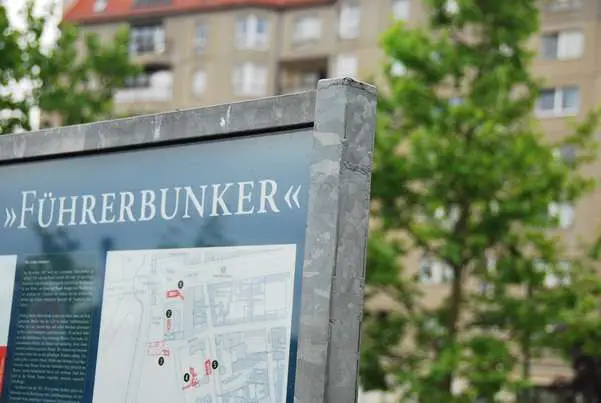
THE INFORMATION SIGN READS Fehurer Bunker


EXT. TOURIST BUS – DAY


INT. TOURIST BUS – DAY


A middle-aged TOUR GUIDE stands by the front seat, facing

the passengers.

TOUR GUIDE

The Berlin police don’t

want us any closer.


EXT. TOURIST BUS – DAY


Tourist faces peering from the windows.


INT. TOURIST BUS – DAY


Tourists from the far side of the bus bend and peer

over those seated.


EXT. LINDEN TREE ON HILL – DAY


One raven flutters and lands on a tree limb.


EXT. TOURIST BUS – DAY


Two or three faces are pressed in each window.


INT. TOURIST BUS – DAY


The Tour Guide is pointing through the window.


TOUR GUIDE


All of a sudden, the city says it

is unsafe. (laughs) They don’t want

to see all you rich tourists being

swallowed.

DE

(image) http://www.thetraveltart.com/wp-content/uploads/2012/07/Adolf-Hitlers-Bunker-Is-A-Carpark-Downfall-Film-Parody-Time.jpg

The Pope Speaks Of Satan And Evil

This excerpt was written before Karol Józef Wojtyła’s passage to the Otherworld, and certainly before his elevation to sainthood. He had his part to play in my novel, Places of Evil, where my characters confront, and combat, Satan.  I trust he smiles down more than ever upon my endeavours. [DE]

(image)

http://www.laprensalatina.com/edicion-especial-del-2011/vatican-john-paul-ii/

* * * * * * * * * * * * * * *

Excerpt from “Places of Evil”

“Who is friend, and who is foe, Holiness?”

“Do you ask of me a catechism?” The Pope peers at Mr. S. with interest. “Indeed a reversal of roles.”

The two men walk among the crypts of the Sagve Grotto Vaticane, moving in and out of the light, cast from each entrance. The Pope has requested the candles and tapers of every grotto be lit, and this is the only illumination. He has also dismissed his attendants and Swiss Guards.

The crypts line a horseshoe-shaped corridor extending from the Old Basilica to the sarcophagus of St. Peter. The Pope has yet to enter any grotto or chapel they pass. As they slowly walk, Mr. S. keeps close to his frail companion. The Pope’s doctors have given him a pager to summon help, if necessary. Mr. S. assumes the Pope is aware of this, as he seems aware of everything around him.

“Holy Father.” Mr. S speaks softly. “Why have you chosen this location for our discussion?”

“Secrecy.”

“With due respect, Holiness.” Mr. S. indicates their surroundings with a sweep of his hand. “There is secrecy – but this is entombment.”

“I think you come to me with death.” The Pope also points. “What better place?”

“I do not interpret my quest so Spartanly.” Mr. S. contemplates their confines before he continues. “The church assumes we live again after this life ceases.”

“Death of the soul.” The Pope stops moving. “Death after death.” He taps his cane against the toe of Mr. S’s left shoe. “This is the platter you place before me. This is what the boy dreams.”

“I was informed you had not been told his dream.” Mr. S. looks at his foot.

“I see those around me skilfully use evasion.” The Pope leans on his cane, and Mr. S. can feel the pressure. “So I have looked all the harder.” He moves the cane, and turns toward a corridor. “Let us continue our stroll.”

The Pope walks with more purpose, and Mr. S. wonders if their conversation gave him time for some rest.

“There is secrecy of a different sort.”

“Holiness?” Mr. S. takes some hasty steps to catch up.

“Satan arrives by invitation.” The Pope’s voice holds humour. “I believe neither of us has requested the pleasure of his company.”

They reach the glow from an array of flickering candles, and the Pope stops again.

“I come to the Grotto every All Souls Day, and in spirit, visit all the cemeteries of the world.” He lowers his voice. “Even after they have ceased to be, the dead entangle the living with their lives. It is a mistake to forget them.”

“Do the dead need our memories?”

“To them, we are echoes.” He nods toward the tomb behind the flickering candles. “They are in their new lives – they do not think of themselves as dead.”

“But you feel these new lives are threatened?”

“That is ultimately the raven hovering over your back.” The Pope expertly snuffs a candle with two of his fingers. “Satan accomplishes nothing with the death of our body – that comes naturally enough.”

“Why do you mention `ravens’, Holiness?” Mr. S. does not hide his surprise.

“Do they now not have their own restaurant in Berlin.”

“Do your functionaries tell you everything?”

“As they avoid topics they think I can no longer handle, they must fill the gaps.” The Pope closes his fingers over the flame of another candle. “A comforting meal might make Berlin a place of pilgrimage.”

“How serious is the Pontiff?” Mr. S. is stock still.

“How serious should I be?” The Pope watches the spiralling smoke rise above his hand. “Since Berlin – bombed, defiled, and built again – is the lair of the Beast, it must be cleansed.” His fingers move to another candle. “Berlin, where evil seeps into the very ground.”

“They have not kept this from you, Holy Father.” Mr. S. gazes at the trinity of extinguished candles before he looks at the Pope. “For even they do not know.”

“A fortiori.”  The Pope rubs his two fingers together. “Mother Ursula herself would not engage this topic.”

“Then how do you know?” As Mr. S. steps closer to the Pope, he breathes in the smoke from the candles.

“If I ask the same question, you will point at `signs’ and `feelings’.” The Pope indicates the extinguished candles. “We don’t see a light, we notice there is darkness.”

“I live in Berlin. I feel the accumulation of evil.”

“I look at the world. I travel the world as no one else can.” The Pope raises his cane. “I see the world – far beyond the orchestrated itineraries of those who invite me.” His breath makes the flame of the candles sway. “I know my history; I have lived the history.” He turns to look at Mr. S., the movement of his cassock making the candles dance. “It is two thousand years since our Lord walked this earth, and I have seen the most evil century of them all. How can I not know the power of Satan?”

“With respect, Holy Father, there are others who – ”

“You bring to me the boy.” The Pope’s breath is against Mr. S’s ear. “The twin who dreams of things he can not dream. His sister, who sees what none of us can see.” His voice fills the still grotto. “You lay into our arms a baby in need of protection. A baby named after Mother Ursula, who knew the ways of facing down the devil.” The Pope holds up his cane. “This body may be beyond repair, but I clearly see the many things arrayed before me.”

The two men stand close together, their faces reflecting the red glow cast by the elaborate candles. Through the silence of the corridor of crypts, they hear the hiss and crackle of the many burning wicks. The Pope is again refreshed by his rest, and starts walking with purpose. Mr. S. takes a last look at the illuminated reliquary, and steps quickly to catch up.

“Who was buried in there?”

“No body.”  The Pope stops unexpectedly, and taps Mr. S. on the chest with the handle of his cane. “Only the heart of our revered predecessor, Pius IX.” The Pope chuckles. “It is said they entombed it just to prove he had one.”

They continue with little conversation, the Pope’s cane sounding hard along the corridor. Occasionally the Pope points out a particular crypt or chapel, but does no more than mention who is there. Paul II is given a hearty wave, and Gregory V has the cane pointed at him. Before one entrance the Pope gives a little courtly bow.

“A saint of particular reverence?” Mr. S. is curious.

“No.” The cane jabs toward the entrance. “One of the few ladies to join the ranks of our mausoleum. Queen Christine of Sweden.” He suddenly swings his cane to point along the other side of the corridor. “And there is my immediate predecessor, John Paul I.”

“I did have the pleasure of meeting him, Holiness.”

“Not given a chance.” He shakes his head. “Such is death.”

Mr. S. feels he is being led to more than the end of the corridor, which is not far away. He is less surprised this time when his companion stops.

“Have you noticed these?”

“Holiness?” The cane is not used to point.

“Up.” The Pope shifts his gaze. “Look up.”

Mr. S. does as he is told. He sees a grill in the ceiling, from which diffused light seeps through the floor of St. Peter’s Basilica.

“We refer to them as crypt skylights.” The Pope’s cane thwacks Mr. S. on the leg. “That light is what our lives are, compared to the brightness and warmth surrounding God.”

“I don’t have your conviction.”

“I wonder.” The Pope moves forward. “Would you be doing what you do without the deepest conviction in the world?”

They are now definitely heading for the crypt of St. Peter. When this last and most impressive shine is reached, Mr. S. will chose his questions with care, and then be on his way. He fears he will still be unsure of his destination.

“What do you think of our necropolis?” The Pope’s voice is stronger. “Do you know the Vatican is built upon a city of the dead?”

“Yes.” Mr. S. smiles. “I find it significant as both fact and symbol.”

“A church `built upon this rock’ has become more secure by burrowing into it.” The Pope laughs deeply.

“Your symbol has become real.” Mr. S. taps the side of his head. “I’m not going to try to untangle that. Let’s leave it buried.”

“We humans never leave anything buried, which is perhaps unwise.” The Pope’s voice dips. “Perhaps astute.” He suddenly turns to Mr. S., his hand gesturing grandly. “Have you heard of Flavius Agricola?”

“I don’t believe so, Holiness.”

“A voice from centuries ago.” He lowers his hand. “I like to listen to them.” The Pope leans on his cane, and speaks in a stage whisper. “Flavius Agricola once resided in our city of the dead.”

“I assume he was not a Pope I haven’t heard about.”

“Flavius well pre-dates our humble personages, although he falls under the ire of Urban VIII in 1612.”

“So much for resting in peace.”

“Tut tut.” The Pope’s stage whisper becomes more aggressive. “You interrupt our tale.”

“Ab ovo usque ad mala.” Mr. S. spreads his hands. “Pray continue.”

“Paucis verbis.” The Bishop of Rome pauses a long moment, staring at Mr. S. “Flavius Agricola left his fellow mortals some final words of advice, which he had chiseled into the stones of his mausoleum. `Mix the wine, drink deep, and do not refuse the pretty girls the sweets of love/for when death comes, earth and fire devour everything.’

“I must say, Holy Father – at the risk of being offensive – it sounds like good advice.”

“I am not offended.” The Pope nods his head. “The gifts of God are meant to be accepted.” He lifts his cane and shrugs his shoulders. “But my esteemed predecessor, Urban VIII of happy memory, was of a different opinion. He had the sarcophagus of Flavius Agricola broken up and thrown into the Tiber.”

“Exitus Flavius.” Mr. S. reverts to a stage whisper of his own.

“Bone and stone.” The Pope’s voice lowers. “The lesson remains.”

“Forgive me, Holy Father.” Mr. S. looks closely at the other man. “What am I to do with this knowledge?”

“Teach it to the boy.”

“To Janus?”

“Preach it, if you have to. He is being consumed by doom and death.” The Pope’s voice raises to the level of a sermon. “This is why he dreams of Satan. Death is important – but it comes at the end of life, not in its midst.”

“Janus leads us somewhere, Holy Father. That has to be played out.”

“Of course.” The Pope twists his cane in his hands. “But after this is done, do not just give the twins a vacation. Add more living to their lives.”

The Pope resumes walking. Soon they approach the halo of light cast into the corridor by the candles of St. Peter’s crypt. When they stop at its entrance, the Pope nudges Mr. S. playfully.

“Two altars – no waiting.”

“Are we to pray?”

“There is always a place for prayer.” He stands without the use of his cane. “My advice about the boy – it is also for you.” He slowly turns his head to gaze across the crypt. “Come.”

Mr. S. follows down the steps, and over the polished floor to the sarcophagus of St. Peter.

“Do you know what they found with the blessed bones?”

“No, Holy Father.”

“Mixed together were the remains of two younger men, an elderly woman, a pig, and a horse.” The Pope rests on his cane. “To know such things helps keep one humble.”

“We are all God’s children,” suggests Mr. S.

“And some of us are chosen.” The Pope smiles. “Indeed, some of us are anointed.” He turns his back to the spectacular chamber. “But few of us seek out Satan to end his ways.”

“Do you believe in Satan, Holy Father?”

“Ah – the catechism again.” He stares at Mr. S.  “The question, I suspect, which you do not want to ask.”

“I sometimes feel I am on a fool’s errand.”

“And I sometimes feel I pray to the emptiness of space.” The Pope touches Mr. S. on the face with his fingers. “Such is the residue of despair.”

“Do we stop evil?” Mr. S. looks unflinchingly into the other man’s eyes. “Does evil come from Satan, or is it woven into Man himself?”

“Neither Satan nor God are restricted to the absolutes of human reason.” The Pope lowers his hand.

“Do you mean it’s both?”

“Take any child.” The Pope counts on his fingers. “Two years, four years, six years old. They already know right from wrong. Such awareness is innate.” He grips his cane tightly. “They must ask Satan into their lives – but Satan will never refuse them.”

“Satan makes them evil?”

“Satan offers them opportunities.” The Pope leans forward on his cane. “Satan may even make them chose. But the choice is theirs alone.”

The Pope takes a couple of steps toward the nearest candle holder. His movements are both careful and exact. Before Mr. S. is aware of what is happening, the cane flashes through the air. It decapitates the thick candle a handsbreadth below the flame. The segment of sputtering wax and wick tumbles across the floor.

“However, when one’s belief returns, that is what one does to Satan.”

Ship Voyage, Crew and Chickens in the 14th Century

marco-polo-yarmourh-bar

From China Lily

{A 14th Century sea voyage}

More than once he had brought chickens on board ship for the voyage. He had been totally unprepared the first time to find the crew (and even the officers) were far more interested in having fresh meat than fresh eggs. They had barely been out of the site of land when some crewmen brought Matzerath two dead chickens. They said that they found the birds fighting and that they were so badly injured there was nothing to do but to wring their necks.

            The next time it was just one chicken. Matzerath was told that it had escaped and bashed its brains out trying to get out of the galley. Then there were four chickens, somewhat bloodied, and he was told the chip’s cat had got to them. By now he was down to just a few chickens, and was only mildly surprised when they turned up, in ones and twos, broken-necked near the crude coop he had built.

            He toyed with the idea of cooking them in some manner that would repel the crew, but the fact of the matter was that he enjoyed the feast himself.

            On a couple of other voyages Matzerath had constructed secure hen coops. He put two  layers of wire over the frame and put a lock from his own house on the door. He wore the key, along with others, around his neck. There would be no cats intruding and no chickens getting free to ‘kill themselves’ against the sides of the ship. And things went well – for a week.

            Matzerath began to find, one chicken at a time, the members of his flock at the entrance of his galley. The galley was meagre, with barely room for a fire, a preparation space, and some provisions. He was allowed to make hot meal only on Sunday and Wednesday. The ship could not carry much fuel and the crew was (rightfully) terrified of a fire breaking out. Matzerath always had to have an officer present to cook a meal. The flame was always dowsed with copious buckets of sea water when the cooking was done.

            The chickens appeared the days he was going to prepare a hot meal. As there was no pretense that the birds had escaped and died, they were plucked and cleaned. Since no one could abide waste on the shop, and because he took a generous portion of breast for himself, Matzerath cooked them without complaint. The carcasses guaranteed a soup for those who didn’t get much of the actual bird, and all went on as before. He eventually found out that some member of the crew, adept with tools as so many seamen were, had untwined and cut the wire in one corner of the coop. he effectively made a flap that he could undo and secure without it being noticeable.

            When Matzerath finally found this entrance, his supply of hens was so low that he did nothing. He had managed to have two months of eggs (which did not seem overly appreciated), and some meals of chicken that he himself enjoyed. He also realized that the contest between himself and the chicken thieves eased some of the boredom of the long voyage.

            His next time out at sea he also had chickens and a coop. He took pains to make it more secure, and his chickens lasted longer. However, the owners complained about the waste of the chicken feed at the end of the voyage.

            On the trip after that, his whole flock caught some disease within the first week.

The birds became bloated and stank within the same day they died. Their feathers were moist and puss formed where they were attached to the skin. There was no space in the coop to separate the ill birds from the others. The captain was swift in his judgement about getting rid of the corpses. He feared the disease might spread to his crew. He had seen ships overcome by a rapid wave of sickness.  Had it been further into the voyage, the crew might have eaten them but, as it was, Matzerath had to dump them over the side.

DE

(image)http://www.ciaofamiglia.com/emigrants/Ships/Marco_Polo/Marco-Polo-Yarmourh-BAR.jpg

The Ghost Of A Chance In The Supernatural Workshop

ghoststoriesana00jamegoog_0252

I do give writing workshops, though few and far between. I doubt I can be classed as a specialist in anything, I am more a ‘nuts and bolts’ instructor. However, I do write a lot of supernatural material, and I am adept at dialogue. Both are fun to play around with.

I was blessed at one Supernatural workshop to have every student both interested, and showing an accomplishment in writing. There is, of course, more chance of this when they are laying down the big bucks, but it is still appreciated.

One of the students took me aback during the course of the day. She had handled my bizarre and distracting writing exercise with aplomb, which is always positive. However, in more general discussions, she balked at my dictat that writers must write at regular times, preferably every day.  She did not have the time (with young children at home). She even stole time when a child bathed, by scribbling quickly while watching the child. Although there was time in the late evening, she refused to intrude on that. She watched TV and let her mind rest. I can readily accept that part, as that is what I also do. I doubt I could be creative past nine o’clock  even if it meant I would win the Booker.

In the afternoon, she surprised me by, quite frankly, looking ten years younger. She was relaxed and more engaging. I like to think she was reacting to being able to be somewhere where all she had to do was deal with writing. That’s my story and I’m sticking to it.

In the course of further general discussion, she tossed off the fact that, the previous year, she had “written a novel”. At first we thought she was in jest. However, she was taking a course from some ‘by mail’ organization, where they give exercises and critiqued work returned to them. The woman who had no time, had written a novel in a year (besting me by a year and a half). I know from her writing abilities it would not be a poor novel, and, if nothing else, it was a foundation to other writing.  I don’t even know if she’ll submit it to a publisher – it was a learning exercise.

Kudos to her, said I, and every student agreed.

DE

(image) https://ebooks.adelaide.edu.au/j/james/mr/antiquary/plates/ghoststoriesana00jamegoog_0252.jpg

A Year Goes Past And The Writing Continues

spofec-rr-ghost-tune-160

(image)http://1.bp.blogspot.com/-O43_czTkQ_I/VCFhPJYIfII/AAAAAAAAKHM/yq9FuImgLDI/s1600/SPOFEC-RR-Ghost-Tune-160.jpg

A year ago I started (returned to, actually), writing something every day.

“Every day” is not exact, and perhaps not even wise. I have settled into six days a week, with a day (Thursday) off. When advised to write every day, a writer should know that they should write regularly, at least four or five days every week. And try for a decent amount of time per day, at least one to two hours. Find a rhythm that works and stick to it unto death.

I began last year with the intent of finishing my novel, a thriller called The Bonner Prediction. That I have done, and edited twice. One more edit remains. That should be completed in a couple of months.

However, in the intervening year, I returned to a story I had started in the previous year. It’s genesis was less as a short story, and more of a character sketch. By that I mean my main interest was to write solely about this particular character which, other than for my novel about Franz Kafka, I don’t believe has happened to me. Setting was also well-established. Other than that, I follow the character, Alison Alexandra.

Alison Alexandra is taking me on a wild, unplanned and exciting ride. It is some of the most purely enjoyable writing I have done. Fifty or so pages so far. Obviously not a short story, but I don’t know to what extent it will go. Alison Alexandra is chock -a-block full o’ surprizes. Today she is taking a ride in a Rolls Royce “Ghost”. Oh – what will happen?

So – let me tell ya – write every day. 

I wrote the following a year ago.

Perhaps my creative stream is bubbling away

I did not plan a New Year resolution. What I had planned was to write something on my current novel the first day of the new year.

This is also not planned, but – so far – I have written every day of the year except two – one a travel day, and one a deliberate ‘take-a-day-off-day’. I am two or three chapters from the end of thisThriller. I have not written fiction so steadily for months. I hope it keeps on.

This is the part which I do nor know is related to my writing situation.

I have never dreamt about any of my writing – never. I know many artists dream about their work, get ideas about their work in dreams and such, but not me. So, I did not have a dream about my writing. However, I recently awoke from a dream where I was talking to my publisher. She said I should do another book of short stories about the Elephant. Is that close?

And, finally, the incident below. On Twitter, I came across an announcement of a restaurant/bakery in Calgary. The Corbeaux. This means The Ravens. They have a store sign which has noted similarities to one which I have described in a manuscript. And you can see their sign in this photo.

https://fbexternal-a.akamaihd.net/safe_image.php?d=AQCKukhRj63heHlL&w=470&h=246&url=http%3A%2F%2Ftoquesandtruffles.files.wordpress.com%2F2014%2F12%2Fimg_8531.jpg%3Fw%3D1200&cfs=1&upscale=1

And then you can read what appears in my unpublished second Satan novel, where ravens play an important part.

Perhaps my creative stream is bubbling away.

From Places Of Evil

Mr. S. does rehearse what he plans to say to Breeze, both while he waits for the taxi, and then in the twenty minute ride to her restaurant. He is surprised Dorkas and Caleb made as such little protest. He suspects they agree with his concerns about the twins, even if not enthusiastic with his solution.

Mr. S. has the taxi stop a couple of blocks from the restaurant. Breeze has installed a new sign, and she wants his opinion of how effective it will be attracting customers. Although he helped – at her insistence – to choose the design, he has yet to see the finished object.

He walks along the street, pretending to be someone looking in shop windows for a gift. He actually wants to purchase Breeze a celebratory present, but that is for later. He tricks himself enough, that when he finally does look up at the sign, it is with a degree of surprise.

Breeze has not purchased a painted sign, as he had supposed. The design is similar to the ones they discussed, but she has not chosen an image imposed upon a wooden background. Instead, there are carved and painted shapes jutting from the front of the building, parallel to the wall.

A thick piece of wood, chiseled into the shape of a tree top, is attached over the lintel. Two branches sprout from the trunk of the tree, which tapers to an uneven and jagged tip. At the very top, a life-sized carved raven sits, its head tilted up. On each of the protruding branches sits another raven, their bills open as they look at each other.

Nailed to the bottom of the tree, a metal chain hangs to the door, holding a wooden sign printed in Old German script. It announces the name of the restaurant: The Hungry Ravens.

“As black as black can be.”

Mr. S. hums as he walks across the narrow street. He has reservations about her sense of humour, with this reference to the ravens. Their unfathomable connection to the work of the Organization, and their role of `familiar’ to Satan’s intentions, are beyond – in his opinion – the wryest of humours.

As he steps toward the front door, he notices a more subtle change. Breeze has sand-blasted the brickwork facing the street. The dark red hue enhances the outline of the tree and its occupants. They look as if they are silhouetted against a sunset.

DE

Adapt A Novel Manuscript To A Movie Script

(image)

It will take a whole host of other people to tell me how successful I will be. I’ve done it twice, and realize I must not only ignore my usual method of writing, but often go exactly against it.

I  have attempted to “learn” how to write for film, with many instruction books, and classes, and workshops, and meetings with people. I read many film scripts, which did help me accept the (to my eye) arcane format. But the one thing which turned me visual was the comment of a writer/editor friend who said, after reading my attempt, “I can’t see it.” That is, it did not cause visual action in her mind. And I understood.

Perhaps the biggest hurdle to get over is to accept that a movie is not a book  Changes, additions, and omissions will be necessary. As with a stage play, there is a finite time limit that generally clocks in under two hours. The threads and plot points of a movie are different. And the characters (I swear) feel this freedom, and choose to accentuate other aspects of themselves than are revealed in a novel.

The very fact their paragraphs of dialogue must be reduced to two or three lines makes them uppity. And because they can, in mere seconds, be in diverse locations, performing radically different actions, they become exact without apology. They don’t have to fill in the spaces.

The writer has to fill in the spaces however, and do so with visual stimulation. The transitions have to be swift. Their descriptions exact.

The road is always the fast lane, and the characters kick the tires with gusto.

DE


Avoid The Trial of Writer’s Block

chop away at the writer’s block

(image)

An ounce of prevention is worth a pound of cure (even in metric).

I experienced over two month’s of writer’s block many years ago. I did, literally, sit at my desk for hours, and can to this day accurately describe that desk. Its vision is before/behind my eyes as I key. It had a red leather surface, boarded in black. It was of thick mahogany with drawers. It faced the wall not far from the door to the room. I have placed it in one of my novels.

To not have this debilitating situation happen again, I have devised a scheme that I find is 90% successful in combating writer’s block.

Do not finish your thought on page or screen. Make sure it is solidly in your mind (make notes if necessary) but do not write it down.

If it’s a description – don’t finish it.

If it’s dialogue – don’t complete it.

If it’s a line of poetry – don’t end it.

The next day, start off with the phrase you would have ended with yesterday. Read the preceding page or two, and when you enter the phrase not completed, the odds are excellent you will continue on your way.

DE

Create a free website or blog at WordPress.com.

Up ↑