Search

kafkaestblog

It is a whirlwind in here

Tag

May Day

Franz Kafka And May Day

In Kafka In The Castle, I fill in the ‘missing’ diary entries from Kafka’s real diary. He either did not fill in these days himself, or he destroyed them. There are some estimates that Kafka destroyed 70% – 80% of everything he wrote.

~~~~~~~~~~~~~~~~~~~~~~~~~

30 April 1918

            If one can love and loathe the same thing, I do so with travel. Even as short a trip as the afternoon train to Prague. Regardless of the destination. And I don’t really mind so much, once I’m on the conveyance and moving. It’s having to get ready. It’s having to think about it.

     Ottla – of course – had all my things together and in the waggon before breakfast. I took a last walk around the village, as unobtrusively as possible, for I had said any `good-byes’ I wished to make the day before. And to Farmer L. the day before that. I was tempted to go past Fraulein G’s door – to be able to look at her one last time. She will fade in my mind. Faces and bodies always fade. But I did not.

     I went along the road which leads to Oberklee, and sat beneath my favourite tree for a short while. But, as is my habit, I became late, and had to hurry back to Ottla’s. Before the past and future started to mingle as I stared across fields and hills. O. insisted I have lunch, and then the hired hand drove us to the station. There were a few waves and farewells from people, which I had to return. My fingers to my hat.

     The wait at the station was not long, since the train was on time and we nearly were not. And the ride was uneventful. The day was clear and crisp, and I looked at the farms and countryside with new understanding. New curiosity. I saw where a field had just been started, and could guess which meal the farmer might have tonight. The condition of his boots. The gratitude for this Tuesday sunshine.

     And such things kept me thinking of Prague. Until it was in the distance. Until the landscape changed. Until the outskirts surrounded us. Until Prague filled the windows, swallowed the train whole, scraped us from the living earth. Then I was home.

01 May 1918

            It is like the day after the funeral.
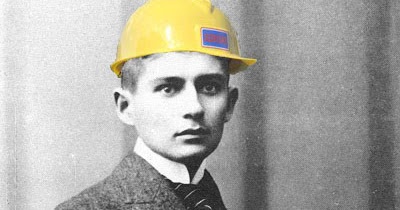
Kafka Sprints Through May Day Full Of Many Thoughts

kafka_hard_hat

Excerpt from my Kafka In The Castle, where I fill in all of his missing diary entries. Here he is dealing with a time twenty-eight years after the first May Day was declared. Kafka dealt with workers every day of his work life. But he didn’t take their problems home.

By the way – in real life – Kafka is credited with inventing the the hard hat.

+++++++++++++++++++++++++++

27 April 1917

Life seems to offer a handful of solutions which solve nothing. If I could get out of Prague, then I wouldn’t have to get out of Prague.


29 April 1917

Ottla managed to get away, and I’ll be able to visit. The dead man next door (I have since found his name was Adolf) also managed to get out of Prague. Him, I can not visit, but I can follow.


03 May 1917

The thoughts of the living discourage the dead. I spend so much time watching over myself, that there is no one left to watch over me.


06 May 1917

I write to Ottla. I make no mention of her terminated neighbour. I do say “hello” from father. Not an uneven balance.


08 May 1917

If Shakespeare were alive today, and people pestered him about Hamlet, would he wonder what all the fuss was about?


(image) 2.bp.blogspot.com/-atmC5fHIQp0/UhqBTCq06LI/AAAAAAAAAkA/S47fPCQHuww/w1200-h630-p-k-no-nu/kafka_hard_hat.jpg

Kafka Saves A Worker And His Job

s-l300

Franz Kafka  (in the daytime) was a government employee who looked after the welfare of workers for the Imperial government. He was on the side of the workers – among other things, he is credited with inventing the hard hat.

In my novel about him, Kafka In The Castle, he has an encounter with a worker who needs assistance. This is how he would react.

Excerpt from Kafka In The Castle


16 February 1917

There was a commotion at the office today. It was late morning, and from far below, coming up the stairwell, I could hear a voice bellowing: “Doktor Kafka. Doktor Kafka.” It was a terrible voice, full of blood and darkness. I got from my desk and went to the door. There were other voices, trying to calm, saying: “He can’t be disturbed.” But the voice was louder, more horrible, close in the corridor.  “Doktor Kafka – for the love of God.”   My secretary wanted me to stay inside, hoped the man would just move along the corridor until the police were summoned. But – I was curious; the man had my name, and his voice was … terrified.

I opened the door and stood in front of it.  “I’m Kafka,” I said. The man lunged at me, and went to his knees.  “Doktor Kafka?” he said.  “Yes, I’m Kafka.” He reached out, grabbing for my hand.  “Jesus, Jesus, for the love of Jesus – they say that you’ll help me.”  He was a heavy man, and looked as if he had the strength to pull off doors, yet the tears burst from his eyes.  “I can get no work. I fell from a bridge, and my back is twisted and in pain.” He slumped against the wall, looking at my eyes.  “I have a family, Doktor Kafka. A baby not a year old.”  “You were working on this bridge?” I asked.  “Yes.” His voice slid down his throat. “I was helping repair the surface.”  “Then you deserve your insurance. Why can’t you get it?” He straightened up, and tried to stand. “I have to fill in papers; the doctor can see no wounds; the foreman said I drank; because my brother is a thief, I am not to be trusted.” I held out my hand, and he slowly stood. “I’m telling you the truth, Doktor Kafka.”  “If that is so,” I said, “you’ll get the money due you.”  “I’m so tired,” he said.

I gave instructions to those standing around – no other work was to be done until this man’s case was decided. I took him to my office, where he sat. He sat – practically without a word – for five hours. I summoned a prominent doctor to look at him. The doctor prodded, and the man screamed. Officials from his village were telephoned. I helped him with the details on the forms. His truth was in his pain. He left our stony building with money in his hand, and his worth restored. The people who assisted me had smiles on their faces. A man had needed their help.

(image)https://s3.amazonaws.com/s3.timetoast.com/public/uploads/photos/8116639/s-l300.jpg?1478339017

Blog at WordPress.com.

Up ↑