Search

kafkaestblog

It is a whirlwind in here

Tag

Kafka

Pictures Of Kafka’s Young Holiday Love


frantzkafka_vKafka liked the ladies and he had many relationships. While in the first year of his ‘love-of-a-lifetime’ affair with Felice Bauer (they were engaged twice but – indeed – never married) he met “The Swiss Girl”. In his diaries she was only referred to as W. or G. W. They were together for ten days in a spa on Lake Garda. She was a Christian. He was thirty and she was eighteen. However the relationship (apparently sexually consummated) made a great impression on him for the rest of his life.

Research over the years has finally revealed who she is, and Google search even provides photos. However, very little else (as far as I can find) is known about her. Where did her life lead after an encounter with Kafka?

In my own tale about Kafka, I have him making a few poignant comments about “The Swiss Girl”. As with Kafka, they are as sad as they are sweet. But they *are* sweet.

Below is her image and name. Also some of Kafka’s actual diary entries about the incident.

DE

* * * * * * * * * * * * * * *

15 October 1913. Perhaps I have caught hold of myself again, perhaps I secretly took the shorter way again, and now I, who already despair in loneliness, have pulled myself up again. But the headaches, the sleeplessness! Well, it is worth the struggle, or rather, I have no choice. The stay in Riva was very important to me. For the first time I understood a Christian girl and lived almost entirely within the sphere of her influence. I am incapable of writing down the important things that I need to remember. This weakness of mine makes my dull head clear and empty only in order to preserve itself, but only insofar as the confusion lets itself be crowded off to the periphery. But I almost prefer this condition to the merely dull and indefinite pressure the uncertain release from which first would require a hammer to crush me.


20 October 1913 I would gladly write fairy tales (why do I hate the word so?) that could please W. and that she might sometimes keep under  the table at meals, read between courses, and blush fearfully when she noticed that the sanatorium doctor has been standing behind her for a little while now and watching her. Her excitement sometimes—or really all of the time—when she hears stories. I notice that I am afraid of the almost physical strain of the effort to remember, afraid of the pain beneath which the floor of the thoughtless vacuum of the mind slowly opens up, or even merely heaves up a little in preparation. All things resist being written down. If I knew that her commandment not to mention her were at work here (I have kept it faithfully, almost without effort), then I should be satisfied, but it is nothing but inability. Besides, what am I to think of the fact that this evening, for a long while, I was pondering what the acquaintance with W. had cost me in pleasures with the Russian woman, who at night perhaps (this is by no means impossible) might have let me into her room, which was diagonally across from mine. While my evening’s intercourse with W. was carried on in a language of knocks whose meaning we never definitely agreed upon. I knocked on the ceiling of my room below hers, received her answer, leaned out of the window, greeted her, once let myself be blessed by her, once snatched at a ribbon she let down, sat on the window sill for hours, heard every one of her steps above, mistakenly regarded every chance knock to be the sign of an understanding, heard her coughing, her singing before she fell asleep.


22 October 1913. Too late. The sweetness of sorrow and of love. To be smiled at by her in the boat. That was most beautiful of all. Always only the desire to die and the not-yet-yielding; this alone is love.


Translated by Joseph Kresh


Gerti Wasner
Gerti Wasner

Franz Kafka, Fun-Loving and Full Of Joy

41yvspy2fdl-_sx331_bo1204203200_

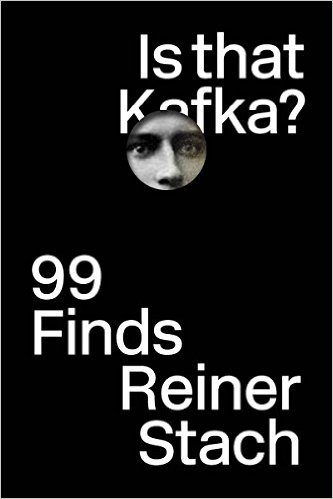
Here are links to two new reviews about a book that shows the other side of Kranz Kafka, where he participates in life with joy and excitement.

Is that Kafka? 99 Finds by Reiner Stach detail 99 facts about Kafka that he discovered in writing his three volume biography about him. They show that Kafka had his ordinary life ways, and a whimsy of more gentle proportions than much of his creative output.

What Color Were Kafka’s Eyes by Avi Steinberg in The New Yorker is detailed and entertaining. And in answer to his query, from the number of different sources answering this question, I’ll stick to Kafka’s passport description: “dark blue-grey”.

http://www.newyorker.com/books/page-turner/what-color-were-kafkas-eyes

99 Ways Of Looking At Kafka by Jeffrey Zuckerman in The New Republic is a well-rounded description of the book, examining one or two excerpts in detail. And I appreciate the illustrations.

https://newrepublic.com/article/131838/99-ways-looking-kafka

All things Kafka fascinate me, and though there might not be much new for one who has written a book about Kafka, I am still looking forward to reading this book.

Here is one of the “missing” diary entries I constructed for my Kafka In The Castle.


01 January 1917

              There was a cloud caught in

the branches of a tree today, outside my

parents home. Or so it appeared. I got up

from the cot and went to tell Ottla, but

she was clearing the kitchen, tending to

the dishes. So I was radical, unthinking –

driven by haste – and told the only one

not consumed by labour. I told my father.

“In the trees?” he asked. I propelled him

from his chair, thrusting the papers

aside. He followed me, and I could see the

surprise on his face. “Where?” he asked;

and I pointed out the window. “But I see

nothing.”  “Oh, you have to lie on the

cot.”  “On the cot?”  “And with your head

just so.” I pushed him onto it, and he

lay, looking sideways. “But you are

right,” he said. I thought because of the

holiday he might be humouring me, but then

I saw that his jaw hung open, and his face

was astonished. Does the boy never grow,

that he can feel so good to be vindicated

by his father?

DE

Letter To Kafka About Life And Government

Franz_Kafka_Brief_an_den_Vater_

Dear F K:

Although it will give you no pleasure – well, ‘little’ pleasure – you are correct in all your observations.

Governments become the tools of the bureaucracies which run them. It doesn’t matter what type of Government, from the monarchy under which you lived, to the right wing horror of fascists which called themselves socialists, to the inept socialism pretending to be ‘for the people’. All three governments held their sway over the city where you spent your life.  All three oppressed the people they ruled. All three looked after themselves first.

Writers are either writers or they aren’t. The urge to write encircles one like a snake around its prey. Feed it and it won’t quite squeeze you to death. You can not ignore it – even at your peril. It is with you every hour of every day, ever inquisitive and (sadly) always looking for something better.

Love is a see-saw of extremes. Every high guarantees a low. Every low reaches for a high. Every high reaches for a high. When these hills and valleys are eventually levelled, they are still desired.

Sex is highly over rated. The thing of it is, even rated fairly ’tis a consummation devoutly to be had.  Yes – I know – you appreciate Shakespeare. On a par with Goethe, even if you can’t bring yourself to say the words.

People are just one damned thing after another. Of course, so many people have brought you blessings that you throw up you hands to ward off the snake. Sometimes loosening its grip.

There is no castle with walls thick enough to hide against the perils of being human.  Which is why you never tried. Except the grave, of course. Except the grave.

Yours,

D

Kafka Was Not Tortured, Sex-Starved Or Crazy

kafka5

When Kafka gave readings of his work, he left the audience rolling in the aisles from laughter. He was a polite and considerate fellow, concerned about the people around him. People enjoyed his company. Children adored him.

Reiner Stach has written the most recent – and, it can be safely said – the most definitive biography of Franz Kafka. All three volumes. And he has detailed the life and work of the man, the trials and the dark outlook, the insistent search and recording of the truth that would disturb anyone’s peace of mind. But – almost, it seems, to his surprise – Stach also encountered numerous occasions and writings that show a man far more balanced than most give Kafka credit for. He has collected them in their own book, Is That Kafka? 99 Finds. The book is to be released in an English translation 21 March 2016.

The Nation has printed two excerpts of the book, which I happily include. They show both Kafka’s keen observational eye (he did, after all, write the very first newspaper article describing aeroplanes at an air show he attended) and also his humour. Why, I’m looking at my desk right now.

DE

~~~~~~~~~~~~~~~~~~~~~~~~~~~~~~~~~~~~

Who Was Kafka?
A collection of ephemera complicates the picture of Franz Kafka as a tortured neurotic.
By Reiner Stach
Yesterday 10:32 am


The Paris Metro

In the course of researching his acclaimed three-volume biography of Franz Kafka, Reiner Stach discovered numerous curiosities and idiosyncrasies about the writer that, taken together, complicate the image of Kafka as a tortured neurotic. He loved beer and slapstick. He undertook a fitness regime popularized by a Dutch exercise guru. He tried to cheat on his high-school exams. He used his desk as a metaphor for self-parody and waxed lyrical about the Paris metro. Stach details some of these oddities in Is That Kafka? 99 Finds, first published in Germany in 2012 and forthcoming from New Directions on March 21 in a translation from the German by Kurt Beals. The following two finds are reprinted with the permission of the publisher.
Kafka Takes the Subway

The Metro seemed very empty to me back then, particularly if I compare it to my trip to the races, when I was sick and alone. Even apart from the emptiness, the metro’s appearance showed the influence of a Sunday. The dark steel color of the walls dominated. The work of the conductors, shoving the doors of the cars open and shut and swinging themselves in and out, was in keeping with the spirit of a Sunday afternoon. People walked slowly along each long correspondence (i.e. transfer). The unnatural indifference of the passengers, their acceptance of this travel by Metro, became clearer. The way that people turned toward the glass doors, that individuals disembarked at unknown stations far from the opera, appeared capricious. Despite the elec. light, changes in the daylight are clearly visible in the stations, particularly when you have just gone down, particularly this afternoon light, just before dusk. Entering into the empty terminal station, Porte Dauphine, a mass of pipes comes into view, a glance into the loop where the trains are allowed to travel in a single curve after such a long, straight trip. It is much more unpleasant to go through a tunnel in a railway train, in the Metro there is no trace of that oppression that the passenger feels beneath the mass of the mountain (even if it is held in check). You also aren’t far from people, it is a city facility, e.g., like the water in the pipes. Leaping backward when disembarking, then moving forward again, all the more forcefully. This disembarking on the same level. Small offices with a telephone and a bell apparatus, usually empty, direct the operation. Max likes to look in. The noise of the Metro was terrible when I took it for the first time in my life, from Montmartre to the grand boulevards. Aside from that it isn’t bad, rather it even intensifies the pleasant, calm feeling of speed. The advertisement for Dubonnet is very well-suited to being read, expected, and observed by sad and unoccupied passengers. Elimination of language from commerce, since one does not have to speak when paying, or when getting on or off. Because it is so easy to understand, the Metro offers the best opportunity for an eager, weakly foreigner to assure himself that he has quickly and correctly made his way into the very essence of Paris on his first try. Foreigners can be recognized by the fact that they are already lost by the time they reach the topmost landing of the Metro stairs, they do not exit the Metro and seamlessly lose themselves in the life of the street like Parisians. And upon exiting, reality only slowly begins to correspond to the map, since, if we had come on foot or by hired car, we never would have made it to this square onto which we just emerged without the guidance of the map


Kafka’s Desk

Now I’ve taken a closer look at my desk and realized that nothing good can be produced on it.

(more) http://www.thenation.com/article/who-was-kafka/

Kafka Passport Reaches Twice Expected Price At Auction

Alas, I did not get it. And to think they gave it to Kafka for nothing.

I am contemplating a novel dealing with the time frame of this passport. Kafka attained it near the end of his life so he could travel to Berlin and to sanatoriums in other countries. But, he was already doomed.

DE

Sold for US$ 37,500 (CA$ 49,742) inc. premium

Bonhams

KAFKA, FRANZ. 1883-1924. Czechoslovak Passport Signed ("Dr. F. Kafka František"), [Prague, June 1922].
Lot 182
KAFKA, FRANZ. 1883-1924.
Czechoslovak Passport Signed (“Dr. F. Kafka František”), [Prague, June 1922].
Sold for US$ 37,500 (CA$ 49,742) inc. premium

Letter To Franz Kafka

19.09.2015

Dear F:

Though it will give you no pleasure (well, ‘little’ pleasure) you are correct in all your observations.

Governments become the tools of the bureaucracies that run them. It doesn’t matter what type of Government, from the monarchy under which you lived, to the right-wing horror of fascists that called themselves socialists, to the inept socialism pretending to be ‘for the people’. All three governments held sway over the city where you spent your life.  All three oppressed the people they ruled. All three looked after themselves first.

Writers are either writers or they aren’t. The urge to write encircles one like a snake around its prey. Feed it and it won’t quite squeeze you to death. You can not ignore it – even at your peril. It is with you every hour of every day, ever inquisitive and (sadly) always looking for something better.

Love is a see-saw of extremes. Every high guarantees a low. Every low reaches for a high. Every high reaches for a high. When these hills and valleys are eventually levelled, they are still desired.

Sex is highly over rated. The thing of it is, even rated fairly “’tis a consummation devoutly to be had”.  Yes – I know – you appreciate Shakespeare. On a par with Goethe, even if you can’t bring yourself to say the words.

People are just one damned thing after another. Of course, so many people have brought you blessings that you throw up you hands to ward off the snake. Sometimes loosening its grip.

There is no castle with walls thick enough to hide against the perils of being human.  Which is why you never tried.

Except the grave, of course.

Except the grave.

Yours,

DE

The Trial is over.

Kafka Makes Demands After He Is Dead

Much is made – again and again – about Kafka’s famous request to his friend, Max Brod, that all his manuscripts be burned unread. That included all his fiction, all his letters, and all his diaries.  Consigned to the flames and removed from the earth.

Had this been done, most of the work for which Kafka is famous would never be known, for little was published during his life. His skewed yet realistic outlook on life, now famously known as Kafkaesque, would not be classed in every dictionary. A touchstone, known the world over, would have been lost. Kafka might, at best, been remembered as the man who wrote about the bug.

I will point out that Brod gets a bum rap about defying Kafka’s direction to burn all his manuscripts. Yes, Kafka did indeed make this request of Brod. He apparently made it a few times, both verbally and in writing.  Each time, Bord told him outright he would not follow Kafka’s request. “It ain’t” – if I might slip into a vernacular it is unlikely the erudite Brod would ever use – “going to be me, chum.”

And I will also point out the obvious. If Kafka really wanted all his manuscripts burned, he could have just as easily (indeed – more easily) done it himself. He certainly did burn much of what he wrote. Brod once found him doing it.

Kafka might have renewed this written request near the end of his life, but he made it to a man whom he know would not do it. That was Kafka.

DE

Kafka Goes To The Movies

ever watching

Although Kafka disliked most technology, he did love to go to the cinema. He also had a great fondness for theatre and actors  (and particularly actresses), though he does not seem to have written any plays.

In the Prague of Kafka’s day, various charities were associated with particular cinemas.  When one paid for a ticket, a portion of the price went to the charity associated with the cinema. You could help the hungry, the homeless, people with medical needs.

Kafka (being, after all, Kafka) particularly enjoyed attending the theatre for the blind.

Kafka To The Day: Writing His Diary

(page from *real* Kafka diary)

One of the most  startling situations regarding Kafka and my (re)construction of his *missing* diary occurred when I had been working on the manuscript a couple of months.

I initially (of course) had the hope of literally writing a diary entry a day. Not only did my real life intervene, but some of the constructed diary entries took days to write. Also, there were times when many of my diary entries were but a few lines long. Thus, I might do a number in a day of writing.

In one instance, as I was checking Kafka’s real diaries, I noted one of his entries had the exact date as the day I was reading it. That is, if he was filling in  a diary entry on Friday, 19 October (for I forget the exact day I realized this), I was reading it on Friday, 19 October. I looked at a perpetual calendar, and not only was the year in which I was writing an exact numerical year to his, so was the following year. 

As a result, I believe my novel took on a more authentic flavour. When I put my pen to paper on the 14th of March, it was also a Wednesday in 1917.  

DE

(image)  http://swc2.hccs.edu/htmls/rowhtml/kafka/Diaries.GIF

Create a free website or blog at WordPress.com.

Up ↑