Search

kafkaestblog

It is a whirlwind in here

Tag

Kafka

Thanksgiving As Kafka Gives It

016898305_30300


In my novel, Kafka In The Castle, I follow a couple of years of Kafka’s life through diary entries. Admittedly, I never had him comment about a US Thanksgiving. But this is one take on his giving thanks.

~~~~~~~~~~~~~~~~~~~~~~

30 September 1917

There was a knocking at the window this morning. A polite and concise rap rap rap. It awoke me while the room was barely light.

Who could want me so early? And then again, an insistent rap rap rap. I was confused, wondering where I was. The panic of Prague weighted down the covers, and I was sorry I had opened my eyes. The room, the smells – even the bed – was not familiar, so I was both bothered and assured by the strangeness.

When I realized I was not in Prague – for who could knock on my third floor window – I remembered I was in Zurau, where things were different. Here my window looked onto a yard, and anyone could  be at it. Was there something wrong? Was Ottla after my help? I even wondered, as I searched for my slippers, if her young man had somehow arranged leave from the army, and after much travail had managed to reach the wrong room. I could understand that very well.

I walked hesitantly over to the window, and cautiously pulled back the curtain. Such a commotion ensued that I stepped back in some fright. A bird flew immediately past the glass, its wings frantic as it screeched in agitation. It had been perched on my window ledge, pecking away at the frame. Ottla says it may have been after insects or grubs settled in for the winter.

“Insects in the walls of the house?” I asked.  “Yes.” She was quite matter-of-fact.  “It is a warm place for them during the cold months.”  I was not inclined to argue with the logic, but neither had I thought I would be existing in such close proximity with the tenants of nature.

Houses for warmth and bugs for food. It is a blend of the base and the subtle which I can appreciate. Much – I like to think – as does the annoyed bird.

DE

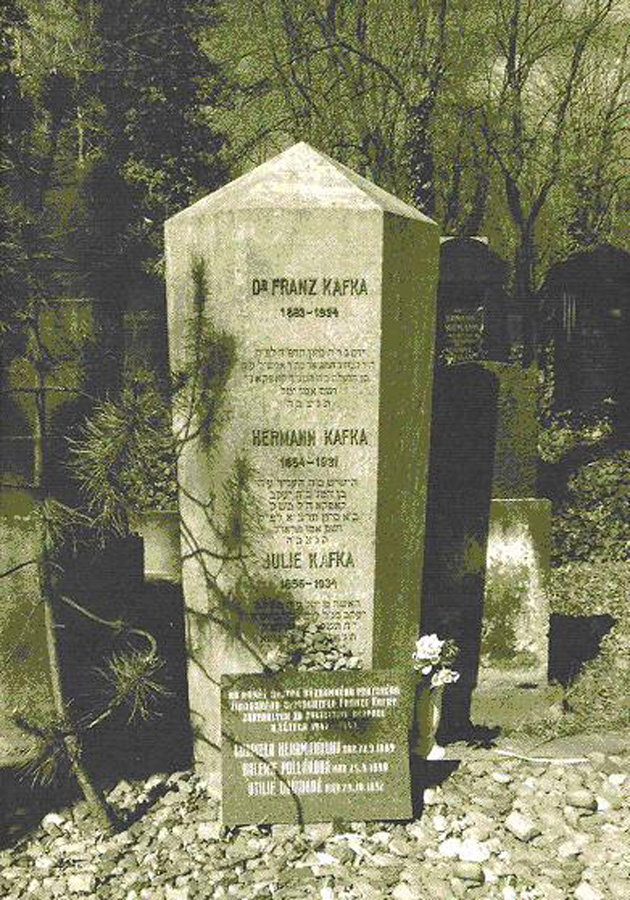
It Is A Grave Thing To Be Dead


kafka-photo-grave-300dpi-4c5c1958

(image)http://zeek.forward.com/workspace/uploads/kafka-photo-grave-300dpi-4c5c1958.jpg

I enjoy graveyards, and peruse them with vigour. It’s true I don’t plan to spend the rest of my life in them, but, after that …

So, I have many tales of cemeteries to tell. Hardly any are scary because, contrary to popular depiction, graveyards are not haunted. Unless one happens to die in one (or – worse yet – die after being buried in one), there are no lingering spirits to haunt. Graveyards are a place, however, to go and contemplate those buried there. I am planning for myself a grand mausoleum.

While researching my novel about Franz Kafka, I went to Prague. In those days it was still under communist subjugation, and travel in and out of Czechoslovakia, to say nothing of travelling the country, was complicated and dangerous. I was fortunate to have arrangements to stay with a Czech academic and his nuclear scientist wife while in Prague. They had a social standing which facilitated an easier visit.

Unknown to me upon arrival, the academic was an amateur historian. When he found the major thrust of my visit concerned Kafka, he was full of places to visit. Many of them I did not know about, and others I doubt I would have found on my own. For instance, he took me to the small house where Kafka had lived on Alchemist Lane, which eventually became the setting for half of my novel. Even though Kafka was in disfavour at the time, the house was noted for the fact he lived there, and it was on tourists lists. In a Kafkaesque twist, it was even then a bookstore, but none of his books were allowed on the shelves.

One of the places I was taken was to Kafka’s grave. It is situated nowhere near where Kafka lived his life, but is in a huge Jewish graveyard on the outskirts of the city. It took nearly an hour on the subway to reach the area. And then a walk to the graveyard itself. And then a walk through the graveyard, though the way to Kafka’s grave was signed. I would never have thought of trying to get there myself.

Kafka is buried with his mother and father (though, literally, vice versa, as he died first). It is only years after the fact that I read about the drama of his death, and the drama at the graveside. His young lover, Dora, who had spent the last year of his life with him, attempted to leap into the grave. She had to be restrained by Kafka’s best friend, Max Brod.

I lingered a long time – perhaps a half hour – by the grave. In the Jewish tradition I left a stone upon the gravestone. In my own twist, I also left a pen. And, because there were few about, and I was so moved, I lay down upon the grave itself.

DE

Kafka And His Very Young Love

106933578_o

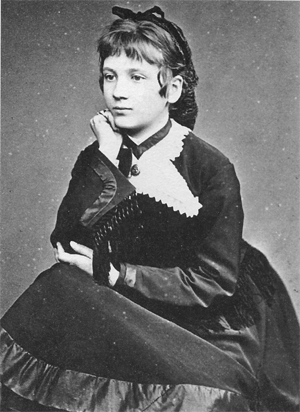
Gerti Wasner

Kafka liked the ladies and he had many relationships.

While in the first year of his ‘love-of-a-lifetime’ affair with Felice Bauer (they were engaged twice but – indeed – never married) he met “The Swiss Girl”. In his diaries she was only referred to as W. or G. W. They were together for ten days in a spa on Lake Garda.

She was a Christian. He was thirty, and she was eighteen. However the relationship (apparently sexually consummated) made a great impression on him for the rest of his life.

Research over the years  finally revealed who she is, and Google search even provides photos. Her name is Gerti Wastner.However, very little else (as far as I can find) is known about her.

Where did her life lead after an encounter with Kafka?

Here are some of Kafka’s actual diary entries about the incident.

DE

~~~~~~~~~~~~~~~~~~~~~~~~~~~~~~~~~~~

15 October 1913

Perhaps I have caught hold of myself again, perhaps I secretly took the shorter way again, and now I, who already despair in loneliness, have pulled myself up again. But the headaches, the sleeplessness! Well, it is worth the struggle, or rather, I have no choice. The stay in Riva was very important to me. For the first time I understood a Christian girl and lived almost entirely within the sphere of her influence. I am incapable of writing down the important things that I need to remember. This weakness of mine makes my dull head clear and empty only in order to preserve itself, but only insofar as the confusion lets itself be crowded off to the periphery. But I almost prefer this condition to the merely dull and indefinite pressure the uncertain release from which first would require a hammer to crush me.


20 October 1913

I would gladly write fairy tales (why do I hate the word so?) that could please W. and that she might sometimes keep under  the table at meals, read between courses, and blush fearfully when she noticed that the sanatorium doctor has been standing behind her for a little while now and watching her. Her excitement sometimes—or really all of the time—when she hears stories. I notice that I am afraid of the almost physical strain of the effort to remember, afraid of the pain beneath which the floor of the thoughtless vacuum of the mind slowly opens up, or even merely heaves up a little in preparation. All things resist being written down. If I knew that her commandment not to mention her were at work here (I have kept it faithfully, almost without effort), then I should be satisfied, but it is nothing but inability. Besides, what am I to think of the fact that this evening, for a long while, I was pondering what the acquaintance with W. had cost me in pleasures with the Russian woman, who at night perhaps (this is by no means impossible) might have let me into her room, which was diagonally across from mine. While my evening’s intercourse with W. was carried on in a language of knocks whose meaning we never definitely agreed upon. I knocked on the ceiling of my room below hers, received her answer, leaned out of the window, greeted her, once let myself be blessed by her, once snatched at a ribbon she let down, sat on the window sill for hours, heard every one of her steps above, mistakenly regarded every chance knock to be the sign of an understanding, heard her coughing, her singing before she fell asleep.


22 October 1913.

Too late. The sweetness of sorrow and of love. To be smiled at by her in the boat. That was most beautiful of all. Always only the desire to die and the not-yet-yielding; this alone is love.


Translated by Joseph Kresh

My Letter To Kafka – Life Lessons With Postage Due

016898305_30300

My Present / Your Future

Still in this World

A Life Away

Dear F:

Although it will give you no pleasure – well, ‘little’ pleasure – you are correct in all your observations.

Governments become the tools of the bureaucracies which run them. It doesn’t matter what type of Government, from the monarchy under which you lived, to the right wing horror of fascists who called themselves socialists, to the inept socialism pretending to be ‘for the people’. All three governments held their sway over the city where you spent your life.  All three oppressed the people they ruled. All three looked after themselves first.

Writers are either writers or they aren’t. The urge to write encircles one like a snake around its prey. Feed it and it won’t quite squeeze you to death. You can not ignore it – even at your peril. It is with you every hour of every day, ever inquisitive and (sadly) always looking for something better.

Love is a see-saw of extremes. Every high guarantees a low. Every low reaches for a high. Every high reaches for a high. When these hills and valleys are eventually levelled, they are still desired.

Sex is highly over-rated. The thing of it is, even rated fairly ’tis a consummation devoutly to be had.  Yes – I know – you appreciate Shakespeare. On a par with Goethe, even if you can’t bring yourself to say the words.

People are just one damned thing after another. Of course, so many people have brought you blessings that you throw up you hands to ward off the snake. Sometimes loosening its grip.

There is no castle with walls thick enough to hide against the perils of being human.  Which is why you never tried. Except the grave, of course. Except the grave.

Yours,

 D

Kafka Pages Survive Fire, History, And The Law

page-of-kafkas-writing-1(From Der Process by Franz Kafka)

Much keeps being made about Franz Kafka telling his best friend, Max Brod, to burn all of his (Kafka’s) manuscripts, and that Max did not do it. What keeps being overlooked is that Kafka made this request three or more times, and each time Max told him outright that he would not do it.

Kafka asked a person whom he knew would not burn his manuscripts to burn his manuscripts. That is a perfect encapsulation of Kafka. He could justify to himself that he tried. He made the effort.

Had he wanted them all burned, he would have done it himself.

So, now, some remaining manuscripts of Kafka have ended their own trial, and will be made available.

Brod estimated that Kafka actually did burn about 80% of all his own manuscripts. In my novel, Kafka In The Castle, I have described such an incident, based on secondary sources. It follows the current News article about Kafka’s manuscripts.

DE

~~~~~~~~~~~~~~~~~~~~~~~~~~~~~~~~~~~~~~~~~~~~~~~

Franz Kafka literary legal battle ends as Israel’s high court rules in favor of library

  • Country’s supreme court rules manuscripts are the national library’s property
  • Estate’s heirs must hand over documents, which include unpublished writings
Franz Kafka had instructed Brod to burn the manuscripts after his death but his friend did not honor that request and took them with him when he fled the Nazi invasion of Czechoslovakia in 1939 and emigrated to Palestine.
Kafka had instructed his friend Max Brod to burn the manuscripts after his death but Brod took them with him when he fled the Nazi invasion of Czechoslovakia in 1939. Photograph: CSU Archives/Everett Collect/Rex

The nation’s top court on Sunday rejected an appeal by the heirs of Max Brod, a friend of Kafka and the executor of his estate to whom he had willed his manuscripts after his death in 1924.

Kafka had instructed Brod to burn the manuscripts after his death but his friend did not honor that request and took them with him when he fled the Nazi invasion of Czechoslovakia in 1939 and emigrated to Palestine.

On his death in 1968, Brod bequeathed the papers to his secretary Esther Hoffe, with instructions to give them to the “Hebrew University of Jerusalem, the municipal library in Tel Aviv or another organization in Israel or abroad”.

But Hoffe, who died in 2007, instead kept them and shared them between her two daughters – sparking multiple legal battles.

In the trial against Hoffe’s heirs, which began in 2009, the state of Israel demanded they hand over all the documents, which included unpublished writings, arguing it was Brod’s last will.

Hoffe’s daughters refused, however, saying the papers – estimated to be worth millions of dollars – had been given to their mother by Brod and therefore she could dispose of them any way she wanted.

In its ruling, the supreme court said: “Max Brod did not want his property to be sold at the best price, but for them to find an appropriate place in a literary and cultural institution.”

Hoffe had during her lifetime sold the original manuscript of The Trial –considered by some to be one of Kafka’s best works – for $2m.

The Hoffe family kept the bulk of the collection locked away in bank safety deposit boxes in Israel and Switzerland and over the years sold some papers to collectors.

https://www.theguardian.com/books/2016/aug/08/franz-kafka-papers-israel-court-ruling

++++++++++++++++++++++++++++++++++++++

Excerpt from: Kafka In The Castle


18 April 1917

Max occasionally tells me that my writing makes a mockery of real life. But I find that the life which surrounds me  – which I wade through every day – makes a mockery of anything I can write. What place do my awkward dreams and petulant hopes have in this real world. “Do they keep me warm?” as my father asks. Father would have been happy – if far from understanding – had he been watching me this past hour. I wedded both worlds through flame. Passion enough for me, and heat enough for him.

On this abrupt cold day, in this chilled, unwelcoming house. I opened the empty, blackened stove, and prepared to make a fire. I read too many newspapers, so their pages were abundant. All this vague war news, getting more vague, and pointing only to disaster. A match struck against the side of the stove, and the war news erupted. A fitting end. Then, since I’m not allowed into their war so my flesh can perish, my other life could at least enter the inferno.

I took a pile of manuscripts from the chair and placed them into the flame. Page by page. Words and sentences marching. I didn’t even look to see what they were. Which characters vanished. Which actions ceased. All equal to me, and all equal to the flames. Some of the pages were older work, which I carry from house to house with the intent of making better. This time I succeeded. Other pages were created in this tiny house, where there are too many eyes at the windows, and too many years caught in the dust. They followed into the fire, sometimes by the handful.

And now, I ponder over these pages beneath my fingers. However, there is new wood within the stove, and for the moment, the heat sustains me.


19 April 1917

Max was horrified when I told him about last night. “You burned your stories? Are you crazy?”  “I wrote them, so I must be.”  He smiled at that. Max’s anger can be easily deflected, for it is never deep. Max is a very good man, and cares for me more than I do myself. “And the novel? The Amerika novel?” I told him that many chapters of that must have been burned. Probably right from the start – they were no doubt the first things I grabbed from the chair.  “Anything else?”  “There were a couple of plays. I remember pages of dialogue.”

Max’s voice became hollow. He might no longer be angry, but neither was he happy. “I didn’t know you had written any plays. You have secrets even from me.”  “I keep secrets from myself. Don’t be offended.”  “What else?”  I could picture him writing down an inventory. “Some diary entries – those were deliberate.”  “And was that the end of your pyromaniacal obsession?”  “Of my own work – yes.” He looked at me questioningly – he didn’t need another secret. “There were a couple of bundles of letters from Felice. Neatly tied with string. They burned slowly. I have not had such warmth from her for a long time.”

Engaged And The Joy Of Marriage From “Kafka In The Castle”

ca246f_f0a30bdddff74353b79db12596f98ae9

09 July 1917

We have become engaged for the second time. Joy from my parents. My beaming father. How glad I was that Ottla wasn’t there. I looked around the room and saw what awaited me – overstuffed furniture and mouths full of banality. F. had tea with us, and nibbled on the dainty cakes. And I knew she was taking in each chip of the porcelain to relay to her mother. Weighing and judging.

My father is crude, my mother gushes, but there is obviously money. And, I am a Herr Doktor of Laws, and well advanced up the ladder of bureaucracy. Yes, there are some elements of the brooding author, but that can be restricted to conversations with my friends after dinner on Sunday. Or, a couple of evenings at the coffee house a month. Those should be avenues enough to tend to my funny, little needs. A few hours in the dark, twitching like a timid rodent.

Then, each week could begin anew. We even did our social duties, Felice and I. Visiting friends and relations with the joyous news. In a stiff, high collar which I had to borrow from my father. Much to his delight. We last called upon Max and his wife, as afternoon dragged into evening. Plates of food and platters of words. Max could not take his eyes from my chafing collar, and I knew he wanted to ask about it. But he dared not. Not in front of wife and fiancee. His and mine. He could not contain his smile however. Horror and humour. Mine and his. At least the social niceties were over once we left his house – except, of course, for my walk with F. back to her hotel. She debated whether or not to return to my parents, but I dissuaded her. She might have allowed an embrace on the outside steps, had I but tried. Had I only tried.

But I scuttled away, ascended some other steps, and here I am within this tiny house. The door is open because of the heat, but even had I locked and bared it after me, I fear they all would still enter. Would walk through the walls if necessary. Would scale the castle with ladders, if necessary. They are never going to let me rest. Even as I sleep, they will be lurking in my dreams.

DE

(image) http://static.wixstatic.com/media/ca246f_f0a30bdddff74353b79db12596f98ae9.jpg

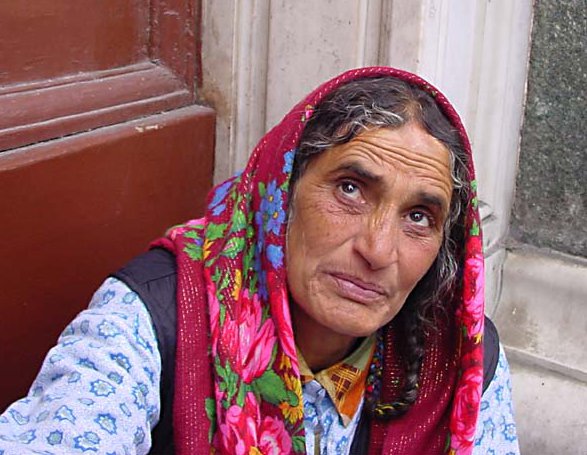
A Gypsy Speaks The Future Of Truth And Death [from: Kafka In The Castle]

gypsywoman

08 June 1917

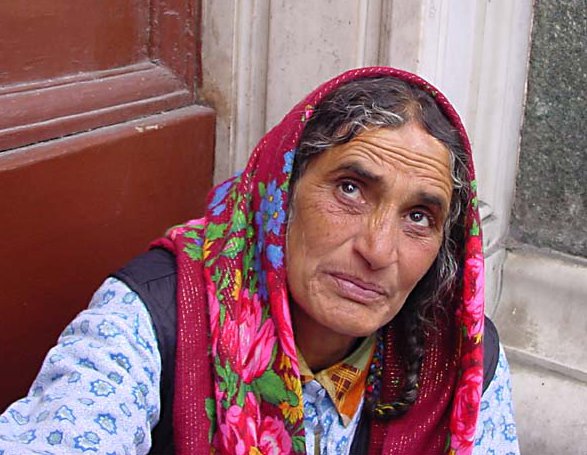
A Gypsy confronted me today, and I was in the mood for a bit of sport. Her age was difficult to tell – certainly a decade older than me. In her swirl of shawls and dangling jewellery, heavy make-up on her face, she could almost have been in disguise. She peered at me with an intense sigh, attempting – I am sure – to penetrate my own disguise.

“You are a Jew,” she said.

“And you a Gypsy,” I replied.

She seemed pleased with my response, for her professional smile became real.

“You state the obvious,” she said. “As becomes a Doktor of Laws,”

I replied. “But to your eyes, do you not state the obvious?”

“Are you going to banter with a poor old Gypsy woman, instead of barter? That would make you suspiciously like one of us.” She said this with a growl in her throat.

“The Gypsy and the Jew,” I said, feeling the challenge which I so miss. “Perhaps an opera – but I think it’s been done to death.”

“They will try to do us all unto death,” she said harshly, and turned away.

I had the fear she was going to leave me without another word, but what she did was to spit fulsomely onto the street.

“They can’t kill us all,” I said, but I knew she heard the doubt in my voice.

She slowly faced me again.

“So. Even a Doktor of Laws can have hope. That is refreshing – but foolish.” She took my hand and felt my palm roughly with her thumb, although all the while her eyes never left my face. “You are going to travel.”

“Travel is a vague word. One can go on many types of voyage.”

“And reach many destinations,” she added, still holding my hand. “If you take away my vagueness, you take away my trade.”

“Then let me pay you for your services right now.”

This transaction would make her loose my hand, which is what I wanted most of all. She had frightened me, for her eyes and face were full of truth. I know the truth. I know it when it presents itself, stark and unobscured. I search out truth endlessly, yet still can flee at its approach. As in her eyes. But she gripped me more fiercely, and pulled my hand up.

“The coin, Herr Doktor.” Her voice was now soft. “The coin can wait.”

She at last lowered her eyes and looked closely at my palm. She rubbed the lines and whorls of my skin. She touched her finger to her lips, and spread the moisture along my hand.

“Your lifeline, Herr Doktor,” she took a quick look in my eyes, “of Laws. You deceive with the youth upon your face. Is that not so?”

“If your eyes stop at the mask, then no, the years have not etched themselves deeply.”

“Not on your face, Herr Doktor of Laws.” Her grip was intense. “But on your palm…” She hissed. “You will soon embark upon that final voyage.”

She released my hand, rubbed her fingers across her sleeve.

“But you will not go in haste. There will be many stops along the way.”

Suddenly her face was full of the most beautiful smile, and her laughter was genuine.

“I see you do not complain of vagueness now.” She held out her hand. “The coin, Herr Doktor of Laws. This time I have truly earned it.”

I dug deeply into my pocket, and feared that I may have overpaid her. But, perhaps, that is not possible.

DE

(image) http://1.bp.blogspot.com/-SDayP1IJD0M/TVrspG3I5oI/AAAAAAAAGko/RjODxg1C_WI/s1600/gypsyWoman.jpg

Kafka Sweeps Away Dust, Gold And War [from: Kafka In The Castle]

objects-of-use-chinese-broom-remodelista-518x600

27 November 1916

Should I comment upon my unique and strange surroundings – this tiny house of Ottla’s. Not shared with a fiancée, but a sister. This place would not do for Felice, it is too small and too spare and too far from the heart of the city. But I feel secure against the winter. Up here in the castle.

As with all the tiny houses on Alchemist Lane, this one has its history of the quest for gold. Thus I fit right in, for I am after such purity.


17 December 1916

Although Ottla seems content with just her Sunday afternoons in this tiny house, I was careful to make certain no one was here before I entered. Since the Alchemist Lane ends in a stone wall, all who enter have to return the way they came. How awkward. Ottla would just smile and ask after my health, it is I who would look at my feet. My love affair of letters would blush on such sure ground. But, we did not pass.

This place is of course a fantasy, a burrow in which to hide through these winter months. It’s barely big enough to bury a man properly, yet before Ottla moved in, a family of eleven crammed their lives into it. Knowing how fortunate I am in this world never seems to help in mine. I thought I might leave both worlds, with the help of the army. Friends and family have told me how grateful I should be that I am unable to join. My official dispensation because I am indispensable to the bureaucracy of the Empire. F. looked upon me in disbelief when I told her I would try again to enlist. Perhaps I can gather the spirits of the necromancers who have lived on this lane to assist me.


18 December 1916

I could, with my broom, sweep away the glory of war. It is less than the dust of this tiny house.

DE

(image) http://www.remodelista.com/wp-content/uploads/2015/03/objects-of-use-chinese-broom-Remodelista-518×600.jpg

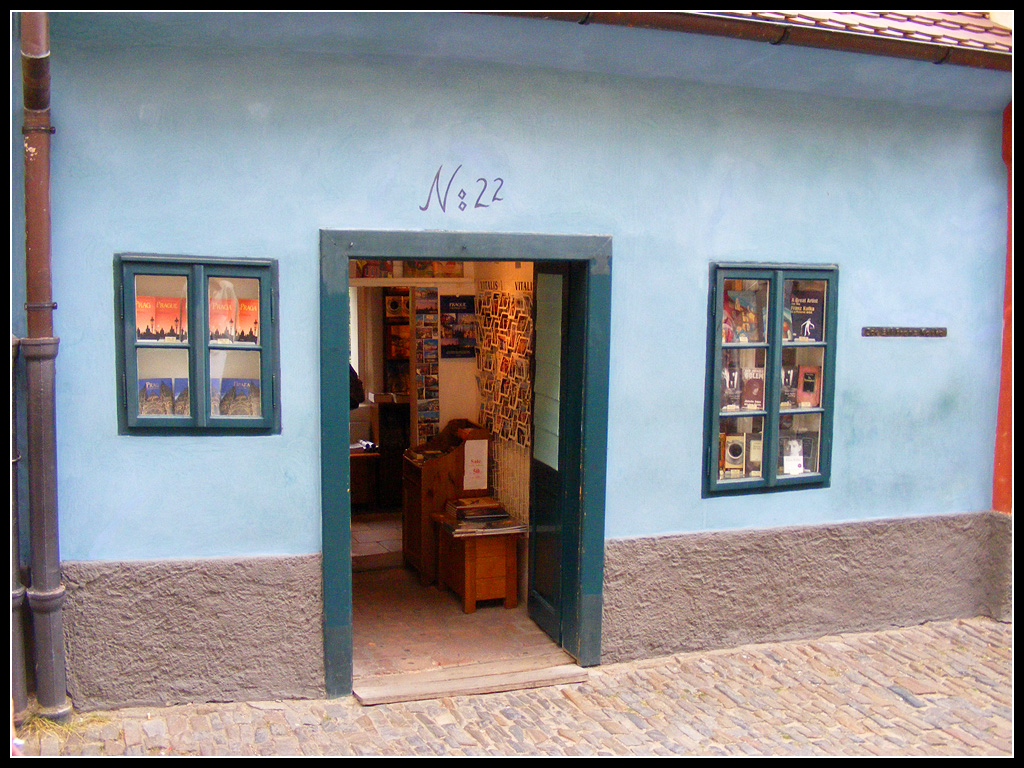
Franz Kafka Turns Words To Gold On The Golden Lane

3848764367_a7b9e65ed5_o

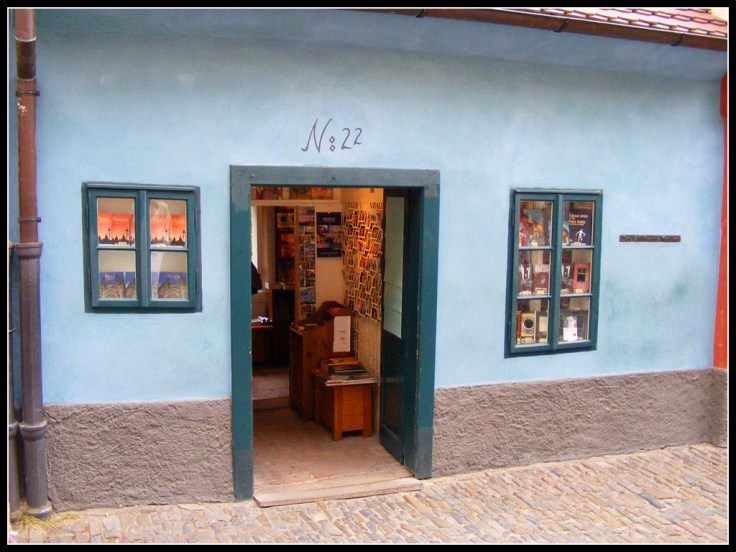
[Kafka’s house on The Golden Lane]

A burrow offers security and comfort.  Kafka found both in his sister’s tiny house on the Golden Lane.

The Golden Lane is a narrow, dead-end yet massively historic lane, hugging an interior wall of the huge Prague Castle. Centuries ago the small buildings along the lane housed workers of the Castle, including some resident alchemists. Thus the name.

Ottla – Kafka’s sister – had rented it so she could spend time with her lover, and not be bothered by parents and comments. Her lover was not only a Christian, but he was soon going to leave to fight in World War I. Time was precious. However, she rarely had opportunities to use it other than the weekends, so she offered Franz the use of the tiny house for most of the time. And use it he did, though he never stayed the night.

Through fall, winter and spring Kafka wrote a whole book of short stories there. For a single block of time, it was one of his most creative periods.

When I visited, under the Communist rule of the time, it had been converted to a book store. Of course (which he would have appreciated) there were no books by Kafka for sale. Today he is displayed in the windows.

It was only when I went thorough the small rooms, and looked out the window into The Stag Moat, that I realized how important the house would become in Kafka In The Castle, my novel about Kafka. It was cozy – even with the space cramped by tourists. It had been little altered. I could easily imagine Kafka looking through the same glass and walking through the same doorways. No doubt stooping because he was tall. Research met reality.

One of the last stories Kafka wrote, during his final year in Berlin, was called The Burrow. A version exists and is published, though a longer version is supposed to be among his ‘missing’ papers. In it a tiny animal keeps incessantly burrowing to keep away from an enemy. A vague noise convinces the animal to burrow deeper. Yup – that’s Kafka.

DE

(image) https://farm3.staticflickr.com/2645/3848764367_a7b9e65ed5_o.jpg

Create a free website or blog at WordPress.com.

Up ↑