Director of Operations – Bluenose II


My novel. Kafka In The Castle, fills in Kafka’s missing diary entries. This is how I imagine Kafka’s best friend, Max Brod, reacts to one of the many times Kafka burned his own manuscripts.
~~~~~~~~~~~~~~
19 April 1917
Max was horrified when I told him about last night.
“You burned your stories? Are you crazy?”
“I wrote them, so I must be.”
He smiled at that. Max’s anger can be easily deflected, for it is never deep. Max is a very good man, and cares for me more than I do myself.
“And the novel? The Amerika novel?”
I told him that many chapters of that must have been burned. Probably right from the start – they were no doubt the first things I grabbed from the chair. “Anything else?”
“There were a couple of plays. I remember pages of dialogue.”
Max’s voice became hollow. He might no longer be angry, but neither was he happy. “I didn’t know you had written any plays. You have secrets even from me.”
“I keep secrets from myself. Don’t be offended.”
“What else?”
I could picture him writing down an inventory.
“Some diary entries – those were deliberate.”
“And was that the end of your pyromaniac obsession?”
“Of my own work – yes.”
He looked at me questioningly – he didn’t need another secret.
“There were a couple of bundles of letters from Felice. Neatly tied with string. They burned slowly. I have not had such warmth from her for a long time.”
[image] https://quelibroleer.files.wordpress.com/2011/05/libo-quemandose1.jpg

An Excerpt from my Kafka In The Castle, where I fill in all of his missing diary entries. Kafka never avoided life – if anything, he perhaps plunged too deeply into it. But I think he never felt he was a part of what went on around him. He understood reality too well.
~~~~~~~~~~~~~~~~~~~
01 June 1917
I have been on the outside, looking in – the darkness of the night behind me, the fog resting close upon the harbour.
I’ve watched diners at their ease, the fire colourful through the grate, the rich hue of the glass raised to the lips. And my own face, peering back at me as I look in, reflecting like a ghost’s shadow from the window.
And the very next night, I have been on the inside, looking out – seated at the very table I had previously observed.
The fireplace at my back, its warmth more than welcome. And I glanced out at the harbour, its fog higher than the previous evening, but not yet obscuring the lights of the ships. Their portholes wavering.
And, as I brought the red liquid to my lips, I saw my own face dimly doing the same in the window, imposed and distant between me and the fog. And I felt as alone as I did the night before.
Whether I was sitting or standing; whether in the warmth, or in the fog – I was still me.
Always K.
Always observing.

An Excerpt from my Kafka In The Castle, where I fill in all of his missing diary entries. Perhaps because the summer heat is getting to him, his patience is thin with those whose hope outstrip the realities of life and – particularly – death.
~~~~~~~~~~~~~~
17 June 1917
I am told that you can’t lose people, that “…they will always be with you in memory.” Max is heavy with this type of comment – as if the hand of sentimentality brushed off his coat before he set out on each day.
Both the intelligent and the slow of wit seem to be struck dumb by this nonsense. Emotion, I suppose – hope, I suppose – has no place for reason among its folds. But, if you can not touch, or have expectation of being touched, then the people and places are as gone as yesterday.
There is no way to travel back, and the future beckons with only an empty gesture and a hollow laugh. Bowing low at the open doorway to usher you in, but the room is empty. And will remain ever so.
When they are no longer there to hold their hand out to you – well, then they are no longer there.
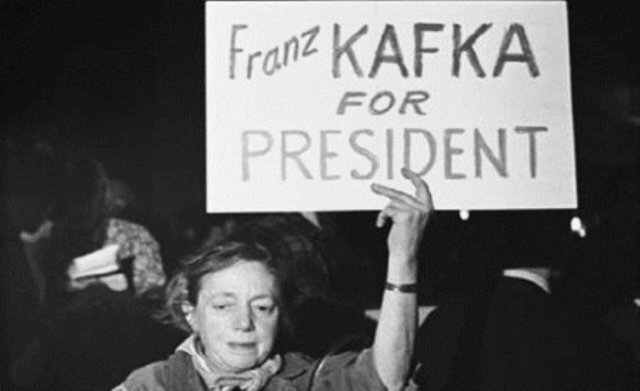
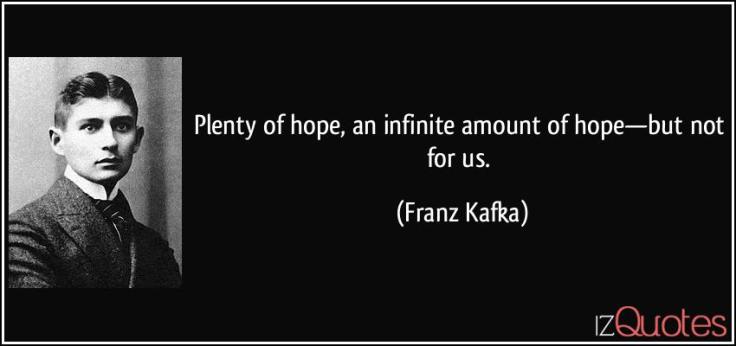
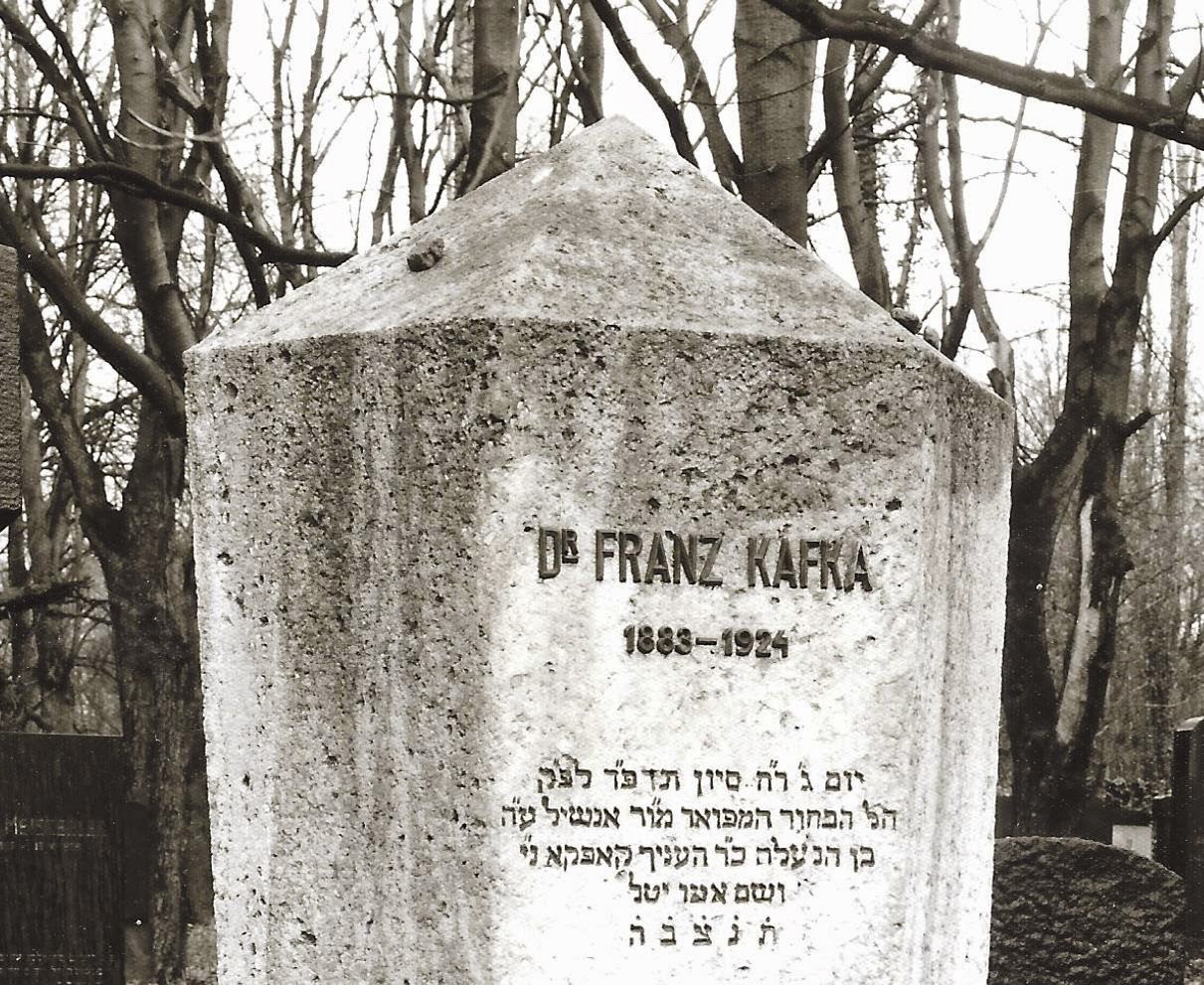
Franz Kafka inches toward being dead for 100 years.He died on this day, 03 June, in 1924. he did not go gently into that good night, though he probably was just as happy to be gone. It was difficult to satisfy Kafka,
I wonder what Kafka would think about the worldwide communication and information of today. He was a rigid fixture of the staid (he hated using the telephone). He also was a keen observer of the world around him (he wrote the first newspaper report about aeroplanes, and he invented the safety helmet). It was more this deep divide in his personality which caused him his problems, about which he so famously wrote.
He did not fit into his personal world, yet he fit into the real world perfectly. He was adored by his friends and by many ladies. He was respected at his work and rose to a position of power. His stories were published to acclaim in his lifetime.
Kafka lived a Kafkaesque life. He died a Kafkaesque death (he caught tuberculosis because he drank “pure” unpasteurised cow’s milk). He was rigid in his personal beliefs (until proved wrong), yet he was a beacon of compassion to others.
Kafka was always on a tightrope. He looked at things with such accuracy that his comments can seem bizarre. Supposedly his last words were: “Kill me, or you are a murderer.” They were to his doctor, as Kafka beseeches for an overdose of morphine.
I have written much about Kafka. I will share but two.
This is the diary entry I had him write in my fictional novel “Kafka In The Castle”:
03 July 1917
The anniversary of my birth. In honour of the day, I do not make it my last.
And this is a short story.
The old Rabbi moved slightly on his bed, and the young man raced over.
“Yes, Rebbe?”
The old Rabbi opened his eyes, showing the cast of death which had almost consumed him. “Ka … ” he groaned.
The young man had been told the dying Rabbi would never regain his senses, and he did not know what to do. He was scared, almost horrified, but he leaned closer.
“What is it? What do you want?”
The old Rabbi struggled for breath. “Ka … Kaf …”
The young man gazed at the face, saw its pallid features and the clouded eyes. He touched a shrunken cheek, raised his voice to a shout. “What is it? What can I do?” He could hear wheezing, the struggle for air. He put his ear directly over the gaping mouth.
“Ka … Ka …” One last ragged breath, a low hollow whisper. “Kafka died for your sins.”


“I wish to state before this assembled multitude;
“Before this packed house;
“Before this captive audience;
“That I have every right
“(As much as each of you)
“To be here and represent my interests,
“My justifications
“And my associations,
“Because I am a member in every day,
And, perhaps
“Even as the nights which are too cold
“And the elevators, as they so often do – stop.
“You look askance.
“Indeed, you look at me in That manner
“That indicates
“That
“The corners of your eyes are full of mistakes!
“Which proves to me beyond and above
“To heaven even,
“Even to the very Golden Gates
“Where the various saints
“Hang to the golden bars
“And swing to and fro in the Celestial breezes
“That cause clouds to scud across the sky,
“And there is barely time to think of a reply.”
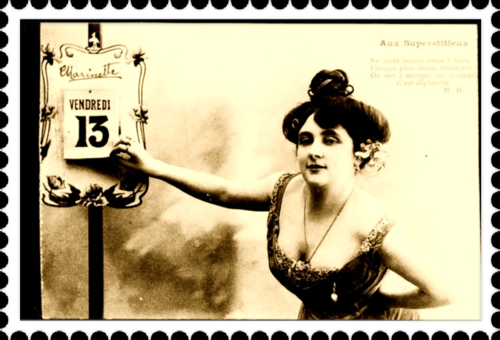
[Image] http://3.bp.blogspot.com/-MdKIWdDP1wI/TxCSAm2WKAI/AAAAAAAAEfs/z6pxZKrt1iE/s640/friday13th.png

In my novel, The Fifth Corner Of The Earth (which I class as a contemporary history) five people, decedents of five people through the centuries, must come together to decide whether it is time to end the Earth – the proverbial End Times. But this time, one of those chosen is a woman. And women’s power is described.
~~~~~~~~~~~~~~~~~~~~~~~~~~~
She went along the hallway, turned down a longer, narrower corridor, and came to her brother’s room.
“Markos?”
She knocked on the door, but when there was no reply, she called again.
“Markos?”
“Please, Atropos. Come in.”
She lifted the latch and walked into the darkened room. She went down a few steps, and crossed the stone floor, until she came to the thick wool rug which covered the area beneath the bed. Her brother stretched his hand along the bedclothes.
“It is almost time for you to leave?”
“In the half hour.”
“You’ve been troubled.” He sat higher in the bed. “How are you feeling now?”
“That’s supposed to be my question.” She laughed nervously.
“I feel as I am – closer to death.” Markos pulled at the bedclothes. “We must not pretend anything different.”
“There’s always the chance – ”
“You’re talking to your brother – your younger brother to whom you have taught so much. Of course I know of `chance’.”
Markos started to cough, and doubled over as the sound filled the room.
“You see.” He forced a laugh. “As if on cue.” He held up his hand as she came closer. “They would have to give me new lungs, to do any good now. There is no place for `chance’.”
“Do you want a drink?” She reached for the pitcher of water.
“I want to talk.” As he again sat up, he pointed past the water on the table. “Get it for me, please.”
She stretched and took the black envelope in her hand. As she gave it to Markos, the sun insignia on the back glowed in the dimness of the room.
“Thank you, Atropos.” He lay it on the covers in front of him. “And thank you for the honour of asking my council.”
“Markos, I – ”
“It means a lot to me.” He held up her hand to stop her words. “You still have confidence in the advice I can give.”
“Of course I have – ”
“Ah, my sister.” He spoke slowly. “The dead and near dead have one thing in common. They no longer need to be humoured.” He touched her hand. “I don’t want to be a weight on your mind when you’re away.”
“How can I stop thinking about you?”
“I don’t ask that.” He smiled. “I hope I’m always in your thoughts. That’s how I’ll keep alive.”
“Oh, Markos.”
“You feel too much, sometimes, Atropos. Is that part of being a woman?”
“I don’t know.” She forced a smile.
“I think it is.” He pushed one of the pillows more firmly beneath him. “I think it’s because you can bring life into existence – you can actually feel a soul develop inside you. Women have a touch of God within them because of that.”
Markos hesitated, his breathing more laboured. He looked at his sister intently, his eyes hot from fever.
“Men will always envy you that power. We envy you the power to create life, and the feelings it must give.” He smiled abruptly. “Our duty done, we really become quite superfluous.”
“You surprise me.” Atropos spoke softly.
“What have I got to lose by letting you know of my primordial envy? My fears and inferiority mean nothing at death’s door.” He looked away. “I no longer dread you will turn them against me, and look upon me with contempt.”
“Markos. I would never have done that.”
“I am like all humans, Atropos. I have doubt of my own worth held within me like an insoluble capsule. Your words can’t dissolve it – even the knowledge of death leaves it untouched.” He stroked his chest. “Death just puts it in perspective.”
“I don’t feel that way.”
“No, you don’t.” His hand stopped moving. “And I suspect the others whom you are soon to meet are spared this most human failing.” He closed his eyes. “I want to make certain you understand. We humans are forced to carry this sense of worthlessness around like a curse. Remember that when you decide about us.”
“But where does it come from?”
“That question … ”
Markos turned his head. He opened his eyes, and looked out at the blue sky framed by the small window. Sunlight would soon be streaming through.
“I am not going to live long enough to answer that question.” He looked back at her. “Come closer.”
“What is it?” She leaned over the bed.”
“Don’t worry about me.” He clasped her hands in a strong grip. “I’m prepared for what it to happen to me – and accept it. Tell me you do the same.”
“I know you are going to die.” She searched for words. “I’m not sure I can accept it.”
“Then believe me, my honest sister, when I say I am content.” Markos stared at her face. “Tell me that my death will not cloud your mind on your journey.”
“I’ll keep you in my mind and heart.” She momentarily lost her breath. “Always. My sadness won’t distract me.”
Markos sighed, and his hands relaxed. He then picked up the envelope which had fallen beside him, and handed it to her.
“Here.”
She took it, then bent and kissed him.
“Good bye, Markos.”
“God guard you, Atropos.”
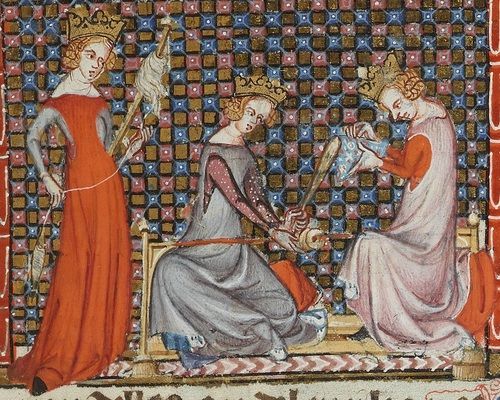
[Image} http://i.pinimg.com/originals/fb/48/ad/fb48adcbaf691feeb5b0c9484c44ff7f.jpg