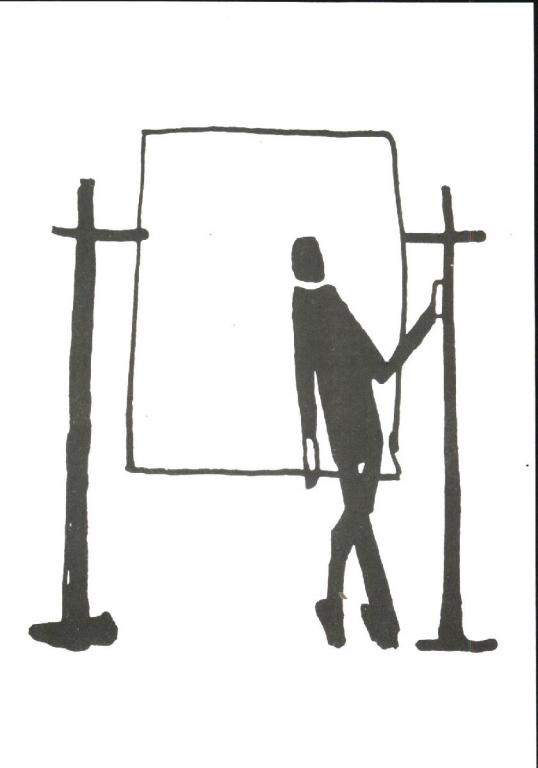
[Image of Kafka by Kafka]
In my novel, Kafka In The Castle, I fill in the lost (or destroyed) diary entries of Franz Kafka. He recorded many of his dreams. So do I.
**************
04 March 1917
I dreamed I was a prophet. The prophet Amshel, which is my Jewish name.
And, I could talk to God.
And I was looking at myself in the mirror.
And I was looking back at me. I mean, Franz was in the mirror, looking back at me – the me of Amshel – who was looking in the mirror. Except, I was as much me looking out, as I was me looking in.
The wall behind the prophet was painted red, while the one behind Franz was of brown wood. They both could raise their fists at each other, and sometimes did. In unison, of course. That was the law.
“Certainly, you may speak to God,” said Franz. “What is there in that? Everyone speaks to God – in sentences, in actions, with their lives. No one is more talked-to in the Universe than God. But what a prophet needs, is to have God speak back.”
And then God spoke, from somewhere behind the mirror, but He did not speak to Amshel. He spoke to Franz.
“You are on the wrong side,” said God.
“Speak to me,” said Amshel.
“Wrong side of what?” asked Franz.
“Of the mirror,” answered God.
“Don’t speak to him,” shouted Amshel. “He is from the world of vipers.” And Amshel raised his fist, but Franz had to hold up his fist in turn.
“I am not the prophet you seek,” said Franz, and pointed his finger at the mirror. “There is your prophet.” And Amshel was also pointing toward the glass.
“Not him – you don’t want him.” He then turned his hand toward himself. “I’m the one you want.”
But Franz was just as vehement, as his thumb arched toward his own chest. “Not me.” For emphasis, he placed his hand over his heart. “In this, God, you have erred.”
And his words echoed those of Amshel, who also had his hand upon his heart. “In this, God, you have erred.”
And the two faces stared at one another, their fingers clutching at the garments they wore.
But God was silent.

The RAF Red Arrows flew on over an eerily quiet Buckingham Palace on Friday morning to mark Victory in Europe Day. In what was supposed to be a day of huge celebration with thousands of people lining the streets, instead the only people out to see the flypast were journalists and photographers. It had been…
via Red Arrows fly over an abandoned Buckingham Palace to commemorate VE Day — Royal Central


Excerpt from my Kafka In The Castle, where I fill in all of his missing diary entries. Here he is dealing with a time twenty-eight years after the first May Day was declared. Kafka dealt with workers every day of his work life. But he didn’t take their problems home.
By the way – in real life – Kafka is credited with inventing the the hard hat.
+++++++++++++++++++++++++++
27 April 1917
Life seems to offer a handful of solutions which solve nothing. If I could get out of Prague, then I wouldn’t have to get out of Prague.
29 April 1917
Ottla managed to get away, and I’ll be able to visit. The dead man next door (I have since found his name was Adolf) also managed to get out of Prague. Him, I can not visit, but I can follow.
03 May 1917
The thoughts of the living discourage the dead. I spend so much time watching over myself, that there is no one left to watch over me.
06 May 1917
I write to Ottla. I make no mention of her terminated neighbour. I do say “hello” from father. Not an uneven balance.
08 May 1917
If Shakespeare were alive today, and people pestered him about Hamlet, would he wonder what all the fuss was about?
(image) 2.bp.blogspot.com/-atmC5fHIQp0/UhqBTCq06LI/AAAAAAAAAkA/S47fPCQHuww/w1200-h630-p-k-no-nu/kafka_hard_hat.jpg


