Search

kafkaestblog

It is a whirlwind in here

To Find Rest In The Graveyard

(image)

I http://images.nationalgeographic.com/wpf/media-live/photos/000/227/cache/saint-magnus-cemetery-richardson_22760_600x450.jpg

I enjoy graveyards, and peruse them with vigour. It’s true I don’t plan to spend the rest of my life in them, but, after that …

So, I have many tales of cemeteries to tell. Hardly any are scary because, contrary to popular depiction, graveyards are not haunted. Unless one happens to die in one (or – worse yet – die after being buried in one), there are no lingering spirits to haunt. Graveyards are a place, however, to go and contemplate those buried there. I am planning for myself a grand mausoleum.

While researching my novel about Franz Kafka, I went to Prague. In those days it was still under communist subjugation, and travel in and out of Czechoslovakia, to say nothing of travelling the country, was complicated and dangerous. I was fortunate to have arrangements to stay with a Czech academic and his nuclear scientist wife while in Prague. They had a social standing which facilitated an easier visit.

Unknown to me upon arrival, the academic was an amateur historian. When he found the major thrust of my visit concerned Kafka, he was full of places to visit. Many of them I did not know about, and others I doubt I would have found on my own. For instance, he took me to the small house where Kafka had lived on Alchemist Lane, which eventually became the setting for half of my novel. Even though Kafka was in disfavour at the time, the house was noted for the fact he lived there, and it was on tourists lists. In a Kafkaesque twist, it was even then a bookstore, but none of his books were allowed on the shelves.

One of the places I was taken was to Kafka’s grave. It is situated nowhere near where Kafka lived his life, but is in a huge Jewish graveyard on the outskirts of the city. It took nearly an hour on the subway to reach the area. And then a walk to the graveyard itself. And then a walk through the graveyard, though the way to Kafka’s grave was signed. I would never have thought of trying to get there myself.

Kafka is buried with his mother and father (though, literally, vice versa, as he died first). It is only years after the fact that I read about the drama of his death, and the drama at the graveside. His young lover, Dora, who had spent the last year of his life with him, attempted to leap into the grave. She had to be restrained by Kafka’s best friend, Max Brod.

I lingered a long time – perhaps a half hour – by the grave. In the Jewish tradition I left a stone upon the gravestone. In my own twist, I also left a pen. And, because there were few about, and I was so moved, I lay down upon the grave itself.

DE

Kafka Passport Reaches Twice Expected Price At Auction

Alas, I did not get it. And to think they gave it to Kafka for nothing.

I am contemplating a novel dealing with the time frame of this passport. Kafka attained it near the end of his life so he could travel to Berlin and to sanatoriums in other countries. But, he was already doomed.

DE

Sold for US$ 37,500 (CA$ 49,742) inc. premium

Bonhams

KAFKA, FRANZ. 1883-1924. Czechoslovak Passport Signed ("Dr. F. Kafka František"), [Prague, June 1922].
Lot 182
KAFKA, FRANZ. 1883-1924.
Czechoslovak Passport Signed (“Dr. F. Kafka František”), [Prague, June 1922].
Sold for US$ 37,500 (CA$ 49,742) inc. premium

Eagle And Crows Face Off By A City Graveyard

show down

(image)

I http://www.naturebob.com/zenphoto/cache/Birds/hawks-and-eagles/bald-eagle-and-northwestern-crow_595.jpg

I was within three minutes of finishing my daily walk.This particular route takes me through an historic graveyard in the centre of the city. The graveyard encompasses two city blocks and is surrounded by a metal fence. One walks through a gate, along a cement path, and through another gate. The second gate is three minutes from my residence.

I was part way through the graveyard when I saw a group of people crowded together near the path. I assumed it was a group of youth, who often use the graveyard as a ‘park’. I assumed they were just hanging out, but i did keep an eye on them. When I was close enough I realized it was a film crew of seven or eight. They were clustered around a boom camera, one which can rise to a moderate height. As they were directly across from an historic cairn, I thought they might be filming some sort of documentary, and photographing the cairn. I passed them by, making a point not to gawk.

Just past the other gate I was about to cross the street. As i looked both ways for cars I saw, about five car lengths away, a bald eagle standing on the pavement. if one can not ‘literally believe their eyes’, this was the time for me. However, realizing it was there, I figuratively rubbed my eyes. It was standing stock still. I immediately thought it was a) stuffed and b) it was some sort of prop for that movie crew. Such is the imagination.

Within seconds the tableaux changed. The bald eagle started (or returned to) hopping around. And, now taking in more of what was before my eyes, I saw a crow overhead. The crow was diving at the eagle. Then, as quickly, I saw other crows in the sky, a half dozen or so. They were all circling overhead, and were taking turns aiming at the eagle. The eagle started hopping around even more.

I do not know what had happened to make this encounter occur. Now I wondered if the eagle was injured. It was moving slowly and kept its wings folded. The crows were not (I assume – wisely) making contact with the big bird. They were, however, constant and raucous. The term “dive bombing” comes to mind. The eagle became more agitated.

Without any effort (so it seemed) the eagle lifted into the air. This caused an increase in the vocal alarms of the crows. The eagle started a steady ascent toward the south, looking as magnificent as eagles are supposed to do. All the crows now circled continually, keeping their distance and cawing incessantly. The eagle was soon high above the tops of the trees. It made a slow alteration of course and headed toward the river, which is five blocks away from the graveyard. It kept gaining altitude and the crows kept pursuit. All the birds became too distant to observe.

As they all departed I heard a shout behind me. I turned in time to see the camera on its boom extended high, pointed toward the first gate I had entered. Within seconds a young man was running along the cement path through the graveyard. The camera lowered and tracked him until a voice shouted “Cut!” he stopped right in front of the memorial cairn.

Three minutes later I turned into the driveway of my residence.

DE

The Cat of the Ship Retires in Halifax – Mice Rejoice

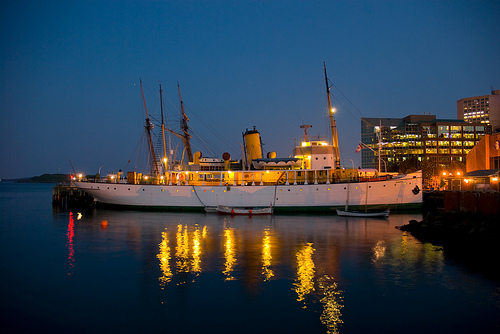
Erik The Red, the mouser of The CSS Acadia, moored permanently in Halifax harbour as a museum ship, retires today. Even as I write this. So, I will repost my own encounter with Erik, one day during the winter.

Dark comes early these days, and will do so for months. My frequent walks along Halifax harbour now usually begin in the dusk and always end in the dark. The lights near and far are beautiful, and the lack of fellow travellers is pleasing. And any ships that pass in the night on their way to sea are well-lit sights to see.

On ship stays in port, however. It is The CSS Acadia. The CSS Acadia survived the Halifax Explosion and sailed for many a long year afterward. She served in both World Wars and retains her original steam engines and boilers. She even has her original crew quarters. The CSS Acadia is still afloat in Halifax Harbour and is a part of the Maritime Museum of the Atlantic.  She is open to visitors and receives many. She also has a cat.

I met the cat the other night (not for the first time). He is an orange tabby called Erik, and is classed as the ship’s Junior Rodent Control Officer (Junior because there is a more senior cat aboard). He is not a “house cat”, but ranges the wharves at will. He is generally intent upon his business but deigns to be  friendly. If he deems he has the time, he’ll give you a look over and allow some fraternizing. Perhaps the lack of human folk prompted him to trot toward me and encourage some human hand contact. At any rate he allowed himself to be patted a few minutes. He even walked with me  (well . . . scooted around me as I walked) for a few ship lengths before he returned to his nocturnal endeavours. A sleek, gold arrow aimed into the dark.

DE

Erik
Erik joined the Museum Crew during the height of the Tall Ships 2000 craze. One evening, Steve Read, one of the ship’s staff, was proceeding back to the vessel when he noticed he was being followed by an orange tabby, who wouldn’t take no for an answer. He came aboard ship and has been a part of the crew ever since, taking on the role of Junior Rodent Control Officer. A trip to the vet revealed that Erik was about three years old and that a return visit would have to be arranged for another three months. Despite coming back from that second visit with two less pieces of tackle, Erik’s love for the ship and her staff is as strong as ever.
http://museum.gov.ns.ca/mma/AtoZ/mascots.html

CSS Acadia

http://museum.gov.ns.ca/mma/AtoZ/acadia.html

News item:

http://www.cbc.ca/news/canada/nova-scotia/cat-mouser-retire-party-1.3235843?cmp=rss&utm_source=dlvr.it&utm_medium=twitter

Letter To Franz Kafka

19.09.2015

Dear F:

Though it will give you no pleasure (well, ‘little’ pleasure) you are correct in all your observations.

Governments become the tools of the bureaucracies that run them. It doesn’t matter what type of Government, from the monarchy under which you lived, to the right-wing horror of fascists that called themselves socialists, to the inept socialism pretending to be ‘for the people’. All three governments held sway over the city where you spent your life.  All three oppressed the people they ruled. All three looked after themselves first.

Writers are either writers or they aren’t. The urge to write encircles one like a snake around its prey. Feed it and it won’t quite squeeze you to death. You can not ignore it – even at your peril. It is with you every hour of every day, ever inquisitive and (sadly) always looking for something better.

Love is a see-saw of extremes. Every high guarantees a low. Every low reaches for a high. Every high reaches for a high. When these hills and valleys are eventually levelled, they are still desired.

Sex is highly over rated. The thing of it is, even rated fairly “’tis a consummation devoutly to be had”.  Yes – I know – you appreciate Shakespeare. On a par with Goethe, even if you can’t bring yourself to say the words.

People are just one damned thing after another. Of course, so many people have brought you blessings that you throw up you hands to ward off the snake. Sometimes loosening its grip.

There is no castle with walls thick enough to hide against the perils of being human.  Which is why you never tried.

Except the grave, of course.

Except the grave.

Yours,

DE

The Trial is over.

Kafka’s Passport at Auction

Coming to auction next week is Franz Kafka’s signed Czechoslovak passport. The author was born in Prague in 1883. This 32-page booklet with various manuscr

Source: Kafka’s Passport at Auction

Kafka’s Passport at Auction – The Fine Books Blog

Source: Kafka’s Passport at Auction – The Fine Books Blog

Kafka Makes Demands After He Is Dead

Much is made – again and again – about Kafka’s famous request to his friend, Max Brod, that all his manuscripts be burned unread. That included all his fiction, all his letters, and all his diaries.  Consigned to the flames and removed from the earth.

Had this been done, most of the work for which Kafka is famous would never be known, for little was published during his life. His skewed yet realistic outlook on life, now famously known as Kafkaesque, would not be classed in every dictionary. A touchstone, known the world over, would have been lost. Kafka might, at best, been remembered as the man who wrote about the bug.

I will point out that Brod gets a bum rap about defying Kafka’s direction to burn all his manuscripts. Yes, Kafka did indeed make this request of Brod. He apparently made it a few times, both verbally and in writing.  Each time, Bord told him outright he would not follow Kafka’s request. “It ain’t” – if I might slip into a vernacular it is unlikely the erudite Brod would ever use – “going to be me, chum.”

And I will also point out the obvious. If Kafka really wanted all his manuscripts burned, he could have just as easily (indeed – more easily) done it himself. He certainly did burn much of what he wrote. Brod once found him doing it.

Kafka might have renewed this written request near the end of his life, but he made it to a man whom he know would not do it. That was Kafka.

DE

Flying Fish in Halifax Harbour

fresh and tasty

(image)

I https://media.pitchup.co.uk/uploads/mackerel-fishing-trips.jpg

There is a relatively new and very long pier at one of the container terminals in Halifax. It seems to go out a quarter of the way into the harbour. It offers the best view of the mouth of the harbour, along with some (now) unique views back into the harbour itself.

As I was standing at the end, jutting into the harbour and watching the passing ship traffic (hello, cruise ship), I noticed a man with a fishing pole, casting away. He did not seem too successful, but did toss the occasional fish (mackerel) into a large pail. As I watched my ships, he cast away. Sometimes his fish leaped from the pail and flopped about on the pier. He did not seem concerned, though I rather hoped one of them would slide under the fence and return to the water far below.

I stayed about an hour and was preparing to leave. So was the fisherman. He called me over and asked me if I wanted any fish. I did have interest, but, in addition to transporting fish on a bus, and also having to gut and clean them, I declined. It was then he offered the grandest of shows.

He reached into his pail and started tossing the fish over the high, barbwire-topped fence which enclosed the container terminal. On the other side was a vast platform, upon which waited a flock of seagulls. As each mackerel sailed over the fence, and slid across the cement, the gulls descended. I anticipated many bird fights. I was surprised to see each gull that reached a fish first, just swallowed the mackerel whole.

Gulp.

Slide into gullet.

Fly away gull.

The other gulls then turned their attention to the next flying fish.

It was quite the entertainment.

DE

Blog at WordPress.com.

Up ↑