From country to city. Not my personal choices, but there is still much that is interesting and evocative.
DE

via This weeks best photos under #Canada (24 Photos) — theCHIVE
From country to city. Not my personal choices, but there is still much that is interesting and evocative.
DE
via This weeks best photos under #Canada (24 Photos) — theCHIVE
I saw a sight that I believe I have actually never seen, though it is fabled the world over.
Standing on the front stoop to test the air I saw a robin on the grass. Robins are rather skittish and usually, when a human presence is so close, it will make them hop (and they truly do *hop*) away. But this one stayed put.
My understanding is that birds ‘hear’ the worms under the earth – that is how they detect them. I assume that is why they so often have their head in a cocked position. However, for this robin, the listening part of the chase was over.
As I watched the robin made a strike into the earth with its beak. It was then that an almost cartoon-like image occurred. The bird had a portion of the worm in its beak and began to pull. It pulled and pulled and the worm stretched and stretched. It made me think of someone pulling a threaded needle from the fabric they were sewing. The length of the worm became even longer than the robin’s body. With this constant and slow tug, the worm finally popped out of the earth.
Then the robin had a go at it.
The bird took at the long, brown earthworm and began to snip off pieces with its beak. It could not have been more effective if it had a pair of scissors. Substantial, beak-sized pieces which it swallowed quickly. The long earthworm became shorter and shorter, giving the robin less to hold on to. In under two minutes the worm became one remaining morsel hanging from the robin’s beak. It was only then that the robin began to hop across the grass. The last piece of worm disappeared inside the robin and the robin quickly took off.
One satisfied predator.
One less worm.
DE

(image) http://robinloznakphotography.blogspot.ca/2012/02/early-bird.html
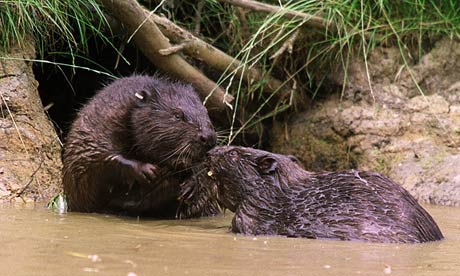
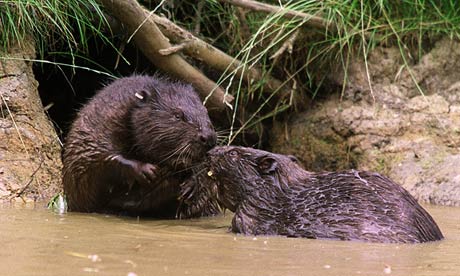
I was walking along the river and heard the strangest noise.
It was one of those noises which, when I found out what It was, sounded exactly as it should. A beaver was chewing at a branch on the bank of the river. First there were small rolling noises, as the branch went through its hands. Then the ‘gnaw gnaw gnaw’. And then the turning noise and the cycles were repeated.
This went on fifteen minutes or so, until the beaver and I both heard noises in the water.
We both saw another beaver approaching. The beaver-at-gnaw quickly went in her direction (though I can only guess which sex was which). They swam toward each other then rubbed faces. The approaching beaver made small bawling noises like a young calf. They rubbed bodies and seemed to sniff each other. They then swam in different directions.
This performance – the swimming away, the languid circling, the approaches – went on for twenty minutes. A couple of times the ‘gnawing’ beaver clambered over the over beaver’s back, but this lasted just a few seconds. The beaver that had first approached rubbed noses once again, then made the bawling sounds one more time.
I never appreciated how large beavers are until one of them came up on the bank. The water was clear enough to see their feet and tail move underwater (I wonder if the portion out of the water might have the 1/10 proportion of an iceberg). The sun was setting and they became difficult to see. However they decided to part anyway. One began to go down river toward the harbour and one headed to the other shore. For me an experience of a lifetime.
DE
 Kafka liked the ladies and he had many relationships. While in the first year of his ‘love-of-a-lifetime’ affair with Felice Bauer (they were engaged twice but – indeed – never married) he met “The Swiss Girl”. In his diaries she was only referred to as W. or G. W. They were together for ten days in a spa on Lake Garda. She was a Christian. He was thirty and she was eighteen. However the relationship (apparently sexually consummated) made a great impression on him for the rest of his life.
Research over the years has finally revealed who she is, and Google search even provides photos. However, very little else (as far as I can find) is known about her. Where did her life lead after an encounter with Kafka?
In my own tale about Kafka, I have him making a few poignant comments about “The Swiss Girl”. As with Kafka, they are as sad as they are sweet. But they *are* sweet.
Below is her image and name. Also some of Kafka’s actual diary entries about the incident.
DE
* * * * * * * * * * * * * * *
15 October 1913. Perhaps I have caught hold of myself again, perhaps I secretly took the shorter way again, and now I, who already despair in loneliness, have pulled myself up again. But the headaches, the sleeplessness! Well, it is worth the struggle, or rather, I have no choice. The stay in Riva was very important to me. For the first time I understood a Christian girl and lived almost entirely within the sphere of her influence. I am incapable of writing down the important things that I need to remember. This weakness of mine makes my dull head clear and empty only in order to preserve itself, but only insofar as the confusion lets itself be crowded off to the periphery. But I almost prefer this condition to the merely dull and indefinite pressure the uncertain release from which first would require a hammer to crush me.
20 October 1913 I would gladly write fairy tales (why do I hate the word so?) that could please W. and that she might sometimes keep under the table at meals, read between courses, and blush fearfully when she noticed that the sanatorium doctor has been standing behind her for a little while now and watching her. Her excitement sometimes—or really all of the time—when she hears stories. I notice that I am afraid of the almost physical strain of the effort to remember, afraid of the pain beneath which the floor of the thoughtless vacuum of the mind slowly opens up, or even merely heaves up a little in preparation. All things resist being written down. If I knew that her commandment not to mention her were at work here (I have kept it faithfully, almost without effort), then I should be satisfied, but it is nothing but inability. Besides, what am I to think of the fact that this evening, for a long while, I was pondering what the acquaintance with W. had cost me in pleasures with the Russian woman, who at night perhaps (this is by no means impossible) might have let me into her room, which was diagonally across from mine. While my evening’s intercourse with W. was carried on in a language of knocks whose meaning we never definitely agreed upon. I knocked on the ceiling of my room below hers, received her answer, leaned out of the window, greeted her, once let myself be blessed by her, once snatched at a ribbon she let down, sat on the window sill for hours, heard every one of her steps above, mistakenly regarded every chance knock to be the sign of an understanding, heard her coughing, her singing before she fell asleep.
22 October 1913. Too late. The sweetness of sorrow and of love. To be smiled at by her in the boat. That was most beautiful of all. Always only the desire to die and the not-yet-yielding; this alone is love.
Translated by Joseph Kresh
 Gerti Wasner
 Gerti Wasner

A number of years ago I received a phone call from a rather panicked Government Administrator. There was a huge weekend Arts Conference being held, for all disciplines in the province. A reader who was to present – well, entertainment – at lunch was unable to attend. Could I fill in for him. It was two days away.
Yes, said I.
My Elephant stories are all under five minutes, and they are all amusing. They read themselves. Why not.
What I did not realize was the extent of this conference. Nor did I fully appreciate that the readings were to be held during the luncheon. Something like an after dinner speech. In the middle of the day.
There was one other English reader, the late Bill Bauer. Bill is a genius, a wit, a funny fellow, and an excellent reader. A tough act to follow so I was glad to be a co-participant. The other two readers were reading in French (New Brunswick is a bi-lingual province). They were to go first, Bill and I second.
The venue – for a reader – was a hell-hole (if I may be blunt). Two large rooms filled with tables and post-meal listeners. There was no way to face them all at the same time. Bill seemed fazed by nothing but I was uncomfortable. I was glad enough the French readers went first.
They were both poets (as was Bill). My French is far from the best but, by their reading method and the reaction of the audience, it appeared that they read the most dour and angst-filled poems imaginable. Sadness and despair crept through the room(s). At least Bill and I would be a contrast.
Bill is an excellent reader – a performer, in fact. He knows when to show them and knows when to hold them. He is insightful, philosophical, inovative and just damned funny. I will laugh at a poem of his which I have read a dozen times. Few can successfully end a poem with the main character screaming the immortal words: “Aphids, aphids, aphids.” Bill does.
It may be that we were both assisted by the dour poets, for Bill’s applause was enthusiastic. I was admittedly disconcerted by attempting to read to these hundreds of people scatted upon two sides of me. But – let’s face it – ya gotta laugh at The Elephant as he takes his concerns to God. And (I hope) appreciate God’s thoughtful and kindly replies. If Bill left them laughing (and he did) then The Elephant left them laughing more.
At the end it was time for all the participants to bustle back to their conferences. But some did come up to make comments to the readers. And then occurred an event which I will cherish to my grave. An elderly French nun (in real nun garb) came up to me. She was assisted by a younger nun. The old sister put her hand on my arm. She looked up at me, and in a conspiratorial voice, thick with her French accent, said: “Ah, that Elephant.” And she smiled.

From China Lily
{A 14th Century sea voyage}
More than once he had brought chickens on board ship for the voyage. He had been totally unprepared the first time to find the crew (and even the officers) were far more interested in having fresh meat than fresh eggs. They had barely been out of the site of land when some crewmen brought Matzerath two dead chickens. They said that they found the birds fighting and that they were so badly injured there was nothing to do but to wring their necks.
The next time it was just one chicken. Matzerath was told that it had escaped and bashed its brains out trying to get out of the galley. Then there were four chickens, somewhat bloodied, and he was told the chip’s cat had got to them. By now he was down to just a few chickens, and was only mildly surprised when they turned up, in ones and twos, broken-necked near the crude coop he had built.
He toyed with the idea of cooking them in some manner that would repel the crew, but the fact of the matter was that he enjoyed the feast himself.
On a couple of other voyages Matzerath had constructed secure hen coops. He put two layers of wire over the frame and put a lock from his own house on the door. He wore the key, along with others, around his neck. There would be no cats intruding and no chickens getting free to ‘kill themselves’ against the sides of the ship. And things went well – for a week.
Matzerath began to find, one chicken at a time, the members of his flock at the entrance of his galley. The galley was meagre, with barely room for a fire, a preparation space, and some provisions. He was allowed to make hot meal only on Sunday and Wednesday. The ship could not carry much fuel and the crew was (rightfully) terrified of a fire breaking out. Matzerath always had to have an officer present to cook a meal. The flame was always dowsed with copious buckets of sea water when the cooking was done.
The chickens appeared the days he was going to prepare a hot meal. As there was no pretense that the birds had escaped and died, they were plucked and cleaned. Since no one could abide waste on the shop, and because he took a generous portion of breast for himself, Matzerath cooked them without complaint. The carcasses guaranteed a soup for those who didn’t get much of the actual bird, and all went on as before. He eventually found out that some member of the crew, adept with tools as so many seamen were, had untwined and cut the wire in one corner of the coop. he effectively made a flap that he could undo and secure without it being noticeable.
When Matzerath finally found this entrance, his supply of hens was so low that he did nothing. He had managed to have two months of eggs (which did not seem overly appreciated), and some meals of chicken that he himself enjoyed. He also realized that the contest between himself and the chicken thieves eased some of the boredom of the long voyage.
His next time out at sea he also had chickens and a coop. He took pains to make it more secure, and his chickens lasted longer. However, the owners complained about the waste of the chicken feed at the end of the voyage.
On the trip after that, his whole flock caught some disease within the first week.
The birds became bloated and stank within the same day they died. Their feathers were moist and puss formed where they were attached to the skin. There was no space in the coop to separate the ill birds from the others. The captain was swift in his judgement about getting rid of the corpses. He feared the disease might spread to his crew. He had seen ships overcome by a rapid wave of sickness. Had it been further into the voyage, the crew might have eaten them but, as it was, Matzerath had to dump them over the side.
DE
(image)http://www.ciaofamiglia.com/emigrants/Ships/Marco_Polo/Marco-Polo-Yarmourh-BAR.jpg

If something interests me, I’m curious to know more. I don’t have to like the topic or source. One does not understand things or people by sticking to their own world view. I fear boredom more than ideas.


 kafkaestblog