Search

kafkaestblog

It is a whirlwind in here

Category

play

TWO BEAVERS ON THE LEFT BANK

b9316892033z-1_20150407140501_000_gqhaejp35-1-0

I was walking along the river and heard the strangest noise. It was one of those noises which, when I found out what It was, sounded exactly as it should. A beaver was chewing at a branch on the bank of the river. First there were small rolling noises as the branch went through its hands, and then the ‘gnaw gnaw gnaw’, and then the turning noise and the cycles were repeated.

This went on fifteen minutes or so, then the beaver and I both heard noises in the water. We both saw another beaver approaching. The beaver-at-gnaw quickly went in her direction (though I can only guess which sex was which). They swam toward each other, then rubbed faces. The approaching beaver made small bawling noises like a young calf. They rubbed bodies and seemed to sniff each other, then they swam in different directions. This performance – the swimming away, the languid circling, the approaches – went on for twenty minutes. A couple of times the ‘gnawing’ beaver clambered over the over beaver’s back, but this lasted just a few seconds. The beaver which approached rubbed noses once again, and made the bawling sounds one more time.

I never appreciated how large beavers are until one of them came up on the bank. The water was clear enough to see their feet and tail move underwater (I wonder if the portion out of the water might have the 1/10 proportion of an iceberg). The sun was setting and they became difficult to see. However they decided to part anyway. One began to go down river toward the harbour and one headed to the other shore.

But I bet they were going to meet the next day.

(image)https://www.gannett-cdn.com/-mm-/4830728e976abc86eb61c42be56b80bf12a60879/c=0-75-3000-2325&r=x408&c=540×405/local/-/media/Salem/2015/04/07/B9316892033Z.1_20150407140501_000_GQHAEJP35.1-0.jpg

Shakespeare’s Birth And Death Day Is A Couplet

Shakespeare could look you in the eye and tell you who you are – so well-versed in the ways of people he was. He would then place you upon the stage, and have an actor have a go at you. With puns and foibles and insights.

Thus do I repeat my Shakespeare (though not exactly Shakespearean) homage.

~~~~~~~~~~~~~~~~~~~~~~~~~~~

The stage

Is as bare as my lady’s ass

In his lordship’s bedchamber.

Rough-hewn

In the most knockabout way,

Leaving splinters

In the palace lawns of the imagination.

There’s many a dip ‘twixt the trap and the lip.

It fares little better

Than hastily strewn boards

Covering parched ground,

With barely enough elevation

To keep the understanding masses at bay.

Were one fool enough

To come from out the wings,

And at centre front

Begin a soliloquy about the beauty

Of the wretched arena on which he stands,

To fight the resulting

And justified

Spontaneous combustion,

There would not be found one drop of piss

From any a Thespian’s hose.

For who,

Could allow

This sacrilege to be spoken?

Even the flag atop the pole knows

The magic is not yet arrived.

A stage without commercial trappings:

without solid doors and thick drapes;

uncluttered by pillars and arches,

tables and chairs,

windows and fireplaces;

sans orchestra,

sans balcony,

sans pit.

A stage revealing all its secrets.

Profound as emptiness.

A stage in wait.

For in this world writ small

– as in the globe around –

the audience has nothing to know,

nothing to learn,

until the actor makes an entrance,

prepares to fight past our eyes

to battle with those thoughts

and fears

which lurk in sheltered halls.

What’s Hecuba to him?

Why – nothing.

Merely a name in a script,

A cue at which to turn his profile thus.

It is what Hecuba becomes to we who wait,

that turns the key upon the heavy gate.

~DE BA. UE


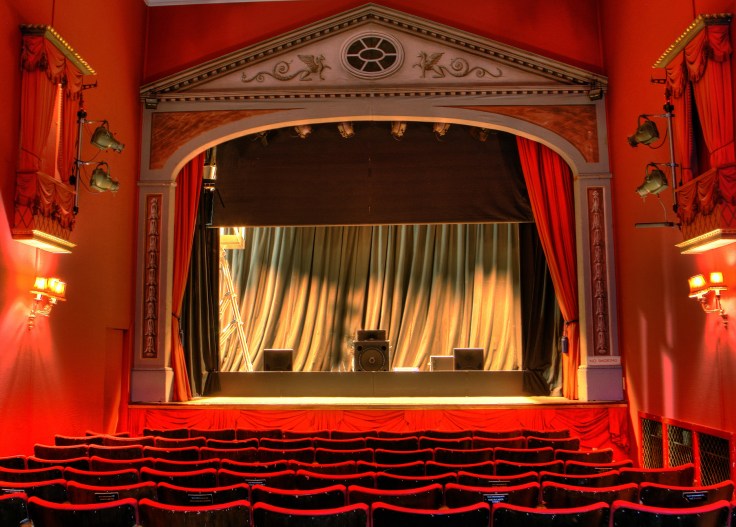
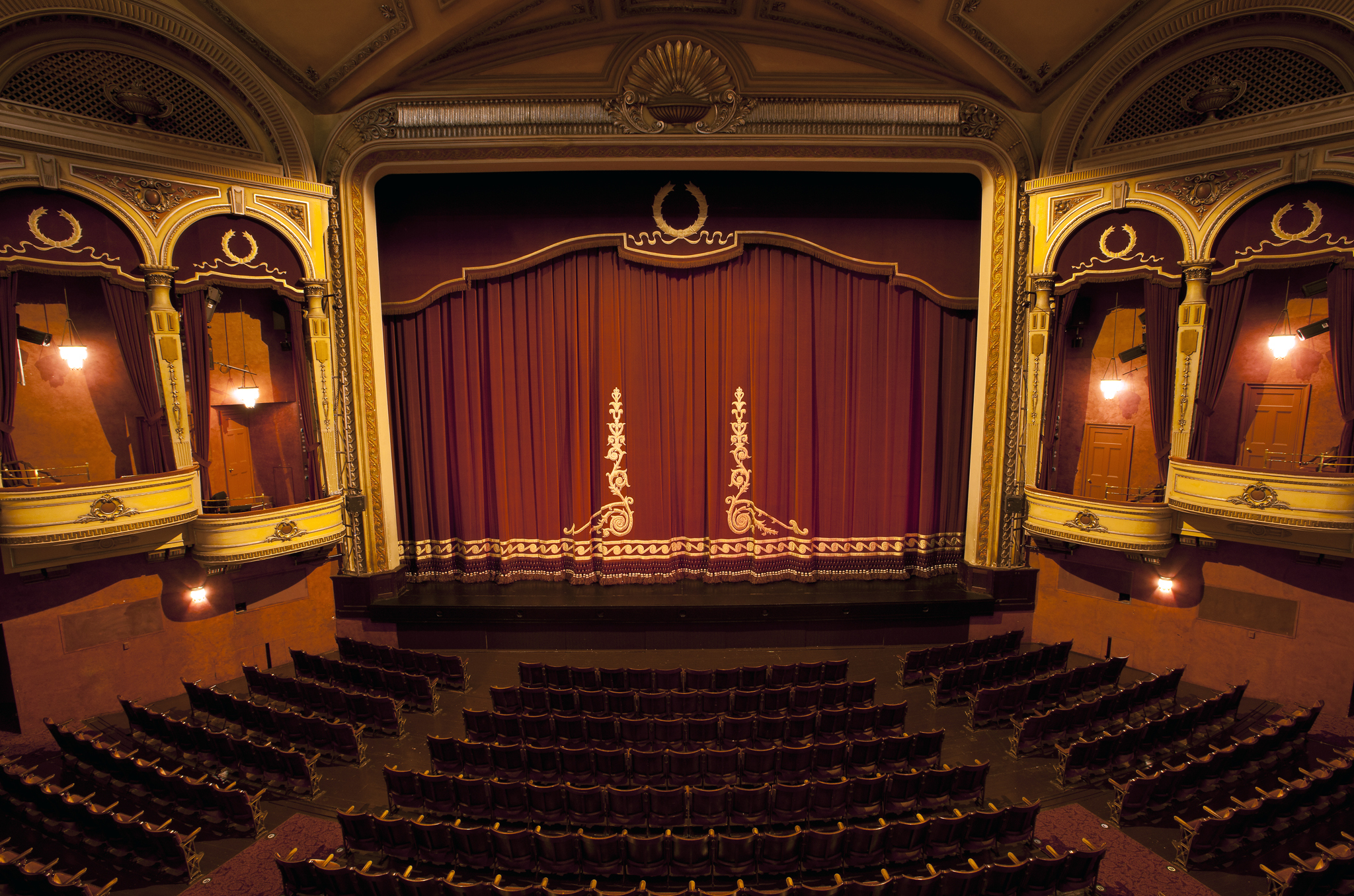
What Is Hecuba To Him – To Us – As We Gaze Upon The Theatre Stage?


image

The stage is as bare as my lady’s ass in his lordship’s bedchamber. Rough-hewn in the most knockabout way, leaving splinters in the palace lawns of the imagination.

There’s many a dip ‘twixt the trap and the lip.

It fares little better than hastily strewn boards covering parched ground, and barely enough elevation to keep the understanding masses at bay.

Were one fool enough to come from out the wings, and at centre front begin a soliloquy about the beauty of the wretched arena on which he stands, to fight the resulting and justified spontaneous combustion, there would not be found one drop of piss from any a Thespian’s hose.

For who could allow this sacrilege to be spoken?

Even the flag atop the pole knows that the magic is not yet arrived.

A stage without commercial trappings:

without solid doors and thick drapes;

uncluttered by pillars and arches, tables and chairs, windows and fireplaces;

sans orchestra, sans balcony, sans pit.

A stage revealing all its secrets. Profound as emptiness.

A stage in wait.

For in this world writ small – as in the globe around – the audience has nothing to know, nothing to learn, until the actor makes an entrance, and prepares to fight past our eyes to battle with those thoughts and fears which lurk in sheltered halls.

What’s Hecuba to him?

Why – nothing.

Merely a name on a page of script, a cue at which to turn his profile thus.

It is what Hecuba becomes to we who wait,

that turns the key upon the heavy gate.

DE

(image) https://media.timeout.com/images/101695099/image.jpg

Cruise Ship Queen Mary 2 Heads Out To Sea

image

The larger-than-life cruise ship, Queen Mary 2, was in Halifax for the day, and departed this evening. It probably gets special attention because of its grandeur. Also, the Cunard Shipping Line, nominal owner of the ship, was the creation of a Halifax chap, Samuel Cunard, back in 1839. The Cunard Line is now folded into the Carnival empire, but that’s business.

As The Queen Mary 2 left, it was escorted by a Canadian Navy Coastal Defence Vessel – the HMCS Summerside, a harbour fire boat spraying arcs of water, and even a helicopter flew overhead. It took its time leaving.

I have written about the the launch of Queen Mary 2 in my novel Fame’s Victim. The main character of my novel, known as ST, is good friends with the actual Queen Elizabeth the Second, who launched the ship. ST and his lady friend, a famous actress whom he always refers to as Garbo (though she be not the actual Garbo) are on the maiden voyage of the Queen Mary 2. That chapter is below.

DE

(image)https://www.ctvnews.ca/polopoly_fs/1.2462900.1436552018!/httpImage/image.jpg_gen/derivatives/landscape_620/image.jpg

~~~~~~~~~~~~~~~~~~~~~~~~~~~~

Excerpt From Fame’s Victim:

“Your Majesty.”

ST extends his hand just as a volley of the extensive fireworks light up The Queen Mary 2 and the harbour side where she has just been launched. He flinches but the Queen does not.

“So much for the Queen’s weather.” The Queen points to the torrents pelting the dock. “It rains on my reign.”

“Yes, Ma’am.” ST hears Garbo’s barely repressed giggle behind him. “I believe you have not met – “

“This charming lady with the delightful sense of humour.” The Queen looks past ST. “No, I have not.”

ST takes a side step as Garbo extends her hand.

“Your Majesty.”

Garbo has been instructed that formal curtsies are not in fashion, but the actress in her makes her modified one very graceful. The Queen is obviously amused and pleased.

“We understand you both are on the maiden voyage to the United States.”

“Yes, Ma’am.”

“Is he attempting some sort of record, do you think?” The Queen points to ST.

“Ma’am?” Garbo is confused.

“The last flight of the Concorde and now the first voyage of QM2.” The Queen smiles. “It sounds to me like some type of Time muddle.”

“Ma’am.” Garbo giggles and ignores protocol by touching the Queen’s arm. “I don’t make theories about Time and he doesn’t try to act.”

“Very sensible.” The Queen looks from one to the other. “I don’t act either.”

There is another eruption of fireworks, and they look into the dark sky. The vibrant colours flash against the side of the ship and sparkle on the water’s surface.

“We had best go in.”

“Yes, Ma’am.”

Even before ST has agreed, ship’s crew and members of the Queen’s entourage have opened doors and produced umbrellas for the twenty second walk.

“I’m not sure what my grandmother would think of her namesake.” The Queen indicates that ST and Garbo walk beside her, which causes some manoeuvring as the Queen is using a cane because of her hip operation. “Perhaps a ship which dwarfs the Titanic would be beyond her comprehension.”

Three abreast confuses those in attendance though the ranks quickly settle into place. As they approach the doorway ST executes a couple of half steps so the women go through the entrance without crowding. He then quickly returns to his place.

“Mind you, Queen Mary would certainly appreciate the opulence.” There is a quick royal chuckle. “And she could tally the worth of each item to within ten pound, if not sometimes to the shilling.”

ST assumes the Queen would know the powers of her own grandmother, but he wonders if anyone could rightly cost the grandeur that surrounds them. He and Garbo will shortly be taking a tour of the high points while the Royal party will be given a different tour of other high points. He has been told that a complete tour of all the high points would take ten hours. A leisurely inspection will take three days of their trip if he so desires. It is a far cry from the Concorde where twenty minutes served the same purpose.

“My walking stick shortens my own look around.” The Queen smiles up at the couple. “However there is a Wedgwood Panel I have insisted upon. Do try to see it on your own – it graces a wall in Kings Court.”

“Yes. Ma’am.” ST answers with less enthusiasm though he will give it a close examination, as he will no doubt be queried the next time they meet.

The three of them now cross a wide and carpeted expanse where ship’s crew and invited guests line both walls. The Queen notes a decidedly younger crowd mingling together and glances at Garbo.

“Let’s work either side of the room. I would guess that section is more for you than me.”

“Yes, Ma’am.” Garbo blushes. “I’m sure they would be happy to see you.”

“Not ‘as happy’.” The Queen nods in their direction. “One knows one’s time and place.”

As Garbo approaches the now-applauding group, the Queen slows her pace, making ST do likewise. Her voice is low enough to make him lean closer to her.

“”You’ve been in the news.”

“Ma’am?”

“Hollywood sightings and Paris auctions and the trailing of Google.”

“Yes, Ma’am.”

“Welcome back.”

Every Stage Waits For Action On World Theatre Day

3405608142_9c99681644_o

The stage is as bare as my lady’s ass in his lordship’s bedchamber.

Rough-hewn in the most knockabout way, leaving splinters in the palace lawns of the imagination. There’s many a dip ‘twixt the trap and the lip.

It fares little better than hastily strewn boards covering parched ground, and barely enough elevation to keep the understanding masses at bay.

Were one fool enough to come from out the wings, and at centre front begin a soliloquy about the beauty of the wretched arena on which he stands, to fight the resulting and justified spontaneous combustion, there would not be found one drop of piss from any a thespian’s hose.

For who could allow this sacrilege to be spoken? Even the flag atop the pole knows that the magic is not yet arrived.

A stage without commercial trappings: without solid doors and thick drapes; uncluttered by pillars and arches, tables and chairs, windows and fireplaces; sans orchestra, sans balcony, sans pit.

A stage revealing all its secrets. Profound as emptiness.

A stage in wait.

For in this world writ small – as in the globe around – the audience has nothing to know, nothing to learn, until the actor makes an entrance, and prepares to fight past our eyes to do battle with those thoughts and fears which lurk in sheltered halls.

“What’s Hecuba to him?”

Why – nothing.

Merely a name on a page of script, a cue at which to turn his profile thus.

It is what Hecuba becomes to we who wait,

That turns the key upon the heavy gate.

DE

(image)https://farm4.staticflickr.com/3628/3405608142_9c99681644_o.jpg

Alison Alexandra and Harrison Ford Cast Off Lines To Get To Sea

200px-mooring

Alison Alexandra, the main character in my current Work in Progress, is about to set out on a sea cruise. She wishes nothing as boring as a Cruise Ship, so she is going on a freighter that has room for twelve passengers. She gets accommodations as comfortable as the ship’s officers, plus decent food and some entertainments. The drawback – which she does not consider a drawback – is that she goes where the freighter goes as it drops off and picks up cargo. Not necessarily fancy ports of call.

Alison Alexandra has just spent my week of writing watching the business on the dock as the freighter gets ready to cast off. For this scene I have stolen (and greatly altered) an incident that happened to me. I hear that’s what authors do, but it seems a rare situation for me.

I previously described what happened to me those many years ago, and do so again. Alison Alexandra is actually watching a crewman named Ellerton do what I did, when I stopped a submarine from running amok.

~~~~~~~~~~~~~~~~~~~~~~~~~~~

Harrison Ford And Me

In 2001/02 the movie, WIDOWMAKER K-19, was made, much of it filmed in Halifax harbour and out on the nearby ocean. It deals with submarines and an in-ship disaster, staring Harrison Ford and Liam Neeson.

I was not aware of this when I visited Halifax. I went down to the waterfront and went along the boardwalk. It was very foggy on the water (which it can be without having much on land). I was exceedingly surprised to see, looming out of the fog, a submarine next to the wharf. There are submarines in Halifax, but they are berthed at the naval dockyard a couple of kilometers from where I was walking.

It took a couple of minutes to realize that it was not a naval submarine (no markings). What was happening was that the submarine was being turned by a couple of tugboats. I read later that each side of the same submarine was altered differently so, in close ups and aerial footage, it could appear to be two different submarines.

However, there quickly appeared to be a problem. From the shouts and gesticulations of a man on the wharf, I found out that one of the mooring lines had not been cast from the wharf. The submarine was being pulled away from the dock, but it was still attached. It was a gigantic and thick mooring line, and I do not know what damage would have been done to either ship or dock.

The man was yelling to another man on the deck of the sub, who had a bullhorn and in turn was bellowing to the crew of the tug boat. However, nothing was heard over the roar of the engines (tugboats have powerful engines). The man on the wharf was trying to lift the mooring line from its post before it got too taut to move. I ran over and helped him, and we managed to get it from the post just as it started to be pulled into the water.

Of course I watched the movie credits closely, but I was not mentioned.

No famous movie actors were involved in this incident.

DE

(image)https://upload.wikimedia.org/wikipedia/commons/thumb/3/3f/Mooring.jpg/200px-Mooring.jpg

Turning A Novel Into Film – Characters On The Loose

screenplay_square

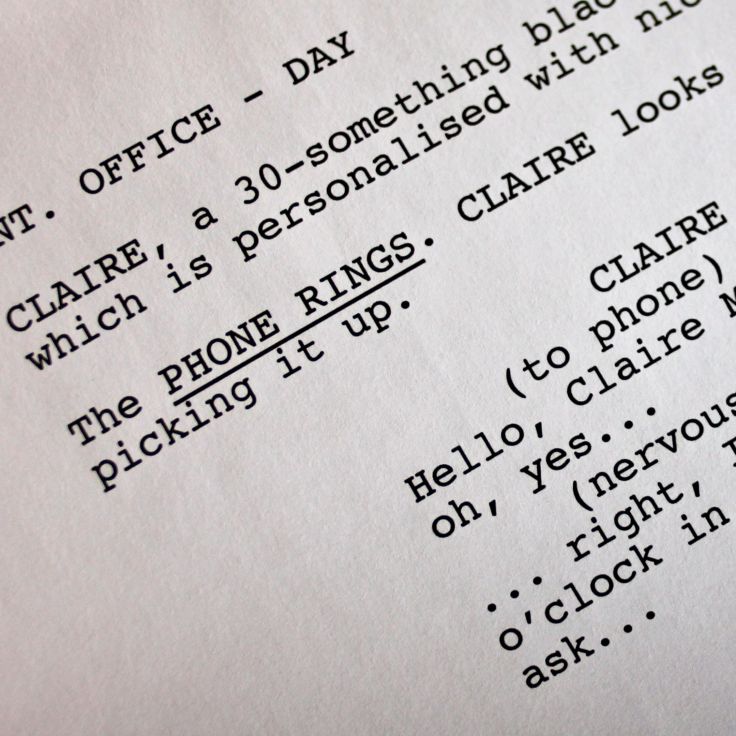
When adapting a novel manuscript to a film script, I realize it will take a whole host of other people to tell me how successful I might be. I’ve done this twice before, and realize that I must not only ignore my usual method of writing, but often go exactly against it.

I attempted to “learn” how to write for film. I read many instruction books, attended classes and workshops, and had meetings with people. I read many film scripts, which did help me accept the (to my eye) arcane format. But the one thing that actually turned me visual, was the comment of a writer/editor friend who said, after reading my attempt, “I can’t see it.”

That is, it did not cause visual action in her mind.

And I understood.

Perhaps the biggest hurdle is to accept that a movie is not a book, and that changes, additions and omissions will be necessary. As with a play, there is a finite time limit, that generally clocks in under two hours. The threads and plot points of a movie are different. And the characters (I swear) feel this freedom, and choose to accentuate other aspects of themselves than revealed in a novel.

The very fact their paragraphs of dialogue are best reduced to two or three lines makes them uppity. And because they can, in mere seconds, be in diverse locations, performing radically different actions, they become exact without apology. They don’t have to fill in the spaces.

The writer has to fill in the spaces however, and do so with visual stimulation. The transitions have to be swift and their descriptions exact. The road is always the fast lane and the characters kick the tires with gusto.

DE

(image) http://www.indiewire.com/wp-content/uploads/2014/11/screenplay_square.jpg

Then Came Each Actor On His Ass

globetheater


The stage is as bare as my lady’s ass in his lordship’s bedchamber. Rough-hewn in the most knockabout way, leaving splinters in the palace lawns of the imagination.

There’s many a dip ‘twixt the trap and the lip.

It fares little better than hastily strewn boards covering parched ground, and barely enough elevation to keep the understanding masses at bay.

Were one fool enough to come from out the wings, and at centre front begin a soliloquy about the beauty of the wretched arena upon which he stands, to fight the resulting and justified spontaneous combustion, there would not be found one drop of piss from any a thespian’s hose. For who could allow this sacrilege to be spoken? Even the flag atop the pole knows that the magic is not yet arrived.

A stage without commercial trappings: without solid doors and thick drapes; uncluttered by pillars and arches, tables and chairs, windows and fireplaces; sans orchestra, sans balcony, sans pit. A stage revealing all its secrets. Profound as emptiness.

A stage in wait.

For in this world writ small – as in the globe around – the audience has nothing to know, nothing to learn, until the actor makes an entrance, and prepares to fight past our eyes to battle with those thoughts and fears which lurk in sheltered halls.

“What’s Hecuba to him?”

“Why – nothing.

“Merely a name on a page of script,

“A cue at which to turn his profile thus.”

“It is what Hecuba becomes to we who wait,

“That turns the key upon the heavy gate.”


DE

(image) http://clios.com/cms/wp-content/uploads/globetheater.jpg

Kites Fly Over Religion And History

(image)

I https://s-media-cache-ak0.pinimg.com/236x/46/70/f4/4670f4112828e409e6568a5d9df3f3f6.jpg

I was writing the last quarter of a novel. Lots of intensive work in the course of a day. I usually try for a couple hours of walking outside, but it doesn’t always happen. One day, in a later evening than usual for me, I set out for a wander in the immediate neighbourhood.

A reasonable walk away is a small park, run (it is obvious) by the Roman Catholic church. Three park benches, one picnic table, trees and flower beds. There is also a statue of the Virgin Mary in blue vestments. At the foot of the statue are two objects from the Halifax Explosion. One is part of one of the ships that collided and caused the conflagration, the other is part of a church destroyed in the explosion.

Now this is a pleasant place to sit regardless. However, it does hold two connections to my novels. In one novel, I have a significant and spectral occurrence happen at the foot of the statue of a Blue Angel. In another novel, the Halifax Explosion plays its part. I had written both these novels before I ever saw this small park.

So, I sat myself down. I imagine I go there four or five times a year. It is quiet and encourages contemplation. I contemplate. I doubt I have ever seen more than three other people there at any time. I was alone. I assumed that I would remain this way.

I was wrong.

In fifteen minutes or so a gaggle (or a giggle) of young girls appeared. Easily two dozen. None looked older than ten. They were accompanied by four adults. They all held a kite of identical construction. They were let loose to fly them.

A few of the girls were wearing a sash, and a couple more had badges on their shirts. I assumed they were some sort of Brownie troupe. Don’t Brownies fly up? At any rate they all started to run about, encouraged by the adults. If nothing else it was great exercise. It was a windy evening and they had some success with their kites. A handful got the hang of it and kept their kites more aloft than not. Of course, I got hit in the head by one of them. The child apologised. Otherwise I was ignored.

I bet with myself how long this activity would last. I won. Less than fifteen minutes. Then the girls banded in twos and threes and talked. As did the four adults. One girl started to do cartwheels – quite successfully. The girls walked around in groups, talking and giggling. A few sat on the grass. A few did try the kites again, but not for long. One girl somehow got the string leading to her kite caught in her hair. Two of the adults tried to untangle it, with limited success. I heard one of them say they would have to use scissors when they got back to the church. Then, being told to hold hands with their ‘partner’, they all left the park.

I followed soon after. I might not have got my usual bout of contemplation, but my mind was still occupied by other than my usual thoughts. A fair exchange.

DE

Create a free website or blog at WordPress.com.

Up ↑