Search

kafkaestblog

It is a whirlwind in here

Category

actor

Alison Alexandra and Harrison Ford Cast Off Lines To Get To Sea

200px-mooring

Alison Alexandra, the main character in my current Work in Progress, is about to set out on a sea cruise. She wishes nothing as boring as a Cruise Ship, so she is going on a freighter that has room for twelve passengers. She gets accommodations as comfortable as the ship’s officers, plus decent food and some entertainments. The drawback – which she does not consider a drawback – is that she goes where the freighter goes as it drops off and picks up cargo. Not necessarily fancy ports of call.

Alison Alexandra has just spent my week of writing watching the business on the dock as the freighter gets ready to cast off. For this scene I have stolen (and greatly altered) an incident that happened to me. I hear that’s what authors do, but it seems a rare situation for me.

I previously described what happened to me those many years ago, and do so again. Alison Alexandra is actually watching a crewman named Ellerton do what I did, when I stopped a submarine from running amok.

~~~~~~~~~~~~~~~~~~~~~~~~~~~

Harrison Ford And Me

In 2001/02 the movie, WIDOWMAKER K-19, was made, much of it filmed in Halifax harbour and out on the nearby ocean. It deals with submarines and an in-ship disaster, staring Harrison Ford and Liam Neeson.

I was not aware of this when I visited Halifax. I went down to the waterfront and went along the boardwalk. It was very foggy on the water (which it can be without having much on land). I was exceedingly surprised to see, looming out of the fog, a submarine next to the wharf. There are submarines in Halifax, but they are berthed at the naval dockyard a couple of kilometers from where I was walking.

It took a couple of minutes to realize that it was not a naval submarine (no markings). What was happening was that the submarine was being turned by a couple of tugboats. I read later that each side of the same submarine was altered differently so, in close ups and aerial footage, it could appear to be two different submarines.

However, there quickly appeared to be a problem. From the shouts and gesticulations of a man on the wharf, I found out that one of the mooring lines had not been cast from the wharf. The submarine was being pulled away from the dock, but it was still attached. It was a gigantic and thick mooring line, and I do not know what damage would have been done to either ship or dock.

The man was yelling to another man on the deck of the sub, who had a bullhorn and in turn was bellowing to the crew of the tug boat. However, nothing was heard over the roar of the engines (tugboats have powerful engines). The man on the wharf was trying to lift the mooring line from its post before it got too taut to move. I ran over and helped him, and we managed to get it from the post just as it started to be pulled into the water.

Of course I watched the movie credits closely, but I was not mentioned.

No famous movie actors were involved in this incident.

DE

(image)https://upload.wikimedia.org/wikipedia/commons/thumb/3/3f/Mooring.jpg/200px-Mooring.jpg

Turning A Novel Into Film – Characters On The Loose

screenplay_square

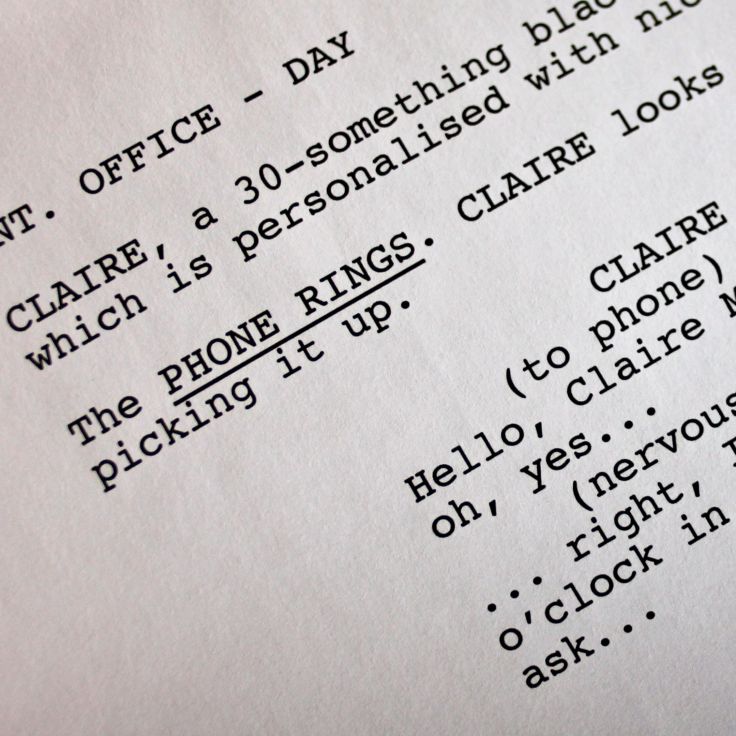
When adapting a novel manuscript to a film script, I realize it will take a whole host of other people to tell me how successful I might be. I’ve done this twice before, and realize that I must not only ignore my usual method of writing, but often go exactly against it.

I attempted to “learn” how to write for film. I read many instruction books, attended classes and workshops, and had meetings with people. I read many film scripts, which did help me accept the (to my eye) arcane format. But the one thing that actually turned me visual, was the comment of a writer/editor friend who said, after reading my attempt, “I can’t see it.”

That is, it did not cause visual action in her mind.

And I understood.

Perhaps the biggest hurdle is to accept that a movie is not a book, and that changes, additions and omissions will be necessary. As with a play, there is a finite time limit, that generally clocks in under two hours. The threads and plot points of a movie are different. And the characters (I swear) feel this freedom, and choose to accentuate other aspects of themselves than revealed in a novel.

The very fact their paragraphs of dialogue are best reduced to two or three lines makes them uppity. And because they can, in mere seconds, be in diverse locations, performing radically different actions, they become exact without apology. They don’t have to fill in the spaces.

The writer has to fill in the spaces however, and do so with visual stimulation. The transitions have to be swift and their descriptions exact. The road is always the fast lane and the characters kick the tires with gusto.

DE

(image) http://www.indiewire.com/wp-content/uploads/2014/11/screenplay_square.jpg

Then Came Each Actor On His Ass

globetheater


The stage is as bare as my lady’s ass in his lordship’s bedchamber. Rough-hewn in the most knockabout way, leaving splinters in the palace lawns of the imagination.

There’s many a dip ‘twixt the trap and the lip.

It fares little better than hastily strewn boards covering parched ground, and barely enough elevation to keep the understanding masses at bay.

Were one fool enough to come from out the wings, and at centre front begin a soliloquy about the beauty of the wretched arena upon which he stands, to fight the resulting and justified spontaneous combustion, there would not be found one drop of piss from any a thespian’s hose. For who could allow this sacrilege to be spoken? Even the flag atop the pole knows that the magic is not yet arrived.

A stage without commercial trappings: without solid doors and thick drapes; uncluttered by pillars and arches, tables and chairs, windows and fireplaces; sans orchestra, sans balcony, sans pit. A stage revealing all its secrets. Profound as emptiness.

A stage in wait.

For in this world writ small – as in the globe around – the audience has nothing to know, nothing to learn, until the actor makes an entrance, and prepares to fight past our eyes to battle with those thoughts and fears which lurk in sheltered halls.

“What’s Hecuba to him?”

“Why – nothing.

“Merely a name on a page of script,

“A cue at which to turn his profile thus.”

“It is what Hecuba becomes to we who wait,

“That turns the key upon the heavy gate.”


DE

(image) http://clios.com/cms/wp-content/uploads/globetheater.jpg

Create a free website or blog at WordPress.com.

Up ↑