Search

kafkaestblog

It is a whirlwind in here

Category

history

#Trump And #Merkel Walk Into A Bar In Hamburg

trump-merkel

~ You are not quite the tuff bad boy I expected, Herr Donald.

~  Maybe not – but your stiff starchiness is evident, Frau Reich Chancellor.

~ One must keep you and the Tzar of all the Russias in their place.

~ Nothing is going to keep Vlad in his corner of his empire.

~ True.

~ Unless . . .

~ Speak it up, Herr Donald.

~ I dunno – you never know who is listening these days.

~ I think we’re safe – the Tzar is on his way home.

~ But “home” is the operative word, Angie.

~ Then you had best whisper into my shell-like ear.

~ All we’d need is a Twitter GIF of that!

~ Not to worry – I’ll just roll my eyes.

~ Well – Frau Angie – why don’t we form an Anchluss?

~ I think you mean an alliance, Herr Donald.

~ I’ll leave the technicalities to you.

~ And we’d already have an alliance, Der Donald, if you behaved yourself.

~ Did you just say “dear”?

~ Not in this lifetime.

~ Just checking, Angie.

~ Nor the one after.

~ The ladies like a bit of power – if you get my drift.

~ Hell would first freeze over.

~ I’m thinking you might accomplish that, Frau Reich Chancellor.

DE

(image)s.newsweek.com/sites/www.newsweek.com/files/styles/embed-lg/public/2017/07/07/trump-merkel.JPG

Belated Greetings And Returns To Kafka On His Birthday

405px-franz_kafka_-_4_jahre

03 July

My Present / Your Future

Still in this World

A Life Away

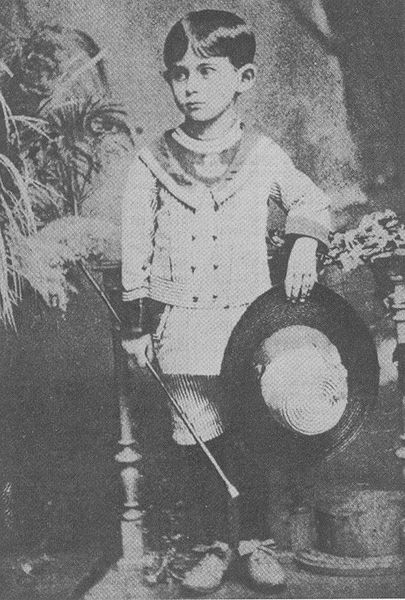
Dear F:

You would find it perverse to be wished a “Happy” birthday, but your response would be gracious. Such is the reality you understand, and how you deal with it. I have found that your reality is actually real.

Although it will give you no pleasure – well, ‘little’ pleasure – you are correct in all your observations.

Governments become the tools of the bureaucracies which run them. It doesn’t matter what type of Government, from the monarchy under which you lived, to the right wing horror of fascists that called themselves socialists, to the inept socialism pretending to be ‘for the people’. All three governments held their sway over the city where you spent your life. All three oppressed the people they ruled. All three looked after themselves first.

Writers are either writers or they aren’t. The urge to write encircles one like a snake around its prey. Feed it and it won’t quite squeeze you to death. You can not ignore it – even at your peril. It is with you every hour of every day, ever inquisitive and (sadly) always looking for something better.

Love is a see-saw of extremes. Every high guarantees a low. Every low reaches for a high. Every high reaches for a high. When these hills and valleys are eventually levelled, they are still desired.

Sex is highly over rated. The thing of it is, even rated fairly, ’tis a consummation devoutly to be had. Yes – I know – you appreciate Shakespeare. On a par with Goethe, even if you can’t bring yourself to say the words.

People are just one damned thing after another. Of course, so many people have brought you blessings, you throw up you hands to ward off the snake. And sometimes – some few times – it loosens its grip.

There is no castle with walls thick enough to hide against the perils of being human. Which is why you never tried.

Except the grave, of course.

Except the grave.

Yours,

D

DE

(image)http://silverbirchpress.files.wordpress.com/2012/06/405px-franz_kafka_-_4_jahre.jpg

The Good Ship “Pegasus”, In Story And For Real


176447_1443024569_2007

In my historical novel, China Lily, set in the 13th Century, I have spent a good deal of time writing about (and thus aboard) the good ship Pegasus. It has been on a trading voyage from Europe to China for nearly three years. I have become quite acquainted with it.

Currently, a manuscript  about the same European trading family, though set a thousand years earlier, is at the historical (though they do other genres) is being considered by the publisher, Pegasus, in New York.

And, this morning, the good ship, The Atlantic Pegasus, is in port.

Let these winged portents coalesce.

Following is a brief portion of China Lily.

~~~~~~~~~~~~~~~~~~~~~~~~~~~~~~~~

Excerpt from China Lily

Cepa is tending to the onions, even as the waves make Pegasus shudder from bow to stern. He knows many members of the crew begrudge his use of fresh water. He has heard the comments about him using buckets of deck wash for the purpose. A couple of the more unimaginative seamen have suggested that salt water will add to their taste. Cepa has so far refrained from asking how they would feel with no onions at all.

Pegasus makes a huge yaw to starboard. Cepa grabs for the support of his hammock hook. He holds on with his left hand as he watches the braces securing the onion boxes. Of the many things that make the crew question his sanity, perhaps the most talked-about is that he has given up the privilege of having one of the few bunks as a place for the onions. Space is so scarce on the Pegasus that he removed the wooden bunk and put in tiers of shelving of the onion setts. He even devised some crude trickle-down tubing so he only waters the top tier. So far he can claim that not one dipper of water has been wasted.

When Cepa had explained to the captain of the ship what he wanted to do, the man had not scoffed as did many of the crew. He had seen the effects of scurvy on many  voyages, and understood that this type of fresh produce did something to control it. In fact, he was very pleased Cepa was willing to sacrifice his bunk space for the purpose.This was not the typical action of the merchants he was paid to transport from Italy to China and back. It usually took half the out-voyage to get these self-important wealthy people to realize that their opinions and needs were of no importance in the world of the ship.

Some sat back and made threats of what retribution would occur when they finally reached port. They always changed their minds after experiencing the first storm at sea. Most soon realized the new world of the ship, and did what they could to fit in.

DE

(image)https://balticshipping.com/uploads/ships/d/a/a/a/7/e/e/c/4/3/1/f/d/5/f/7/3/4/a/8/1/c/5/c/9/a/a/d/f/7/d/2/176447_1443024569_2007.jpg

My Father And The Summer Solstice

telemmglpict000132550612-large_trans_nvbqzqnjv4bqek9vkm18v_rkiph9w2gmnogxyspv9m1jbe0fc3bi1fk

Not that I post this every first day of summer, but I do find it neat to have such a connection to the Celts, about whom I have written three novels.

During World War Two, my father had the unique experience of guarding Stonehenge. Not by himself, of course, there were other members of the Canadian Army with him.
The vast plains around Stonehenge were utilised by the military in both world wars. During the First War, the area was a training ground for troops from various countries. There were many encampments for recruits, with both basic training and preparations to train for the trench warfare awaiting on the continent. There were thousands and thousands of men, and huge amounts of supplies.
During the Second War, the area was used as staging ground for the D-Day invasion. There was great security, and as much secrecy as possible. Soldiers were in place to guard the perimeter.
So, my father found himself not only guarding Stonehenge, but doing so on Midsummer Morn, when the sun rose over the monument. He was a learned man – a school teacher – and versed in the history of the place. He knew of the Celts and the Druids and some of the mythology. He knew this was sacred ground and that Midsummer Morn was especially important. He might have paused and tried to look into the past, and see more in the morning mist than was actually there. I do not know.
He did, however, when their watch was over and they got to eat, tell the other soldiers of the history of the place. He mentioned that, during such celebrations by the Celts, the Druids might have a virgin killed to appease the gods. They were aghast.
“What a waste,” said one.

DE

(image)http://www.telegraph.co.uk/content/dam/news/2017/06/21/TELEMMGLPICT000132550612-large_trans_NvBQzQNjv4Bqek9vKm18v_rkIPH9w2GMNoGXySPv9M1Jbe0Fc3Bi1Fk.jpeg

Memoir Of The Chickens And The Nazi

racist-grafitti
An Oldie Rock station just played Spinning Wheel by Blood, Sweat And Tears. This always – always – brings back my memories of working on a farm in Germany during my university days. It was a hit of the time.

And, since I am currently well into reading Alan Bennett’s new Memoirs, Keeping On, Keeping On, I did what I have not done for years. I excavated my Journals about my three month summer in Europe, and turned to the day which mirrors this.  And, since it proved to be a notable day, I’ll transpose it verbatim (well, except I’ll clean up the spelling).

18 June

An interesting day, in a rather strange way. I got to work some of the morning with the hired hand, Herr Steiner, alone. He could speak no English and I was surprised that I could converse with him as well as i could (we had lots of time and I could speak slowly and I could think things out. We were, as a point of interest, filling wool sacks.


He told me that he  did not care for the place very much and was planning to leave soon. I can not say that he gave me ideas. I already had them.

And then the other interesting queer occurrence. I am tempted to drag all the dramatic interest I can out of this episode, but I may as well tell it in a simple manner, for it happened in a simple way.

I was going into one of the egg houses to collect the noon-time eggs, and as i stepped through the door, I saw it. Now, I had been collecting eggs there twice a day for two weeks, and had never once noticed what i now saw.

There was a swastika scrawled on one of the walls. It was covered in dust (like everything else) and something beside it has been scratched over. I suppose one can not think of Germany without thinking of the Hitler era, and I had wondered what I would do or think if I came across something like this. I had made jokes about the Bunker on the back forty, or the tattered painting of Hitler in the attic.

I put the thing down to its most logical explanation, the imitative scrawl of a six or seven year old child. Even so, rather bigger thoughts went through my head every time I saw someone use a whip rather forcefully.

DE

(image) https://i.cbc.ca/1.3995470.1487856081!/fileImage/httpImage/image.jpg_gen/derivatives/16x9_620/racist-grafitti.jpg

The Queen And Her Birthday

The Queen’s Birthday Parade, Trooping the Colour, took place today in Central London to mark Her Majesty’s official 91st birthday on Saturday. Embed from Getty Images Dressed in a pale blue dress and matching hat, the 91-year-old monarch took the salute at Horseguards Parade and inspected her guards as she does every year. With celebration comes…

via The Queen and Duke of Edinburgh attend Trooping the Colour ceremony — Royal Central

Mother And Son In Thirteenth Century Europe

episode-of-the-child-crusade

Exercpt from: China Lily

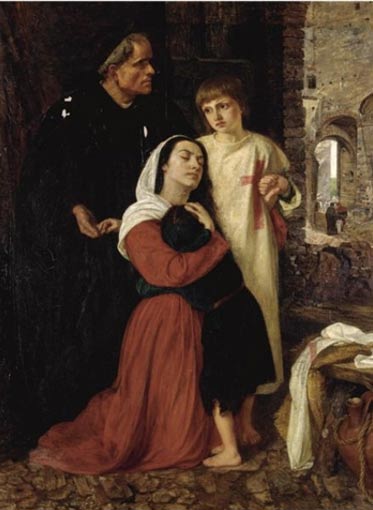
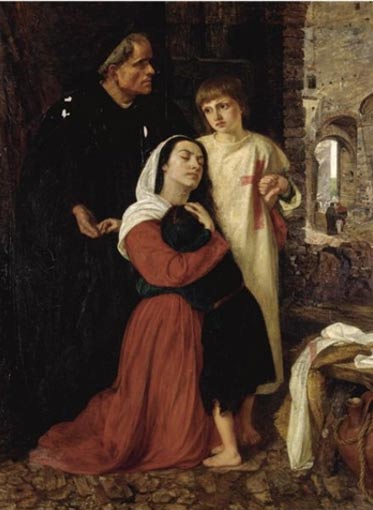
Matzerath’s mother rarely shared her thoughts with anyone. She is as elusive now as when he was a small boy being raised within the shadow of the religious buildings where she still works as a cook. Bishops and abbots come and go, and red-robed Princes of the Church make their visits, for which she must dress appropriately – but she remains. At least Matzerath assumes she is still there, though he has not been back for five years.

Matzerath is small in stature and taken to be younger than he is. At thirteen he is treated as seven. He allows this because he finds there are more advantages then penalties. He knows far more than is expected of him, and avoids many pitfalls through the guile no one expects he has. He also achieves more than is expected from him, and is given much leeway for a child. Had his real age been obvious, he would be perceived as dim-witted. Because he is thought of as a child, he is considered gifted.

Matzerath’s mother is aware of how her son is tolerated – she even encourages his guile. He is treated better than most children, whose father is absent months at a time sailing the North Sea.

Matzerath is also getting an education of sorts, which is generally restricted to the children of nobles and the wealthy. He has learned how to read and write, along with the rudiments of mathematics and geography. He also pokes his nose into the stables, and the smithy, and the carpenters, picking up their basic skills.

He follows his own mother with interest, and can chose, prepare and present many of the dishes she serves at the Monastery. For the notables at the cathedral, and other clergy, she is expected to produce more sophisticated fare. Matzerath has even acquired some of these skills, but a puny child is forbidden to appear near the high table. He does get to nibble the leavings but notes – as he also does at the Monastery – that very little is ever left.

Matzerath would have been content to stay in this arduous life seasoned with episodes of interest and learning, but his elusive nature is discovered by a visiting bishop.

The Bishop is a militant with evangelical frenzy. He is intent upon forming a Children’s Crusade to march to the Holy Land. Matzerath is not sure what this means, though he gathers it will offer an opportunity to leave the confines of the town and local villages where he has spent his life. His mother is better informed.

Even though the last Children’s Crusade happened generations ago, and the Church proclaims it was a wondrous act for the Glory of God, she is fully aware that most of the children never came back. And that the Holy Land is still lost to the grip of heathens. The murmurs from the Monastery and the high table reveal this bishop to be a renegade and unsound in judgment. His ‘new’ crusade is predicted to be a disaster. His abilities to lead it are a joke. However, he does have the ear of the Pope, and his family has much wealth to give to the Church.

Matzerath does not possess an abundant affection for his mother – not for anyone – but he realizes that regardless of the amount of work she extracts from him, she generally does what is best for him. He pays attention to her instructions and her observations and her warnings. She also encourages him to tell her what he sees and hears. As he becomes older, she also wants to know what he thinks about the things he sees. Matzerath realizes she is using him as a spy, but he does not mind. He knows his mother sometimes manipulates the information he brings for her own well-being, but these rewards also come to him.

Matzerath heeds the warnings his mother gives about some of the priests and monks and their interest in boys. He discovers this himself upon a couple of occasions, and even satisfies one priest just to see what it is like. He shares this with his mother because he knows she sometimes does the same.

DE

(image)http://www.ancient-origins.net/sites/default/files/Episode-of-the-Child-Crusade.jpg

Trump And France Walk Into A Bar

flag-of-france

~ Monsieur le Président. What can I get you?

~ I’m guessing it will be wine?

~ It does not need to be.

~ Isn’t that what’s supposed to be civilised?
~ les Français have a much wider civilisation than that.

~ I have a fondness – or is it a weakness – for Charteuse.
~ That is fine, mais …

~ I like the green colour in the glass.
~ Indeed, it is beautiful.
~ Have you another suggestion?

~ Absinthe
~ Uh-oh. That sounds like a baddie, believe me.
~ It has a certain heft.
~ You know I don’t drink?
~  Mais, oui.
~ Then what is the purpose?
~ It is poor diplomacy to drink alone.
~Then have at it.
~ Monsieur Trump, the whole country – all of Europe – would like to thank you.
~ Am I going to get a wedgie here?
~ Not at all – you have saved us.
~ It’s starting to feel really really tight in my butt cheeks.
~ The citizens français have seen what you accomplish.
~ It’s getting hard to sit down.
~ And have voted against something similar happening here.
~ Are you trying to get me to drink this thing?
~ Mais, non. You just keep being who you are.

DE

Hitler, Kafka, And Me

arton3192

I owe my life to Hitler, thanks to the Second World War, and my Canadian soldier father meeting my British War Bride mother.

I imagine it is too crass to say I have a soft spot for Hitler. I’ve studied his personal history, and know something of the man who was (admittedly) only a small part of the monster.

If he had been able to sell more of his paintings . . . who knows what might have happened?

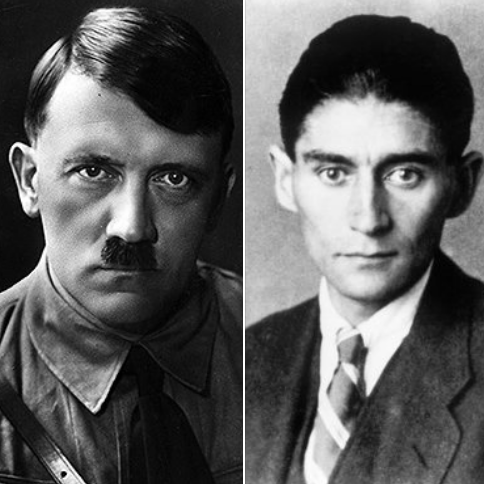
And, I even managed to track down a connection between Hitler and Franz Kafka. This possible meeting  goaded me to write a stand-alone short story about Kafka, in addition to my novel about his missing diaries.  In the short story Kafka is implored to join the Austrian army in WW I so he can kill ” . . . the man who will kill your sisters.”)

In reality, before Hitler came to power, he lived in Munich. In the apartment building where Hitler lived, a cousin of Kafka’s was also a resident.  Nothing is known as to whether the monster met the cousin. Or if Franz visited his cousin. Or if Franz Kafka met Adolf Hitler.

But it would be interesting, a challenge – and even fun – to have these two men (virtual teetotallers and vegetarians both) meet in a coffee house. Or an Art Gallery.

Kafka saw monsters everywhere he looked. Why not give him a real one?

DE

(image)http://oeuvresouvertes.net/IMG/arton3192.png

Create a free website or blog at WordPress.com.

Up ↑