Search

kafkaestblog

It is a whirlwind in here

Author

Dale Estey

I owe my life to Hitler, though I never met the man. My father was paid to stop Hitler, so there is no conflict of interest. I was given a thunk on the back o' the head by God when I was fifteen, and within a week began to write. I haven't stopped. My first novel was accepted 'over the transom'. My first editor/author luncheon in New York included a naked man with roller skates at the next table. For the sake of research I have lain on Kafka's grave, but I did not weep. I wish upon my own gravestone the phrase "Thank God He Didn't Die A Virgin". There is truth in every truth - so watch out. My published novels include the popular fantasy A Lost Tale and the thriller The Bonner Deception. I also have two editions of humorous and spiritual short stories, The Elephant Talks to God, which are appreciated by both young and old. My manuscripts range from stories about unicorns and druids in the 'Passing Through Trilogy' to the 9/11 destruction of New York. I have filled in the missing diaries of Franz Kafka; recounted the first person dementia of a serial killer; explored the outrageous lifestyle of the famous; and listened in while an elephant and God converse. I currently switch my attention between the saga of a family of onion farmers, from Fourth century Italy to the present day, and a contemporary NATO thriller. I live in Canada and make Nova Scotia my home. I prefer to travel by train, but embrace the computer age with passion. I am always on the hunt for unique onion recipes.

WHEN THE GOVERNMENT HATES YOU

Regardless of whether it is fascist, communist or capitalist, all governments hate Franz Kafka.

Kafka, despite his reputation as a depressing malcontent, was an honest humanist. He didn’t belabour the philosophy, he just lived the life. Two stories from his real life stand out which show his basic decency. These are told by other people, for Kafka did not blow his own horn. However, I suspect he did not even think he had done anything special.    

When Kafka first met Oskar Baum, who became a lifelong friend, he bowed his head when he shook hands. This was the formal custom of the day. Oskar felt Kafka’s hair graze his head, which was the only way he could tell that Kafka bowed, because Oskar was blind. To Kafka, the fact that the other man was sightless was no reason not to treat him with the full dignity he would express to any other.      

Later in life, Kafka worked as a lawyer for the Worker’s Accident Insurance Institute for the Kingdom of Bohemia in Prague. This organization was an odd blend of a government and private insurance ‘company’, that paid benefits to injured workers. Although Kafka’s main job was as an administrator, he did sometimes find himself representing the Institute in a court of law.  

On one occasion, he was acting against a worker who was refused benefits for an injury. Kafka believed the worker deserved his benefits, but he would do no less than his best to win the case. His solution was to, from his own pocket, hire an excellent lawyer for the worker. Kafka put forward the best case he could, yet lost. He was greatly pleased.

DE

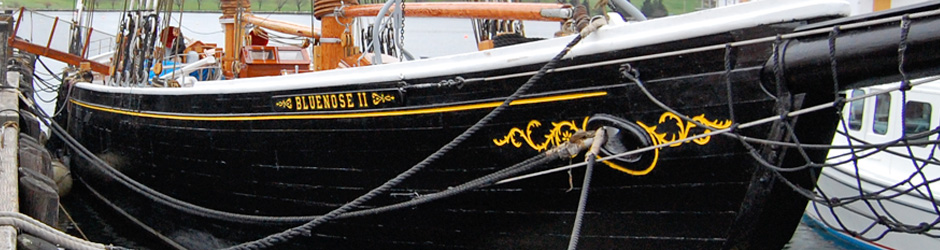
The Bluenose

 A number of years ago, I was seated on a bench in Halifax, watching a cruise ship prepare to leave.  I had noted a tall-masted sailing boat pass, but was more immersed in the huge ship leaving port. Suddenly a man was at my back, asking me to move so I would not get struck in the head.

I turned to see the sailing boat – The Bluenose – coming alongside. It edged toward the dock, closer and closer, and then a crew member on the bow shouted to me.  He asked if I would grab a rope when it was thrown. I agreed, happy to do so. I immediately  had the bow line in my hands and at my feet.

They shouted down to me and asked that I put it over the ‘second’ post. This proved to be quite a chore for something thicker than my arm and heavy in weight.  It took a couple of minutes, but I slipped it over. I jumped back. It was a taut rope indeed.

DE

Blocking Writer’s Block

An ounce of prevention is worth a pound of cure (even in metric).

I experienced over two month’s of writer’s block many a year ago. I did sit literally at my desk for hours. To this day I can  accurately describe that desk. Its vision is before/behind my eyes as I key. It had a red leather top.

I have devised a scheme which I find is 90% successful in combating writer’s block.

Do not finish your thought on page or screen. Make sure it is solidly in your mind (make notes if necessary) but do not write it down. If it’s a description – don’t finish it. If it’s dialogue – don’t complete it. If it’s a line of poetry – don’t end it.

The next day, start with the phrase you could have ended with yesterday. Read the preceding page, slide into the phrase not completed, put in those final words, and the odds are excellent you will continue on your way.

DE

She had God in her feet and Angels in her streaming hair

It was such a summer day.

Death Masks and Death

Bliss Carman, whose death mask it was, and who supplies an appropriate quote.

I took advantage, for my workshop on the Supernatural, to take my students on a field trip to see the death mask of a historically known poet, conveniently placed in a near-by building.

None of them had even heard of ‘death masks’, let alone seen one. I invited them to incorporate the idea of a death mask into their writing exercises. Some did, some did not. However,  it’s possible this visit to death elicited the following story from one of my students. If any do take a look here, they’ll see that I said what I meant about writers stealing all and sundry.

My student and her husband had purchased a new house. Cleaning and renovations eventually took them to the back loft area, which was piled high with decades of accumulated detritus from a long life. They cleared out beds and boxes and newspaper piles and magazines and bundles of clothes and on and on. Anyone who has had to clear out a house knows what this is like.

Near the end of this process, my student noticed a “clump of something” on one of the wooden beams in the ceiling of the loft. Getting ladder and flashlight, her husband climbed to see what it was.  He did not nearly fall from the ladder – that’s hyperbole – but he was definitely taken aback. It was the end of a number of knotted bed sheets.

DE

Kafka And Technology

Kafka at the helm.

Franz Kafka had little use and no affection for that new-fangled invention – the telephone.

Kafka probably also wished he had never seen a typewriter, though he pecked away on it daily.

However,  no doubt to his chagrin, Kafka has been credited with devising the first ‘safety helmet’ or hard hat. He was also awarded a medal for this feat. Now, I knew Kafka had been awarded a medal by the Austro-Hungarian Empire for some services rendered. The beauty of this (something even Kafka appreciated) was that it never happened. By the time the bureaucracy  of the Empire had chewed its way through the procedure, the Empire no longer existed. Empire and Emperor were both gone as a result of the First World War. The Empire had disappeared before Kafka ever got his medal.

For a writer seemingly outside the ‘real’ world, Kafka was acutely aware of it and how it functioned.  He was  the first person to describe for popular consumption, through a newspaper article, the flight of that newfangled device, the aeroplane. He attended an air show in Italy where there were stunts and races. He wrote an account, “Die Aeroplane in Brescia,” which was published in the Prague newspaper Deutsche Zeitung Bohemia. I would say he was impressed, if not exactly pleased.

DE

Kafka And His Burrow

HUMAN BURROW

A burrow offers security and comfort, and Kafka found both in his sister’s tiny house on the Golden Lane.

Ottla – his sister – had rented it so she could spend time with her lover and not be bothered by parents and comments. Her lover was a Christian and ready to go to war. Time was precious. However, she rarely had opportunities other than the weekends, so she offered Franz the use of the tiny house for most of the time. And use it he did, though he never stayed the night.

Through fall, winter and spring Kafka wrote a whole book of short stories there. For one single block of time, it was one of his most creative periods.

When I visited, even under Communist rule, it had been converted to a book store. Of course (which he would have appreciated) there were no books by Kafka for sale. Today he is displayed in the windows.

It was only when I went thorough the small rooms and looked out the window into The Moat that I realized how important the house would become in my novel about Kafka. It was cozy – even with the space cramped by tourists. It had been little altered and I easily imagined Kafka looking through the same glass and walking through the same doorways. No doubt stooping because he was tall. Research met reality.

One of the last stories Kafka wrote, during his final year in Berlin, was called The Burrow. A version exists and is published, though a longer version is supposed to be among his ‘missing’ papers. In it a tiny animal keeps incessantly burrowing to keep away from an enemy. A vague noise convinces the animal to burrow deeper. Yup – that’s Kafka.

DE

Harrison Ford And Me

Harrison Ford And Me

In 2001/02 the movie, WIDOWMAKER K-19, was made, much of it filmed in Halifax harbour and out on the nearby ocean. It deals with submarines and an in-ship disaster, staring Harrison Ford and Liam Neeson.

I was not aware of this when I visited Halifax. I went down to the waterfront and went along the boardwalk. It was very foggy on the water (which it can be without having much on land). I was exceedingly surprised to see, looming out of the fog, a submarine next to the wharf. There are submarines in Halifax, but they are berthed at the naval dockyard a couple of kilometers from where I was walking.

It took a couple of minutes to realize that it was not a naval submarine (no markings). What was happening was that the submarine was being turned by a couple of tugboats. I read later that each side of the same submarine was altered differently so, in close ups and aerial footage, it could appear to be two different submarines.

However, there quickly appeared to be a problem. From the shouts and gesticulations of a man on the wharf, I found out that one of the mooring lines had not been cast from the wharf. The submarine was being pulled away from the dock, but it was still attached. It was a gigantic and thick mooring line, and I do not know what damage would have been done to either ship or dock.

The man was yelling to another man on the deck of the sub, who had a bullhorn and in turn was bellowing to the crew of the tug boat. However, nothing was heard over the roar of the engines (tugboats have powerful engines). The man on the wharf was trying to lift the mooring line from its post before it got too taut to move. I ran over and helped him, and we managed to get it from the post just as it started to be pulled into the water.

Of course I watched the movie credits closely, but I was not mentioned.

No famous movie actors were involved in this incident.

DE

Beaver Tale and Tails

TWO BEAVERS ON THE LEFT BANK

I was walking along the river and heard the strangest noise. It was one of those noises which, when I found out what It was, sounded exactly as it should. A beaver was chewing at a branch on the bank of the river. First there were small rolling noises as the branch went through its hands, and then the ‘gnaw gnaw gnaw’, and then the turning noise and the cycles were repeated.

This went on fifteen minutes or so, then the beaver and I both heard noises in the water. We both saw another beaver approaching. The beaver-at-gnaw quickly went in her direction (though I can only guess which sex was which). They swam toward each other, then rubbed faces. The approaching beaver made small bawling noises like a young calf. They rubbed bodies and seemed to sniff each other, then they swam in different directions. This performance – the swimming away, the languid circling, the approaches – went on for twenty minutes. A couple of times the ‘gnawing’ beaver clambered over the over beaver’s back, but this lasted just a few seconds. The beaver which approached rubbed noses once again, and made the bawling sounds one more time.

I never appreciated how large beavers are until one of them came up on the bank. The water was clear enough to see their feet and tail move underwater (I wonder if the portion out of the water might have the 1/10 proportion of an iceberg). The sun was setting and they became difficult to see. However they decided to part anyway. One began to go down river toward the harbour and one headed to the other shore. For me an experience of a lifetime.

DE

Blog at WordPress.com.

Up ↑