(image)http://zeek.forward.com/workspace/uploads/kafka-photo-grave-300dpi-4c5c1958.jpg
I enjoy graveyards, and peruse them with vigour. It’s true I don’t plan to spend the rest of my life in them, but, after that …
So, I have many tales of cemeteries to tell. Hardly any are scary because, contrary to popular depiction, graveyards are not haunted. Unless one happens to die in one (or – worse yet – die after being buried in one), there are no lingering spirits to haunt. Graveyards are a place, however, to go and contemplate those buried there. I am planning for myself a grand mausoleum.
While researching my novel about Franz Kafka, I went to Prague. In those days it was still under communist subjugation, and travel in and out of Czechoslovakia, to say nothing of travelling the country, was complicated and dangerous. I was fortunate to have arrangements to stay with a Czech academic and his nuclear scientist wife while in Prague. They had a social standing which facilitated an easier visit.
Unknown to me upon arrival, the academic was an amateur historian. When he found the major thrust of my visit concerned Kafka, he was full of places to visit. Many of them I did not know about, and others I doubt I would have found on my own. For instance, he took me to the small house where Kafka had lived on Alchemist Lane, which eventually became the setting for half of my novel. Even though Kafka was in disfavour at the time, the house was noted for the fact he lived there, and it was on tourists lists. In a Kafkaesque twist, it was even then a bookstore, but none of his books were allowed on the shelves.
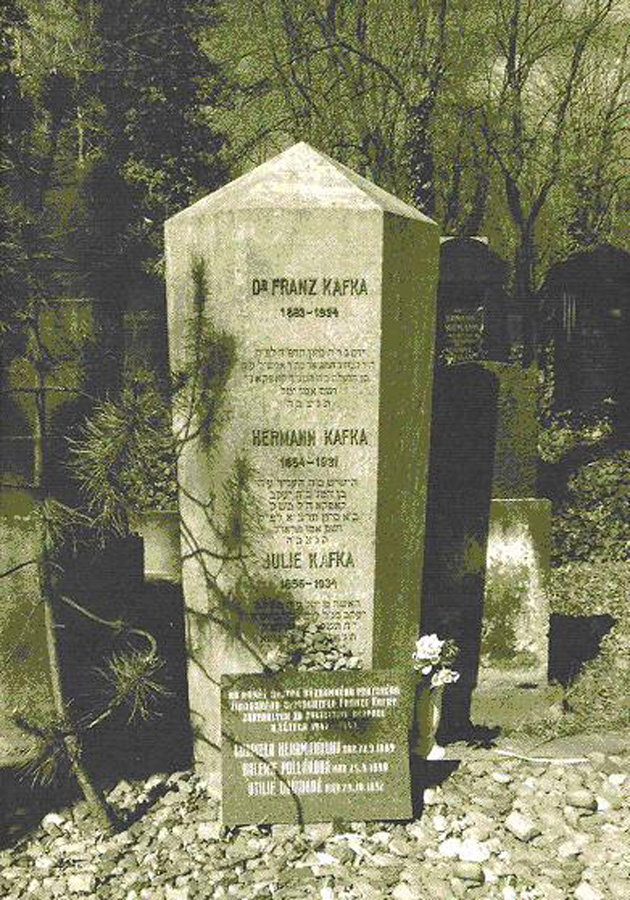
One of the places I was taken was to Kafka’s grave. It is situated nowhere near where Kafka lived his life, but is in a huge Jewish graveyard on the outskirts of the city. It took nearly an hour on the subway to reach the area. And then a walk to the graveyard itself. And then a walk through the graveyard, though the way to Kafka’s grave was signed. I would never have thought of trying to get there myself.
Kafka is buried with his mother and father (though, literally, vice versa, as he died first). It is only years after the fact that I read about the drama of his death, and the drama at the graveside. His young lover, Dora, who had spent the last year of his life with him, attempted to leap into the grave. She had to be restrained by Kafka’s best friend, Max Brod.
I lingered a long time – perhaps a half hour – by the grave. In the Jewish tradition I left a stone upon the gravestone. In my own twist, I also left a pen. And, because there were few about, and I was so moved, I lay down upon the grave itself.
DE


 kafkaestblog