Search

kafkaestblog

It is a whirlwind in here

Tag

manuscript

Kafka Sweeps Away Dust, Gold And War [from: Kafka In The Castle]

objects-of-use-chinese-broom-remodelista-518x600

27 November 1916

Should I comment upon my unique and strange surroundings – this tiny house of Ottla’s. Not shared with a fiancée, but a sister. This place would not do for Felice, it is too small and too spare and too far from the heart of the city. But I feel secure against the winter. Up here in the castle.

As with all the tiny houses on Alchemist Lane, this one has its history of the quest for gold. Thus I fit right in, for I am after such purity.


17 December 1916

Although Ottla seems content with just her Sunday afternoons in this tiny house, I was careful to make certain no one was here before I entered. Since the Alchemist Lane ends in a stone wall, all who enter have to return the way they came. How awkward. Ottla would just smile and ask after my health, it is I who would look at my feet. My love affair of letters would blush on such sure ground. But, we did not pass.

This place is of course a fantasy, a burrow in which to hide through these winter months. It’s barely big enough to bury a man properly, yet before Ottla moved in, a family of eleven crammed their lives into it. Knowing how fortunate I am in this world never seems to help in mine. I thought I might leave both worlds, with the help of the army. Friends and family have told me how grateful I should be that I am unable to join. My official dispensation because I am indispensable to the bureaucracy of the Empire. F. looked upon me in disbelief when I told her I would try again to enlist. Perhaps I can gather the spirits of the necromancers who have lived on this lane to assist me.


18 December 1916

I could, with my broom, sweep away the glory of war. It is less than the dust of this tiny house.

DE

(image) http://www.remodelista.com/wp-content/uploads/2015/03/objects-of-use-chinese-broom-Remodelista-518×600.jpg

Franz Kafka Turns Words To Gold On The Golden Lane

3848764367_a7b9e65ed5_o

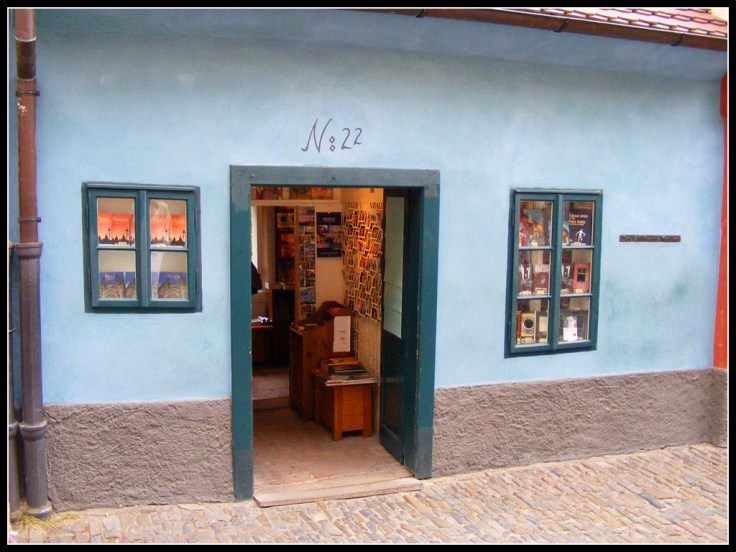
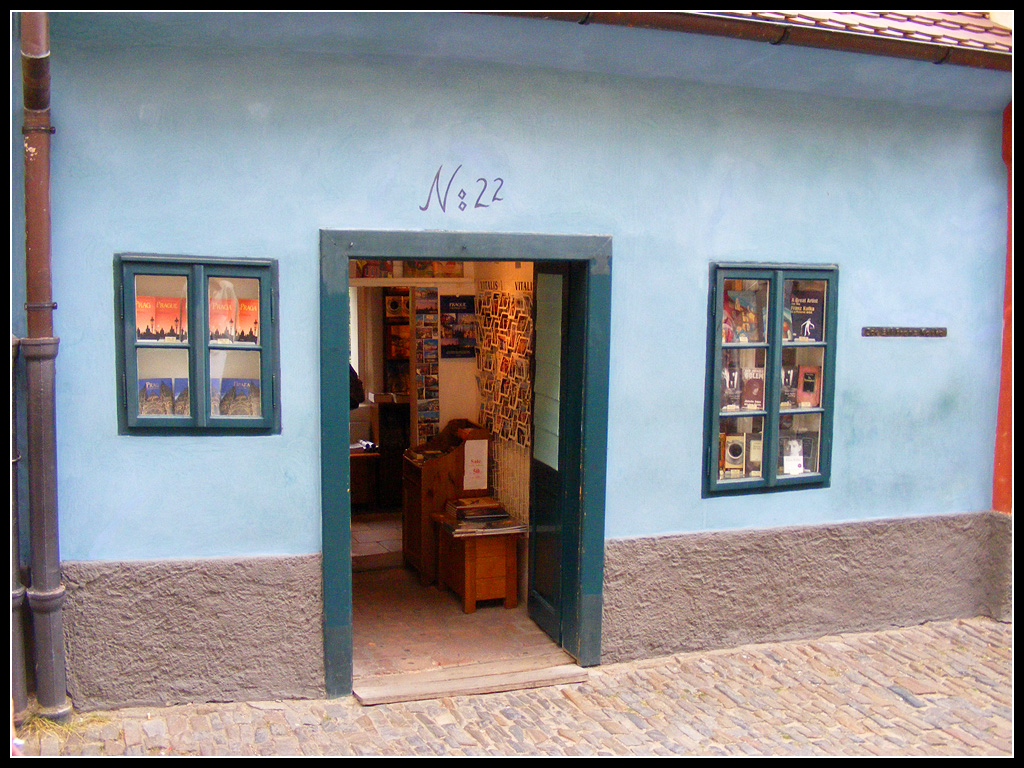
[Kafka’s house on The Golden Lane]

A burrow offers security and comfort.  Kafka found both in his sister’s tiny house on the Golden Lane.

The Golden Lane is a narrow, dead-end yet massively historic lane, hugging an interior wall of the huge Prague Castle. Centuries ago the small buildings along the lane housed workers of the Castle, including some resident alchemists. Thus the name.

Ottla – Kafka’s sister – had rented it so she could spend time with her lover, and not be bothered by parents and comments. Her lover was not only a Christian, but he was soon going to leave to fight in World War I. Time was precious. However, she rarely had opportunities to use it other than the weekends, so she offered Franz the use of the tiny house for most of the time. And use it he did, though he never stayed the night.

Through fall, winter and spring Kafka wrote a whole book of short stories there. For a single block of time, it was one of his most creative periods.

When I visited, under the Communist rule of the time, it had been converted to a book store. Of course (which he would have appreciated) there were no books by Kafka for sale. Today he is displayed in the windows.

It was only when I went thorough the small rooms, and looked out the window into The Stag Moat, that I realized how important the house would become in Kafka In The Castle, my novel about Kafka. It was cozy – even with the space cramped by tourists. It had been little altered. I could easily imagine Kafka looking through the same glass and walking through the same doorways. No doubt stooping because he was tall. Research met reality.

One of the last stories Kafka wrote, during his final year in Berlin, was called The Burrow. A version exists and is published, though a longer version is supposed to be among his ‘missing’ papers. In it a tiny animal keeps incessantly burrowing to keep away from an enemy. A vague noise convinces the animal to burrow deeper. Yup – that’s Kafka.

DE

(image) https://farm3.staticflickr.com/2645/3848764367_a7b9e65ed5_o.jpg

Eating Out In New York – Free Entertainment With Roller Skates

font-b-black-b-font-adult-double-font-b-roller-b-font-font-b-skates1

My friend, Google tells me that “over the transom” is still a viable term. In this case it refers to a manuscript accepted by an editor submitted cold – perhaps even from the dreaded slush pile.

At any rate, my manuscript for A Lost Tale was accepted “over the transom”, and I was asked to New York to meet the editor. Although I had experienced and appreciated Montréal, Toronto, London, Berlin and other large cities by that time, I had not been to New York. Many events of that trip are memorable, but none more than my “lunch” with the editor.

The editor took me to some dark and trendy place for a late lunch. There were not many people there and, restaurant fiend though I am, the food was not my top priority. Discussion of “the work” and proposed changes was more on the menu for me.

However, as I sit across the table from my editor, I can not help but notice a man seated by himself beside the wall. He is tieless and shirtless and, though the lighting is dim, what there is reflects from his naked skin. He sits with a beverage and seems to hum to himself. My editor is discussing both the menu and some confusion he perceives at the beginning of my novel. I note items on the menu unknown to me and am doubly confused.

The shirtless man at the other table increases the volume of his humming and eventually a waiter goes to him and has words. The shirtless man has words back, but they sound like gibberish. At my table the editor suggests something from the menu and I happily comply. There is wine.

Whilst I eat and listen to suggestions, the shirtless man is spoken to by two other waiters. As I (wisely) restrict myself to a second glass of wine, two uniformed policemen enter the restaurant and approach the shirtless man, whose gibberish had increased even more in volume. In the course of a few minutes three other uniformed police officers – one of them female  – arrive on the scene. They are now ranged around the shirtless man and his table. I finally tell my editor what is happening behind him and why I am not concentrating fully upon his suggestions. He turns around.

Two of the officers remove the table from in front of the shirtless man. Two others, one on each side of him, haul him to his feet. It is then that we see his shirtless state continues all the way to his naked feet. The female officer takes the tablecloth from the table and drapes it around him. The four male officers form a circle around the naked, shrouded man uttering his gibberish, and hustle him from the restaurant. The female officer picks up what appears to be a pile of clothes from beneath the table, and a pair of roller skates, and follows them.

I say to my editor that I have never seen anything like that.

My editor concurs.

DE

(image) http://g02.a.alicdn.com/kf/HTB1FsWuKFXXXXcrXXXXq6xXFXXXD/-font-b-Black-b-font-adult-double-font-b-roller-b-font-font-b-skates.jpg

Ship Voyage, Crew and Chickens in the 14th Century

marco-polo-yarmourh-bar

From China Lily

{A 14th Century sea voyage}

More than once he had brought chickens on board ship for the voyage. He had been totally unprepared the first time to find the crew (and even the officers) were far more interested in having fresh meat than fresh eggs. They had barely been out of the site of land when some crewmen brought Matzerath two dead chickens. They said that they found the birds fighting and that they were so badly injured there was nothing to do but to wring their necks.

            The next time it was just one chicken. Matzerath was told that it had escaped and bashed its brains out trying to get out of the galley. Then there were four chickens, somewhat bloodied, and he was told the chip’s cat had got to them. By now he was down to just a few chickens, and was only mildly surprised when they turned up, in ones and twos, broken-necked near the crude coop he had built.

            He toyed with the idea of cooking them in some manner that would repel the crew, but the fact of the matter was that he enjoyed the feast himself.

            On a couple of other voyages Matzerath had constructed secure hen coops. He put two  layers of wire over the frame and put a lock from his own house on the door. He wore the key, along with others, around his neck. There would be no cats intruding and no chickens getting free to ‘kill themselves’ against the sides of the ship. And things went well – for a week.

            Matzerath began to find, one chicken at a time, the members of his flock at the entrance of his galley. The galley was meagre, with barely room for a fire, a preparation space, and some provisions. He was allowed to make hot meal only on Sunday and Wednesday. The ship could not carry much fuel and the crew was (rightfully) terrified of a fire breaking out. Matzerath always had to have an officer present to cook a meal. The flame was always dowsed with copious buckets of sea water when the cooking was done.

            The chickens appeared the days he was going to prepare a hot meal. As there was no pretense that the birds had escaped and died, they were plucked and cleaned. Since no one could abide waste on the shop, and because he took a generous portion of breast for himself, Matzerath cooked them without complaint. The carcasses guaranteed a soup for those who didn’t get much of the actual bird, and all went on as before. He eventually found out that some member of the crew, adept with tools as so many seamen were, had untwined and cut the wire in one corner of the coop. he effectively made a flap that he could undo and secure without it being noticeable.

            When Matzerath finally found this entrance, his supply of hens was so low that he did nothing. He had managed to have two months of eggs (which did not seem overly appreciated), and some meals of chicken that he himself enjoyed. He also realized that the contest between himself and the chicken thieves eased some of the boredom of the long voyage.

            His next time out at sea he also had chickens and a coop. He took pains to make it more secure, and his chickens lasted longer. However, the owners complained about the waste of the chicken feed at the end of the voyage.

            On the trip after that, his whole flock caught some disease within the first week.

The birds became bloated and stank within the same day they died. Their feathers were moist and puss formed where they were attached to the skin. There was no space in the coop to separate the ill birds from the others. The captain was swift in his judgement about getting rid of the corpses. He feared the disease might spread to his crew. He had seen ships overcome by a rapid wave of sickness.  Had it been further into the voyage, the crew might have eaten them but, as it was, Matzerath had to dump them over the side.

DE

(image)http://www.ciaofamiglia.com/emigrants/Ships/Marco_Polo/Marco-Polo-Yarmourh-BAR.jpg

The Ghost Of A Chance In The Supernatural Workshop

ghoststoriesana00jamegoog_0252

I do give writing workshops, though few and far between. I doubt I can be classed as a specialist in anything, I am more a ‘nuts and bolts’ instructor. However, I do write a lot of supernatural material, and I am adept at dialogue. Both are fun to play around with.

I was blessed at one Supernatural workshop to have every student both interested, and showing an accomplishment in writing. There is, of course, more chance of this when they are laying down the big bucks, but it is still appreciated.

One of the students took me aback during the course of the day. She had handled my bizarre and distracting writing exercise with aplomb, which is always positive. However, in more general discussions, she balked at my dictat that writers must write at regular times, preferably every day.  She did not have the time (with young children at home). She even stole time when a child bathed, by scribbling quickly while watching the child. Although there was time in the late evening, she refused to intrude on that. She watched TV and let her mind rest. I can readily accept that part, as that is what I also do. I doubt I could be creative past nine o’clock  even if it meant I would win the Booker.

In the afternoon, she surprised me by, quite frankly, looking ten years younger. She was relaxed and more engaging. I like to think she was reacting to being able to be somewhere where all she had to do was deal with writing. That’s my story and I’m sticking to it.

In the course of further general discussion, she tossed off the fact that, the previous year, she had “written a novel”. At first we thought she was in jest. However, she was taking a course from some ‘by mail’ organization, where they give exercises and critiqued work returned to them. The woman who had no time, had written a novel in a year (besting me by a year and a half). I know from her writing abilities it would not be a poor novel, and, if nothing else, it was a foundation to other writing.  I don’t even know if she’ll submit it to a publisher – it was a learning exercise.

Kudos to her, said I, and every student agreed.

DE

(image) https://ebooks.adelaide.edu.au/j/james/mr/antiquary/plates/ghoststoriesana00jamegoog_0252.jpg

A Year Goes Past And The Writing Continues

spofec-rr-ghost-tune-160

(image)http://1.bp.blogspot.com/-O43_czTkQ_I/VCFhPJYIfII/AAAAAAAAKHM/yq9FuImgLDI/s1600/SPOFEC-RR-Ghost-Tune-160.jpg

A year ago I started (returned to, actually), writing something every day.

“Every day” is not exact, and perhaps not even wise. I have settled into six days a week, with a day (Thursday) off. When advised to write every day, a writer should know that they should write regularly, at least four or five days every week. And try for a decent amount of time per day, at least one to two hours. Find a rhythm that works and stick to it unto death.

I began last year with the intent of finishing my novel, a thriller called The Bonner Prediction. That I have done, and edited twice. One more edit remains. That should be completed in a couple of months.

However, in the intervening year, I returned to a story I had started in the previous year. It’s genesis was less as a short story, and more of a character sketch. By that I mean my main interest was to write solely about this particular character which, other than for my novel about Franz Kafka, I don’t believe has happened to me. Setting was also well-established. Other than that, I follow the character, Alison Alexandra.

Alison Alexandra is taking me on a wild, unplanned and exciting ride. It is some of the most purely enjoyable writing I have done. Fifty or so pages so far. Obviously not a short story, but I don’t know to what extent it will go. Alison Alexandra is chock -a-block full o’ surprizes. Today she is taking a ride in a Rolls Royce “Ghost”. Oh – what will happen?

So – let me tell ya – write every day. 

I wrote the following a year ago.

Perhaps my creative stream is bubbling away

I did not plan a New Year resolution. What I had planned was to write something on my current novel the first day of the new year.

This is also not planned, but – so far – I have written every day of the year except two – one a travel day, and one a deliberate ‘take-a-day-off-day’. I am two or three chapters from the end of thisThriller. I have not written fiction so steadily for months. I hope it keeps on.

This is the part which I do nor know is related to my writing situation.

I have never dreamt about any of my writing – never. I know many artists dream about their work, get ideas about their work in dreams and such, but not me. So, I did not have a dream about my writing. However, I recently awoke from a dream where I was talking to my publisher. She said I should do another book of short stories about the Elephant. Is that close?

And, finally, the incident below. On Twitter, I came across an announcement of a restaurant/bakery in Calgary. The Corbeaux. This means The Ravens. They have a store sign which has noted similarities to one which I have described in a manuscript. And you can see their sign in this photo.

https://fbexternal-a.akamaihd.net/safe_image.php?d=AQCKukhRj63heHlL&w=470&h=246&url=http%3A%2F%2Ftoquesandtruffles.files.wordpress.com%2F2014%2F12%2Fimg_8531.jpg%3Fw%3D1200&cfs=1&upscale=1

And then you can read what appears in my unpublished second Satan novel, where ravens play an important part.

Perhaps my creative stream is bubbling away.

From Places Of Evil

Mr. S. does rehearse what he plans to say to Breeze, both while he waits for the taxi, and then in the twenty minute ride to her restaurant. He is surprised Dorkas and Caleb made as such little protest. He suspects they agree with his concerns about the twins, even if not enthusiastic with his solution.

Mr. S. has the taxi stop a couple of blocks from the restaurant. Breeze has installed a new sign, and she wants his opinion of how effective it will be attracting customers. Although he helped – at her insistence – to choose the design, he has yet to see the finished object.

He walks along the street, pretending to be someone looking in shop windows for a gift. He actually wants to purchase Breeze a celebratory present, but that is for later. He tricks himself enough, that when he finally does look up at the sign, it is with a degree of surprise.

Breeze has not purchased a painted sign, as he had supposed. The design is similar to the ones they discussed, but she has not chosen an image imposed upon a wooden background. Instead, there are carved and painted shapes jutting from the front of the building, parallel to the wall.

A thick piece of wood, chiseled into the shape of a tree top, is attached over the lintel. Two branches sprout from the trunk of the tree, which tapers to an uneven and jagged tip. At the very top, a life-sized carved raven sits, its head tilted up. On each of the protruding branches sits another raven, their bills open as they look at each other.

Nailed to the bottom of the tree, a metal chain hangs to the door, holding a wooden sign printed in Old German script. It announces the name of the restaurant: The Hungry Ravens.

“As black as black can be.”

Mr. S. hums as he walks across the narrow street. He has reservations about her sense of humour, with this reference to the ravens. Their unfathomable connection to the work of the Organization, and their role of `familiar’ to Satan’s intentions, are beyond – in his opinion – the wryest of humours.

As he steps toward the front door, he notices a more subtle change. Breeze has sand-blasted the brickwork facing the street. The dark red hue enhances the outline of the tree and its occupants. They look as if they are silhouetted against a sunset.

DE

Writing By The Numbers

gold-plated for me
I have spent the better part of the last four years writing and editing novels. And the better part of this past year just in the editing. One is historical and the other is a thriller. Both really demand that I keep within the rules of the world I have created/entered. Imagination is certainly needed, but I think of it as a prosaic creativity.

I had been planning, this week, to return to a more creative type of writing. More amorphous and not as controlled. More of whimsy if not exactly whimsical.

I already had a short story partially done. I was greatly surprised I had started it a year ago). I wished to use a new name for the character, and have the setting more vague and open. I was going to start it on Thursday, but was reminded that Thursdays have been “my day off” the past year.  I am superstitious enough to keep to a working formula. So, I left it until Friday, even though it was Friday 13th.

Not having looked at it for nearly a year, I was gobsmacked to find the first line is: Hermione Kafka embraces the number 13.”

Her name is now Alison Alexandra.
Her saga continues.

DE

(image) http://i.telegraph.co.uk/multimedia/archive/02054/number-13_2054848c.jpg

Avoid The Trial of Writer’s Block

chop away at the writer’s block

(image)

An ounce of prevention is worth a pound of cure (even in metric).

I experienced over two month’s of writer’s block many years ago. I did, literally, sit at my desk for hours, and can to this day accurately describe that desk. Its vision is before/behind my eyes as I key. It had a red leather surface, boarded in black. It was of thick mahogany with drawers. It faced the wall not far from the door to the room. I have placed it in one of my novels.

To not have this debilitating situation happen again, I have devised a scheme that I find is 90% successful in combating writer’s block.

Do not finish your thought on page or screen. Make sure it is solidly in your mind (make notes if necessary) but do not write it down.

If it’s a description – don’t finish it.

If it’s dialogue – don’t complete it.

If it’s a line of poetry – don’t end it.

The next day, start off with the phrase you would have ended with yesterday. Read the preceding page or two, and when you enter the phrase not completed, the odds are excellent you will continue on your way.

DE

Kafka To The Day: Writing His Diary

(page from *real* Kafka diary)

One of the most  startling situations regarding Kafka and my (re)construction of his *missing* diary occurred when I had been working on the manuscript a couple of months.

I initially (of course) had the hope of literally writing a diary entry a day. Not only did my real life intervene, but some of the constructed diary entries took days to write. Also, there were times when many of my diary entries were but a few lines long. Thus, I might do a number in a day of writing.

In one instance, as I was checking Kafka’s real diaries, I noted one of his entries had the exact date as the day I was reading it. That is, if he was filling in  a diary entry on Friday, 19 October (for I forget the exact day I realized this), I was reading it on Friday, 19 October. I looked at a perpetual calendar, and not only was the year in which I was writing an exact numerical year to his, so was the following year. 

As a result, I believe my novel took on a more authentic flavour. When I put my pen to paper on the 14th of March, it was also a Wednesday in 1917.  

DE

(image)  http://swc2.hccs.edu/htmls/rowhtml/kafka/Diaries.GIF

Blog at WordPress.com.

Up ↑