In my novel, Kafka In The Castle, I fill in missing entries of his actual diaries. There are many days to fill, as he either did not write during these days, or he destroyed the record.
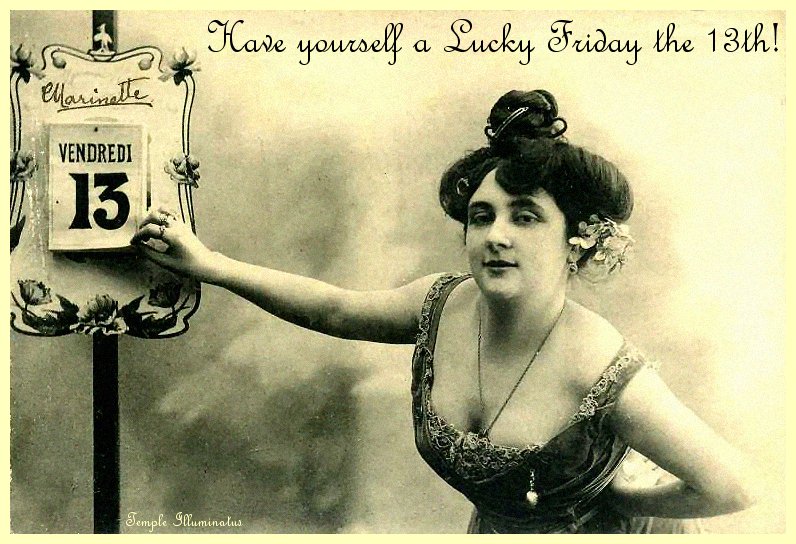
I do give him a brief recognition of Friday 13th. Kafka was not a superstitious person, and such things weighed on him lightly.
In reality, memories of the Swiss Girl he mentions (a teen he met and probably “embraced”) haunted him all his life. But pleasantly – oh, so pleasantly.
~~~~~~~~~~~~~~~~~~~~
13 April 1917
I almost wrote down the year as 1913. That was the year I met the Swiss girl. And I remember her joking about Friday the thirteenth, and how we had missed it by just a day. She was superstitious – Christians seem to be. I wonder what precautions she is taking today. It will be three years and seven months since I saw her. Yet some of the things we did could have happened last week. I think that memory must be made of rubber. You can sometimes pull it toward yourself – and sometimes it snaps away like a shot. Causing as much pain.
In Kafka In The Castle, I fill in the ‘missing’ diary entries from Kafka’s real diary. He either did not fill in these days himself, or he destroyed them. There are some estimates that Kafka destroyed 70% – 80% of everything he wrote. *********************************
15 January 1917
Dreamed that I never dream.
“That can’t be true,” said AB, dropping the papers she held. “Everybody dreams.”
“It never happens to me,” I insisted. “And what’s more, I don’t really believe that anyone else dreams, either.”
“Of course people dream,” said AB, dropping bunches and pots of flowers on the floor. “I dream all the time. I’m full of dreams every night.”
“Even tonight?” I asked, excited, because I had some power, some type of knowledge, although I didn’t know what it was. “Tonight,” she repeated. “Especially tonight,” she said, dropping bowls of snow on the floor. “It is right now, right here.” Her voice was also full of excitement. “I am dreaming about you.”
“Me?” I said. “You can’t be dreaming about me. I’m right here – I’m not in your dream.”
“Not only are you in my dream,” she said, dropping automobiles and tram cars on the floor, “but you’re talking in your usual obstinate way. You’re cross, and you’re silly, and you’re shaking your hands at me.”
“I’m doing no such thing,” I said, wringing my hands and starting to yell.
“You’ve taken your absurd thoughts,” she said, dropping pieces of Prague on the floor, “and you’re forcing me to be part of them.”
“Even if it’s true – all true,” I said, trying to sweep Prague into the river, “it still isn’t me. You’re the one having the dream.”
AB snatched the broom out of my hand, and dropped it to the floor. “Then try to wake me,” she said.
16 January 1917
I have the feeling, that what I really am doing at the office, is committing suicide. And doing a good job.
In my novel, Kafka In The Castle, I fill in the lost diary entries that he either ignored, or destroyed.
Kafka made this walk hundreds of times (and I managed a few, myself).
The following is the entry I made of Kafka crossing the Bridge, and what he pondered.
Excerpt From Kafka in the Castle
~~~~~~~~~~~~~~~~~~~~~~~~~~~~~~~~
29 August 1917
I strolled the Charles Bridge a long time tonight, before coming on to the castle. I have the feeling that the river air helps my lungs.
I also like the city lights reflecting from the racing water. And the occasional boat, lanterns stern and bow.
I have once or twice steered my own boat through the dark, the flickering light dripping through the gloom before me. If I could have reached the sea while it was still dark, I would have tried to do so. But I was younger then. And could breathe deeply.
Fantasy fuelled this escape, from my Moldau island and then along the Elbe, through Dresden, Magdeburg and Hamburg, to the freedom of Helgoland Bay. Further into the North Sea, if I wanted. Perhaps to Iceland, where I could become lost in the snow and white.
All this, from my perch upon the Charles Bridge, as I strolled from side to side, and one end to the other. My last smile reserved for the statues staring down on me.
Their stony expressions etched upon their faces, as is mine to me.
Boston Modern Orchestra Project, Gil Rose, conductor
Dalit Warshaw (b. 1974) is a multi-threat artist. As a composer and pianist, she has created a distinguished career. Her first orchestra piece was commissioned when she was eight years old, and this prodigious distinction has been followed by a body of work that encompasses music for orchestra, chamber ensembles, vocalists, choruses, and Letters of Mademoiselle (2018), a staged song cycle for the talented soprano Nancy Allen Lundy.
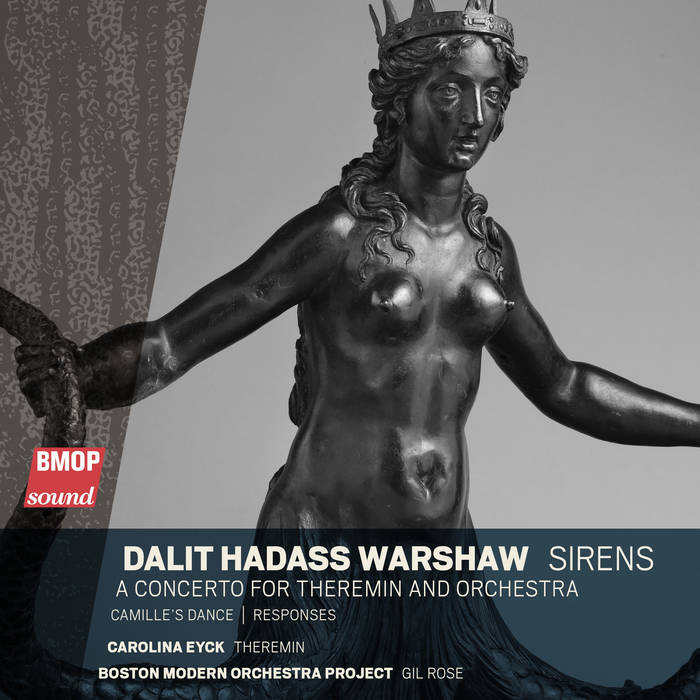
The theremin has become an important part of her work. Warshaw has performed the instrument in high profile settings, including appearances with the New York Philharmonic. Sirens is a recording of her theremin concerto and two other orchestral pieces, performed by the Boston Modern Orchestra Project, conducted by Gil Rose.
Responses (2016) is a triptych that reflects upon three of Brahms’s Intermezzos, piano repertoire that Warshaw has studied. Originally composed for solo piano and performed by Warshaw, it has been transformed into a work for large forces that sounds idiomatic in its instrumental writing. Indeed, Warshaw’s orchestration deftly captures both the sehnsucht of romanticism and her own aesthetic, which encompasses both neo-classical and mainstream contemporary classical elements. While the pieces themselves are earnestly serious (as was Brahms in his later years), one can have a bit of fun with the following listening game: without hunting down program notes, see if you can figure out from which intermezzo each movement takes its inspiration.
Camille’s Dance (2000) is named after visual artist Camille Claudel, whose sculptures La Valse and La Fortune grace the cover and interior of the BMOP recording’s booklet. It is a stirring piece, rife with dissonant harmonies and muscular gestures that epitomize the striking characters depicted in Claudel’s sculptures, as well as her fraught relationship with Auguste Rodin.
The soloist for Sirens is the thereminist Carolina Eyck. It is a three movement work that is inspired by Clara Rockmore and, of course, by the singing duo of temptresses found in Homer’s Odyssey, seen through the vantage point of Franz Kafka’s parable “The Silence of the Sirens.” The theremin was taken seriously as an instrument in part because of Rockmore’s advocacy. Eyck has explored an expansion of its capabilities with the Etherwave Pro instrument, which has an extended bass range. She also uses octave pedals to further extend the theremin’s compass.
Rockmore’s first instrument was the violin, and her theremin performances reflected this; several of the pieces in her repertoire were transcriptions of violin repertoire. Thus, the opening movement of Sirens is titled “Clara’s Violin,” which includes thematic material based on her life story and also themes that are ciphers of names: Clara, Leon Theremin, her partner and the inventor of the eponymous instrument, and the KGB, whose agents hounded and even kidnapped Theremin. One needn’t know any of this to appreciate the abundant vitality and craft of the movement. Warshaw’s own experience as a thereminist and her close collaboration with Eyck have yielded a versatile and challenging solo part that belies the notion of the instrument as being limited to special effects and transcriptions.
The second movement uses the Kafka story as a touchstone, with a stirring duo between theremin and piano that reminds us of the two-against-one scenario that Odysseus endured. The third movement is a wild ride with glissandos galore, a theremin specialty, set alongside a fugue that once again employs ciphers of names as its thematic material: “Theremin” as its subject, with “Clara” and “Dalit” used as two countersubjects. The combination of these two elements shows Eyck and her bespoke electronics to best advantage. It also highlights the extraordinary facility of BMOP’s musicians. Careful preparation and the dynamic leadership of Rose are clear in the performances of all three of the programmed pieces, but the jubilation with which the concerto is rendered makes it a strong finale to a thoroughly engaging recording. Recommended.
In my novel, Kafka In The Castle, I fill in the missing entries of his actual diaries. There are many days to fill, as he either did not write during these days, or he destroyed the record.
Kafka did have occasion to ponder Friday 13th. The date was connected to “The Swiss Girl”, whom he met at a resort. She was eighteen and he was thirty-four. It is unclear how intimate their relationship became.
Twice, I give him a brief recognition of Friday 13th. In reality, The Swiss Girl haunted him (pleasantly) all his life.
**************************************
13 April 1917
I almost wrote down the year as 1913. That was the year I met the Swiss girl. And I remember her joking about, and how we had missed it by just a day. She was superstitious – Christians seem to be. I wonder what precautions she is taking today. It will be three years and seven months since I saw her. Yet some of the things we did could have happened last week. I think that memory must be made of rubber. You can sometimes pull it toward yourself – and sometimes it snaps away like a shot. Causing as much pain.
13 July 1917
Friday the 13th again. What better time to think of the Swiss girl, than with F. I don’t know if such memories help sustain me, or if they revel how intolerable the future can sometimes be. I can not imagine the Swiss girl’s face across the table from me, nor her voice singing one of her quiet songs. If I must be trapped, then why can’t I be trapped in the past?
Franz Kafka died on 03/06/1924. He was a young man – a month short of his 41st birthday. However, his death was preordained years earlier. In my novel, “Kafka In The Castle“, I fill in the missing days of his diary. These are the entries I imagine concerning the days he actually found out his fate.
*******************
04 September 1917
A death sentence.
05 September 1917
Max is saying all the right things. All the nice things. And he is saying them all in the right way. An earnest, matter-of-fact truthfulness which sounds plausible. If he does not tread from a very narrow path. Sometimes I find myself a part of his hopeful speculations. And sometimes I find that I am trying to keep his spirits up. If he is going to all this trouble, then shouldn’t I do my part? But: it isn’t his blood. And anyway – he was the one who insisted on the specialist. Chose the renowned Dr. Pick. And heard – almost as soon as myself – the verdict. Tuberculosis. Tuberculosis engaged in both lungs. Like a preparation for marriage. The engaged man now flirting with another lover. And planning a marriage which will be far more permanent that any I could have had with Felice.
I have written a novel where I fill in the missing days of Kafka’s real diary. However, I appreciate the following, which is Kafka’s real opinion of the first employment he ever had. I never had such far-away thoughts at my own first job, but neither was I enraptured by it. I lasted a year.
*****************
“Now my life is in complete disorder,” he wrote to Hedwig Weiler on October 8, after just a week of work. “It is true, I have a job with a tiny salary of 80 crowns and 8-9 interminable hours of work, but I devour the hours outside the office like a fierce beast. . . . I nourish the hope of sitting one day on chairs in far-flung countries, looking out of the office windows onto sugar cane fields or Muslim cemeteries, and the insurance branch interests me greatly, even though for the moment my work is sad.”
He quit after less than a year, on July 31, 1908, citing health reasons. (“We express our amazement that the state of health of the aforementioned, who after the careful examination of the doctor carried out in October last year was recommended as absolutely fit, is after such a short time so bad that his immediate resignation must follow,” reads a letter from the company in Kafka’s file.)
In my novel, Kafka In The Castle, I fill in **missing** diary entries from Kafka’s real diary. He either did not fill in these days himself, or he destroyed them. It is estimated Kafka destroyed 70% – 80% of everything he wrote. I am as accurate as I can be in my timeline
11 August 1917
I went to the office as usual. I was still coughing, and took extra handkerchiefs. The Director asked if I had a cold, and I told him I wasn’t sure. That certainly was true – I wasn’t sure what I had. When I met Max in the afternoon, he was horrified when I told him what had happened to me. And angry with me – genuinely angry. He told me that I was stupid.
I’m sure it’s a word he has never used in relation to me. Stupid.
I was astounded, and my surprise was such that I started coughing again. This made Max propel me all the more rapidly to the doctor. I feel that doctors are never really to be trusted. But sometimes, they are necessary. There had been so much blood.
I suppose that is what woke me – the coughing – or else I might have choked on it. Or even drowned in my own blood.
I had to sit on the edge of the bed and grope for the light cord, to find out what this wetness was on my face and hands. Even then, I was more surprised than startled. I was wondering more how to stop the mess, than anxious about its cause. Blood from my throat, pumping out of my mouth. I slipped off the pillowcase, and tried to use it as a gag, coughing and spitting into it while trying to wipe my face. This gushing stream from my mouth did not seem to be stopping however, so I warily made my way to the sink. Even the usually chattering maid was subdued this morning, as she tried to scour the porcelain and the walls. “Herr Doktor,” she said. “You don’t have long for this world.” But at the time, the minutes had certainly seemed long when I had been leaning over the sink, one hand steadying myself against the wall while my gasping and spitting seemed to turn everything red. It was a relief to finally get to sleep. I felt I had really earned it.
Of course, this afternoon the doctor took his time prodding and peering, asking the most obvious questions while Max fretted like a parent. And took the doctor seriously. The questions about the blood seemed to disturb him. And the doctor was full of questions – wanting to know about the pain, and the amount of blood, and its duration. Had anything like this happened before? Any incidents in my family? Had I received any recent blows to the face or neck? Had I tried to eat or drink since it happened? Was I dizzy, or short of breath? Did I have headaches? Actually, this was the only time he seemed to take an interest in my answers. I mentioned that after the incident had happened, a headache which I had for days finally disappeared. I was able to sleep peacefully the rest of the night.
He then rattled off words like thoracic dual apices, hemorrhage, and catarrh, and gave me two bottles of medicine to take at alternate times of the day. And that was that. Examination over and we’re out in the street. Max also expressed some reservations about the diagnosis, and suggested I should see a specialist. As he walked me back to work at the Institute, I at least had reason for not taking an active part in the conversation. I noticed that one prominent word was prominently absent from all discussion.



 kafkaestblog
