Search

kafkaestblog

It is a whirlwind in here

Tag

history

KAFKA’S BIRTHDAY!

03 July is Kafka’s birthday. Celebrations are running rampant in the world.

Hearty renditions of “Hip hip hooray” with an exuberant “Huzzah!”, echo through every major city, and each quiet hamlet.

And this year, I will dive (and then delve) into the new book containing all of Kafka’s various drawings. Some are a tad odd.

I have written Franz the following letter (as yet, unanswered).

~~~~~~~~~~~~~~~~~~~~~~~~~~~~

My Present / Your Future

Still in this World

A Life Away

Dear F:

You would find it perverse to be wished a “Happy” birthday, but your response would be gracious. Such is the reality you understand, and how you deal with it. I have found that your reality is actually real.

Although it will give you no pleasure – well, ‘little’ pleasure – you are correct in all your observations.

Governments become the tools of the bureaucracies which run them. It doesn’t matter what type of Government, from the monarchy under which you lived, to the right wing horror of fascists that called themselves socialists, to the inept socialism pretending to be ‘for the people’. All three governments held their sway over the city where you spent your life. All three oppressed the people they ruled. All three looked after themselves first.

Writers are either writers or they aren’t. The urge to write encircles one like a snake around its prey. Feed it and it won’t quite squeeze you to death. You can not ignore it – even at your peril. It is with you every hour of every day, ever inquisitive and (sadly) always looking for something better. You have thrown up your hands to ward off the snake. Sometimes – some few times – it loosens its grip.

Love is a see-saw of extremes. Every high guarantees a low. Every low reaches for a high. Every high reaches for a high. When these hills and valleys are eventually levelled, they are still desired.

Sex is highly over rated. The thing of it is, even rated fairly, ’tis a consummation devoutly to be had. Yes – I know – you appreciate Shakespeare. On a par with Goethe, even if you can’t bring yourself to say the words.

There is no castle with walls thick enough to hide against the perils of being human. Which is why you never tried.

Except the grave, of course.

Except the grave.

Yours,

D

~~~~~~~~~~~

And, in my novel about him, Kafka In The Castle, I gave him this diary entry.

03 July 1918

The anniversary of my birth.

In celebration of the day, I did not make it my last.

How Irritable Does The Old Earth Get On EARTH DAY?

Let us contemplate

The EARTH we walk upon

For a day,

And a lifetime.

And hope that

That lifetime

Will be ours

And not the EARTH.

For the EARTH

After centuries,

And millennia,

And the speck

From which it sprang,,

Whether through Genesis,

Or the Big BANG,

(Both of which are

eerily similar)

Is

– let’s face it –

Getting pissed off!

From the molten lava

Heaving into the heavens,

To the storms at sea

And one on EARTH.

All giving us

Fair warning

Of

Just who

Is in charge.

DE

I Am Full Like The Moon

Paw, the cat/kitten,

Black as a sky night

With one white mitten,

Was up yesterday morning

And saw the waxing gibbous moon. 


The moon – of course – affects Paw,

As it does all the animals

(Including us).


But Paw,

A persnickety little bugger 

At the best of times,

Seems to take umbrage

With the moon,

Or 

At the moon,

When it grows (and glows)

To its full height and size.


Paw,

Being a cat,

Does not howl at the moon,

But he spits,

And hisses,

And growls,

And goes “Itititititititit”,

And makes himself quite a nuisance.

He will get the crazies,

And dash back and forth

From window, to door,

To window.


I’d let him out (I swear, just to be quit of him),

But I have no guarantee

– None at all –

That he would come back,

And I’d miss the little bugger.

[That’s the truth]


I bundle him firmly

(So I won’t get lacerated),

And carry him up 

To the lantern room

At the top of the lighthouse.

I let him loose.


I’ll find him in the morning,

Finally asleep, 

But still, occasionally,

Muttering “Itititititititit” to himself,

While he dreams. 

I’m The Lighthouse Poet Laureate of Partridge Island /1821 – 2026 / A lot of stuff have I seen / A lot of stuff to report}

Does Friday 13th Work It’s Christian Magic On Kafka?

fridaythe13th

In my novel, Kafka In The Castle, I fill in missing entries of his actual diaries.  There are many days to fill, as he either did not write during these days, or he destroyed the record.

I do give him a brief recognition of Friday 13th. Kafka was not a superstitious person, and such things weighed on him lightly.

In reality, memories of the Swiss Girl he mentions (a teen he met and probably “embraced”) haunted him all his life. But pleasantly – oh, so pleasantly.

~~~~~~~~~~~~~~~~~~~~

13 April 1917

I almost wrote down the year as 1913. That was the year I met the Swiss girl. And I remember her joking about Friday the thirteenth, and how we had missed it by just a day. She was superstitious – Christians seem to be. I wonder what precautions she is taking today. It will be three years and seven months since I saw her. Yet some of the things we did could have happened last week. I think that memory must be made of rubber.  You can sometimes pull it toward yourself – and sometimes it snaps away like a shot. Causing as much pain.

(image)https://www.playhugelottos.com/uploads/assets/news/PlayHuge/Fridaythe13th.jpg

Are You Enjoying The Ride With Kafka And Trump?

11 Year Anniversary Achievement

Happy Anniversary with WordPress.com!

You registered on WordPress.com 11 years ago.

Thanks for flying with us. Keep up the good blogging.

Kafka Has A Dream And Then Ponders His Life

In Kafka In The Castle, I fill in the ‘missing’ diary entries from Kafka’s real diary. He either did not fill in these days himself, or he destroyed them. There are some estimates that Kafka destroyed 70% – 80% of everything he wrote.
*********************************

15 January 1917

Dreamed that I never dream.

“That can’t be true,” said AB, dropping the papers she held. “Everybody dreams.”

 “It never happens to me,” I insisted. “And what’s more, I don’t really believe that anyone else dreams, either.”

“Of course people dream,” said AB, dropping bunches and pots of flowers on the floor. “I dream all the time. I’m full of dreams every night.”

“Even tonight?” I asked, excited, because I had some power, some type of knowledge, although I didn’t know what it was. “Tonight,” she repeated. “Especially tonight,” she said, dropping bowls of snow on the floor. “It is right now, right here.” Her voice was also full of excitement. “I am dreaming about you.”

“Me?” I said. “You can’t be dreaming about me. I’m right here – I’m not in your dream.”

“Not only are you in my dream,” she said, dropping automobiles and tram cars on the floor, “but you’re talking in your usual obstinate way. You’re cross, and you’re silly, and you’re shaking your hands at me.”

“I’m doing no such thing,” I said, wringing my hands and starting to yell.

“You’ve taken your absurd thoughts,” she said, dropping pieces of Prague on the floor, “and you’re forcing me to be part of them.”

“Even if it’s true – all true,” I said, trying to sweep Prague into the river, “it still isn’t me. You’re the one having the dream.”

AB snatched the broom out of my hand, and dropped it to the floor. “Then try to wake me,” she said.

16 January 1917

I have the feeling, that what I really am doing at the office, is committing suicide. And doing a good job.

Kafka Walks The Charles Bridge In Prague And Ponders The World

In my novel, Kafka In The Castle, I fill in the lost diary entries that he either ignored, or destroyed.

Kafka made this walk hundreds of times (and I managed a few, myself).

The following is the entry I made of Kafka crossing the Bridge, and what he pondered.

Excerpt From Kafka in the Castle

~~~~~~~~~~~~~~~~~~~~~~~~~~~~~~~~

29 August 1917

I strolled the Charles Bridge a long time tonight, before coming on to the castle. I have the feeling that the river air helps my lungs.

I also like the city lights reflecting from the racing water. And the occasional boat, lanterns stern and bow.

I have once or twice steered my own boat through the dark, the flickering light dripping through the gloom before me. If I could have reached the sea while it was still dark, I would have tried to do so. But I was younger then. And could breathe deeply.

Fantasy fuelled this escape, from my Moldau island and then along the Elbe, through Dresden, Magdeburg and Hamburg, to the freedom of Helgoland Bay. Further into the North Sea, if I wanted. Perhaps to Iceland, where I could become lost in the snow and white.

All this, from my perch upon the Charles Bridge, as I strolled from side to side, and one end to the other. My last smile reserved for the statues staring down on me.

Their stony expressions etched upon their faces, as is mine to me.

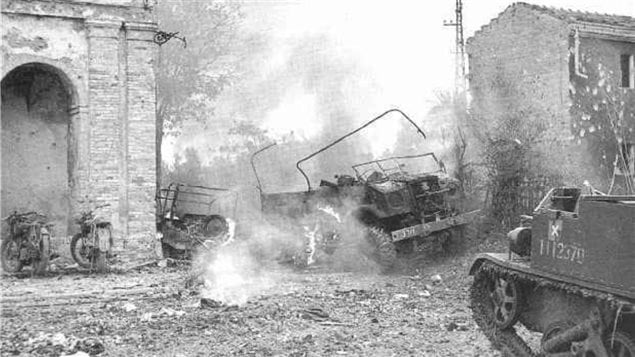
My Father, Byron Caleb Estey, Served In The Canadian Army For The Entirety Of The Second World War

151221_ce0h0_rci-m-burning_sn635

My father, Byron Caleb Estey, served in the Canadian Army for the entirety of the Second World War. He was 31 when he signed up, and was a decade or more older than most of the soldiers he served with. At the end of the war, he was offered an instant promotion from Corporal to Sergeant Major.

He declined. He had had enough.

He was with the 90th Anti-Tank Battery. He was the member of the crew who calculated the coordinates to aim the gun and destroy targets. He did this up through Sicily and Italy, except for those times when he grabbed his rifle to shoot at soldiers shooting at him.

I imagine I could write pages repeating the anecdotes he told – and maybe some day I will. He didn’t talk all that much about the war, and when he did, I’d guess 80% of his stories were humorous. The other 20% were not.

I regret not discussing his war experiences more with him, but he did not encourage it. I once asked how close he got to the German soldiers. He said, close enough to kill them.

He hated Germans and Japanese all of his life. I understand that this is not the way of most soldiers. They mellow. They come to understand that soldiers on the other side were doing a job, just as they were. My father was not one of these. Those 20% of his stories explained his attitude to me.

He fought in – arguably – the most horrific and bloodiest battle in the war, the Battle of Ortona over Christmas week of 1943. He marched over piles of bodies, and crawled over piles of bodies. Such were the details he would tell. He didn’t speak of his feelings, or use words like “horror”.

On Remembrance Day he would march in the community parade. He rarely lingered for a meal or beer or camaraderie at The Legion. He did not seem affected by the memorial event, and did not talk any more or less about his experiences just because it was 11 November.

Because his tales were more funny than not, I’ll close on what might have been his last funny story.

At his death, the Royal Canadian Legion wanted to conduct a small ceremony at the funeral parlour. They requested that his medals be pinned to his chest. But, the medals could not be found. This was odd, because they were important to him, and he always wore them for the Remembrance Day parade.

It is excessive to say that the whole house was searched – but not by much. Drawers, shelves, boxes, closets, clothes, were repeatedly searched. Nothing. The Last Post was played over a Veteran with no medals.

Months later, when the house was being sold and possessions were being removed, his clothes were searched before being given away. In the side pocket of a jacket he never wore were the medals, all spiff and shiny.

He would have smiled at that.

Dale Estey
After Margaret Atwood’s Memorable Memoir, Can I Be Far Behind?

I have shared this tale before, and feel encouraged to do so again. It is an odd milestone in my own writing odyssey, and when Margaret Atwood achieves a profound feat, as her new memoir reveals, I do take note. I have about forty pages of my own memoir done, and years to go before I sleep.

*******************************

It was not my intent to piss off Margaret Atwood.

The opposite, in fact. I wanted her to know she was an inspiration.

She was giving a reading at the University of New Brunswick in my student days. I attended, but there was quite the gathering and she was whisked away at the end. However, I overheard there was a ‘gathering’ in her honour. Invitation only, of course. Academia and literati.

I crashed the party (that was the term used by the professor who clapped his sturdy hand upon my shoulder but – happily – did not thrust me into the night).

But Ms. Atwood was kept deep in many a learned conversation and I had no opportunity to converse. I did, however, overhear where she would be spending next afternoon – the historic University Observatory.

Next day I knocked upon the Observatory door.

It was not a cheerful Margaret Atwood who answered, and answered with alacrity.

She asked my name.

She asked my business.

And she asked how the hell I knew where she was. She had stolen the day to do some writing. Some ‘real’ writing, in this window-of-opportunity grudgingly offered on the book tour.

At least I was there to praise Atwood and not to bury her with some essay question.

Nor had I a manuscript to hand to her.

I might not have garnered a smile, but her curt thank you was reward enough.

For me, at least.

DE

Create a free website or blog at WordPress.com.

Up ↑