Search

kafkaestblog

It is a whirlwind in here

Tag

dialogue

Alison Alexandra Has Novel Expectations That Don’t Have A Ghost Of A Chance In The Pandemic

“I’d like Bridget to meet you,” says Alison Alexandra.

“No.” R/Jane-the-Ghost shakes her head. “That can’t happen.”

“She’s my cousin,” says Alison Alexandra. “Blood relation, and straight as a die.”

“No – that’s not the way it works.” R/Jane-the-Ghost smiles. “Even though I like your little pun. Trust me.”

“She’s been to the Mansion.”

“Not my department,” says R/Jane-the-Ghost. “As you know – I have not.”

“I’ve noticed that,” says Alison Alexandra.

“Different stages of departure,” says R/Jane-the-Ghost. “As for me – I am well and truly dead.”

“Well then.” Alison Alexandra actually tries to see her companion. “Do you have any advice?”

“About what?”

“How to deal with this Pandemic?”

“You’ve got booze stacked away?”

“Yes. And more coming.”

“Then that pretty well covers it,” says R/Jane-the-Ghost. “Creature comforts for the creature. Your spirit will take care of itself.”

“Body and soul,” suggests Alison Alexandra.

“When threatened, your body will be more aware of your soul.” R/Jane-the-Ghost smiles. “The booze will make it easier for you to say ‘hello’.”

“Cousin Bridget would like to know that.”

Killing All My Pretty Darlings As The Edit Gathers Steam

I am ripping my five-year-in-the-making novel apart in the edit. I do so love editing. Dialogue, descriptions, witty comments, all get turfed with abandon. They were great fun to write, but they don’t fit the novel now.

Don’t stop me before I kill again. **Mad Cackle**

The following is a brief example of what gets tossed asunder. My characters are visiting a Police Museum.

They leave the first room, cross the hall, and enter the second. Whereas most of the exhibits in the other room dealt with criminals and their crimes, here the displays concentrated on the police force and policing itself.

In the first room there did not seem to be a definite pattern to the displays. Here, things are set out in chronological order. There is some overlap, so not all are exact decade by decade. But most of the display segments do not stray by more than ten years, and are not forced into uniform-sized display footage.

“Which direction do you want to go?” asks Alison Alexandra.

“I’m more interested in the contemporary things.” Amanda points. “Except for that.”

“The Paddy Wagon?”

“Yes. Let’s go see it. Maybe we can get inside.”

“Maybe we’ll get arrested if we get inside.”

“Maybe they’ll take us away.”

“Then we will miss the ship.”

The paddy Wagon is a black box of a vehicle, large and hefty-looking. It is in the middle of the room, so visitors can walk around it. When they approach, they see it is on a raised platform, and each wheel rests on a metal plate.

“That looks to be the real deal,” says Amanda.

“That it does.” Alison Alexandra looks at the license plate. “It was on the streets in 1948.”

“Do you think it has been restored?”

“Well, I’m guessing it was solidly built at the time.” Alison Alexandra gives the back doors a thwack. “After all, it was a mobile prison.”

“Full of miscreants,” says Amanda.

“Yes. And no doubt rowdy.”

“If we get locked in, do you think we’d be rowdy?”

“Goes with the territory.”

“We could sing.”

“Sing and catcall,” says Alison Alexandra.

“You could do one.” Says Amanda, “And I could do the other.”

“Mix it up.”

“yes.”

“That would confuse the coppers.”

“They’d beat their nightsticks on the walls,” says Alison Alexandra.

“Maybe they would beat rhythm to our singing,” says Amanda.

“We could break out in “They call the wind Maria’.”

“’The Black Maria’,” says Amanda.

“I see you understand two part harmony.”

“And if I don’t,” says Amanda, “You could beat out a few bars.”

“That’s criminal.”

“So’s my singing,” says Amanda.

Unbeknownst to them, as they have been chatting, and peering into the windows of the vehicle, a door opened near the display of uniforms on manikins. A stout yet still powerfully-built man steps though. He stands amidst the manikins for a minute, realizing that he has not been heard. He decides he had better announce himself, before he frightens anyone.

“Now you two ladies are not going to be troublemakers, are you?”
~~~~~~~~~~~~~~~~~~~~~~~~~~~

And here is the edit.

They cross the hall and enter the second room. Here the displays concentrate on the police force and policing itself.

In the first room there was no definite pattern to the displays. Here, things are set in chronological order.

“Which direction do you want to go?” asks Alison Alexandra.

“I’m more interested in contemporary things.” Amanda points. “Except for that.”

“The Paddy Wagon?”

“Yes. Let’s go see it. Maybe we can get inside.”

“Maybe we’ll get arrested if we get inside.”

“Maybe they’ll take us away.”

The Paddy Wagon is a black box of a vehicle, large and hefty. It is in the middle of the room, so visitors can walk around it. When they approach, they see it is on a raised platform, and each wheel rests on a metal plate.

“That looks to be the real deal,” says Amanda.

“It does.” Alison Alexandra looks at the license plate. “It was on the streets in 1948.”

“Do you think it has been restored?”

“I’m guessing it was solidly built at the time.” Alison Alexandra gives the back doors a thwack. “After all, it was a mobile prison.”

“Full of miscreants,” says Amanda.

“And no doubt rowdy.”

“If we get locked in, do you think we’ll be rowdy?”

“Goes with the territory.”

“We could sing.”

“Sing and catcall,” says Alison Alexandra.

“You could do one,”says Amanda, “I could do the other.”

“Mix it up.”

“Yes.”

“That would confuse the coppers.”

“They’d beat their nightsticks on the walls,” says Alison Alexandra.

“Maybe they would beat rhythm to our singing,” says Amanda.

“We could break out in “They call the wind Maria’.”

“’The Black Maria’,” says Amanda.

“I see you understand two part harmony.”

“And if I don’t,” says Amanda, “You could beat out a few bars.”

“That’s criminal.”

“So is my singing,” says Amanda.

 As they were chatting, and peering into the windows of the vehicle, a door opens near the display of uniforms on mannequins. A stout, yet still powerfully-built, man steps through. He stands amidst the mannequins for a minute, realizing he has not been heard. He decides to announce himself, before he frightens anyone.

“Now you two ladies are not going to be troublemakers, are you?”

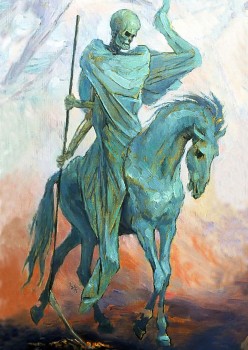
Trump And Death Walk Into A Bar

death-on-pale-horse-viktor-vasnetsov-248x350-1
~ Donald, you’re making my work easier.
 
~ It’s good for the economy.
 
~ Oh, I do love money. It’s great fuel for my business.
 
~ What’s good for business is good for the country. Believe me!
 
~ Oh, Donald – I believe everything you say.
 
~ You do?
 
~ Yes.  Death be not proud.
 
~ Aren’t you supposed to be on a horse?
 
~ Pestilence rode on ahead, and the other two went with him.
 
~ Scary guys. Very spooky.
 
~ Pestilence is preparing the way.
 
~ Ah, it isn’t that bad.
 
~ You know better, Donald.
 
~ Yeh. But I am a bit worried.
 
~ Why?
 
~ What if you guys kill off too many of the dupes who voted for me?
 
~ You’re afraid to lose the election?
 
~ Nah – that part is a bore. A snoozer.
 
~ Then what?
 
~ Buddy can’t buy my shit if he’s dead.

Trump and Jesus Walk Into A Bar

1_252016_b1-dela-trump-halo-8201

~ Was it in vain?

~ What?

~ That you took My name.

~ They crucify me like there’s no tomorrow.

~ There is no tomorrow.

~That’s OK for You to say.

~ I know.

~ But, down here, I don’t get a break.

~ Don’t you think there’s a reason for that?

~ You mean because they don’t understand me?

~ Perhaps more because they do.

~ Hey, I’m looking after Your country.

~ You have other sheep to tend to.

~ But I’m King of the World.

~ You have a big fall in front of you.

~ Oh, I’m protected. I have (haha) more money than God.

~ The eye of the needle is narrow indeed.

~ I’m no fool. I’ll get off and walk.

~ There is no one other to walk in your shoes.

~ You know, we even look alike.


[Image] media.washtimes.com.s3.amazonaws.com/media/image/2016/01/25/1_252016_b1-dela-trump-halo-8201.jpg

Then Came Each Actor On His Ass

globetheater


The stage is as bare as my lady’s ass in his lordship’s bedchamber. Rough-hewn in the most knockabout way, leaving splinters in the palace lawns of the imagination.

There’s many a dip ‘twixt the trap and the lip.

It fares little better than hastily strewn boards covering parched ground, and barely enough elevation to keep the understanding masses at bay.

Were one fool enough to come from out the wings, and at centre front begin a soliloquy about the beauty of the wretched arena upon which he stands, to fight the resulting and justified spontaneous combustion, there would not be found one drop of piss from any a thespian’s hose. For who could allow this sacrilege to be spoken? Even the flag atop the pole knows that the magic is not yet arrived.

A stage without commercial trappings: without solid doors and thick drapes; uncluttered by pillars and arches, tables and chairs, windows and fireplaces; sans orchestra, sans balcony, sans pit. A stage revealing all its secrets. Profound as emptiness.

A stage in wait.

For in this world writ small – as in the globe around – the audience has nothing to know, nothing to learn, until the actor makes an entrance, and prepares to fight past our eyes to battle with those thoughts and fears which lurk in sheltered halls.

“What’s Hecuba to him?”

“Why – nothing.

“Merely a name on a page of script,

“A cue at which to turn his profile thus.”

“It is what Hecuba becomes to we who wait,

“That turns the key upon the heavy gate.”


DE

(image) http://clios.com/cms/wp-content/uploads/globetheater.jpg

Adapt A Novel Manuscript To A Movie Script

(image)

It will take a whole host of other people to tell me how successful I will be. I’ve done it twice, and realize I must not only ignore my usual method of writing, but often go exactly against it.

I  have attempted to “learn” how to write for film, with many instruction books, and classes, and workshops, and meetings with people. I read many film scripts, which did help me accept the (to my eye) arcane format. But the one thing which turned me visual was the comment of a writer/editor friend who said, after reading my attempt, “I can’t see it.” That is, it did not cause visual action in her mind. And I understood.

Perhaps the biggest hurdle to get over is to accept that a movie is not a book  Changes, additions, and omissions will be necessary. As with a stage play, there is a finite time limit that generally clocks in under two hours. The threads and plot points of a movie are different. And the characters (I swear) feel this freedom, and choose to accentuate other aspects of themselves than are revealed in a novel.

The very fact their paragraphs of dialogue must be reduced to two or three lines makes them uppity. And because they can, in mere seconds, be in diverse locations, performing radically different actions, they become exact without apology. They don’t have to fill in the spaces.

The writer has to fill in the spaces however, and do so with visual stimulation. The transitions have to be swift. Their descriptions exact.

The road is always the fast lane, and the characters kick the tires with gusto.

DE


Blog at WordPress.com.

Up ↑