Search

kafkaestblog

It is a whirlwind in here

Tag

death

The Funeral Ends For A Dead Princess

From Being Famous:

He wonders where Diana is.

If the whole context of this service is correct, and her Spirit Everlasting is afloat in some other world, does she have the slightest interest in these proceedings? Do you care what is on the plate after you have eaten the meal?

Is it – as he hopes – an all new wonderful adventure?

ST is returned to the present by the familiar words of The Lord’s Prayer. He is actually reciting  “Give us this day our daily bread” before he realizes what he is doing.

Stopped in place and time.

He could be a child again (perhaps he is) wondering what `trespasses’ are. He could be the aware young man, wondering why God would have a penchant to lead us into temptation. And he could be as he now is, wondering if this was the only way for a troubled young woman to be delivered from evil.

ST is fully attentive to the final hymn, and The Commendation of the Dead to the Lord.

He suspects it is an all-or-nothing package: that Diana and Jesus and God are present and appreciative to what is happening around him; or that he and everyone else are just singing and praying to the empty rafters. He fears his faith has skidded to the unstable foundation of hope.

The cortege prepares to leave the Abbey. Although the choir sings as the procession slowly moves to the west end of the church, it is really silence which hangs over this vast array of people. Again the casket with its ruptured body wend their way down the aisle, the flower arrangement an almost dull glow in this final, sombre setting.

“Weeping at the grave creates the song.”

Or so the song goes.

Then there is the final minute.

The minute of silence.

Observed by the Nation.

Observed by ST.

Observed -perhaps- as a minute’s pause in the enormous expanse of Eternity by a dead princess.

(image)http://www.westminster-abbey.org/__data/assets/thumbnail/0006/90933/Diana-fun-1997-outside-72.jpg


Diana As The Dead Princess

diana-elvis-638167

In my novel, More Famous Than The Queen, my famous character – known only by his initials, ST – is invited to attend the funeral of Diana, Princess of Wales. This is from his arrival at Heathrow Airport.

~~~~~~~~~~~~~~~~~~~~~~~~~~~~~~~~~~~~~~~

“Did you ever meet Dodi?”

“Should it be a State funeral?”

“They say she telephoned you. Any comment?”

“Were the Princess and Dodi getting married?

“BBC International. Any possibility of an interview?”

“How long will you be in London?”

“Do you think the Queen has treated her shabby?”

“Do you think the photogs killed her?”

“They say the Royals welcome her back into their world only as a corpse. Do you agree?”

“Welcome to my world.” ST sighs the words, but not loudly enough to be picked up by the forest of microphones.

Less than a day ago, his world consisted of the back yard of his Nova Scotia hideaway, and a running debate with himself about the merits of hour-old coffee. Wife Number Two (he realizes this term is a bit cruel, for her name is Miriam, and they parted amiably enough) swore coffee should be thrown away if it became an hour old. ST can’t notice a difference, and wonders if it is a deficiency in him.

This was the height of his concern when his email, and his fax, dropped the invitation/summons into his lap. He had reacted as if the questionable hot coffee was dumped on him instead.

His stirred-up memories of Diana are also bittersweet.

Particularly his recollections of her troubled phone calls. At first she would be full of apology for disturbing him, but this quickly gave way to a jumble of questions and gossip. She seemed to be forever asking advice, yet she had her decisions already made. Which never irritated him, and obviously never bothered her, for within a few months she would be on the phone again, and the cycle would commence.

ST wishes he could have had the chance to give her one last piece of advice.

And that she would have taken it.

Stay in the hotel for the night.

DE  

(image)cdn.images.express.co.uk/img/dynamic/106/590x/secondary/diana-elvis-638167.jpg

God And Death Kept Me From A Poetry Reading

emily-dickinson-because-i-could-not-stop-500x344

Admittedly I set out later than I should, but the poetry readings were to go from 7-9. Enough time for some of it. However, as I was a few blocks away from the harbour (yes, I was also going to stop by the harbour first) I heard Latin chanting.

I greatly enjoy Latin chanting, so imagine my surprise. It turned out there was a large tent set up in a parking lot beside the Roman Catholic cathedral. Six men were chanting a service for a small group. It seemed related (in some way) to the jazz festival happening in the city. They had mics and lights. I lingered by the  fence and listened. Evocative and effective.

However, I did feel I should go to the poetry readings, so off I went.

But I gave in to my temptation of visiting the harbour on the way. It was there, as I sat looking out to sea, that an elderly, white haired man struck up a conversation. A visitor who had arrived by train for a week of vacation.

The first vacation without his wife, dead these fourteen months.

She was eighty-four.

When he said this, he saw the look of surprise on my face.

“Bet you can’t guess my age,” said he.

I answered, with some truth, that I never answer that question.

“Eighty-one,” he said.

I granted I would have shaved a dozen years off his age.

“Married sixty years,” he said. Always had travelled with her. Always went by car. “But it wouldn’t be the same,” he said. So he took the train.

So – yes – I stayed to talk to him.

“Get up every morning to fill the day is my motto,” he said.

So I answered his questions about the islands, and if the helicopters flying overhead were military, and if all the ships needed the use of the tugboats we were standing beside, and was there somewhere close he could buy magazines, and how he got this real good travel deal through CAA, and how he talks to everyone.

“Is that really the ocean out there?” He pointed.

I nodded.

It was.

DE

(image)http://www.poetseers.org/wp-content/uploads/emily-dickinson-because-i-could-not-stop-500×344.jpg

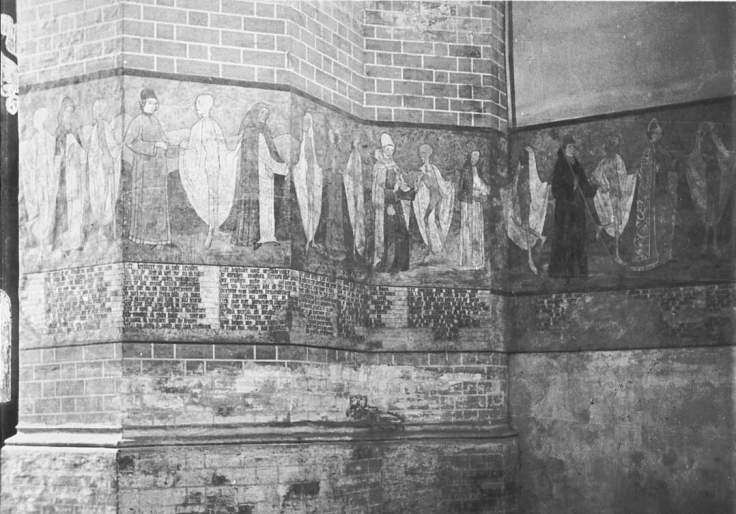
The “Dance of Death” [Der Berliner Totentanz] Offered For Halloween

In my novel, “There Has Been A Sighting”, sightings of Satan are tracked and confronted. An antechamber to such an encounter occurs in the crypt of the St. Marien church, in Berlin.
 

berlin-1936

~~~~~~~~~~~~~~~~~~~~~~~~~~~~~~~~~~~~~~~~~

Dorkas removes the keys from her pocket. “Which is worse, do you think. Keys keeping things out, or keys letting things in?”

“They each – ” begins Breeze.

“You may as well have the flashlight.” Dorkas interrupts her. “Until we get the damn door open.”

Breeze has to hurry to stay in step, and almost drops the flashlight in her haste. When they reach the door, Dorkas quickly inserts the key. It works with ease.

“Fortune smiles on my enterprise,” mutters Dorkas.

“I don’t understand.” The young woman is perplexed as she looks around. “I’m certain when I was here, the painting was on these walls.” She watches Dorkas put the other key into a second door. “We didn’t go anywhere else.”

“What did Agnes tell you?” Dorkas opens the door, and glares down a darkened flight of steps.

“I’m not supposed to say.”

“Mother Ursula certainly expects me to go down into the gloom.” Dorkas is harsh. “Otherwise, why am I here?”

“I don’t deny that’s the way it is now.” Breeze stands beside her, peering into the dark. “I just wonder if it is what we would find tomorrow.”

“I may as well take their kind illumination.”

“Agnes only had a candle.” Breeze gives her the flashlight.

“Agnes could not fear half the terror I feel.” Dorkas shines the light down the stairs. “She expected to come back.”

“I’ll be waiting.”

“If I’m not forever, then I won’t be long.”

As Dorkas descends, the stone walls absorb the light, pockmarking the surface with rough shadows. She pauses before entering the room, perturbed by the dimness. Her light had shone brightly minutes ago, but now its beam seems submerged in water.

“Damn.”

She slaps the flashlight against her open palm.

“I’d do better with – ”

She stumbles on the bottom step, twisting her right foot as she is thrown against the wall.

“Damn.”

The flashlight falls and rolls across the floor. She hears its metal casing scratch over the stones, and watches the beam of light spiral like a demented beacon, until it turns around to shine back into her face.

“I won’t stay if that goes out.”

Dorkas deliberately speaks aloud.

“Whether I’m in Berlin for a night or a year.”

She tests her foot and finds her ankle is slightly injured.   “If I break my leg, what will they do? Leave me down here?”     She bends over to get the flashlight.

“A permanent fixture.”

As she takes the light, she points it away from herself.

“Christ.”

The feet are bare, and dirty, and raising dust as they dance. A cloud of dust rises up their emaciated legs to their knees. Although Dorkas is in a crouched position, she jerks away from the figures, and sprawls on her back.

She starts to cough in the dust, and the ragged, whirling band begins to encircle her. The light gripped in her hand strays across their bodies, and catches the glint of bleached, protruding teeth as they grin down at her.

“A tomb.” Dorkas shouts.

She can not count the number of hands reaching toward her, their flesh mottled from the iridescence of putrefaction. The frayed cuffs of their funeral finery trail strands of unravelling cloth, and she cringes from the touch.

“You want me with you?” Dorkas struggles to her knees. “To end on your wall?”

Bejewelled rings and bracelets rattle against bony fingers and wrists. The sound fills her ears as the hands, extending to grab her, are jostled by the tempo of the dance. They can not stop their own feet, and they can not stop their partners who hurry them ever on.

“I won’t.” Dorkas holds the light in both hands. “Alive or dead.”

Der Totentanz becomes smaller as the figures tighten the circle around Dorkas. A whiff of their decay permeates the dust, and she turns her head, coughing even more. But she can’t avoid their movement, their grasping hands, their stench. Victory is etched upon their faces.

“Dorkas.”

She barely hears her name as she huddles more closely to the floor. She is afraid to stand in case the frenzied dancers graze against her. She fears that the slightest brush – whether from their knees, their fingers, or even their rotting clothes – will lift her to her feet and make her a part of this final procession.

“Dorkas! I can’t turn on the electric lights.”

“You wouldn’t want to see.” Dorkas tries to shout, but her throat is clamped by hysteria. “This is worse than buried alive. I’d rather be in the dark.”

The dust of the dead is filling her mouth as she switches off the flashlight.

“Dorkas! For God’s sake.”

Breeze comes plunging down the stairs, scraping her hands as she steadies herself against the wall.

“Answer me!”

When she reaches the bottom, she stops in the blackness. Her hesitation is brief, and she starts forward at her usual pace, hands outstretched. She strains to hear the slightest sound.

“Dorkas? Did you drop the flashlight?”

“Are you alive?”

“Dorkas?” Breeze turns abruptly, for the voice is behind her. “Of course I’m alive.”

“Then I guess we both are.”

Dorkas gets to her knees, and slowly stands.

“Berlin proves to be as wonderful as I anticipated.” She brushes dust off her shirt. “Let’s get out of here.”

“Did you lose the flashlight?” Breeze starts to move toward the other woman’s voice.

Dorkas is momentarily puzzled, then realizes it is still gripped fiercely in her hand. She switches it on, casting a beam over Breeze’s legs.

“You’re it.”

“I thought you were it.” Breeze looks down at her legs, then follows the light back to Dorkas. “When you didn’t answer, I thought something had gone wrong.”

“I’m in Berlin.” Dorkas laughs harshly. “Everything goes wrong.”

She approaches the younger woman slowly.

“I don’t know where I would be if you hadn’t come to me.” Dorkas strokes Breeze’s arm. “Your intervention won’t make the others happy.”

“I’ll handle himself if you take care of the old girl.”

“Deal.”

“Let’s take a look.” Breeze reaches for the flashlight.

“A look?”

“At the bloody painting.” Breeze is turning the light toward the wall. “I know it’s been a long time since I’ve seen it, but maybe we can figure how its now in a different place.”

“No.” Dorkas swats the flashlight with her hand. “If you accept that there is God and Satan, then you accept there are things beyond your power.”

She stands close to Breeze, the light between them.

“You do not invite what can destroy you – that is dangerous folly.”

“But you came here.”

“Yes.” Dorkas takes back the flashlight. “I came here. And that courage – and you – enables me to walk out of here.”

She looks Breeze in the eyes.

“I have light, and I have a friend, and I’m not going to be buried alive. Not tonight, at any rate.”

She shakes the flashlight.

“Not here, at any rate.”

Dorkas sighs deeply.

“But I’ve done my part.”

“These are distinctions I don’t understand.” Breeze begins to feel uncomfortable. “Here we are – standing right here. Haven’t you won?”

“If you tempt fate?” Dorkas speaks softly. “No – fate will always win. Fate has all the cards.”

“That sounds fatalistic.”

“Life is fatal.”

“Perhaps I’ll come back tomorrow and be a tourist.” Breeze wants to hear her own voice. “Will a bunch of loud Italians and pushy Americans keep the dancers in the painting?”

“It might make it easier for them to mingle.”

“I’m not going to see them step from the wall,” insists Breeze.

“I suggest you look closely at the mustiest Italian, or the most hysterical American.” Dorkas shines the light toward the exit. “And then keep your distance.”

Dorkas is impatient as she watches the young woman walk through the beam of light, and quickly begins to follow.

“Did you say something?”

“No.” Dorkas answers curtly, but she has heard it too.

It is a sound which stays in her ears, until the door is firmly closed and locked behind them.

The sounds of an interrupted dance, where she knows partners are still being sought.

DE


(image)http://www.dodedans.com/Full/berlin-1936.jpg

Love, Death, And Memories – It Was An Autumn Night

cm7952q

(image)https://images.atgstores.com/img/p400/1683/cm7952q.jpg    

   Some day she would not wake – she prays for this every night as she lays waiting for sleep. Tonight is not bad, there will be no need to use a pill. In fact, she is very good about the pills. Dr. Morgan has told her – almost encouraged her, she feels – to use a pill a night, and not fight for sleep as she sometimes does. But she can not bring herself to believe that that is right – she is certain Ned would never have agreed to it.


     Ned was never one to take the easy way out. Not, she would hasten to add, that he was some sort of doomsayer, or a fanatic of any sort. But he did believe that it was up to each person to solve their own problems. Where he may have expected too much, was believing that all problems had a solution, and he would keep at something with a relentless persistence.


     She would sometimes stand near him as he was trying to replace some tiny piece of a machine, or climb yet again on the shed roof with some tar, and she would say, “Leave it be, Ned. Let it alone.” But he would just pause, settle back on his heels and perhaps light a cigarette, and say that he may as well be putting in the time on this as on anything else.


     And back he would go at it. As far as she knew, he never gave up on anything until it was done. He was not the type to gloat, or even show much sense of satisfaction, and she had been married to him for years before she recognised his small mannerisms which meant that he was pleased.


     She turns over, being careful not to lay an arm on his side of the bed, or let a foot stray over the line she has refused to cross for eight years, ever since she reached out one morning and touched cold flesh.


     No, she will not need a pill tonight, her work has tired her enough to eventually bring on sleep. It is, of course, the memories weaving through her mind which she would really like to stop with the pills. Those memories she can barely stand, and without which she could not live.

DE

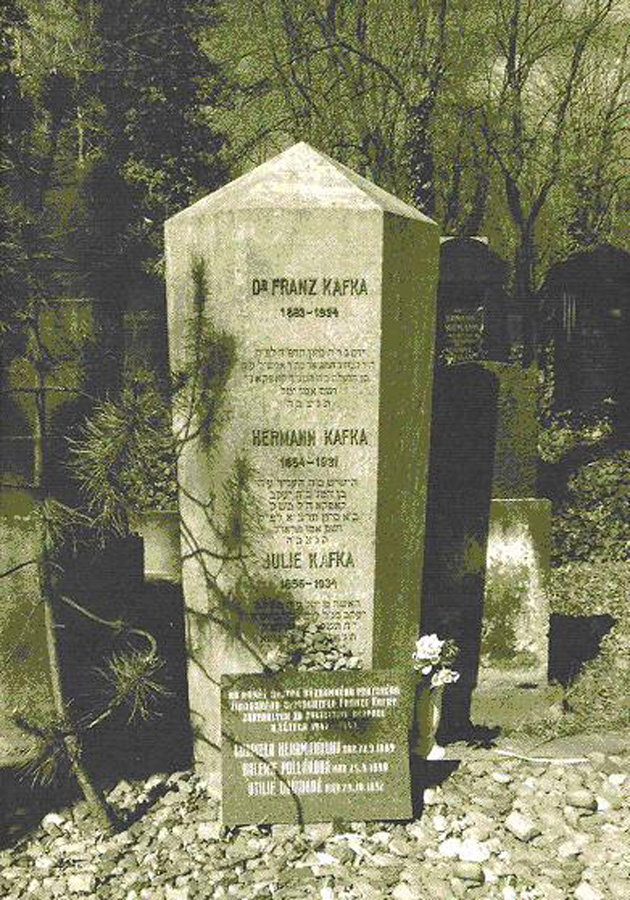
It Is A Grave Thing To Be Dead


kafka-photo-grave-300dpi-4c5c1958

(image)http://zeek.forward.com/workspace/uploads/kafka-photo-grave-300dpi-4c5c1958.jpg

I enjoy graveyards, and peruse them with vigour. It’s true I don’t plan to spend the rest of my life in them, but, after that …

So, I have many tales of cemeteries to tell. Hardly any are scary because, contrary to popular depiction, graveyards are not haunted. Unless one happens to die in one (or – worse yet – die after being buried in one), there are no lingering spirits to haunt. Graveyards are a place, however, to go and contemplate those buried there. I am planning for myself a grand mausoleum.

While researching my novel about Franz Kafka, I went to Prague. In those days it was still under communist subjugation, and travel in and out of Czechoslovakia, to say nothing of travelling the country, was complicated and dangerous. I was fortunate to have arrangements to stay with a Czech academic and his nuclear scientist wife while in Prague. They had a social standing which facilitated an easier visit.

Unknown to me upon arrival, the academic was an amateur historian. When he found the major thrust of my visit concerned Kafka, he was full of places to visit. Many of them I did not know about, and others I doubt I would have found on my own. For instance, he took me to the small house where Kafka had lived on Alchemist Lane, which eventually became the setting for half of my novel. Even though Kafka was in disfavour at the time, the house was noted for the fact he lived there, and it was on tourists lists. In a Kafkaesque twist, it was even then a bookstore, but none of his books were allowed on the shelves.

One of the places I was taken was to Kafka’s grave. It is situated nowhere near where Kafka lived his life, but is in a huge Jewish graveyard on the outskirts of the city. It took nearly an hour on the subway to reach the area. And then a walk to the graveyard itself. And then a walk through the graveyard, though the way to Kafka’s grave was signed. I would never have thought of trying to get there myself.

Kafka is buried with his mother and father (though, literally, vice versa, as he died first). It is only years after the fact that I read about the drama of his death, and the drama at the graveside. His young lover, Dora, who had spent the last year of his life with him, attempted to leap into the grave. She had to be restrained by Kafka’s best friend, Max Brod.

I lingered a long time – perhaps a half hour – by the grave. In the Jewish tradition I left a stone upon the gravestone. In my own twist, I also left a pen. And, because there were few about, and I was so moved, I lay down upon the grave itself.

DE

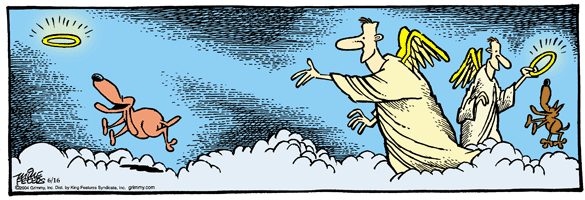
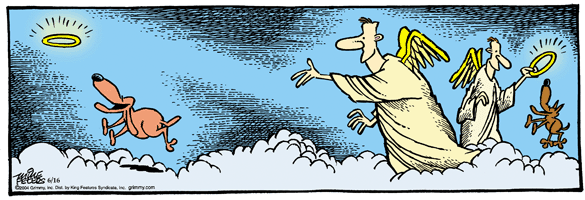
It’s A Dog’s Life … And Eventual Death

pets_in_heaven02

(image) http://www.blessedquietness.com/pets_in_heaven02.gif

I have spent some portions of my life house-and-pet sitting. Always enjoyed it. And there are certainly tails to tell.

One such dog-sit was with Tibbit, a great, friendly dog. She just passed on to a more comfortable afterlife this week, leaving nothing but fond memories on my part. We shared this following episode a few years ago. I’ll share again in her memory.

*********************************


This past weekend I looked after a dog whilst her owners went out of town.

Tibbit is a big, friendly dawg who likes inspecting piles of leaves. She has a long lead which her benevolent human allows to go as far as possible. She knows (better than her accompanying human) that there are treats at the end of each walk.

On Saturday I didn’t get Tibbit out until after dark. We skirted the university (where her masters work) and went up a street bordering the campus. We both liked the Christmas lights. Near the top of the street we met an inebriated gentleman warning us of a bear in the surrounding woods.

“Flush him out,” said he, “And I’ll get my 3 aught 3.”

“Get the rifle first,” I replied, and we went our respective ways.

Now Tibbit and I doubted the veracity of the gentleman, so when we came to a trail through the woods, we took it. I will admit I did peer more intently into the gloom than usual, but one trail led to a larger trail which led back to the university. We advanced without incident.

On Sunday I again walked Tibbit toward the university, though from a different direction. It was a crisp, clear day and she gamboled (as much as the leash allowed ) through the new fallen snow. Sunshine gleamed. This time we were on the other side of the campus, but our walk eventually led to a position about half a mile away from where we were the previous evening.

We followed another trail into the woods and admired the sun through the fir trees. The path was wide and sloped. It came to turn some distance away which would lead us even closer to where we were the day before.

At the top of the slope Tibbit stopped dead in her tracks. She stared and stared. She glanced briefly into the woods but mainly kept staring along the trail. I saw nothing nor heard anything (and I was intent upon both).

Tibbit did not move and made not a sound. She just kept staring.

After a solid two minutes of this I started to backtrack and she made no complaint.

You betcha she got her dog treats.

DE

Dream Of Death And Ghosts [from “Kafka In The Castle”]

21 March 1917

Dreamed I was standing in a balcony with him. In a town in Northern Italy. We could see across the rooftops, to a plain slipping gently toward the foothills of the mountains. The day was clear – a cool spring morning – and the touch of sun was welcome on our skin.

He pointed to a laden waggon passing beneath us. A curtain of dust rose from its wheels as it squeezed through a narrow lane. We watched it for awhile, then he turned to me, his body a silhouette against the vivid sky.

“I enjoyed my funeral. I wish we could have talked about it after – it was one of those things to share.”

“We did share it,” I pointed out. “I was there.”

“But I was not,” he said.

Then he eased himself over the balcony, and without effort, we were sitting in the back of the waggon, perched upon boxes and equipment. We rattled out of the village toward the countryside.

“I loved the outdoors,” he said. “I still remember my last walk in the fields.”

We moved slowly through the country side, the waggon rarely being jostled along the rutted road. The teamster must have been an expert, but he never turned his face to us. Intent upon his business, I suppose.

“You forget that I am dead; for which I thank you.”

“Sometimes I do,” I replied.

“It is at those times, I sometimes think I’m still alive.”

He occasionally pointed to things behind me. Once there was a rabbit. The countryside spread endlessly, without another person in sight. I mentioned this, and he nodded.

“It will be crowded at our destination. But I’ll want to meet my wife.” He then leaned toward me, across the waggon. “You helped me, you know – in our final dance.” He smiled, then sighed, then pointed beneath me.   “My destination is close, I must return.”

I looked down, and saw I was sitting on a coffin – the polished brown one of his funeral. I moved, then bent over, prepared to open it. His fingers touched the wood beneath my hand.

“No. Do not look. You would not like what you found.” His smile seemed forced, there were more teeth showing than usual. “I embrace my new world. But for you, I am well and truly dead.”

DE

(image) http://machedavvero.it/wp-content/uploads/2013/05/valletta11.jpg

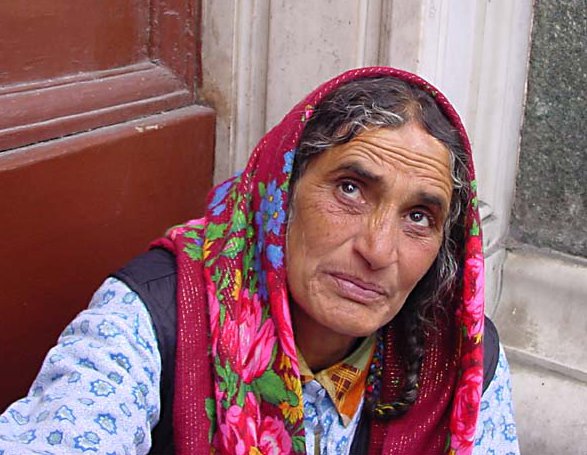
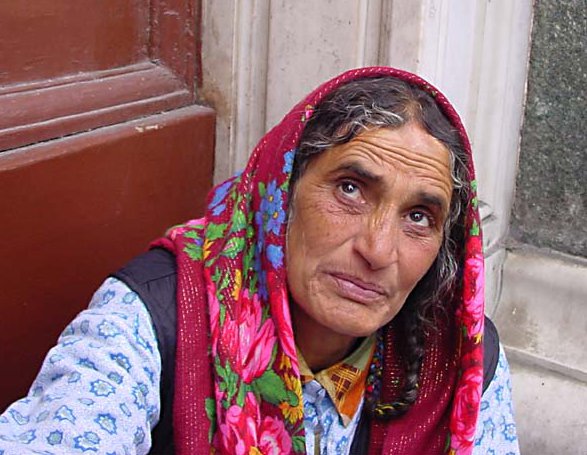
A Gypsy Speaks The Future Of Truth And Death [from: Kafka In The Castle]

gypsywoman

08 June 1917

A Gypsy confronted me today, and I was in the mood for a bit of sport. Her age was difficult to tell – certainly a decade older than me. In her swirl of shawls and dangling jewellery, heavy make-up on her face, she could almost have been in disguise. She peered at me with an intense sigh, attempting – I am sure – to penetrate my own disguise.

“You are a Jew,” she said.

“And you a Gypsy,” I replied.

She seemed pleased with my response, for her professional smile became real.

“You state the obvious,” she said. “As becomes a Doktor of Laws,”

I replied. “But to your eyes, do you not state the obvious?”

“Are you going to banter with a poor old Gypsy woman, instead of barter? That would make you suspiciously like one of us.” She said this with a growl in her throat.

“The Gypsy and the Jew,” I said, feeling the challenge which I so miss. “Perhaps an opera – but I think it’s been done to death.”

“They will try to do us all unto death,” she said harshly, and turned away.

I had the fear she was going to leave me without another word, but what she did was to spit fulsomely onto the street.

“They can’t kill us all,” I said, but I knew she heard the doubt in my voice.

She slowly faced me again.

“So. Even a Doktor of Laws can have hope. That is refreshing – but foolish.” She took my hand and felt my palm roughly with her thumb, although all the while her eyes never left my face. “You are going to travel.”

“Travel is a vague word. One can go on many types of voyage.”

“And reach many destinations,” she added, still holding my hand. “If you take away my vagueness, you take away my trade.”

“Then let me pay you for your services right now.”

This transaction would make her loose my hand, which is what I wanted most of all. She had frightened me, for her eyes and face were full of truth. I know the truth. I know it when it presents itself, stark and unobscured. I search out truth endlessly, yet still can flee at its approach. As in her eyes. But she gripped me more fiercely, and pulled my hand up.

“The coin, Herr Doktor.” Her voice was now soft. “The coin can wait.”

She at last lowered her eyes and looked closely at my palm. She rubbed the lines and whorls of my skin. She touched her finger to her lips, and spread the moisture along my hand.

“Your lifeline, Herr Doktor,” she took a quick look in my eyes, “of Laws. You deceive with the youth upon your face. Is that not so?”

“If your eyes stop at the mask, then no, the years have not etched themselves deeply.”

“Not on your face, Herr Doktor of Laws.” Her grip was intense. “But on your palm…” She hissed. “You will soon embark upon that final voyage.”

She released my hand, rubbed her fingers across her sleeve.

“But you will not go in haste. There will be many stops along the way.”

Suddenly her face was full of the most beautiful smile, and her laughter was genuine.

“I see you do not complain of vagueness now.” She held out her hand. “The coin, Herr Doktor of Laws. This time I have truly earned it.”

I dug deeply into my pocket, and feared that I may have overpaid her. But, perhaps, that is not possible.

DE

(image) http://1.bp.blogspot.com/-SDayP1IJD0M/TVrspG3I5oI/AAAAAAAAGko/RjODxg1C_WI/s1600/gypsyWoman.jpg

Blog at WordPress.com.

Up ↑