
Happy Anniversary with WordPress.com!
You registered on WordPress.com 11 years ago.
Thanks for flying with us. Keep up the good blogging.
Happy Anniversary with WordPress.com!
You registered on WordPress.com 11 years ago.
Thanks for flying with us. Keep up the good blogging.
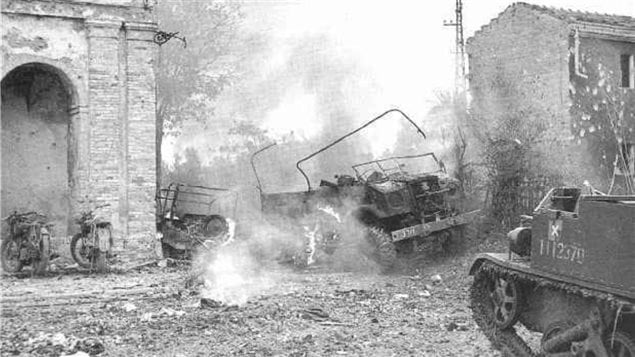
My father, Byron Caleb Estey, served in the Canadian Army for the entirety of the Second World War. He was 31 when he signed up, and was a decade or more older than most of the soldiers he served with. At the end of the war, he was offered an instant promotion from Corporal to Sergeant Major.
He declined. He had had enough.
He was with the 90th Anti-Tank Battery. He was the member of the crew who calculated the coordinates to aim the gun and destroy targets. He did this up through Sicily and Italy, except for those times when he grabbed his rifle to shoot at soldiers shooting at him.
I imagine I could write pages repeating the anecdotes he told – and maybe some day I will. He didn’t talk all that much about the war, and when he did, I’d guess 80% of his stories were humorous. The other 20% were not.
I regret not discussing his war experiences more with him, but he did not encourage it. I once asked how close he got to the German soldiers. He said, close enough to kill them.
He hated Germans and Japanese all of his life. I understand that this is not the way of most soldiers. They mellow. They come to understand that soldiers on the other side were doing a job, just as they were. My father was not one of these. Those 20% of his stories explained his attitude to me.
He fought in – arguably – the most horrific and bloodiest battle in the war, the Battle of Ortona over Christmas week of 1943. He marched over piles of bodies, and crawled over piles of bodies. Such were the details he would tell. He didn’t speak of his feelings, or use words like “horror”.
On Remembrance Day he would march in the community parade. He rarely lingered for a meal or beer or camaraderie at The Legion. He did not seem affected by the memorial event, and did not talk any more or less about his experiences just because it was 11 November.
Because his tales were more funny than not, I’ll close on what might have been his last funny story.
At his death, the Royal Canadian Legion wanted to conduct a small ceremony at the funeral parlour. They requested that his medals be pinned to his chest. But, the medals could not be found. This was odd, because they were important to him, and he always wore them for the Remembrance Day parade.
It is excessive to say that the whole house was searched – but not by much. Drawers, shelves, boxes, closets, clothes, were repeatedly searched. Nothing. The Last Post was played over a Veteran with no medals.
Months later, when the house was being sold and possessions were being removed, his clothes were searched before being given away. In the side pocket of a jacket he never wore were the medals, all spiff and shiny.
He would have smiled at that.
Dale Estey
Paw, the cat/kitten,
Black as a starless night
With one white mitten,
Has outdone himself.
Again.
He came and got me,
Tracked me down,
(I was repairing part
Of the Partridge Island
Dock)
And bade me follow.
Demanded, actually.
So (of course) I did.
He has yet to understand
I can not scramble
With the alacrity
His four paws
Allow.
He stood waiting
At the top of
The rough trail
And complained.
He then stood by the base
Of the Lighthouse
And complained.
He paced at the
Entrance
Of our rough little forest
And complained.
But he didn’t enter until
I stood beside him.
No complaints now.
So . . . I wondered what
I was going to find.
And – no – I would
Never have guessed.
Paw moved carefully,
But unerringly,
To a spot not far
From the water.
He stopped in front
Of a swath of tall grass.
He sat down.
The rest was up to me.
I stepped (deliberately) over him,
And peered.
In the middle of the
Swath of grass
Was the leg of a deer.
One leg.
Nothing else.
No head
No antlers
No exposed bones
No hide nor hair
(Save the tiny hairs
on this solitary leg
complete with hoof).
Paw didn’t make a sound,
But his tail twitched.
There couldn’t be
Enough meat on it
For even a cat to chew.
There are no deer on Partridge Island.
Nothing much larger than
Paw, himself.
Some hawk or osprey or eagle
Might have dropped it.
Some storm might have
Heaved it ashore from some
Hunter’s field-dressing
Of a fresh kill.
I let Paw do what he wanted.
He didn’t want much.
He did walk its whole length,
Sniffed and licked,
And once
Rubbed his face
Against it.
He paid special attention to the hoof.
He was satisfied.
I was satisfied.
The deer was
With its ancestors.
I carried it
Across the rocks
And tossed it back
Into the sea.
By the time I turned
Back to shore,
Paw was on his way
Home.
I’m The Lighthouse Poet Laureate of Partridge Island /1821 – 2025 / A lot of stuff have I seen / A lot of stuff to report.
DE BA. UEL
Franz Kafka died on 03/06/1924. He was a young man – a month short of his 41st birthday. However, his death was preordained years earlier. In my novel, “Kafka In The Castle“, I fill in the missing days of his diary. These are the entries I imagine concerning the days he actually found out his fate.
*******************
04 September 1917
A death sentence.
05 September 1917
Max is saying all the right things. All the nice things. And he is saying them all in the right way. An earnest, matter-of-fact truthfulness which sounds plausible. If he does not tread from a very narrow path. Sometimes I find myself a part of his hopeful speculations. And sometimes I find that I am trying to keep his spirits up. If he is going to all this trouble, then shouldn’t I do my part? But: it isn’t his blood. And anyway – he was the one who insisted on the specialist. Chose the renowned Dr. Pick. And heard – almost as soon as myself – the verdict. Tuberculosis. Tuberculosis engaged in both lungs. Like a preparation for marriage. The engaged man now flirting with another lover. And planning a marriage which will be far more permanent that any I could have had with Felice.
It isn’t that we had no warning.
Hell, even Paw, the cat/kitten.
Black as Death with one white mitten,
Knew it was coming.
Knew (perhaps) before the rest of us.
And fishing boats, the last couple of days,
Have left notes in the Message Box,
Down on the Lighthouse dock.
One of the notes had been relayed
From the brigantine, HMS Buzzard,
Informing of this passage into the harbour,
And the night this would be done.
So,
As Lighthouse Keeper,
I await
On the Lighthouse dock,
In my navel uniform,
Which I am sometimes
Expected to wear,
Since I represent the might
Of Majesty,
As sole subject, yet overlord,
Of the Lighthouse on Partridge Island.
Waiting for the Red Ship to pass.
I feel the still on the sea.
I understand why they have awaited
This shroud of fog.
I have,
With my vantage point atop the Lighthouse,
Seen the approaching ship,
With each of its lanterns
Glowing through red glass.
I can imagine the unfurled red sails.
So, I stand,
And I wait,
With my own red lantern,
And wish I were hunkered down
With Paw, the cat/kitten,
Who chose his hiding place
An hour ago.
I wish for Sister Darling,
Of The Rarified Church Of The World (Reformed),
To be with myself and Paw,
On this night.
And this passage.
She could offer both physical
And Spiritual comfort,
To Paw and me.
Paw likes to nestle beneath
Her wealth of long hair,
And I would like to touch it.
But she,
With both the Bishop of the Roman church,
And the Bishop of the Anglican church,
In their simple cassocks,
Unrobed of their vestments,
And also, with the Mi’kmaq Shaman,
Await on the dock,
On shore,
In the deserted port,
To move this cursed cargo
Of human decay and death.
They will sing and chant their
Religious words of hope.
While I, when the time is right,
Will curl up in my greatcoat
Beside Paw,
And wait out the night
While these folk of Faith
Do the dirty business of God.
{I’m The Lighthouse Poet Laureate of Partridge Island /1821 – 2024 / A lot of stuff have I seen / A lot of stuff to report}
Robert (Bob) Gibbs has left the building:
I considered Bob Gibbs an honorary member of my very exclusive (and never acknowledged) “Grand Lake Writers Group” This august body consisted of myself, Elizabeth Brewster, and Robert Hawks (neither of them knew of its existence, either). We all three lived within the vicinity of Grand Lake (I could see it from the upper windows of my home).
We three included aspects of the Grand Lake area in our books.
Well . . . so did Bob.
In some of his writings, his characters boarded riverboats, and took a trek which got them to Grand Lake from Saint John. One such Riverboat pier was a twenty minute walk from my house. Although not certain of this, I like to think he pulled into this port upon occasion. Evangelical meetings were generally on the agenda. I have (in my way) incorporated this into one of my novels.
I remember Bob once being nonplussed by my activity.There was a party at his house (such a delightful place, next to a railway). It was either a birthday party for Elizabeth Brewster, or a celebration of a book launch by her. I showed up with the gift of a bottle of champagne. I handed it to Bob.
His look was one of surprise. I’m not sure I had ever seen him surprised. I had the suspicion he knew everything. I still have that suspicion.
He made the comment (I don’t remember if it was to anyone) “Look, he brought champagne.” My interpretation was that Bob didn’t think I had enough sophistication to do such a thing. Or, he didn’t know what to do with the bottle.
When I left, it was still unopened.
The Essential Robert Gibbs – Robert Gibbs – Google Books
Whatever three ships mean
two freighters and a tanker
standing off Partridge Island
more like scanned-for presences
than really anything out there
(I saw three ships come sailing in
come sailing in singing itself
off-season off-key)
~ Bob Gibbs [Skipping Round the Biosphere]
PART THE FIRST
It isn’t that we had no warning.
Hell, even Paw, the cat/kitten.
Black as Death with one white mitten,
Knew it was coming.
Knew (perhaps) before the rest of us.
And fishing boats, the last couple of days,
Have left notes in the Message Box,
Down on the Lighthouse dock.
One of the notes had been relayed
From the brigantine, HMS Buzzard,
Informing of this passage into the harbour,
And the night this would be done.
So,
As Lighthouse Keeper, I await
On the Lighthouse dock,
In my navel uniform,
Which I am sometimes
Expected to wear,
Since
I represent the might
Of Majesty,
As sole subject, yet overlord,
Of the Lighthouse on Partridge Island.
Waiting for the Red Ship to pass.
I feel the still on the sea.
I understand why they have awaited
This shroud of fog.
I have,
With my vantage point atop the Lighthouse,
Seen the approaching ship,
With each of its lanterns
Glowing through red glass.
I can imagine the unfurled red sails.
So, I stand,
And I wait,
With my own red lantern,
And wish I were hunkered down
With Paw, the cat/kitten,
Who chose his hiding place
An hour ago.
PART THE SECOND
I had wished for Sister Darling,
Of The Rarified Church Of The World (Reformed),
To be with myself and Paw,
On this night.
And this passage.
She could offer both physical
And Spiritual comfort,
To Paw and me.
Paw likes to nestle beneath
Her wealth of long hair,
And I would like to touch it.
But she,
With both the Bishop of the Roman church,
And the Bishop of the Anglican church,
In their simple cassocks,
Unrobed of their vestments,
And also, with the Mi’kmaq Shaman,
Await on the dock,
On shore,
In the deserted port,
To move this cursed cargo
Of human decay and death.
They will sing and chant their
Religious words of hope.
While I, when the time is right,
Will curl up in my greatcoat
Beside Paw,
And wait out the night
While these folk of Faith
Do the dirty business of God.
{I’m The Lighthouse Poet Laureate of Partridge Island /1821 – 2024 / A lot of stuff have I seen / A lot of stuff to report}
In my novel, Kafka In The Castle, I fill in **missing** diary entries from Kafka’s real diary. He either did not fill in these days himself, or he destroyed them. It is estimated Kafka destroyed 70% – 80% of everything he wrote. I am as accurate as I can be in my timeline
11 August 1917
I went to the office as usual. I was still coughing, and took extra handkerchiefs. The Director asked if I had a cold, and I told him I wasn’t sure. That certainly was true – I wasn’t sure what I had. When I met Max in the afternoon, he was horrified when I told him what had happened to me. And angry with me – genuinely angry. He told me that I was stupid.
I’m sure it’s a word he has never used in relation to me. Stupid.
I was astounded, and my surprise was such that I started coughing again. This made Max propel me all the more rapidly to the doctor. I feel that doctors are never really to be trusted. But sometimes, they are necessary. There had been so much blood.
I suppose that is what woke me – the coughing – or else I might have choked on it. Or even drowned in my own blood.
I had to sit on the edge of the bed and grope for the light cord, to find out what this wetness was on my face and hands. Even then, I was more surprised than startled. I was wondering more how to stop the mess, than anxious about its cause. Blood from my throat, pumping out of my mouth. I slipped off the pillowcase, and tried to use it as a gag, coughing and spitting into it while trying to wipe my face. This gushing stream from my mouth did not seem to be stopping however, so I warily made my way to the sink. Even the usually chattering maid was subdued this morning, as she tried to scour the porcelain and the walls. “Herr Doktor,” she said. “You don’t have long for this world.” But at the time, the minutes had certainly seemed long when I had been leaning over the sink, one hand steadying myself against the wall while my gasping and spitting seemed to turn everything red. It was a relief to finally get to sleep. I felt I had really earned it.
Of course, this afternoon the doctor took his time prodding and peering, asking the most obvious questions while Max fretted like a parent. And took the doctor seriously. The questions about the blood seemed to disturb him. And the doctor was full of questions – wanting to know about the pain, and the amount of blood, and its duration. Had anything like this happened before? Any incidents in my family? Had I received any recent blows to the face or neck? Had I tried to eat or drink since it happened? Was I dizzy, or short of breath? Did I have headaches? Actually, this was the only time he seemed to take an interest in my answers. I mentioned that after the incident had happened, a headache which I had for days finally disappeared. I was able to sleep peacefully the rest of the night.
He then rattled off words like thoracic dual apices, hemorrhage, and catarrh, and gave me two bottles of medicine to take at alternate times of the day. And that was that. Examination over and we’re out in the street. Max also expressed some reservations about the diagnosis, and suggested I should see a specialist. As he walked me back to work at the Institute, I at least had reason for not taking an active part in the conversation. I noticed that one prominent word was prominently absent from all discussion.
Tuberculosis.

 kafkaestblog