Search

kafkaestblog

It is a whirlwind in here

Tag

cheese

Alison Alexandra Tastes Humble Food From The Gods

Alison Alexandra does open the door. She is met with a barrage of deep and alluring odours. They are rich and fresh and smooth and piquant, and every one of them inviting.

“Take these.” Emma Alice hands her a small metal ladle and a pottery cup.

‘What do I do with these?”

“Sample.”

“Try them?”

“Yes.” Emma Alice laughs. “Though I mix metaphors – go hog wild.”

Emma Alice removes the lid from the first ceramic urn. It is full of rich white cream. Alison Alexandra dips the ladle, and pours a small portion into her mug.

“Oh, that’s rich.” Alison Alexandra takes a final sip. “Rich and mellow.”

“Creamy?” Emma Alice laughs.

“Yes – exactly.”

“Cream from Jersey cows,” says Emma Alice. “It is always smooth.”

“Will you be selling it?” asks Alison Alexandra.

“We use a lot of it here. It’s a favourite” Emma Alice puts the lid of the urn back in place. “But we will sell the rest. Or trade.”

“Trade?”

“Yes. It’s much easier and more fulfilling.” Emma Alice starts toward another urn. “You have what they want, and they have what you want.”

“So you don’t have to produce what they already can provide.”

“Exactly.” Emma Alice lifts another lid. “Nor they for what we make. Time and expense saved on both sides.” She points into the urn. “Now for something different.”

Alison Alexandra dutifully puts the ladle in and takes a small portion of liquid. She pours it into her mug and puts it to her lips.

“Wowza!”

“What a word.” Emma Alice giggles.

“What a taste,” says Alison Alexandra. “What a difference.” She puckers her lips. “It’s not poison, is it?”

“It serves its purpose.” Emma Alice replaces the lid. “It’s whey – the liquid remaining when you make cheese from milk. It is used in baking, to temper other tastes.”

“But still.” Alison Alexandra gives a discreet cough. “You are pulling a prank.”

“A bit” Emma Alice takes off the lid of an urn from a higher shelf. “It will make this buttermilk seem palatable.”

“Oh, I’ve actually had buttermilk,” says Alison Alexandra.

“Have you?”

“I think it was touted as being good for digestion.” Alison Alexandra stretches to put the ladle into the container. “I did not take it for very long.”

She pours an amount into her mug. She takes a sniff before she takes a sip.

“I’d make the same decision today.”

“The whey didn’t wet your taste buds?

“Not by a drop.”

“Well,” Emma Alice taps the lid back into place. “Enough of the bitter, now for the sweet.”

“I’m going to get a treat?”

“Fine Holstein milk.” Emma Alice paces across the floor. “Straight out of the cow.”

“I like the bulk of a Holstein,” says Alison Alexandra. “They seem more solid with their black and white markings. ‘Moo! Moo! Get outta the way!’”

“The train engine among cattle,” suggests Emma Alice.

“They emote more purpose,” says Alison Alexandra.

“See what you think.” Emma Alice lifts the cover off a large urn.

Alison Alexandra can tell from the rich, warm smell of the milk that a treat is in store. She puts her ladle more deeply than usual, and brings it back as full as full can be. She pours it into her mug without a drop sliding down the side. She sips in the same careful manner. She looks directly at Emma Alice and grins.

“Moo!”

“Taste buds calmed?”

“Yes.”

“Little Miss Muffet trauma removed?”

“Yes.” Alison Alexandra exaggerates a startled look. “Why – were there spiders?”

“There are always spiders,” says Emma Alice. “They foil the insects. But I think none will dangle by your tuffet.”

“Oh, that would be all right.” Alison Alexandra scoots out the last drops of milk with her little finger. “I actually like spiders.”

Cheese And Rum Aged At Sea In Ancient And Modern Times


1-sailing-ship-anonymous

(image) images.fineartamerica.com/images-medium-large-5/1-sailing-ship-anonymous.jpg

This is not only an idea whose time has come, but it is an idea I have used in three novels starting over three decades ago. In my novels, I have some edible substance aged through transport at sea.

In A Lost Gospel, set in the time of Christ, I have seafarers strengthen an unnamed gruel stored in a barrel that is used to relieve the effects of seasickness. It tastes vile.

In my two  historical “Onion” novels, I have special cheeses aged during the two year long sea trips my characters take for trading purposes. They return tasting right (and ripe) fine.


Here is a current news story set along the same lines.

A Nova Scotia distillery is sending its spirits out Monday on an around-the-world trip on a tall ship, promising it will taste better for the journey.

Four barrels of rum from Lunenburg’s Ironworks Distillery will spend the next 15 months in the cargo hold of the three-masted tall ship Picton Castle.

https://www.halifaxtoday.ca/local-news/nova-scotia-distiller-sending-four-barrels-of-rum-on-round-the-world-voyage-837196?utm_source=Email&utm_medium=Email&utm_campaign=Email

++++++++++++++++++++++++++++++++++++

And here is an excerpt from my novel, China Lily.

The storage hold for the cheese is actually a room partitioned from the main hold by thick oak planks. Its back wall is the side of The Pegasus. There is a raised floor to keep the cheese from the bilge, and a barred door with heavy locks. The Cannaras had the room designed, and placed specifically, so it would not hinder the running of the ship through either weight or volume displacement. In addition, the Cannaras paid the other owners an impressive surcharge for the space.

Matzerath steps back as Cepa unlocks and opens the door. The cheeses have not been moved for over two years, except through the motions of The Pegasus itself. They are tightly packed with straw and wax, three to a wooden crate. The crates are kept in place through the use of ropes and webbing that allows them to move with the motion of the ship. If they break loose they can dent, break, or even shatter their thick outer shell of wax. The exposure to air would turn them to rot.

The two and more years of exposure to the sea salt atmosphere tightens the ropes and webbing. They reach a point where it is not worth the effort to unbind them. Cepa begins to use his knife on all the ties.

He is quickly followed by Matzerath, who does not question the reason for Cepa’s actions, but just follows suit. Together they make short work of the ropes and webbing. Matzerath gets by the doorway and takes his place in the human chain. Cepa hands a crate of the cheese to him. He carries it to the first man on the steps who, in turn, takes it up the steps to the next man. In this way the cheeses go from man to man until they are placed in the carts. It is not backbreaking work, but it is awkward and exhausting enough that Cepa eventually calls for a break. They all go up to stand on deck to take advantage of the fresh air.

“How long have you been selling this ‘voyage cheese’?” Matzerath is watching the frenzied activity on the dock.

“Over two hundred years.” Cepa keeps an attentive eye on the cheeses already on deck. “But never any trip as long as this one.”

“Any magic secret in making it?”

“The choice of the onions. But I don’t actually make the cheese – that is for others in the family.” Cepa smiles. “I help create the mystique.”

“Mystique?”

“Yes.” Cepa turns to scan the dock. “Look at those three men on horseback.”

“Yes?”

“One is a priest; one from the noble’s house; and the third leads the cheese maker’s guild.” Cepa holds up his hand to shade his eyes from the morning sun. “Their sole reason to be here is to verify that these cheeses actually come off The Pegasus. They will affix a seal onto each crate.”

“They don’t trust the Cannaras?” Matzerath turns to Cepa in surprise.

“They trust us because this was our idea.”

“Ha! You Cannaras are crafty.”

“There are few questions asked about items brought back from far away. They are so foreign they have to be authentic.”

“But cheese made right here …” begins Matzerath.

“Yes – anyone can make cheese.” Cepa indicates that he wants to walk around the deck. “And it all looks the same once covered and waxed.”


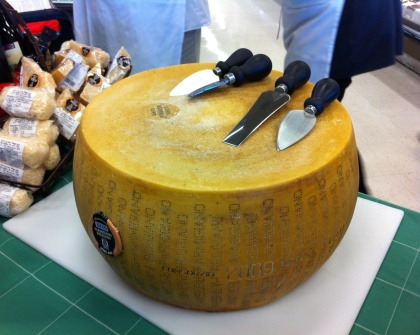
“Say Cheese!”

the-wheel-ready-for-cracking

(image) https://3wheeledcheese.files.wordpress.com/2012/09/the-wheel-ready-for-cracking.jpg

Thank you reality!

In my historical novel trilogy about onion farmers, which stretches  from the 3rd Century to the present day, I have my main characters, the Cannara family from Italy, invent an “onion cheese”.

In the second part of the trilogy, I have the Cannaras take some of this cheese on a trading voyage to China. Theses voyages could last well over a year. I have them forget some of the rounds of their cheese, and they makes a return voyage. To their surprise, the Cannaras find that the length of travel and the motions of the ship have produced superior cheese. This they sell at a high profit.

Immediately following is a current news article about some cheese found on a ship that sank 340 years ago.

Below that is an excerpt from my novel, China Lily.

DE

~~~~~~~~~~~~~~~~~~~~~~~~~~~~~~~~~~~~~~~~~~

Wednesday July 27, 2016

340-year-old cheese discovered at shipwreck site and, man, does it stink

A dairy product, believed to be cheese, has been discovered at the wreck site of The Kronan. The Swedish warship sank before a battle with the Danish/Dutch allied fleet in 1676.

A dairy product, believed to be cheese, has been discovered at the wreck site of The Kronan. The Swedish warship sank before a battle with the Danish/Dutch allied fleet in 1676. (Kalmar County Museum)

Listen 5:22

Divers exploring a sunken 17th-century gunship from Sweden say they have discovered what they believe to be cheese.

“The smell and the texture of the material really points in that direction,” Lars Einarsson tells As It Happens guest host Helen Mann.

“I don’t know if anyone is going to taste it.” – Lars Einarsson

Einarsson, the marine archeologist who heads up The Kronan Project, thinks that the cheese smells like a mix of yeast and Roquefort.

“When it was opened the first time, it was really overwhelming, in a positive way. It was smelling ‘live,’ as opposed to dead organic material, which doesn’t smell very nice. It seemed to be alive.”

The material was found in a tin at the wreck site of The Kronan, the largest ship of its time. It sank in 1676 in the Baltic Sea, which helped preserve the cheese all these years.

The Baltic Sea is a ideal for preservation of the cheese, according to Einarsson. The low salinity, along with the fact that the ship sank in clay, helped seal the pewter canister away like a time capsule waiting to be opened.

lars

Lars Einarsson is a marine archeologist and director of The Kronan Project. (Lars Einarsson)

When asked if anyone would dare bite into the 340-year-old cheese, Einarsson paused.

“I don’t know if anyone is going to taste it. We are quite optimistic about getting an analysis of the chemical makeup of the product though.”

The cheese has been sent to a lab and Einarsson hopes to have the results of what exactly they have within a month. He adds that it may wind up on display some day.

“If it’s possible in terms of preservation, we’ll definitely [put it on display.] But first of all, we have to safeguard the material.”

http://www.cbc.ca/radio/asithappens/as-it-happens-thursday-edition-1.3699151/340-year-old-cheese-discovered-at-shipwreck-site-and-man-does-it-stink-1.3697365?cmp=rss

~~~~~~~~~~~~~~~~~~~~~~~~~~~~~~~~~~~~~~~~~~~~~~~~~~~~~~~~~~~~~~~~~~~~~~

~~~~~~~~~~~~~~~~~~~~~~~~~~~~~~~~~~~~~~~~~~~~~~~~~~~~~~~~~~~~~~~~~~~~~~

Excerpt from China Lily:

Just as he did on his last two voyages, Cepa will also bring a few wheels of the onion cheese back to Europe. He has established an authentic pedigree, with the local bishop stamping a date on the sealing wax of the cheese. Assuming there has been no damage by seawater (which has happened to a few of the wheels); the “onion cheese” has such renown the Cannara’s joke that they can almost sell it for its weight in gold.

The “ocean cheese” came about through an accident. On the first voyage Cepa had taken, some of the wheels of onion cheese had been swamped by seawater. The storm was so rough their wax had gotten chipped and cracked. Cepa instructed that they just be thrown overboard. However, before that happened, other crew members shifted cargo and the cheese was shoved into a corner and hidden. Other goods, purchased at different ports, kept obscuring the cheese. When they returned to Europe the cheese wheels were revealed. In the process of throwing them into the harbor, Cepa discovered a half dozen wheels in the middle had not actually been damaged.

A couple of months later, when the Cannaras decided to cut open one of the wheels, they found the cheese had acquired a piquancy and an oddly smoother texture. Speculation was that the motion of the ship, the salt in the air, and the additional years of ageing made the essence of onion permeate the cheese more broadly.

Cepa tried half the wheel on the extended family. The other half he proportioned out to the three medicinal bathing lodges the Cannaras owned, scattered through the foothills of the Alps. He had thought of just using it in Cannara taverns, or even as a supplement to the mid-meal at some of their businesses. The response he received from both the family and patrons of the spas changed his mind.

Even though the onion cheese had been touted for its “medicinal properties” at the spas, and promoted as an “oriental delicacy” elsewhere, the enthusiasm with which it generated proved that everyone reveled it its taste. Cepa was well-aware that part of the family lore concerned an Enaiy of centuries ago who had tried making cheese under water. He wondered if there was any part of the process that might be similar to the sea voyage. Perhaps the amount of additional time was part of her attempt, or bring rocked by the waves. He had no idea if the Cannara’s current recipe for onion cheese had anything to do with her underwater process.

His “ocean cheese” had been so well received that the Cannara family put a small sample on display to taste. Then they began to auction it off. Because most of those who used their spas were wealthy, or nobles, or rulers of the church, members of this social strata had already heard of the cheese. It was as rare as spice. It only appeared in small quantities every few years. Having no way to calculate a production cos, the Cannaras started at the base price for their regular onion cheese. Those of wealth and appetite took care of the rest.

Blog at WordPress.com.

Up ↑