Search

kafkaestblog

It is a whirlwind in here

Kafka Never Slept In This Prague Hotel

hotel-century-old-town

When I visited Prague to research my novel, Kafka In The Castle, I went to many of the places that were part of  Kafka’s life. One such place – the small house where he wrote a whole book of short stories – became a setting for a third of my novel.

However,the building where he was employed, The Workers’ Accident Insurance Institute for the Kingdom of Bohemia in Prague, I only saw at a distance across a Square. It was not a happy place for Kafka, though he was very successful at his employ, and rose to an administrative position of importance. It was not really much of a setting for my novel.


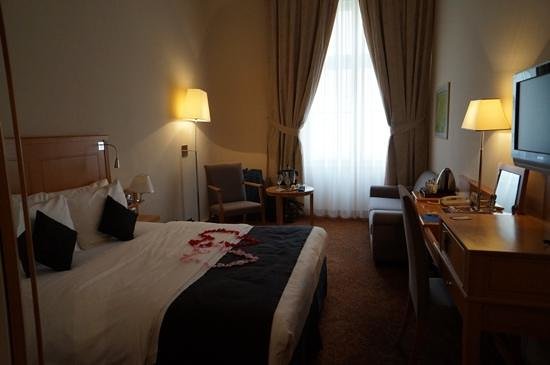
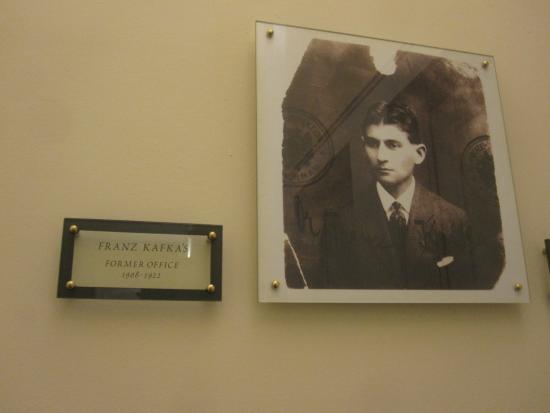
That building is now a fancy hotel, and Kafka’s office is a room for rent. It is even designated The Franz Kafka room, and contains mementos. It is where I plan to stay when next I visit. I hope there is not a long list of folk wishing to spend the night there, too. It even includes a restaurant named after his fiancée, Felice.


Following is some information about the hotel, and some photos of the room.
~~~~~~~~~~~~~~~~~
The hotel is situated in the heart of Prague, next to the Old Town Square, where the famous medieval astronomical clock is mounted on the southern wall of the Old Town City Hall. The Neo-Baroque building was built in the 19th century by Alfonse Wertmuller, a famous architect in Prague. It was formerly the office of the Workers’ Accident Insurance of Kingdom of Bohemia, where Franz Kafka worked as an insurance clerk from 1908 to 1922. His spirit can still be felt in the hotel, as his bronze bust welcomes guests in the lobby in front of the majestic stairs.
hotel-century-old-town
room
~~~~~~~~~~~~~~~~~~~~~~~~~~~

In addition, this is one of the few diary entries I wrote, set in his office building,

 
Excerpt from Kafka In The Castle

16 February 1917

There was a commotion at the office today. It was late morning, and from far below, coming up the stairwell, I could hear a voice bellowing: “Doktor Kafka. Doktor Kafka.” It was a terrible voice, full of blood and darkness.

I got from my desk and went to the door. There were other voices, trying to calm, saying: “He can’t be disturbed.” But the voice was louder, more horrible, close in the corridor.  “Doktor Kafka – for the love of God.”   My secretary wanted me to stay inside, hoped the man would just move along the corridor until the police were summoned.

But – I was curious; the man had my name, and his voice was … terrified.

I opened the door and stood in front of it.  “I’m Kafka,” I said. The man lunged at me, and went to his knees.  “Doktor Kafka?” he said.  “Yes, I’m Kafka.” He reached out, grabbing for my hand.  “Jesus, Jesus, for the love of Jesus – they say that you’ll help me.”

He was a heavy man, and looked as if he had the strength to pull off doors, yet the tears burst from his eyes.  “I can get no work. I fell from a bridge, and my back is twisted and in pain.” He slumped against the wall, looking at my eyes.  “I have a family, Doktor Kafka. A baby not a year old.”  “You were working on this bridge?” I asked.  “Yes.” His voice slid down his throat. “I was helping repair the surface.”  “Then you deserve your insurance. Why can’t you get it?”

He straightened up, and tried to stand. “I have to fill in papers; the doctor can see no wounds; the foreman said I drank; because my brother is a thief, I am not to be trusted.” I held out my hand, and he slowly stood. “I’m telling you the truth, Doktor Kafka.”

“If that is so,” I said, “you’ll get the money due you.”  “I’m so tired,” he said.

I gave instructions to those standing around – no other work was to be done until this man’s case was decided. I took him to my office, where he sat.

He sat – practically without a word – for five hours. I summoned a prominent doctor to look at him. The doctor prodded, and the man screamed. Officials from his village were telephoned. I helped him with the details on the forms. His truth was in his pain. He left our stony building with money in his hand, and his worth restored.

The people who assisted me had smiles on their faces.

A man had needed their help.

Kafka And His Friend, Max Brod, Share A Laugh In Heaven

kafka-brod

(Max Brod + Franz Kafka w/ hat)

I kinda do wonder if Franz is whispering into Brod’s ear (wherever they may have ended up) “I told you to burn them.”

To which Brod would accurately reply, “You knew I wouldn’t. If you wanted it done, you would have done it yourself.”

~~~~~~~~~~~~~~~~~~~~~~~~~~~~~

Franz Kafka archive reclaimed by Israel national library | Books | The Guardian

Israel’s national library has unveiled a missing batch of Franz Kafka’s papers, ending more than a decade of legal wrangling between Israel and Germany over the author’s legacy.

(more) https://www.theguardian.com/books/2019/aug/07/israel-national-library-unveils-reclaimed-franz-kafka-archive


Circles Are The Answer ~ Space & Universe & Beyond

1-milkyway-galaxy

“Circles are the answer.

“Just look at any circle and you’ll see what I mean. Of course, no one else is to know about the circles. They must be very stupid if they can’t see something so obvious.

“Yet, you get hints, don’t you – all the time out there. And in your own life – the way things happen so you never get anywhere. Never change.

“The earth, of course, and the sun – well, that’s something you can see. Either way you look at it, the one goes around the other in a big circle that takes in the whole sky. And the earth and the sun and the moon are round  – all circles in their own right. So you have circles which are going around in circles, if you get my meaning.

“And if you look further – reach out into the universe as far as you can go – they tell us that everything is going around everything else. Smaller circles and elongated circles which take in such large distances that numbers become forgotten.

“Now, this means that everything, eventually, comes back upon itself. The beginning is really the end. That’s what most people would think – and that’s where they make their mistake.

“You see, things don’t start by beginning – they start by ending. It’s the end which comes first in a circle, so, instead of going back to where it started, it comes back to its end.

“That explains it.”

[Image] https: //i2.wp.com/everwideningcircles.com/wp-content/uploads/2014/12/1-milkyway-galaxy.jpg?resize=1600%2C901&ssl=1


Chow Down: Fake Food To Go (With Your Fake News)


manufacturing-fake-food-a-620

Please, Ladies and Gentlemen, I think it’s time to – please, if you don’t mind – it really is time to begin our – thank you, that’s much better – time for our meeting to start.

As you can see by looking around, this gathering is exclusively for Department Heads, and there will be no minutes taken. These projections are for your ears only.

Not only would we not wish another company to get them, but there is a chance the general public may become concerned, little realising the economics of our endeavours. A brief history of colours, dyes and artificial essences will give us a place to start. Run the strawberry jam, please.

As you can see, Ladies and Gentlemen, the colours on the slide are excellent. The rich red hue of the strawberries is exactly the colour you’ll find in the jar. We spent years developing that dye. Also, the years that went into getting the artificial taste and smell to adhere to the colour is something that most people would not imagine.

 Of course, even with our best efforts, there has always been a problem with that cloying, rather heavy sensation on the tongue. That has been offset by the addition of more sugar. We had complaints when the product was first introduced, but it appears these have now disappeared with new generations who know nothing different. People just accept that strawberries, strawberry ice cream, and strawberry jam all have their own tastes. Next slide, please.

Oh, yes, well, we’ll pass over this slide quickly. I just put that in to show you we finally managed to get rid of the strawberries altogether. As you can see on the close-up, the red glob is really made from compressed fibres – as one of our chemists said, more straw than berry. Even the seeds are produced and added with a gum mixture. We have found that bone meal seems to last best of all.

Now, this next lot we are very proud of. Bronson, these should be of particular interest to you, since they deal with our fast food chain.

The buns are made of very porous fibre, almost like real dough. and the brown colouring gives them a nice toasted look. The meat patty is still half real – we can’t seem to budge the government on that. Still, being able to advertise 100% all beef helps – as long as the fat, bone, guts etc that go into it all comes from a cow, we’re home free. Notice the use of the black lines of dye, to make it appear the meat has just come off the grill.

An interesting experiment has been done with some of our ever-thick milk shakes. We wanted to see how long the latex used to keep it together would hold up under the combined attacks of various strawberry, chocolate, etc. dyes, the fats and gums of the milk mixture, and the acids from the artificial flavours. You’ll be pleased to know that some of them still were thick after four months of refrigeration.

It is easy to see how latex based paints can last for so many years. We are now experimenting with making our french fries out of pulped wood chips. Texture, flavour and colour have all been overcome, but there still seems to be some unfortunate reactions to the hot fat.

[Image} https://cbsnews1.cbsistatic.com/hub/i/2015/11/20/60e34786-c484-49a6-8043-848a0523156c/1eca0dcddb6e9e3cb2f8b8f9a6ce42d7/manufacturing-fake-food-a-620.jpg#

Kafka Has A Beer With His Father

148184

In Kafka In The Castle, I fill in the ‘missing’ diary entries from Kafka’s real diary. He either did not fill in these days himself, or he destroyed them. There are some estimates that Kafka destroyed 70% – 80% of everything he wrote. 

On this day, Kafka spent the afternoon with his father – an unusual event. And he even had a beer – he was not much of a drinker. But Kafka knew his estranged sister, Ottla, was coming to visit. Her parting of months before had been vicious.

***************************************

25 June 2017

We are rarely alone with each other, and the strain was palpable. I wanted to act as normally as possible, but since my usual conversation is what generally infuriates him, that seemed unwise. We read the newspapers, and I managed enough comments about the articles, and elicited his tiresome opinions about the war, and didn’t argue with him too much, that the afternoon – although slow – passed with little rancour. I even had a beer with him, and he showed his surprise. And, I even enjoyed it – but then, I had earned it.

In fact, it may have been the unaccustomed alcohol which lessened the shock of seeing Ottla enter the apartment with mother. Father stood from his chair, the newspapers falling at his feet. “Ottla has an hour before she must catch her train,” said Mother. “I have asked her in for some tea.” Father glared at her an excessively long minute without speaking, managing however to give me an occasional menacing glance. He then abruptly sat again, gathering his papers and holding them in front of his face. “Don’t give her too much,” came his voice from behind the pages. “Too much tea can make a long journey uncomfortable.” I knew that he had already read the pages he held, and I wondered what he was thinking.

About ten minutes passed, and then mother came back and asked if we would like any tea. “Yes,” my father answered, but instead of waiting for it to be brought to him, as is his usual practise, he followed mother into the dining room. And I followed him. Ottla didn’t look up, but he did manage to ask some questions about the farm, and she delivered some cautious replies. She stayed another twenty minutes, then I walked her to the station. It had been mother’s idea to come home, and Ottla had not strongly resisted. I know that she and father will never apologize to each other, but at least they now speak. Once we were out of sight of the house, she gripped my hand and held it until we reached the train. “How can I love that monster?” she asked from the train as it pulled away. “How can you not?” I replied. I hope the noise from the wheels drowned out my words.


26 June 1917

Fight and you die. Surrender and you die.


27 June 1917

Live and you die.


[Image] https:/ /s.inyourpocket.com/gallery/148184.jpg


Follow That Elephant

kenya_amboseli_corlettewesselswildlifeelephant2

The elephant was a curious pachyderm, and followed his persistent quest with a guileless intensity.

“More lucky than smart,” said some of the other elephants, as he blundered his way toward another piece of knowledge. They nodded their heads in his direction with the heavy weight of caution, and warned their small ones that too much thought would make them strange.

“An elephant wades in water,” they would sagely say, “only if the mud hole is wide enough.”

And the little ones would watch him, as they stood between the legs of their parents, and wish that they could follow.

[Image] https: //artofsafari.travel/wp-content/uploads/2016/08/Kenya_Amboseli_CorletteWesselsWildlifeElephant2.jpg

Stinking Hot Weather Meets The North Atlantic Ocean

Pier 21, Halifax

I was perched on my favourite bench looking out the mouth of the harbour to the North Atlantic, when three twenty-somethings decided to perch on the edge of the wharf in front of me.

They obviously had been having the following discussion a good time before they arrived. Buddy 1 told the other two he was going to jump into the harbour. Buddy 2 was saying he wouldn’t dare, all the while daring him. The Girl was mostly quiet with an occasional laugh. She did say once or twice it was ass silly idea.

This discussion went on about ten minutes, Buddy 1 getting more determined, Buddy 2 egging him on more and more, and the Girl’s laughter getting a bit more nervous.

I felt I was an audience for them, though their voices did get higher whenever other folk passed. I noted that the idea to jump was not getting any less insistent.  I felt that none of them were under any influence of drink or drugs, they were obviously physically fit, and I noted the closest Life Preserver was two minutes away if I had to throw it. I, myself, was not going in after anyone, no matter how refreshing the splash.

Usually, such joking around does not persist, so I was less surprised than the other two when Buddy 1 started taking off shoes and socks. Then his shirt. Buddy 2 kept daring him. The word “chicken” was bandied. The Girl was now voicing more cautious comments.

Buddy 1, who had made certain they were near a ladder, stood up on the foot-high wooden planking at the edge of the pier. Buddy 2 switched between comments that Buddy 1 was crazy, to more outlandish dares. The Girl sighed dramatically and just said he was crazy. I agreed – but silently. And over Buddy 1 went. He didn’t dive, but side way flopped. It was six to ten feet to the water. The splash was impressive. His scrambling up the ladder even more so.

Now, Buddy 1 was standing, soaking wet in a pool of water. Other people were paying attention. Some made comments as they passed “Was it cold enough for ya? Haw haw.” The Girl was shaking her head. Buddy 1 dared Buddy 2 to jump in. Buddy 2 said he would, if Buddy 1 jumped in again. The Girl said for them to stop being crazy. But, once in, what was there to lose?

Into the ocean goes Buddy 1 again. A side way splash. Up the ladder as fast as ever.

More people are walking past, making comments.

Buddy 2 said there were even people  further away filming with their phones. He told the Girl to take out her phone and take some pictures. He took off his shoes and his shirt. He gave his hat to the Girl. He jumped. He called from the water for Buddy 1 to join him. Buddy 1 did. They both were up the ladder right quick. They were both dripping. They were both shivering. The both dared the Girl to jump.

The Girl handed her phone to Buddy 2. She slipped out of her sandals.  She might have heard one of the Buddies start to say “You wouldn’t dare.” In she went. She was not quite as quick up the ladder,  but both Buddy 1 and Buddy 2 helped her.

They all three were uncontrollably shivering. They all put on their foot ware. One passer by told them how cold the North Atlantic really was. He said they should get home and get into a hot shower or bath.  They were all shivering greatly, but I think they shook their heads in agreement.

And away they went.

[Image] https: //farm8.staticflickr.com/7031/6700698963_b7a10e3063_z.jpg


Turn Over A New Leaf Pell-Mell

turn-over-a-new-leaf-2-520x400

Alison Alexandra sometimes thinks of turning over a new leaf. Sometimes at the most traditional of times, like at New Year or her birthday or under a full moon or when the tide is at its highest. But then she remembers that well into her pre-teen years she thought the expression to turn over a new leaf meant reaching into the branches of a tree and flipping her wrist (somewhat like Amanda does when cutting cards) and when she found out the flip flip flipping concerned paper pages she was so bored she never did it. No, not once.

And anyway, why would she overturn anything in some sort of orderly fashion when she pell-mell turns things over at the very time they seem that they need to be overturned and not a minute or an hour or a full moon or one leaf later. That now is indeed now is, indeed, now and as she daily finds out from her windows or cliffs overlooking the ocean; tide and time await no Alison Alexandra. So she will not wait for them.

Alison Alexandra has often thought – and she also often thinks – that she could happily turn over all her leaves just from her prow-of-a-ship room jutting into the sea or the cliffs that, as yet, do not erode under her feet as she walks them looking out to sea. But that would be unwise and probably as stagnant as a rotting fish that sometimes lodges itself at the base of her cliff and though she has not travelled as often as those sailors and their spyglasses, she has travelled as far as many of them just to keep those leaves flip flip flipping.

So, today she is going to walk to town.

[Image} https://www.telllaurailovecrochet.co.uk/wp-content/uploads/2016/01/turn-over-a-new-leaf-2-520×400.jpg

Kafka And His Hot Summer Night Of The Dead

franz-kafka-house-golden-lane-prague

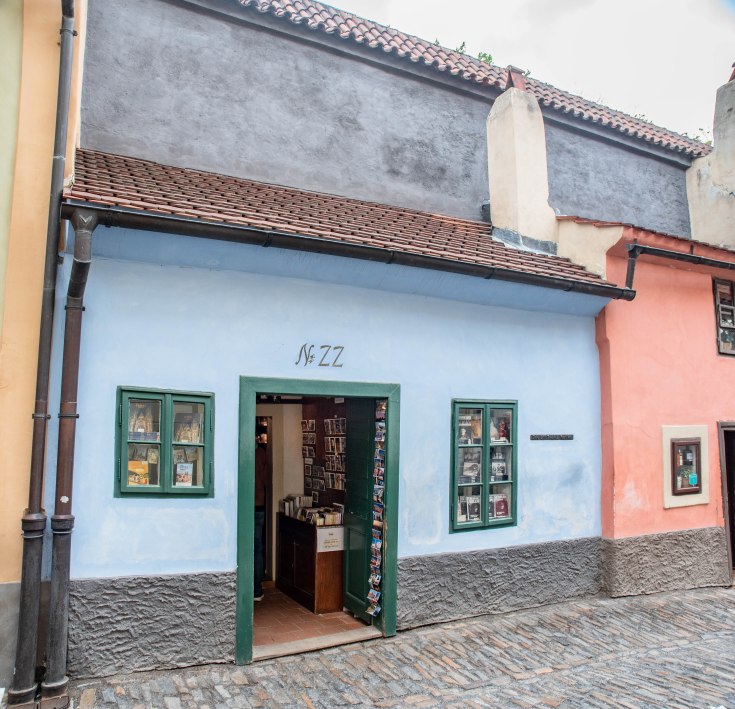
Kafka’s House: Number 22


In my novel, Kafka In The Castle, I fill in Franz Kafka’s missing diary entries. Every day chosen is a day where he either left no record, or destroyed the pages.

On this night, he meets the woman who was the girlfriend of Kafka’s neighbour on The Alchemist’s Lane, who had killed himself. Kafka found the body. He also found a note addressed to her, which he kindly burned.

*****************************************

25 July 1917

I had not been here long – the newspaper only partially read – when I thought I heard a noise at the door. A woman was framed in the open doorway, her hand still hesitant upon the wood. I rose from my chair, and she stepped back into the lane.

“Yes?” I asked.

“You knew him?” she asked in turn.

She was a slender woman, sallow complexion, and younger in age than Ottla. I walked toward the door, for it seemed apparent she was not about to enter.

“You were his neighbour – the Herr Doktor?”

She did not retreat any further, and I was now standing in the doorway.

“Oh,” I said. “You mean … ” But I had to stop, for I could not remember his name. I finally had to point to the house next door.

“Yes,” she said. “He killed himself.”

“Yes.” I had to agree.

“Did he …” she began, and I could sense her difficulty in having this discussion. “Did he say anything about me. I’m Julie.”

“We can go in, if you like. I do have a key.” I am an expert at stalling for time. “No one has moved in.”

She looked at me in disbelief, her face seeming to age as various expressions moved across it.

“No – that isn’t …” she began, staring at the other door. “I was never here. We didn’t have that type of friendship. But I have not been able to remove him from my mind. If he ever spoke of me, I care to know about it.”

My hope was that she would never ask about an envelope addressed to her.

“So you don’t wish to go in?”

“No. That means nothing to me.” She took a step closer. “Just if he talked.”

“You were his girlfriend?”

“He thought me so – though I told him differently, and offered no encouragement. But perhaps he drank too much to pay attention.”

“You were with another man?”

“He told you that? So – he did speak of me.”

“Yes.”

“What else did he say?”

There are times to tell the truth; times to expand the truth for clarification; and times to compress.

“He said that he saw you together with a man. And that he missed you.”

“Did he say anything the night he killed … the night he died?”

I didn’t pause, because I had stalled just so I could answer this question.

“He asked me if I was going to be in my house over the evening.” Here I did pause, as if in thought. “And he said he didn’t like the other people on the lane.”

“Nothing else?”

“Pleasantries – good evening, etc. He said he liked our talks.”

“He talked a lot?”

“No, not really.”

“Was there a note?”

“You should ask the police about that.” I was very calm. “They searched his house.”

“Yes, perhaps I will. He said nothing further?”

“We did not really have conversations.” I shrugged my shoulders. “He was always drunk.”

“Even that night?”

“Oh yes. The night he hanged himself – most certainly.”

“And you were the one who found…”

“Yes, Miss. And, I contacted the police.”

“He was … was dead when you found him?”

“Yes.” I looked directly into her eyes. “He did a very effective job.”

She was quiet for a moment, staring at his door. She looked along the Lane, then finally at me.

“You have been most kind, Herr Doktor. I’m sorry to have troubled you.” She did not wait for a response, and was turning away when I spoke.

“If I may ask, Miss. This happened three months ago.”

“To the night,” she said.

“Three months. Why have you waited until now?”

“It does not seem long.”  She was conscious of others on the Lane looking in our direction. “His attention – though I never asked for it – was so total and persistent, that I have felt it deserved my interest.”  She shook her head slightly. “But not any more. I wish to put an end to it.” She unexpectedly stepped toward me. “That’s all right, isn’t it, Herr Doktor?”

The question was so intense that I touched her shoulder.

“Yes. Without any doubt – yes. You’ve spent enough time on a ghost within a memory.”

I smiled, and she walked away, quickly down the Lane. Death’s hand released its grip.


Blog at WordPress.com.

Up ↑