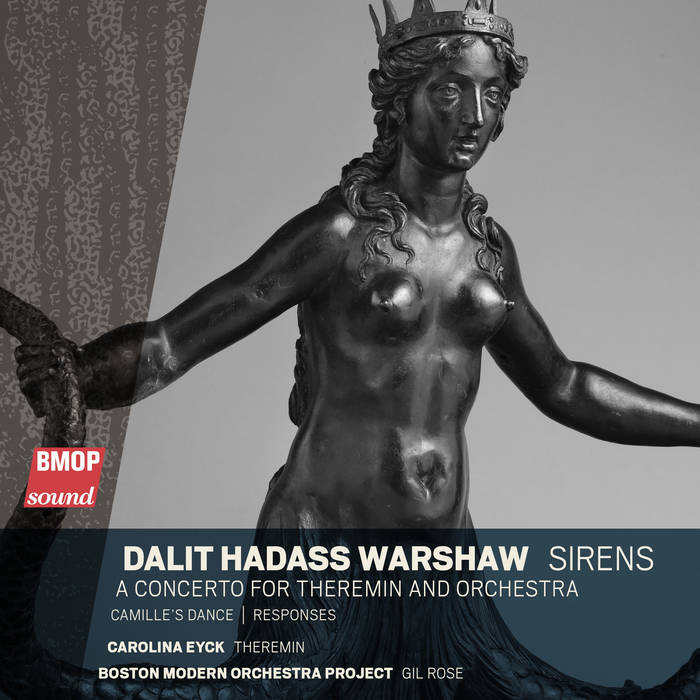
Boston Modern Orchestra Project, Gil Rose, conductor
Dalit Warshaw (b. 1974) is a multi-threat artist. As a composer and pianist, she has created a distinguished career. Her first orchestra piece was commissioned when she was eight years old, and this prodigious distinction has been followed by a body of work that encompasses music for orchestra, chamber ensembles, vocalists, choruses, and Letters of Mademoiselle (2018), a staged song cycle for the talented soprano Nancy Allen Lundy.
The theremin has become an important part of her work. Warshaw has performed the instrument in high profile settings, including appearances with the New York Philharmonic. Sirens is a recording of her theremin concerto and two other orchestral pieces, performed by the Boston Modern Orchestra Project, conducted by Gil Rose.
Responses (2016) is a triptych that reflects upon three of Brahms’s Intermezzos, piano repertoire that Warshaw has studied. Originally composed for solo piano and performed by Warshaw, it has been transformed into a work for large forces that sounds idiomatic in its instrumental writing. Indeed, Warshaw’s orchestration deftly captures both the sehnsucht of romanticism and her own aesthetic, which encompasses both neo-classical and mainstream contemporary classical elements. While the pieces themselves are earnestly serious (as was Brahms in his later years), one can have a bit of fun with the following listening game: without hunting down program notes, see if you can figure out from which intermezzo each movement takes its inspiration.
Camille’s Dance (2000) is named after visual artist Camille Claudel, whose sculptures La Valse and La Fortune grace the cover and interior of the BMOP recording’s booklet. It is a stirring piece, rife with dissonant harmonies and muscular gestures that epitomize the striking characters depicted in Claudel’s sculptures, as well as her fraught relationship with Auguste Rodin.
The soloist for Sirens is the thereminist Carolina Eyck. It is a three movement work that is inspired by Clara Rockmore and, of course, by the singing duo of temptresses found in Homer’s Odyssey, seen through the vantage point of Franz Kafka’s parable “The Silence of the Sirens.” The theremin was taken seriously as an instrument in part because of Rockmore’s advocacy. Eyck has explored an expansion of its capabilities with the Etherwave Pro instrument, which has an extended bass range. She also uses octave pedals to further extend the theremin’s compass.
Rockmore’s first instrument was the violin, and her theremin performances reflected this; several of the pieces in her repertoire were transcriptions of violin repertoire. Thus, the opening movement of Sirens is titled “Clara’s Violin,” which includes thematic material based on her life story and also themes that are ciphers of names: Clara, Leon Theremin, her partner and the inventor of the eponymous instrument, and the KGB, whose agents hounded and even kidnapped Theremin. One needn’t know any of this to appreciate the abundant vitality and craft of the movement. Warshaw’s own experience as a thereminist and her close collaboration with Eyck have yielded a versatile and challenging solo part that belies the notion of the instrument as being limited to special effects and transcriptions.
The second movement uses the Kafka story as a touchstone, with a stirring duo between theremin and piano that reminds us of the two-against-one scenario that Odysseus endured. The third movement is a wild ride with glissandos galore, a theremin specialty, set alongside a fugue that once again employs ciphers of names as its thematic material: “Theremin” as its subject, with “Clara” and “Dalit” used as two countersubjects. The combination of these two elements shows Eyck and her bespoke electronics to best advantage. It also highlights the extraordinary facility of BMOP’s musicians. Careful preparation and the dynamic leadership of Rose are clear in the performances of all three of the programmed pieces, but the jubilation with which the concerto is rendered makes it a strong finale to a thoroughly engaging recording. Recommended.
In my novel, Kafka In The Castle, I fill in the missing entries of his actual diaries. There are many days to fill, as he either did not write during these days, or he destroyed the record.
Kafka did have occasion to ponder Friday 13th. The date was connected to “The Swiss Girl”, whom he met at a resort. She was eighteen and he was thirty-four. It is unclear how intimate their relationship became.
Twice, I give him a brief recognition of Friday 13th. In reality, The Swiss Girl haunted him (pleasantly) all his life.
**************************************
13 April 1917
I almost wrote down the year as 1913. That was the year I met the Swiss girl. And I remember her joking about, and how we had missed it by just a day. She was superstitious – Christians seem to be. I wonder what precautions she is taking today. It will be three years and seven months since I saw her. Yet some of the things we did could have happened last week. I think that memory must be made of rubber. You can sometimes pull it toward yourself – and sometimes it snaps away like a shot. Causing as much pain.
13 July 1917
Friday the 13th again. What better time to think of the Swiss girl, than with F. I don’t know if such memories help sustain me, or if they revel how intolerable the future can sometimes be. I can not imagine the Swiss girl’s face across the table from me, nor her voice singing one of her quiet songs. If I must be trapped, then why can’t I be trapped in the past?
Franz Kafka died on 03/06/1924. He was a young man – a month short of his 41st birthday. However, his death was preordained years earlier. In my novel, “Kafka In The Castle“, I fill in the missing days of his diary. These are the entries I imagine concerning the days he actually found out his fate.
*******************
04 September 1917
A death sentence.
05 September 1917
Max is saying all the right things. All the nice things. And he is saying them all in the right way. An earnest, matter-of-fact truthfulness which sounds plausible. If he does not tread from a very narrow path. Sometimes I find myself a part of his hopeful speculations. And sometimes I find that I am trying to keep his spirits up. If he is going to all this trouble, then shouldn’t I do my part? But: it isn’t his blood. And anyway – he was the one who insisted on the specialist. Chose the renowned Dr. Pick. And heard – almost as soon as myself – the verdict. Tuberculosis. Tuberculosis engaged in both lungs. Like a preparation for marriage. The engaged man now flirting with another lover. And planning a marriage which will be far more permanent that any I could have had with Felice.
Looking myself up on the Internet (as one is sometimes wont to do), I came across this. I posted this nearly ten years ago, and have/had totally forgotten it. So, it’s a possibility others have forgotten it also. I find it quite interesting.
Isabella d’Este, Giovanni Cristoforo Romano, 1500.
There is a tradition in “my” branch of the Estey family that we descend from the d’Este of Italy. The d’Este clan were rich and powerful and influential. They married well which – yes – brought the infamous Lucrezia Borgia into the family when she wed Alfonso I d’Este, Duke of Ferrara.
My father had a reproduction of Alfonso’s sister, Isabella, readily at hand. Isabel was a name for at least one daughter in every generation of Esteys. Lucrezia attempted to befriend Isabella, but to no avail.
The town of Este is in Northern Italy, in the Veneto region, about a two hour car ride from Venice. It’s most recent population figure of two years ago was around 17,000. I have a special fondness for this part of Italy and have sprinkled references to it in some of my novels. Indeed, my whole historical onion trilogy is centred around a town in this area.
So, Este was certainly a destination when I travelled through Europe. And the surrounding area. Este was suitably medieval in tone, with its ruined Este castle and wonderful flower beds and bowers and stone bridge over river and walled town and as happily historic as all get out.
I looked to see how many Estes were in the phone book (a respectable number) but I didn’t phone anyone. I would be more thorough and stay longer on another trip. I doubt there is any way to fix up that castle.
I enjoyed all of Italy that I visited (and the rest of Europe held no less enthusiasm from me). But to stick, as it were, around the old homestead, the most enjoyable places were Venice and Florence. I was most surprised to see cruise ships looming from the Venetian waterfront.
I sighed on The Bridge of Sighs – from such beauty to such terror those prisoners were lead. A stunning memory was boating on the Grand Canal at dusk and seeing rooms in a passing mansion ablaze with chandeliers.
Florence was my favourite. It is, of course, awash in museums and galleries and art art Art. To chose the one which stunned me most was Botechelli’s Birth of Venus – and that’s saying a lot, considering. The Ponte Vecchio over the Arno lives up to all its billing. Alas, I bought no gold.
Also, a memory is walking along certain streets and assuming I was near riding stables because of the permeating smell. However, I was in the leather good quarter. There was also the ancient, wire mesh and gated elevator,the type I had only seen in movies, wheezing me aloft to my lodgings. And the lady who left her room key on my table after breakfast. And don’t get me started on the markets and the food. Don’t.
However, there is one golden memory which consists of neither history nor ancient art. This happened in Verona. I was walking along a busy street and looked into the interior of a news vendor. The building also had an array of paperback books. And there, looking back out at me, was my own novel, L’INGANNO BONNER, recently produced in an Italian translation. That was a most pleasant delight indeed.
I have written a novel where I fill in the missing days of Kafka’s real diary. However, I appreciate the following, which is Kafka’s real opinion of the first employment he ever had. I never had such far-away thoughts at my own first job, but neither was I enraptured by it. I lasted a year.
*****************
“Now my life is in complete disorder,” he wrote to Hedwig Weiler on October 8, after just a week of work. “It is true, I have a job with a tiny salary of 80 crowns and 8-9 interminable hours of work, but I devour the hours outside the office like a fierce beast. . . . I nourish the hope of sitting one day on chairs in far-flung countries, looking out of the office windows onto sugar cane fields or Muslim cemeteries, and the insurance branch interests me greatly, even though for the moment my work is sad.”
He quit after less than a year, on July 31, 1908, citing health reasons. (“We express our amazement that the state of health of the aforementioned, who after the careful examination of the doctor carried out in October last year was recommended as absolutely fit, is after such a short time so bad that his immediate resignation must follow,” reads a letter from the company in Kafka’s file.)
I glean through many sources after information of which agent,s and which editors, have purchased recent books that are similar to one of my manuscripts.
When I find someone I think will be compatible to some of my work, I research them. Then, if I think they would have a reasonable interest in my manuscript (and there can be a variety of reasons) I’ll send a query letter.
I prefer to go through this process of finding names a number of times in a row, instead of finding a compatible person, then immediately sending a query. So, when I find a person I plan to contact, I send this information to myself in an email. It can be weeks before I actually send a query to an agent or editor, and then it can be two or more months before I hear a reply.
Last week I came across the information that John le Carré has a new book coming out the end of this year. I adore John le Carré. This announcement unusually named both his agent and editor. I sent both to myself, and I imagine I would get to them in the next two or three weeks.
This morning, April 1st, I had notification of a rejection by an agent for my NATO Thriller. It was a refusal sent through the portal of the agency (which happens more and more). Since it was not an actual response by the agent, I had to go to my Sent file to see who I had sent the query to.
Uh-huh – it was the same agent as John le Carré. So, I actually got rejected before I sent the query.
31 March is a day of note: you take your computer and make sure you have backed everything up, preferably in a number of different places. And then you attempt to remember to do it every time you are working on your computer. Second nature.
When working on a current manuscript (either inputting it into the computer from longhand, or creating it right on the computer), at the end of the working day, I attach the file to an email and send it to myself at four different email addresses. I also download it to the desktop. Weekly (or more) I send it to an external site (I use Dropbox). And (of course) it is on a key.
World Backup Day
World Backup Day is a day for people to learn about the increasing role of data in our lives and the importance of regular backups.
This independent initiative to raise awareness about backups and data preservation started out — like most good things on the internet – on reddit by a couple of concerned users. Let’s make this happen!