Search

kafkaestblog

It is a whirlwind in here

Category

writing

Interview With National Radio Some Years Ago (But Most Answers Remain The Same)

symbole-of-trust


I came across a transcript of this at the end of last year. It’s not that I forgot it, but it took me some time to remember it.

~~~~~~~~~~~~~~~~~~~~~~~~~

1. What unique challenges do you face when writing about serious
non-fiction issues such as religion?

I WRITE about spiritual matters and leave religion to others. The spirit and its quests drive religion – religion just interprets. The biggest challenge I faced in THE ELEPHANT TALKS TO GOD is that the Elephant started asking questions I could not answer. Thus endeth the book.

2. You wrote The Elephant Talks to God in 1989. Why did you decide to
re-release it with the added stories rather than write a sequel?

THIS WAS the decision of the publisher, Goose Lane. When they approached me for a re-issue they were unaware of the additional stories. It was decided the marketplace would prefer one longer book over two shorter ones. Having just one book also reduced production costs, which in turn reduced consumer cost.

3. Why did you decide to become a writer?

“I WAS born like this, I had no choice, I was born with the gift of a golden voice.” This quote from Leonard Cohen sums it up. Not “born” this way exactly, but within one month in grade eleven I went from ‘no writing’ to ‘continually writing’. I have no explanation. I had no previous interest nor inclination toward the arts, or writing. I was not a reader, and only after university deliberately read such children’s classics as Black Beauty and Alice in Wonderland.

4. What books or authors have most influenced your life?

POSSIBLY P.G. WODEHOUSE was the most influential author in my formative period. I even sent him a fan letter and received a response. In university I experienced Franz Kafka, and I believe I have read everything of his in print. Much later I visited Prague to research a novel I have since written about him. There are reports of ‘missing’ stories and diaries of Kafka still in Berlin, which I would dearly love to find.

5. What, in your opinion, are the most important elements of good
writing?

SURPRIZE, HUMOUR and reality. ‘In context’ (it doesn’t matter what the genre) I want to be surprized by what is happening, yet fully believe in the reality created in the book. And somewhere, at least once, every character in every novel should make me laugh at least once.

6. What are you reading right now?

“WICKED” BY Gregory Maguire. His abilities as a writer astound me. I am a slow reader, and seemingly getting slower. Soon (?) to be read will be Alice Munro’s “The View from Castle Rock ” and John LeCarre’s “The Mission Song”, both requested Christmas presents. I also do a lot of research for my novels, and will embark upon histories of China in the near future.

7. What advice would you give to writers starting out?

I HAVE two steadfast rules, one put into rhyme. “When in doubt/take it out.” Regardless of the wonder of the poetic line, or the awe of the slice of dialogue, if you have any questions about its effectiveness, that is reason enough to remove it.
The other concerns the physical writing itself. At the end of your writing day, and you know what the next line of dialogue is, or the description you are going to write, or the next line of the poem – DON”T write them down. Start with them the next day, and you will quickly get back into the writing. I find this works 90% of the time.

8. Describe your writing process.

I’M A morning writer, roughly from 9:00 until 15:00. There’s a meal in there, and research and email and such, but I will generally complete two pages a day. I generally write seven or eight days straight and then take one off. At the start of a novel I have a well developed outline and characters, though I rarely write such things down. I find that at the end of a novel I spend an additional third of the writing time editing what is done. I usually complete a novel in two years.

9. Do you ever suffer from writer’s block? If so, how do you overcome
it?

THREE MONTHS of writer’s block during my second novel has (so far) been my experience with this curse (knock knock knock on wood). I sat at the desk literally for hours per day attempting to continue. I think I wrote five paragraphs in that time. I know of no way to overcome it other than attempting to write each day. My number two tip in question #7 will help in avoiding writer’s block.

10. Naturally, most writer want as many people as possible to read
their work. Who did you have in mind when you were writing this book,
the “believers” or the “non-believers”?

BRITISH PUBLISHER Joseph Dent introduced “Everyman’s Library” in the early 1900’s (which is now published by Penguin Random House UK). As my mother was from England and my father was a proud UEL, there were many of these books when I was growing up. Everyman’s Library had a motto at the beginning of each book:        “Everyman, I will go with thee/and be thy guide,/ in thy most need/ to go by thy side.”     This is what came to mind when thinking of who I write for. I did not write for either believers or non-believers. I wrote for everyone, and my job is to make them accept that the The Elephant believes. 

DE

The House Of Kafka – Now Picture Perfect

1331728884316e067a8fa1b029edac249de7ca0d2d

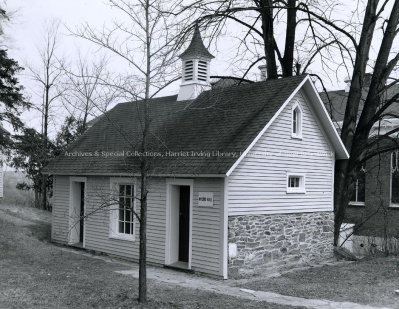
House No. 22 on The Golden Lane is situated in the Prague Castle. It is so called because in the 16th Century, the Emperor had a number of Alchemists trying to make gold. They were housed on this lane.

Kafka did not really live in this tiny house on this narrow lane – his sister did.

And she did not really live in this tiny house on this narrow lane – she rented it so she could have a place to meet her lover in secret.

The secret was necessary because her lover was a Christian.

So the house was vacant most of the time.

Enter Kafka. He  started to go there (at the suggestion of his sister) so he could have a place to be alone. Otherwise he would be with his parents, which was not conducive to either his (nor his sister’s) desires.

He never stayed the night, but was there most evenings for months. He wrote a whole book of short stories in his book The Country Doctor  while there.

I set a third of my novel about Kafka in this tiny house.
I’ve visited it.
Peered from the windows.
Looked up the stairs.
Ducked in the doorway.
When I was there while the country was still under Communist control, it was a book store.
But – Kafka being Kafkaesque long after death – none of his books were displayed.

From Kafka In The Castle

27 November 1916

Should I comment upon my unique and strange surroundings – this tiny house of Ottla’s. Not shared with a fiancée, but a sister. This place would not do for Felice, it is too small and too spare and too far from the heart of the city. But I feel secure against the winter. Up here in the castle.

As with all the tiny houses on Alchemist Lane, this one has its history of the quest for gold. Thus I fit right in, for I am after such purity.

29 November 1916

I like these walks up and down from the castle. I am surprised – and surprised because I am surprised. Perhaps I will sometime stay overnight, but I doubt it. It is Ottla’s house, and she should keep possession in appearance as well as fact. I impose as it is, which may be the right of an older brother, but not my wish. If it weren’t for Ottla, my life would be bleak beyond what I could bear.

27 December 1916

Ottla says I am staying here too late into the night. But she is implying more. I am certain she is soon to tell

me that I should stay in her tiny house all night. Sleep here. Have things prepared and ready so I could go directly to the office in the morning. But the office must be more than just distance from this place.

30 January 1917

What a storm. The storm of the year, perhaps. It was with difficulty that I came here today, and this might be the night when I shall actually stay. This tiny house, once it’s warm, is a perfect refuge. The winds howling along the Stag Moat, throwing snow at the window behind me, can easily put one back into Medieval times. Might someone have been where I am now – not with pen and paper – but tools and flasks, and elusive gold?  With questions and a quest?

DE

(image)https://rail.cc/img/loc/1/1331728884316e067a8fa1b029edac249de7ca0d2d.jpg

Deal With Writer’s Block And Don’t Hope To Die

writers-block-image-472jpg

An ounce of prevention is worth a pound of cure (even in metric).

I experienced over two month’s of writer’s block many a year ago. I did sit literally at my desk for hours, and can to this day accurately describe that desk. Its vision is before/behind my eyes as I key.

I have devised a scheme which I find is 90% successful in combating writer’s block.

Do not finish your thought on page or screen. Make sure it is solidly in your mind (make notes if necessary) but do not write it down. If it’s a description – don’t finish it. If it’s dialogue – don’t complete it. If it’s a line of poetry – don’t end it.

The next day, start off with the phrase you could have ended with yesterday. Read the preceding page, slide into the phrase not used, and the odds are excellent you will continue on your way.

DE

(image)http://www.hmhco.com/~/media/sites/home/media%20center/weblog/spark-a-story/writers-block/writers-block-image-472jpg.jpg?h=267&w=400&la=en

Birthdays Bring Thoughts And Pictures From The Past


399px-mccord_hall

(image)http://unbhistory.lib.unb.ca/images/thumb/2/22/Mccord_hall.jpg/399px-Mccord_hall.jpg

Birthdays make me (surprise) ponder the past.

My great friend and writing mentor, Nancy Bauer, as wise as the ears she sometimes writes about, in the past had mentioned the Past on Facebook. One of the responses to her comment spoke about our mutual times with a fluid writing group, in the gathering place fondly known as The Ice House.

That reminded me of this past blog of mine. It is centred around The Ice House and the passage of time. I’m sure Nancy, who writes a weekly newspaper column and has, occasionally, some trouble thinking of topics, will allow me to modify and steal from myself.

~~~~~~~~~~~~~~~~~~~~~

I came across an announcement today about a memorial reading for the Canadian poet, Alden Nowlan. One of my claims to fame is being mistaken for Alden – sadly three years after he died. Perhaps I had had a rough night the night before. At any rate, at this memorial reading a number of the readers are known to me and come from my ‘era’. One of the things some of us shared was that we were members of the same writing group. This group met on Tuesday nights for two to three hours, reading and commenting on each others work. Save for one Master’s Thesis that I know of, not enough has been written about this long-lasted group. And much could be written. Many notables passed through the door and many eventually-established authors emerged.

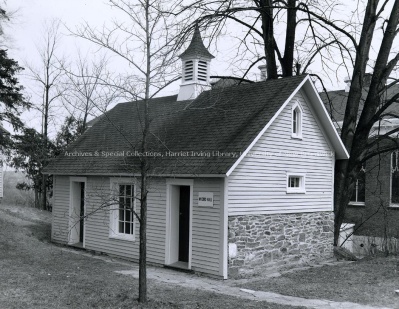
Although the building where we met had the proper name of McCord Hall, it was in fact the very old converted Ice House of the University of New Brunswick. It had been turned fancy with wooden beams and high windows and a long impressive wooden table. The Ice House is in current use as I speak, designated as an English Graduate seminar room. There is even coffee.


Indeed, just recently I wrote a brief story about the Ice House for a CBC contest. It went, in its entirety:

When the august Ice House Gang was in its writing heyday at the University of New Brunswick, the saintly Nancy Bauer was looked upon as our revered Mentor. She was calm and fair, even to the untutored and raunchy. Once, while one of our more seamy members was reading out-and-out pornography, I began to rub my foot against her leg. A look of confusion crossed her face and then, with a voice etched in acid, she loudly announced: “That Estey is feeling me up under the table.”

 
I did not win.

However, perhaps the reason is because of the following. This is part of the description of the memorial reading for Alden:

Along with Nowlan, former University of New Brunswick professor Bob Gibbs was a member of the “Ice House Gang”, a group of faculty members and writers who would gather in an old stone hut on College Hill.

I know much is in the eye of the beholder, but…

DE

Fame And Suicide – A One Way Voyage

doppelflinten-feinstes-doppel-aus-suhl_21

(image) http://www.merkel-die-jagd.de/uploads/tx_templavoila/doppelflinten-feinstes-doppel-aus-suhl_21.jpg

Fame And Suicide/Suicide and fame. The two flirt and then consummate often enough to make one take note.

If someone gets everything they hoped for … or wanted … or expected  … then there is not much left to live for.  Boredom aims the gun or ties the rope.

There are other factors, of course. We can never know another person well enough to tell how they think or feel. The majority of famous people do not remove themselves from this earth. A number of them indeed relish the attention.

More than mere success sent Virginia Woolf walking into the River Ouse.  Ernest Hemingway had personal demons aplenty when he reached for the shotgun.

However, these days Fame stalks those who are famous. Although a famous author does not attract the attention of a famous entertainer, or sports figure, or politician, an author’s fame spreads beyond the usual world of books and readings and tours.

Fame guarantees that attention must be paid. The media makes Fame supersede the reason for the fame. Fame is the elephant in the room, always poised to turn rogue.

Creating is difficult enough.

Creating is time-consuming enough.

Creating is isolating enough.

Fame magnifies all these things and sometimes ignites an unrelenting blaze.

DE

Second Bananas And Also-Rans Complete The Picture

20152bcollage

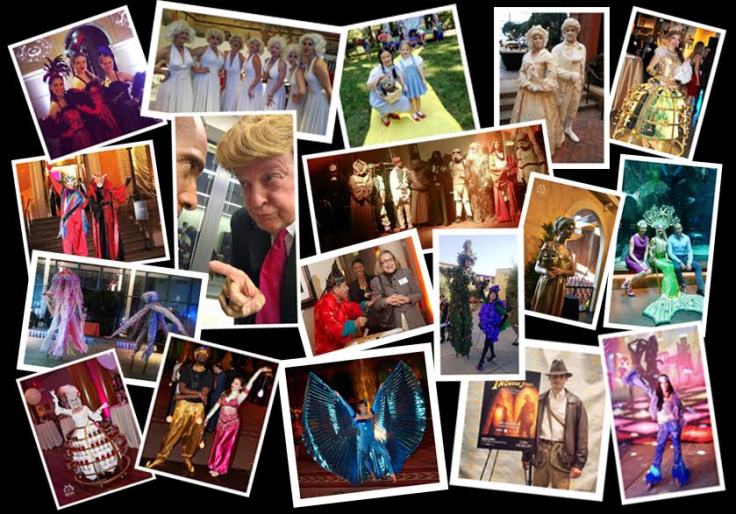
My onion novel, CHINA LILY, spans decades. My main family, the Cannaras, travel the globe (of their time, which is the Fourteen hundreds). Lots of time on ships. Lots of time on horseback.

In their distant locations over their diverse times they meet different people. These people fill the chapters they are in, but then they are gone. They are really secondary characters to the novel, but nothing could be accomplished without them. In their own time frame they are front-and-center.

This same situation happened in my *thriller*. The time frame was much different (squeezed into a few days). And the location was one city until near the end. But the nature of the immediacy and the surprising twists of plot and the intense action called upon the use of many secondary characters. They were figuratively press-ganged into action. They did their bit and were not called upon again. Louie-the-dog was to be a secondary character with a ‘walk on’ part. He stayed.

I am having a growing fascination for these secondary characters. They have to be developed within paragraphs instead of chapters. Their dialogue and thoughts have to be concise and unique from the start. They possess a freedom of action the main characters do not have. They are not loaded down with baggage. They are a challenge to write and difficult to rein in. They are generally saucy and rarely ponder their lot. Yet they must be real and not just plot devices. They have to be taken at face value and accepted quickly. They must stand out in the background.

A novel of only secondary characters – hmmmm . . .

DE

[image] https://3.bp.blogspot.com/-vZSuKHVPTpI/VsNpi-m3ekI/AAAAAAAAU7I/8JA_0K9LM_g/s1600/2015%2Bcollage.jpg

Turning A Novel Into Film – Characters On The Loose

screenplay_square

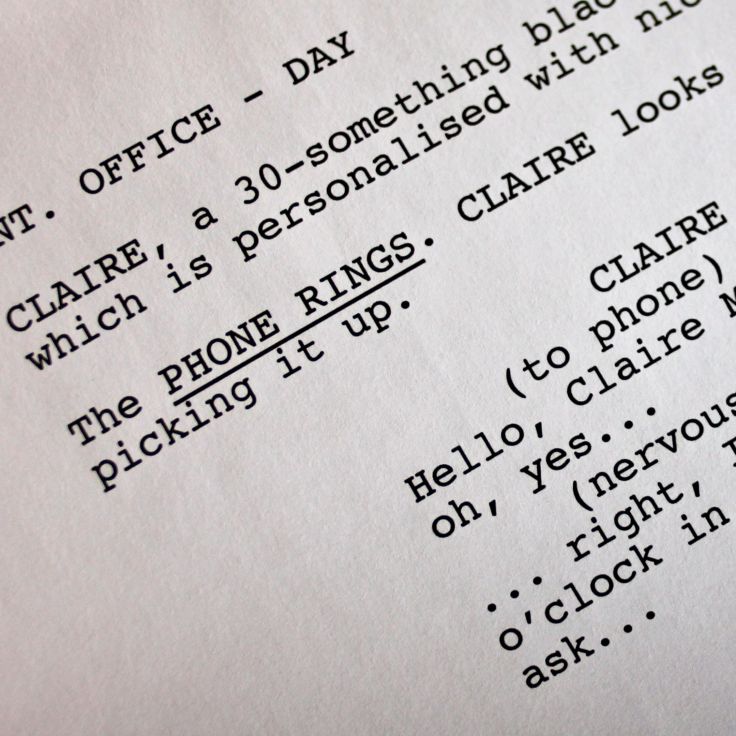
When adapting a novel manuscript to a film script, I realize it will take a whole host of other people to tell me how successful I might be. I’ve done this twice before, and realize that I must not only ignore my usual method of writing, but often go exactly against it.

I attempted to “learn” how to write for film. I read many instruction books, attended classes and workshops, and had meetings with people. I read many film scripts, which did help me accept the (to my eye) arcane format. But the one thing that actually turned me visual, was the comment of a writer/editor friend who said, after reading my attempt, “I can’t see it.”

That is, it did not cause visual action in her mind.

And I understood.

Perhaps the biggest hurdle is to accept that a movie is not a book, and that changes, additions and omissions will be necessary. As with a play, there is a finite time limit, that generally clocks in under two hours. The threads and plot points of a movie are different. And the characters (I swear) feel this freedom, and choose to accentuate other aspects of themselves than revealed in a novel.

The very fact their paragraphs of dialogue are best reduced to two or three lines makes them uppity. And because they can, in mere seconds, be in diverse locations, performing radically different actions, they become exact without apology. They don’t have to fill in the spaces.

The writer has to fill in the spaces however, and do so with visual stimulation. The transitions have to be swift and their descriptions exact. The road is always the fast lane and the characters kick the tires with gusto.

DE

(image) http://www.indiewire.com/wp-content/uploads/2014/11/screenplay_square.jpg

Eating Out In New York – Free Entertainment With Roller Skates

font-b-black-b-font-adult-double-font-b-roller-b-font-font-b-skates1

My friend, Google tells me that “over the transom” is still a viable term. In this case it refers to a manuscript accepted by an editor submitted cold – perhaps even from the dreaded slush pile.

At any rate, my manuscript for A Lost Tale was accepted “over the transom”, and I was asked to New York to meet the editor. Although I had experienced and appreciated Montréal, Toronto, London, Berlin and other large cities by that time, I had not been to New York. Many events of that trip are memorable, but none more than my “lunch” with the editor.

The editor took me to some dark and trendy place for a late lunch. There were not many people there and, restaurant fiend though I am, the food was not my top priority. Discussion of “the work” and proposed changes was more on the menu for me.

However, as I sit across the table from my editor, I can not help but notice a man seated by himself beside the wall. He is tieless and shirtless and, though the lighting is dim, what there is reflects from his naked skin. He sits with a beverage and seems to hum to himself. My editor is discussing both the menu and some confusion he perceives at the beginning of my novel. I note items on the menu unknown to me and am doubly confused.

The shirtless man at the other table increases the volume of his humming and eventually a waiter goes to him and has words. The shirtless man has words back, but they sound like gibberish. At my table the editor suggests something from the menu and I happily comply. There is wine.

Whilst I eat and listen to suggestions, the shirtless man is spoken to by two other waiters. As I (wisely) restrict myself to a second glass of wine, two uniformed policemen enter the restaurant and approach the shirtless man, whose gibberish had increased even more in volume. In the course of a few minutes three other uniformed police officers – one of them female  – arrive on the scene. They are now ranged around the shirtless man and his table. I finally tell my editor what is happening behind him and why I am not concentrating fully upon his suggestions. He turns around.

Two of the officers remove the table from in front of the shirtless man. Two others, one on each side of him, haul him to his feet. It is then that we see his shirtless state continues all the way to his naked feet. The female officer takes the tablecloth from the table and drapes it around him. The four male officers form a circle around the naked, shrouded man uttering his gibberish, and hustle him from the restaurant. The female officer picks up what appears to be a pile of clothes from beneath the table, and a pair of roller skates, and follows them.

I say to my editor that I have never seen anything like that.

My editor concurs.

DE

(image) http://g02.a.alicdn.com/kf/HTB1FsWuKFXXXXcrXXXXq6xXFXXXD/-font-b-Black-b-font-adult-double-font-b-roller-b-font-font-b-skates.jpg

Letter To Franz Kafka

19.09.2015

Dear F:

Though it will give you no pleasure (well, ‘little’ pleasure) you are correct in all your observations.

Governments become the tools of the bureaucracies that run them. It doesn’t matter what type of Government, from the monarchy under which you lived, to the right-wing horror of fascists that called themselves socialists, to the inept socialism pretending to be ‘for the people’. All three governments held sway over the city where you spent your life.  All three oppressed the people they ruled. All three looked after themselves first.

Writers are either writers or they aren’t. The urge to write encircles one like a snake around its prey. Feed it and it won’t quite squeeze you to death. You can not ignore it – even at your peril. It is with you every hour of every day, ever inquisitive and (sadly) always looking for something better.

Love is a see-saw of extremes. Every high guarantees a low. Every low reaches for a high. Every high reaches for a high. When these hills and valleys are eventually levelled, they are still desired.

Sex is highly over rated. The thing of it is, even rated fairly “’tis a consummation devoutly to be had”.  Yes – I know – you appreciate Shakespeare. On a par with Goethe, even if you can’t bring yourself to say the words.

People are just one damned thing after another. Of course, so many people have brought you blessings that you throw up you hands to ward off the snake. Sometimes loosening its grip.

There is no castle with walls thick enough to hide against the perils of being human.  Which is why you never tried.

Except the grave, of course.

Except the grave.

Yours,

DE

The Trial is over.

Create a free website or blog at WordPress.com.

Up ↑