Search

kafkaestblog

It is a whirlwind in here

Category

writing

History, Poetry And Religion In A Cathedral For Evensong

original-5584
[Bishop John Medley (John Fredericton)]
Yesterday a writing colleague, Robert Hawkes, launched his poetry book about a Nineteenth Century Anglican Bishop, John Medley. An intriguing aspect of the launch was that it occurred during an Evensong service, in the very cathedral  where Medley had been bishop.

I am so sorry to have missed the event, not just for the book launch, but because it was a part of Evensong.  My interest in this service is explained in the following blog, that I posted last year, around the time of Remembrance Day.

~~~~~~~~~~
An evening church service is a favourite of mine – even as a child. However, it has fallen out of favour and is no longer regularly offered.

Trusty Google helped me find one last Sunday. Not only an Evensong, but a Choral Evensong. And not only choral, but it was dedicated as a Remembrance Evensong. I was coming in, out of the cold, in style.

It was held in St. George’s Church – also know as the Round Church for its shape. www.roundchurch.ca

I had been in the church as a tourist, but not for years. A 5pm service in November got me there at dusk. It is a large church, complete with upper balconies. It is close in proximity to the Halifax naval yard, and I wondered if there would be some military presence. As it was, an officer in uniform read a lesson, while a military chaplain gave the sermon.

Not having been to an Evensong for decades, I don’t know if it was a large or small congregation. My guess is there were thirty or so people present, plus 10 in the choir, plus 2 ministers, 1 verger and the organist/choir director.

I would say that Evensong is a modified Morning service, perhaps more fitting for the time of day. In addition to a choral choir singing selections on their own, there were hymns that are favourites of mine. “Oh God, Our Help In Ages Past”  “Abide With Me” and three (3) stanzas of “God Save The Queen”. How close to heaven can one monarchist get?

As an added surprise (which would have made my father ecstatic) it was a High Church Anglican church, and even had incense. Perhaps that explained the choral choir.

At the end, after the procession had left, the large and booming organ belted out a selection by César Franck – Pièce Héroïque“. Members of the choir returned and sat in pews to listen.

When it was completed and people started to leave, I had a tiny ageist and sexist lapse. Two little, white-haired ladies got out of their pew to leave. Walking slowly before me, they talked of the music. I thought they were going to complain about the (admittedly) lengthy organ recital.

“Oh, that music,” said one.

“Yes,” said the other, nodding.

“It’s one of my favourite pieces.”

“I know what you mean.”

Finding The Right Hole To Live In

prague-ruelle-or-1

[Kafka’s Alchemist Lane “Burrow” with open door]

A burrow offers security and comfort.  Kafka found both in his sister’s tiny house on the Golden Lane.

The Golden Lane is a narrow, dead-end yet massively historic lane, hugging an interior wall of the huge Prague Castle. Centuries ago the small buildings along the lane housed workers of the Castle, including some resident alchemists. Thus the name.

Ottla – Kafka’s sister – had rented it so she could spend time with her lover, and not be bothered by parents and comments. Her lover was not only a Christian, but he was soon going to leave to fight in World War I. Time was precious. However, she rarely had opportunities to use it other than the weekends, so she offered Franz the use of the tiny house for most of the time. And use it he did, though he never stayed the night.

Through fall, winter and spring Kafka wrote a whole book of short stories there. For a single block of time, it was one of his most creative periods.

When I visited, under the Communist rule of the time, it had been converted to a book store. Of course (which he would have appreciated) there were no books by Kafka for sale. Today he is displayed in the windows.

It was only when I went thorough the small rooms, and looked out the window into The Stag Moat, that I realized how important the house would become in Kafka In The Castle, my novel about Kafka. It was cozy – even with the space cramped by tourists. It had been little altered. I could easily imagine Kafka looking through the same glass and walking through the same doorways. No doubt stooping because he was tall. Research met reality.

One of the last stories Kafka wrote, during his final year in Berlin, was called The Burrow. A version exists and is published, though a longer version is supposed to be among his ‘missing’ papers. In it a tiny animal keeps incessantly burrowing to keep away from an enemy. A vague noise convinces the animal to burrow deeper.

Yes – that’s Kafka.

DE

(image)https://www.avantgarde-prague.com/media/gallery/original/prague-ruelle-or-1.jpg

Ghosts

notecard_youngman_writingdesk

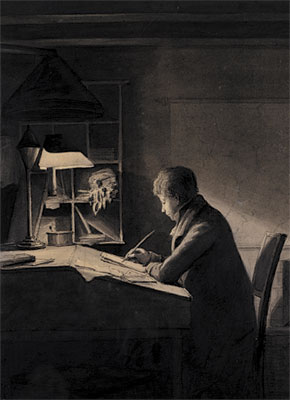
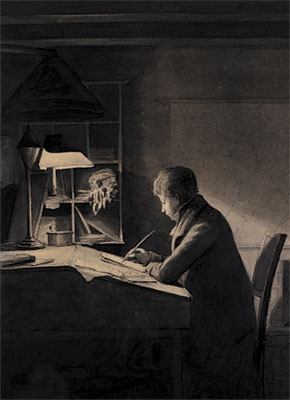
There are ghosts behind the ghosts.

There are legions of the dead,

Lined up to peer

Over my shoulder.

They breathe with satisfaction,

Upon the hand

That writes the word

Ghosts.

The millions of departed,

Disturb the air enough,

To stir the hair,

On my moving wrist.

They keep a place in line,

Patiently waiting,

For me to join them.


DE

(image)http://www.themorgan.org/sites/default/files/images/shop/notecard_YoungMan_WritingDesk.jpg

Writer Zombie Meme Takes A New Twist

40cf4e788d01c8cc4ef12bcc6f3abf4d

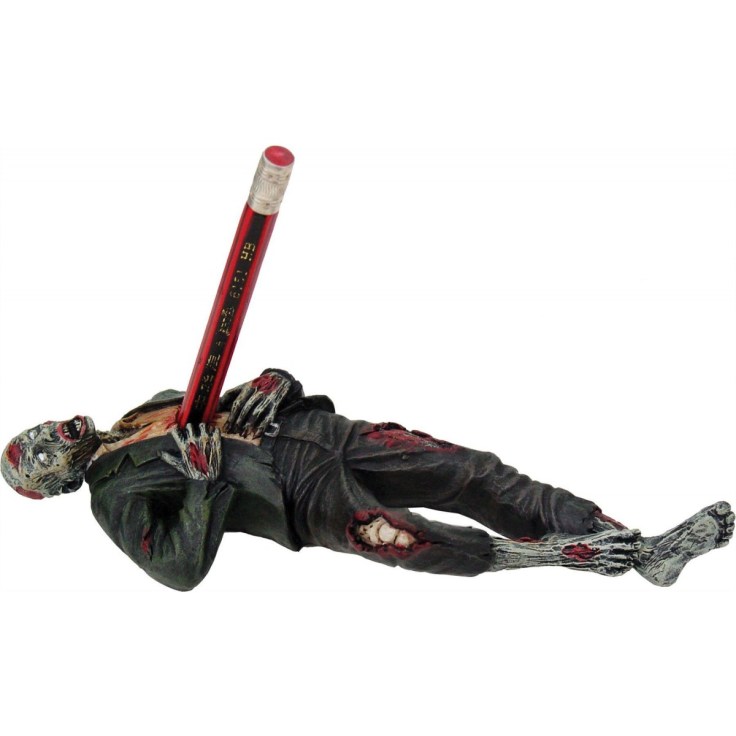
I’m not sure why people approach me on the street with the conviction I’m a writer. This has happened a number of times, out – as they say – of the blue. When I ask why they think so, they become defensive. I have learned just to say ‘yes’ and let the conversation meander from there.

Of course, when I give readings or lectures or talks, it is to be expected that I’m a writer. That’s why I’m there. Even if I don’t wear a name tag (which I dislike with passion). I believe I’ve learned not to read too long (regardless of the great material), but I can chat and answer questions about writing until the cows come home to roost. Clichés with a twist a speciality.

In addition to being narrowed-in on as a writer, I have been mistaken for dead authors. In this situation I do believe I must make some comment. For the sake of the dead as well as myself. Although I believe I can still make a good impression as a person who is alive, even here I have run into trouble. A taxi driver did not want to believe that the writer he mistook me for was dead.

“I never heard that,” said he.

“It’s true.”

“Are you sure?”

“He’s been dead for years.”

“You look just like him.”

“Not in his present state,” said I.

The taxi driver did not find me humorous.

A few days ago, however, a new wrinkle was added to my apparent Zombie life.

I was sitting on a park bench,waiting for a bus and watching the bustle of the city pass by. A man of middle years, puffing on a Vapour, settled on a bench across from me. After a few additional puffs, he stated – not asked –

“You’re a writer.”

“Because I’m using a pen?” (which I was, though I was fiddling with sums)

“Who did you write for?”
“Write for?”
“Between 1959 and 1966.”
“What do you mean, ‘who’?”
“Where would I have seen you?”
“Do you know who I am?”
“You know what I mean.”
“I wrote for some newspapers back then.”
“No – not that.”
“But that’s what I did.”
“When you worked for Hemingway.”
“Earnest Hemingway?”
“I’ve read his books?”
“Oh.”
“You edited his books.”
“I did?”
“You were his editor.”
“I would have been too young to be able to do that.”
“What book did you like?”
“Of Hemingway?”
“You know – which one?’
“I’d guess The Old Man And The Sea.”
“People say that. They’re wrong!”
“They are?”
“It’s a terrible book.”
 
To prove there is a God, my bus arrived.
DE

Kafka Uses The Internet To Prod Me Back To Work

livros-franz-kafka-espanhol-download-gratis-noticias

[Franz Kafka]

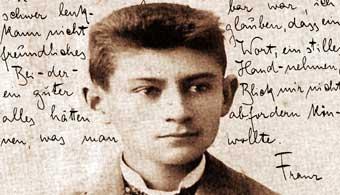
This is saying a lot for Kafka who, in truth, was not even much of a fan of the typewriter. But, he was a constant writer (even if he destroyed – it is estimated – 75% of what he wrote) and certainly expected any other author to be the same.

At any rate, coupled with a bit of travel, I had not written for ten days. It is possible that I have not gone that long a stretch for years. For the last couple of years I had been writing six days a week, rarely missing that amount. I think that in the last few months, writing an original novel and editing another on a daily basis did me in.

But, earlier this week, on the same day, I received the same article in an email and on Facebook. It was a short section of Kafka Diary entries. Real ones (I say this because I have written a novel where I fill in some *missing* Kafka diary entries). It was directed to writers, and commented about some aspects of writing. The one that leapt out at me was:

March 11  How time flies; another ten days and I have achieved nothing.It doesn’t come off. A page now and then is successful, but I can’t keep it up, the next day I’m powerless.

I generally think I can take a hint. And a hint given twice. And a hint from Kafka. And a hint given decades after he is dead, via a medium (pun intended) that Kafka would despise.

So – I took the hint.

A page a day since then.

And onward —>>>

DE


The Mask Of Death Leads To Sundry Places

[Death Mask of the Duke of Wellington]wellington-death-mask

My two gals, Alison Alexandra and her friend, Amanda, are on a sea voyage. A voyage via a freighter, and not a cruise ship. They stop in the ports where the freighter stops, and they take visits of the town if they so desire.

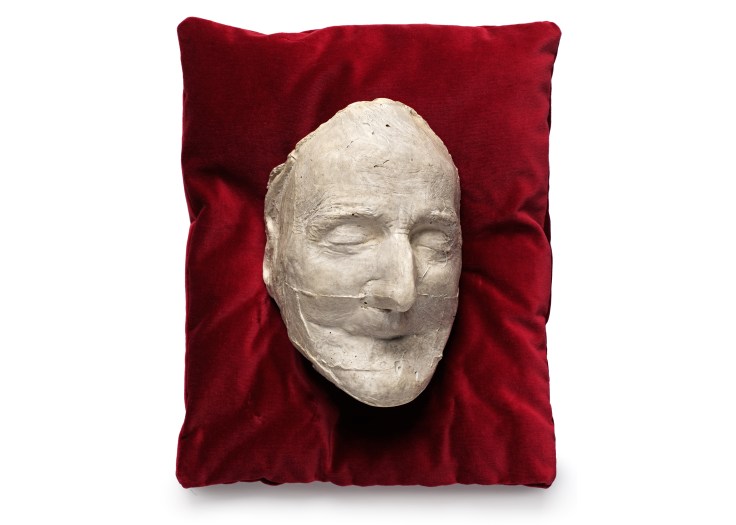
On one of their times on shore, they decide to visit a Police Museum. One of the exhibits is a Death Mask of a hanged murderer. They take great interest in this, noting the repose of the face.

This incident is based on an event in my own life. I melded parts of my experience into my characters afternoon visit during their day ashore. This had not been on my mind when I started this particular chapter.
I once taught a workshop on Supernatural writing. For my workshop I took advantage to take my students on a field trip to see the death mask of a historically known poet. The death mask was conveniently on view in a display case in a near-by building.

None of them had even heard of ‘death masks’, let alone seen one. I invited them to

incorporate the idea into their writing exercises. Some did, some did not.

However, it’s possible this visit to Death elicited the following story from one of my students.

My student and her husband had purchased a new house. Cleaning and renovations eventually took them to the back loft area, which was piled high with decades of accumulated detritus from a long life.

They cleared out beds, and boxes and newspaper piles, and magazines, and bundles of clothes, and on and on. Near the end of this process, my student noticed a “clump of something” on one of the wooden beams of the loft.

Getting ladder and flashlight, her husband climbed to see what it was.

It was the end of a number of knotted bed sheets.

DE

Fame Helps Tie The Rope For Suicide

coiled-up-rope-with-hangmans-noose

Fame and suicide.

Suicide and fame.

The two flirt, and  consummate their relationship often enough to make others take note.

If someone gets everything they hope for,

or want,

or expect,

 there is not much left to live for. 

Boredom ties the rope.

There are other factors, of course. We can never know another person well enough to tell how they think or feel. The majority of famous people do not remove themselves from this earth. Indeed, a large number of them  relish the attention. More than mere success sent Virginia Woolf walking into the River Ouse. Ernest Hemingway had personal demons aplenty.

These days, Fame stalks those who are famous.

Although a famous author does not attract the attention of a famous entertainer, or sports figure, or politician, an author’s fame spreads beyond the usual world of books and readings and tours.

Fame guarantees attention must be paid. The media makes Fame supersede the reason for the fame. Fame is the elephant in the room, always poised to turn rogue.

Creating is difficult enough.

Creating is time-consuming enough.

Creating is isolating enough.

Fame magnifies all these things, and sometimes ignites an unrelenting blaze.

DE

(image)http://www.catholicmannight.com/wp-content/uploads/2013/03/Coiled-up-rope-with-hangmans-noose.jpg

Of An Age And Still Keeping On Trucking

ea31e6ab3e7ec52fc033935fe3c02d14

I wrote the previous blog  about Bertha Klausner a little over a year ago. I found it interesting (indeed, find it interesting), to have some connections to a more distant literary tradition – no matter how tenuous.

So, maybe I come close today, as I just had a response by another literary agent. I had no idea of his tenure in the fields of getting the written word published. Not that I still would not have sent the query letter.

Dear Dale,

Thank you for submitting your materials to *********** for review.  However, after considering them, we have decided that your project is not something we can successfully represent at this time.  At 85, *********** needs to be selective about the projects he takes on and he has more than enough on his plate.  But I wish you good luck finding representation and a publisher for this. 

All the best,

********* (assistant)


~~~~~~~~~~~~~~~~~~~~~~~~~~~~~~~~~~~~~~~

Eleanor Roosevelt,Upton Sinclair, Fidel Castro & Me

While reading some literary site about Amazon, I came across the fact that “Harriet Klausner, an esteemed Amazon reviewer who wrote more than 31,000 book reviews, died”. All power to her, thought I, that is quite a feat. However, I took more note of her last name, one I had not thought of for a long time. Eleanor Roosevelt,Upton Sinclair, Fidel Castro & Me

In my tenure as an author in the world, I have had four or five agents. And I am currently looking anew. At the far beginning of my time, before I was published, I had the New York agent Bertha Klausner – at the start of my career and near the end of hers. She started her agency before I was born and was working two months before she died in 1998 at the age of 96.

Back in those over the transom days, one stuffed typed pages into an envelope, sent them off with return postage on another envelope, and waited up to three months for a reply. And when it came back, you sent it out again. One of my envelopes went to the Bertha Klausner Agency.

However, when it came back, it had other people’s manuscripts in it, and (to my memory) little hand written notes politely saying no. Mistakes happen even at revered agencies, so I sent it all back explaining what had happened. She replied, with neither apology nor thanks, annoyed that mistakes do happen and adding, “Say, you must have something. Do you want to send it to me?” Which I did. Again.

As I said, communications were through slow mails (slow on her side, as with literary agents to this day).  I now assume she initially was both being polite, plus did see some promise in what I had. But after a year or so she said – in effect – ‘thanks but no thanks’, and I sent things to other agents, and eventually had my first novel sale by, indeed, sending it over the transom directly to an editor in New York, who purchased it.

I don’t think I knew that Bertha Klausner had such a stellar career until I looked her up. An agent for decades, she had famous names like Upton Sinclair, Israel J Singer, Eleanor Roosevelt and Fidel Castro. She even represented actor Basil Rathbone.

I imagine I would have become a lost tale.

DE

(image)https://s-media-cache-ak0.pinimg.com/564x/ea/31/e6/ea31e6ab3e7ec52fc033935fe3c02d14.jpg

When Writing Spooks Television

81-e23a9f4fb2887
I am currently writing a *perhaps* novel (that is, perhaps it will be a novel), though I suppose  I should find out if it is a novel since I just passed the 200 page point.

In my current project, following the escapades of Alison Alexandra (entitled Stones for short), my erstwhile activist, Alison Alexandra, is a passenger on a freighter (that takes a limited number of passengers) as it delivers goods from port to port.

I’ve done a fair amount of online research into these freighter cruises as I, myself, would much prefer such a trip over the very crowded (and expensive) Cruise Lines.  But, I will research anywhere that might help my cause. So, a couple of nights ago, on television, there was a documentary about the most recent, largest, and most extravagant Cruise Ship as yet built.

I was very interested in following its construction. I was also very interested in seeing how it was run, taking into consideration the thousands of people who had to be tended to. The delivery of provisions, the kitchens, and the massive amount of work necessary to clear out thousands of folk and then greet thousands of folk on the same day, was fascinating. Not a freighter by any standard, but basic principles were the same.

Then the documentary followed the ship on its first cruise.

Now, back to my reality. At the same time as writing original material about Alison Alexandra, I have been putting a hand-written manuscript of a novel finished a number of years ago into the computer. I do one thing in the morning, and the other in the evening. So far – no problems have arisen.

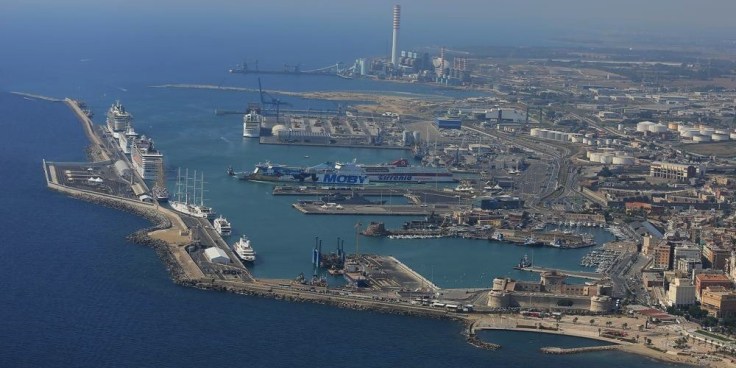
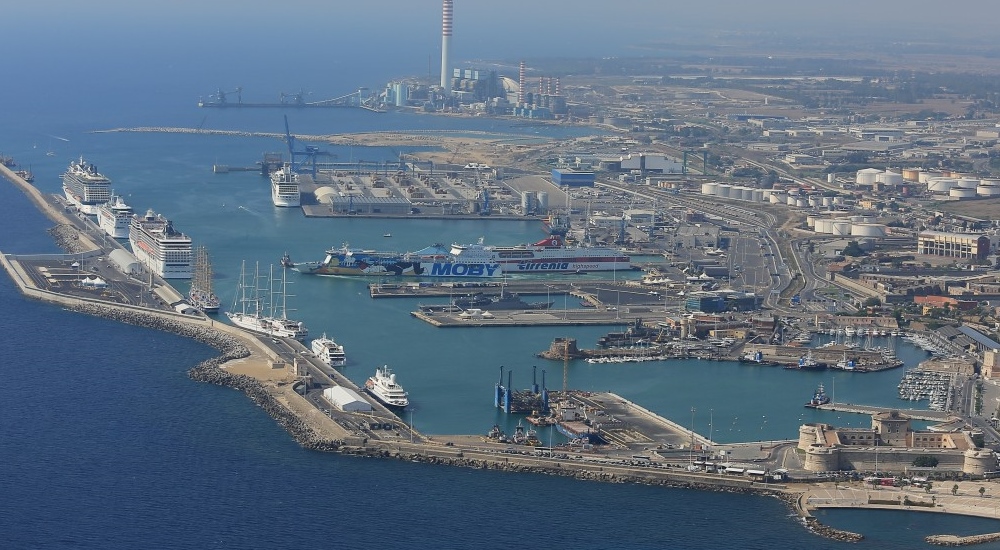
My hand-written manuscript is set in the 1300’s. The first part depicts a two year voyage from Italy to China and back. Both the voyage and events in China are described. And then, the arrival back to Italy. For four straight days, I have been transcribing the docking and aftermath of the ship at Civitavecchia, Italy. It is the closest seaport to Rome.

On television, before my eyes, after a day of writing, the Cruise Ship I had watched from inception to voyage, pulled into the port of Civitavecchia.

Maybe I should take a cruise.
 

DE

Civitavecchia (image)http://www.cruisemapper.com/images/ports/81-e23a9f4fb2887.jpg

Create a free website or blog at WordPress.com.

Up ↑