Search

kafkaestblog

It is a whirlwind in here

Category

short story

Kafka Performed On The Theremin By Carolina Eyck

Why – yes – yes, this is heaven on earth. Let the music soar.

Dalit Warshaw on BMOP (CD Review)
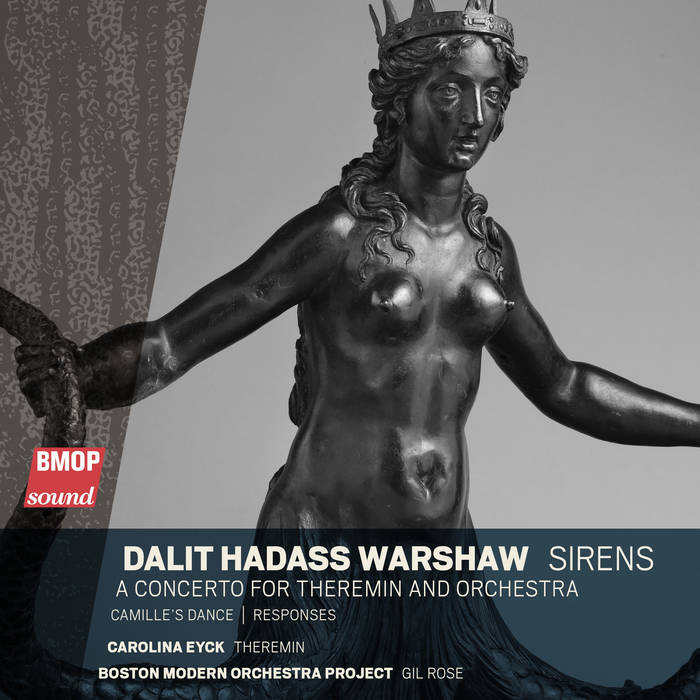
by Christian Carey

Dalit Warshaw

Sirens

Carolina Eyck, theremin

Boston Modern Orchestra Project, Gil Rose, conductor

Dalit Warshaw (b. 1974) is a multi-threat artist. As a composer and pianist, she has created a distinguished career. Her first orchestra piece was commissioned when she was eight years old, and this prodigious distinction has been followed by a body of work that encompasses music for orchestra, chamber ensembles, vocalists, choruses, and Letters of Mademoiselle (2018), a staged song cycle for the talented soprano Nancy Allen Lundy. 

The theremin has become an important part of her work. Warshaw has performed the instrument in high profile settings, including appearances with the New York Philharmonic. Sirens is a recording of her theremin concerto and two other orchestral pieces, performed by the Boston Modern Orchestra Project, conducted by Gil Rose. 

Responses (2016) is a triptych that reflects upon three of Brahms’s Intermezzos, piano repertoire that Warshaw has studied. Originally composed for solo piano and performed by Warshaw, it has been transformed into a work for large forces that sounds idiomatic in its instrumental writing. Indeed, Warshaw’s orchestration deftly captures both the sehnsucht of romanticism and her own aesthetic, which encompasses both neo-classical and mainstream contemporary classical elements. While the pieces themselves are earnestly serious (as was Brahms in his later years), one can have a bit of fun with the following listening game: without hunting down program notes, see if you can figure out from which intermezzo each movement takes its inspiration. 

Camille’s Dance (2000) is named after visual artist Camille Claudel, whose sculptures La Valse and La Fortune grace the cover and interior of the BMOP recording’s booklet. It is a stirring piece, rife with dissonant harmonies and muscular gestures that epitomize the striking characters depicted in Claudel’s sculptures, as well as her fraught relationship with Auguste Rodin. 

The soloist for Sirens is the thereminist Carolina Eyck. It is a three movement work that is inspired by Clara Rockmore and, of course, by the singing duo of temptresses found in Homer’s Odyssey, seen through the vantage point of Franz Kafka’s parable “The Silence of the Sirens.” The theremin was taken seriously as an instrument in part because of Rockmore’s advocacy. Eyck has explored an expansion of its capabilities with the Etherwave Pro instrument, which has an extended bass range. She also uses octave pedals to further extend the theremin’s compass. 

Rockmore’s first instrument was the violin, and her theremin performances reflected this; several of the pieces in her repertoire were transcriptions of violin repertoire. Thus, the opening movement of Sirens is titled “Clara’s Violin,” which includes thematic material based on her life story and also themes that are ciphers of names: Clara, Leon Theremin, her partner and the inventor of the eponymous instrument, and the KGB, whose agents hounded and even kidnapped Theremin. One needn’t know any of this to appreciate the abundant vitality and craft of the movement. Warshaw’s own experience as a thereminist and her close collaboration with Eyck have yielded a versatile and challenging solo part that belies the notion of the instrument as being limited to special effects and transcriptions. 

The second movement uses the Kafka story as a touchstone, with a stirring duo between theremin and piano that reminds us of the two-against-one scenario that Odysseus endured.  The third movement is a wild ride with glissandos galore, a theremin specialty, set alongside a fugue that once again employs ciphers of names as its thematic material: “Theremin” as its subject, with “Clara” and “Dalit” used as two countersubjects. The combination of these two elements shows Eyck and her bespoke electronics to best advantage. It also highlights the extraordinary facility of BMOP’s musicians. Careful preparation and the dynamic leadership of Rose are clear in the performances of all three of the programmed pieces, but the jubilation with which the concerto is rendered makes it a strong finale to a thoroughly engaging recording. Recommended. 

-Christian Carey

Interview with composer Dalit Warshaw

wmht.org/blogs/classical/dalit-warshaw-on-sirens-concerto/

AND LISTEN:

Bedford the Cat Goes Reluctantly Into A Christmas Eve Storm

Bedford the Cat had been stuck inna house for three days. He did not take heed (really) to the explanation that it was -17C with a windchill, and iffen he went out, he would freeze off his ears. He complained and sulked and batted the tree ornaments. Oh, yes – and sulked.


But this morning, the temperature was reasonable (even for thin ears) and his kindly humans decided he could skedaddle into the outside. However, when the door was opened, he was met by a howling snowstorm. Howling loud enough to almost – almost – drown out his howls of complaint.


“This is it, kitty cat,” said one of the kindly humans

Get your arse in gear,” said the other.
For, you see, the kindly humans had already rugged themselves up – hats, scarves and mittens – and that darn cat was going out.

And out he went.


Now, the kindly humans were not so kind that they planned to stay out long. Only long enough, for Bedford the Cat to get a decent run of exercise, and (with luck) desire on his lonesome to go back in.
Well, down the street he trotted, taking some time to bat at snowflakes. And then he reached the end of the street where the fence is, and looked around, and sniffed the air, and then, in the blizzard, took a great, heartfelt, and long-lasting poop.

Although Bedford-the-Cat had adequate facilities inna house, it looked as iffen he had not utilized them. And after this triumph of satisfaction, he proceeded to cover it all up.


And then he proceeded on his usual way. This is along a rough little road, with trees and a field and bushes to explore. There are also two abandoned vehicles near the other end, and he went under each in turn to get out of the storm.


Then, Bedford the Cat came to a narrow lane, which leads up a hill on the way back to the house, where he had been HELD A PRISONER for three days, so his ears wouldn’t fall off.


He was now more used to the blizzard, and took some time to sniff under favourite trees, and look into a backyard to see if his friend, the orange cat, was there. Then he sensed where a more familiar trail might be, under the snow, and went in that direction. He was back near his house, so his kindly humans let him be, and beat their fearless way back to the house themselves.


In about ten minutes, Bedford the Cat was himself at the front door, letting his humans know it was time to open the door. His benevolent humans did as requested.


Bedford the Cat went to his food dish, got a bit of food and a bit of a treat, and went for some rest on the couch.
Bedford the Cat has not indicated a desire to go out since.


DE

Why Do Butterflies Die?

Adapted from “The Elephant Talks To God” ~ Dale Estey

“God, can I ask you a question?”

“Everyone else does,” said God. “What have you got for me this time?”

“It’s about the butterflies.”

“Yes?”

“How come they live for just a season?” The elephant looked down to the ground, then back to the cloud. “They’re so beautiful and so light . . . and friendly. And they do a great job of taking pollen everywhere and helping the flowers and plants. Why, they’re even making sure there is going to be food for me, isn’t that right?”

That’s right,” answered the cloud. “From the butterfly to you with a few extra stages thrown in.”

“So why do they die so soon?”

“Butterflies don’t live a season,” said God. “They live a life.”

“But they’re gone when . . .”

“They’re gone when it’s their time,” answered the cloud. “To a butterfly the season is their life. They expect nothing more and fulfill their existence. To the trees, your life is brief.”

“You mean the butterfly thinks of its season like I think of my years?”

“Seconds or hours, long shadows or short, it’s all the same kind of time,’ said God. “The butterfly feels he has as long a life as you.”

“Really?” asked the elephant.

“Yes,” said God.

“I’m glad,” said the elephant.

And then God spoke to the elephant, and called him by his name, and filled his heart full of his beloved butterflies, and they soared through his blood, wing tip to wing tip, until he understood the power of their life.

The Pagan And Jesus Christmas Has Stood The Test Of Time

Christmas is a fake that has taken root like the holly. It survives tenaciously. It has become a goodies grab fest, and helps keep our commercial society stable. Perhaps reason enough to exist.

The wily Christians conquered the outnumbered Celts, and supplanted their winter festival with the birth of their God. The wily pagans live on in the numerous traditions the Christians stole, so perhaps it is a fair trade. And no doubt those wily pagans chuckle over their cups of mead, noting that this celebration of reverence has become a surfeit of greed.

I have been no fan of Christmas for decades, but its mixed legacy encourages me not to abandon it. My Christian background enhances my enjoyment of the music and traditions. Most commercial intrusions can be muted or turned off. I do have some personal traditions I follow religiously.

I do not even rail against Santa Claus. I heard his sleigh bells one Christmas Eve, when I was four. I saw his sleigh runner tracks in the snow a couple of years later.

I have even been mistaken for Santa Claus a couple of times.

Once, in the line-up in a bank near Christmas, a two-year old pointed at me. Unfortunately, my presence terrified him, and he started to scream and cry. I was wise enough not to go Ho Ho Ho.

Another time – but this happened in early fall – a family approached me as I walked in a park. A boy, who looked to be six or seven, stopped in his tracks, then ran back to his parents. “Santa Claus!”  He pointed. Happily he did not cry. They walked past me in silence.

Also, for decades, I lived close to a residence where one of the very first recitations of ‘Twas The Night Before Christmas happened. The author of that stirring piece, Clement Moore, who wrote it in 1822, sent a copy to his godfather, the Rev Johnathan O’Dell, of New Brunswick. However, the poem was not published until 1837.

And, most recently, I heeded the whims of Christmas Present, who snicked me up the side of the head in a grocery store. I went looking for milk, as the in-store sound system blared “I Saw Mommy Kissing Santa Claus”. When I took out my container of 2% partially skimmed milk, and looked at the best by date, it said December 24. Christmas Eve. Still magical after all these years.

I hummed along about Mommy and Santa and then purchased a personal Christmas treat, which I would normally get a week before the day. Italian Panettone Classico, a fruit cake chock-a-block full of raisins, candied orange peel, eggs and sourdough and (they tell me) natural flavour. I have already had a generous slice.

Why wait for Christmas?

To show I am not a total Scrooge, I have written some Christmas tales.  Here is a wee segment from The Elephant Talks To God:

~~~~~~~~~~~~~~~~~~~~~~~~~~~~~~~

“I want to see you,” said the elephant, and the words raced from his mouth. “I don’t have to see you, you know that. I’ve believed even before you talked to me. But I want to see you, it would mean so much. I wasn’t around for the Baby, but cows and sheep and things got to see Him. I can’t explain but it would … “

“Go home,” said the cloud.

“You’re not angry with me?” said the elephant.

“No.” The cloud started moving away. “It’s an honest request.” The rain stopped falling. “Thank you for coming.”

“You’re welcome,” said the elephant.

“Sing some carols,” the voice was distant. “I like them.”

The elephant turned and started through the woods. He ignored the tasty leaves within easy reach and the tall grass near the brook. He wanted to get home as quickly as possible so he could join the singing he knew was happening later in the evening.

He turned along the trail, snapping a branch here and there in his haste, when he noticed the stillness, the hush which had overtaken the forest. He slowed down and then stopped in his tracks. He turned his head, his small eyes squinting into the brush. There was movement coming toward him, and when the trees parted, he went to his knees with a gasp. Tears rolled from his eyes, and a golden trunk gently wiped them away.

DE

Circles Continue To Be The Answer . . . To So Many Questions

5e9006cb86c3456ba85963ccc03183d9

Perhaps it is circular, but this observation (from an – admittedly – unreliable observer in one of my short stories) has been a constantly popular post over the last few years. Yes – it has even surpassed interest in Franz Kafka. .So I’ll give it another turn

~~~~~~~~~~~~~~~~~~~~~~~~~~~~~

“Circles are the answer.

“Just look at any circle and you’ll see what I mean. Of course, no one else is to know about the circles. They must be very stupid if they can’t see something so obvious.

“Yet, you get hints, don’t you – all the time out there. And in your own life – the way things happen so you never get anywhere. Never change.

“The earth, of course, and the sun – well, that’s something you can see. Either way you look at it, the one goes around the other in a big circle that takes in the whole sky. And the earth and the sun and the moon are round  – all circles in their own right. So you have circles which are going around in circles, if you get my meaning.

“And if you look further – reach out into the universe as far as you can go – they tell us that everything is going around everything else. Smaller circles and elongated circles which take in such large distances that numbers become forgotten.

“Now, this means that everything, eventually, comes back upon itself. The beginning is really the end. That’s what most people would think – and that’s where they make their mistake.

“You see, things don’t start by beginning – they start by ending. It’s the end which comes first in a circle, so, instead of going back to where it started, it comes back to its end.

“That explains it.”

(image) https:////g2.img-dpreview.com/5E9006CB86C3456BA85963CCC03183D9.jpg

Circles Are The Answer – Let The Universe Prove It

5e9006cb86c3456ba85963ccc03183d9

For some reason, this observation (from – perhaps – an unreliable observer from one of my short stories) has been the most popular post of the last couple of years. Yes – even beating out Kafka. So I’ll give it another turn

~~~~~~~~~~~~~~~~~~~~~~~~~~~~~

“Circles are the answer.

“Just look at any circle and you’ll see what I mean. Of course, no one else is to know about the circles. They must be very stupid if they can’t see something so obvious.

“Yet, you get hints, don’t you – all the time out there. And in your own life – the way things happen so you never get anywhere. Never change.

“The earth, of course, and the sun – well, that’s something you can see. Either way you look at it, the one goes around the other in a big circle that takes in the whole sky. And the earth and the sun and the moon are round  – all circles in their own right. So you have circles which are going around in circles, if you get my meaning.

“And if you look further – reach out into the universe as far as you can go – they tell us that everything is going around everything else. Smaller circles and elongated circles which take in such large distances that numbers become forgotten.

“Now, this means that everything, eventually, comes back upon itself. The beginning is really the end. That’s what most people would think – and that’s where they make their mistake.

“You see, things don’t start by beginning – they start by ending. It’s the end which comes first in a circle, so, instead of going back to where it started, it comes back to its end.

“That explains it.”


(image) https:////g2.img-dpreview.com/5E9006CB86C3456BA85963CCC03183D9.jpg

Rules For Writing + One Non-Rule Rule

34743456922_7b4deab196_b

1: Write regularly. Daily might be extreme, but try to be extreme.
2: When in doubt / take it out.
3: At the end of your writing day, do not complete the action/description/dialogue – but know what it is. Start with this known at your next writing time. 90% of the time you will slide right back into the work.

4: Eschew, Ignore and Abandon All Hope Ye Who Enter Here, the notion that there are no rules. There are rules to everything. Artistic Creation demands rules.

5: Follow your characters.
6: Follow your characters.
7: Follow your characters.


(image) https:/c1.staticflickr.com/5/4252/34743456922_7b4deab196_b.jpg

Rules For Writing Fiction

writing-research-brief383109052

1: Write regularly. Daily might be extreme, but try to be extreme.
2: When in doubt / take it out.
3: At the end of your writing day, do not complete the action/description/dialogue – but know what it is. Start with this known at your next writing time. 90% of the time you will slide right back into the work.
4: Follow your characters.
5: Follow your characters.
6: Follow your characters.

[image] https://www.marketingdonut.co.uk/sites/default/files/writing-research-brief383109052.jpg

It Always Ends In Kafka

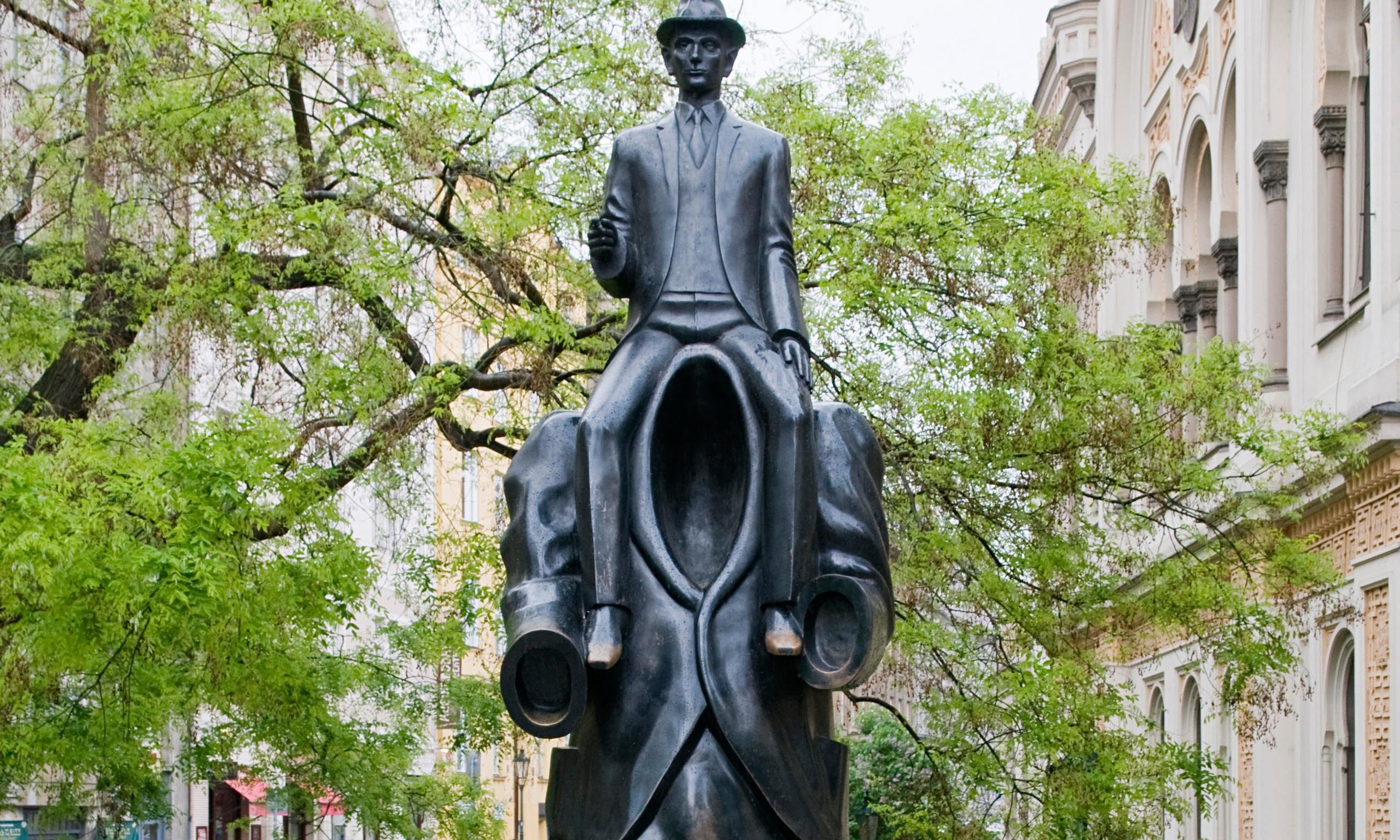
Statue of Franz Kafka

A short story:

The old Rabbi moved slightly on his bed, and the young man raced over.

     “Yes, Rebbe?”

     The old Rabbi opened his eyes, showing the cast of death which had almost consumed him. “Ka … ” he groaned.

    The young man had been told the dying Rabbi would never regain his senses, and he did not know what to do. He was scared, almost horrified, but he leaned closer.

     “What is it? What do you want?”

     The old Rabbi struggled for breath. “Ka … Kaf …”

     The young man gazed at the face, saw its pallid features and the clouded eyes. He touched a shrunken cheek, raised his voice to a shout. “What is it? What can I do?” He could hear wheezing, the struggle for air. He put his ear directly over the gaping mouth.

    “Ka … Ka …” One last ragged breath, a low hollow whisper. “Kafka died for your sins.”

Create a free website or blog at WordPress.com.

Up ↑