Search

kafkaestblog

It is a whirlwind in here

Category

Prague

It Is A Grave Thing To Be Dead


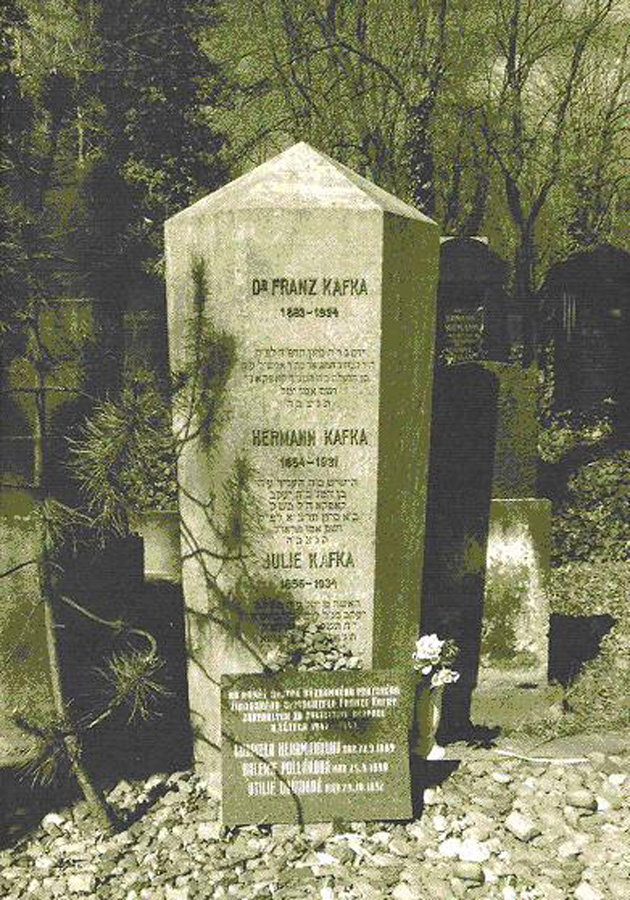
kafka-photo-grave-300dpi-4c5c1958

(image)http://zeek.forward.com/workspace/uploads/kafka-photo-grave-300dpi-4c5c1958.jpg

I enjoy graveyards, and peruse them with vigour. It’s true I don’t plan to spend the rest of my life in them, but, after that …

So, I have many tales of cemeteries to tell. Hardly any are scary because, contrary to popular depiction, graveyards are not haunted. Unless one happens to die in one (or – worse yet – die after being buried in one), there are no lingering spirits to haunt. Graveyards are a place, however, to go and contemplate those buried there. I am planning for myself a grand mausoleum.

While researching my novel about Franz Kafka, I went to Prague. In those days it was still under communist subjugation, and travel in and out of Czechoslovakia, to say nothing of travelling the country, was complicated and dangerous. I was fortunate to have arrangements to stay with a Czech academic and his nuclear scientist wife while in Prague. They had a social standing which facilitated an easier visit.

Unknown to me upon arrival, the academic was an amateur historian. When he found the major thrust of my visit concerned Kafka, he was full of places to visit. Many of them I did not know about, and others I doubt I would have found on my own. For instance, he took me to the small house where Kafka had lived on Alchemist Lane, which eventually became the setting for half of my novel. Even though Kafka was in disfavour at the time, the house was noted for the fact he lived there, and it was on tourists lists. In a Kafkaesque twist, it was even then a bookstore, but none of his books were allowed on the shelves.

One of the places I was taken was to Kafka’s grave. It is situated nowhere near where Kafka lived his life, but is in a huge Jewish graveyard on the outskirts of the city. It took nearly an hour on the subway to reach the area. And then a walk to the graveyard itself. And then a walk through the graveyard, though the way to Kafka’s grave was signed. I would never have thought of trying to get there myself.

Kafka is buried with his mother and father (though, literally, vice versa, as he died first). It is only years after the fact that I read about the drama of his death, and the drama at the graveside. His young lover, Dora, who had spent the last year of his life with him, attempted to leap into the grave. She had to be restrained by Kafka’s best friend, Max Brod.

I lingered a long time – perhaps a half hour – by the grave. In the Jewish tradition I left a stone upon the gravestone. In my own twist, I also left a pen. And, because there were few about, and I was so moved, I lay down upon the grave itself.

DE

Kafka Sweeps Away Dust, Gold And War [from: Kafka In The Castle]

objects-of-use-chinese-broom-remodelista-518x600

27 November 1916

Should I comment upon my unique and strange surroundings – this tiny house of Ottla’s. Not shared with a fiancée, but a sister. This place would not do for Felice, it is too small and too spare and too far from the heart of the city. But I feel secure against the winter. Up here in the castle.

As with all the tiny houses on Alchemist Lane, this one has its history of the quest for gold. Thus I fit right in, for I am after such purity.


17 December 1916

Although Ottla seems content with just her Sunday afternoons in this tiny house, I was careful to make certain no one was here before I entered. Since the Alchemist Lane ends in a stone wall, all who enter have to return the way they came. How awkward. Ottla would just smile and ask after my health, it is I who would look at my feet. My love affair of letters would blush on such sure ground. But, we did not pass.

This place is of course a fantasy, a burrow in which to hide through these winter months. It’s barely big enough to bury a man properly, yet before Ottla moved in, a family of eleven crammed their lives into it. Knowing how fortunate I am in this world never seems to help in mine. I thought I might leave both worlds, with the help of the army. Friends and family have told me how grateful I should be that I am unable to join. My official dispensation because I am indispensable to the bureaucracy of the Empire. F. looked upon me in disbelief when I told her I would try again to enlist. Perhaps I can gather the spirits of the necromancers who have lived on this lane to assist me.


18 December 1916

I could, with my broom, sweep away the glory of war. It is less than the dust of this tiny house.

DE

(image) http://www.remodelista.com/wp-content/uploads/2015/03/objects-of-use-chinese-broom-Remodelista-518×600.jpg

Franz Kafka Turns Words To Gold On The Golden Lane

3848764367_a7b9e65ed5_o

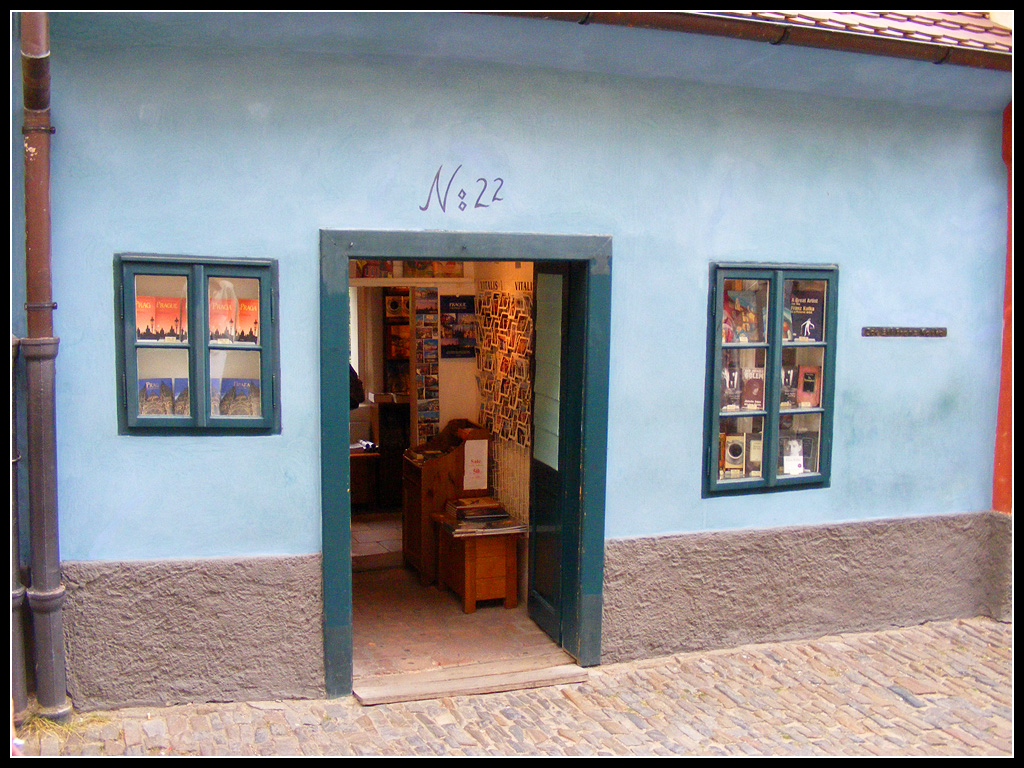
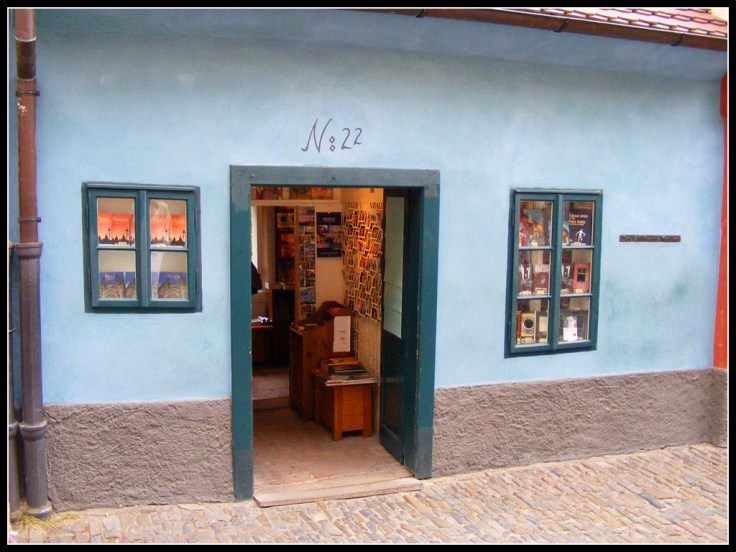
[Kafka’s house on The Golden Lane]

A burrow offers security and comfort.  Kafka found both in his sister’s tiny house on the Golden Lane.

The Golden Lane is a narrow, dead-end yet massively historic lane, hugging an interior wall of the huge Prague Castle. Centuries ago the small buildings along the lane housed workers of the Castle, including some resident alchemists. Thus the name.

Ottla – Kafka’s sister – had rented it so she could spend time with her lover, and not be bothered by parents and comments. Her lover was not only a Christian, but he was soon going to leave to fight in World War I. Time was precious. However, she rarely had opportunities to use it other than the weekends, so she offered Franz the use of the tiny house for most of the time. And use it he did, though he never stayed the night.

Through fall, winter and spring Kafka wrote a whole book of short stories there. For a single block of time, it was one of his most creative periods.

When I visited, under the Communist rule of the time, it had been converted to a book store. Of course (which he would have appreciated) there were no books by Kafka for sale. Today he is displayed in the windows.

It was only when I went thorough the small rooms, and looked out the window into The Stag Moat, that I realized how important the house would become in Kafka In The Castle, my novel about Kafka. It was cozy – even with the space cramped by tourists. It had been little altered. I could easily imagine Kafka looking through the same glass and walking through the same doorways. No doubt stooping because he was tall. Research met reality.

One of the last stories Kafka wrote, during his final year in Berlin, was called The Burrow. A version exists and is published, though a longer version is supposed to be among his ‘missing’ papers. In it a tiny animal keeps incessantly burrowing to keep away from an enemy. A vague noise convinces the animal to burrow deeper. Yup – that’s Kafka.

DE

(image) https://farm3.staticflickr.com/2645/3848764367_a7b9e65ed5_o.jpg

Kafka And His Father Have An Understanding [from: Kafka In The Castle]

kafkafather

01 January 1917

There was a cloud caught in the branches of a tree today, outside my parents home.

Or so it appeared.

I got up from the cot and went to tell Ottla, but she was clearing the kitchen, tending to the dishes. So I was radical, unthinking – driven by haste – and told the only one not consumed by labour. I told my father.

“In the trees?” he asked.

I propelled him from his chair, thrusting the papers aside. He followed me, and I could see the surprise on his face.

“Where?” he asked; and I pointed out the window.

“But I see nothing.”

“Oh, you have to lie on the cot.”

“On the cot?”

“And with your head just so.” I pushed him onto it, and he lay, looking sideways.

“But you are right,” he said.

I thought because of the holiday he might be humouring me, but then I saw that his jaw hung open, and his face was astonished.

Does the boy never grow, that he can feel so good to be vindicated by his father?

DE

Franz Kafka And His Kafkaesque Life

Franz Kafka

Franz Kafka was born in 1883, so he would probably be dead had he lived.

I wonder what Kafka would think about the worldwide communication and information of today. He was a rigid fixture of the staid (he hated using the telephone). He also was a keen observer of the world around him (he wrote the first newspaper report about aeroplanes, and he invented the safety helmet). It was more this deep divide in his personality which caused him his problems, about which he so famously wrote.

He did not fit into his personal world, yet he fit into the real world perfectly. He was adored by his friends and by many ladies. He was respected at his work and rose to a position of power. His stories were published to acclaim in his lifetime.

Kafka lived a Kafkaesque life. He died a Kafkaesque death (he caught tuberculosis because he drank “pure” unpasteurised cow’s milk). He was rigid in his personal beliefs (until proved wrong), yet he was a beacon of compassion to others.

Kafka was always on a tightrope. He looked at things with such accuracy that his comments can seem bizarre. Supposedly his last words were:  “Kill me, or you are a murderer.” They were to  his doctor, as Kafka beseeches for an overdose of morphine.

I have written much about Kafka. This is a diary entry I had him write in my novel “Kafka In The Castle”:

03 July 1917

The anniversary of my birth. In honour of the day, I do not make it my last.

DE

To Find Rest In The Graveyard

(image)

I http://images.nationalgeographic.com/wpf/media-live/photos/000/227/cache/saint-magnus-cemetery-richardson_22760_600x450.jpg

I enjoy graveyards, and peruse them with vigour. It’s true I don’t plan to spend the rest of my life in them, but, after that …

So, I have many tales of cemeteries to tell. Hardly any are scary because, contrary to popular depiction, graveyards are not haunted. Unless one happens to die in one (or – worse yet – die after being buried in one), there are no lingering spirits to haunt. Graveyards are a place, however, to go and contemplate those buried there. I am planning for myself a grand mausoleum.

While researching my novel about Franz Kafka, I went to Prague. In those days it was still under communist subjugation, and travel in and out of Czechoslovakia, to say nothing of travelling the country, was complicated and dangerous. I was fortunate to have arrangements to stay with a Czech academic and his nuclear scientist wife while in Prague. They had a social standing which facilitated an easier visit.

Unknown to me upon arrival, the academic was an amateur historian. When he found the major thrust of my visit concerned Kafka, he was full of places to visit. Many of them I did not know about, and others I doubt I would have found on my own. For instance, he took me to the small house where Kafka had lived on Alchemist Lane, which eventually became the setting for half of my novel. Even though Kafka was in disfavour at the time, the house was noted for the fact he lived there, and it was on tourists lists. In a Kafkaesque twist, it was even then a bookstore, but none of his books were allowed on the shelves.

One of the places I was taken was to Kafka’s grave. It is situated nowhere near where Kafka lived his life, but is in a huge Jewish graveyard on the outskirts of the city. It took nearly an hour on the subway to reach the area. And then a walk to the graveyard itself. And then a walk through the graveyard, though the way to Kafka’s grave was signed. I would never have thought of trying to get there myself.

Kafka is buried with his mother and father (though, literally, vice versa, as he died first). It is only years after the fact that I read about the drama of his death, and the drama at the graveside. His young lover, Dora, who had spent the last year of his life with him, attempted to leap into the grave. She had to be restrained by Kafka’s best friend, Max Brod.

I lingered a long time – perhaps a half hour – by the grave. In the Jewish tradition I left a stone upon the gravestone. In my own twist, I also left a pen. And, because there were few about, and I was so moved, I lay down upon the grave itself.

DE
Kafka Passport Reaches Twice Expected Price At Auction

Alas, I did not get it. And to think they gave it to Kafka for nothing.

I am contemplating a novel dealing with the time frame of this passport. Kafka attained it near the end of his life so he could travel to Berlin and to sanatoriums in other countries. But, he was already doomed.

DE

Sold for US$ 37,500 (CA$ 49,742) inc. premium

Bonhams

KAFKA, FRANZ. 1883-1924. Czechoslovak Passport Signed ("Dr. F. Kafka František"), [Prague, June 1922].
Lot 182
KAFKA, FRANZ. 1883-1924.
Czechoslovak Passport Signed (“Dr. F. Kafka František”), [Prague, June 1922].
Sold for US$ 37,500 (CA$ 49,742) inc. premium

Create a free website or blog at WordPress.com.

Up ↑