Search

kafkaestblog

It is a whirlwind in here

Category

novel

Turning A Novel Into Film – Characters On The Loose

screenplay_square

When adapting a novel manuscript to a film script, I realize it will take a whole host of other people to tell me how successful I might be. I’ve done this twice before, and realize that I must not only ignore my usual method of writing, but often go exactly against it.

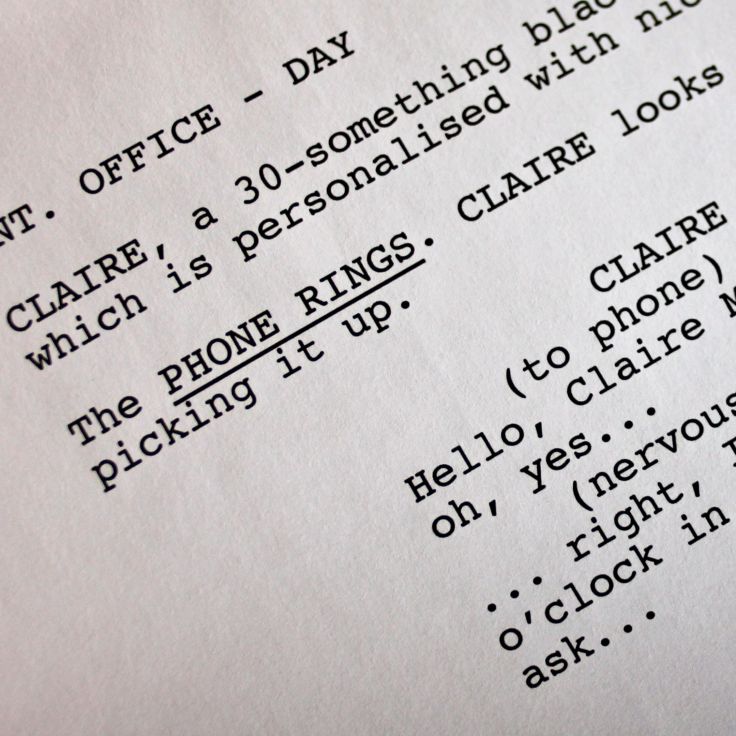
I attempted to “learn” how to write for film. I read many instruction books, attended classes and workshops, and had meetings with people. I read many film scripts, which did help me accept the (to my eye) arcane format. But the one thing that actually turned me visual, was the comment of a writer/editor friend who said, after reading my attempt, “I can’t see it.”

That is, it did not cause visual action in her mind.

And I understood.

Perhaps the biggest hurdle is to accept that a movie is not a book, and that changes, additions and omissions will be necessary. As with a play, there is a finite time limit, that generally clocks in under two hours. The threads and plot points of a movie are different. And the characters (I swear) feel this freedom, and choose to accentuate other aspects of themselves than revealed in a novel.

The very fact their paragraphs of dialogue are best reduced to two or three lines makes them uppity. And because they can, in mere seconds, be in diverse locations, performing radically different actions, they become exact without apology. They don’t have to fill in the spaces.

The writer has to fill in the spaces however, and do so with visual stimulation. The transitions have to be swift and their descriptions exact. The road is always the fast lane and the characters kick the tires with gusto.

DE

(image) http://www.indiewire.com/wp-content/uploads/2014/11/screenplay_square.jpg

Kafka And His Father Have An Understanding [from: Kafka In The Castle]

kafkafather

01 January 1917

There was a cloud caught in the branches of a tree today, outside my parents home.

Or so it appeared.

I got up from the cot and went to tell Ottla, but she was clearing the kitchen, tending to the dishes. So I was radical, unthinking – driven by haste – and told the only one not consumed by labour. I told my father.

“In the trees?” he asked.

I propelled him from his chair, thrusting the papers aside. He followed me, and I could see the surprise on his face.

“Where?” he asked; and I pointed out the window.

“But I see nothing.”

“Oh, you have to lie on the cot.”

“On the cot?”

“And with your head just so.” I pushed him onto it, and he lay, looking sideways.

“But you are right,” he said.

I thought because of the holiday he might be humouring me, but then I saw that his jaw hung open, and his face was astonished.

Does the boy never grow, that he can feel so good to be vindicated by his father?

DE

Kites Fly Over Religion And History

(image)

I https://s-media-cache-ak0.pinimg.com/236x/46/70/f4/4670f4112828e409e6568a5d9df3f3f6.jpg

I was writing the last quarter of a novel. Lots of intensive work in the course of a day. I usually try for a couple hours of walking outside, but it doesn’t always happen. One day, in a later evening than usual for me, I set out for a wander in the immediate neighbourhood.

A reasonable walk away is a small park, run (it is obvious) by the Roman Catholic church. Three park benches, one picnic table, trees and flower beds. There is also a statue of the Virgin Mary in blue vestments. At the foot of the statue are two objects from the Halifax Explosion. One is part of one of the ships that collided and caused the conflagration, the other is part of a church destroyed in the explosion.

Now this is a pleasant place to sit regardless. However, it does hold two connections to my novels. In one novel, I have a significant and spectral occurrence happen at the foot of the statue of a Blue Angel. In another novel, the Halifax Explosion plays its part. I had written both these novels before I ever saw this small park.

So, I sat myself down. I imagine I go there four or five times a year. It is quiet and encourages contemplation. I contemplate. I doubt I have ever seen more than three other people there at any time. I was alone. I assumed that I would remain this way.

I was wrong.

In fifteen minutes or so a gaggle (or a giggle) of young girls appeared. Easily two dozen. None looked older than ten. They were accompanied by four adults. They all held a kite of identical construction. They were let loose to fly them.

A few of the girls were wearing a sash, and a couple more had badges on their shirts. I assumed they were some sort of Brownie troupe. Don’t Brownies fly up? At any rate they all started to run about, encouraged by the adults. If nothing else it was great exercise. It was a windy evening and they had some success with their kites. A handful got the hang of it and kept their kites more aloft than not. Of course, I got hit in the head by one of them. The child apologised. Otherwise I was ignored.

I bet with myself how long this activity would last. I won. Less than fifteen minutes. Then the girls banded in twos and threes and talked. As did the four adults. One girl started to do cartwheels – quite successfully. The girls walked around in groups, talking and giggling. A few sat on the grass. A few did try the kites again, but not for long. One girl somehow got the string leading to her kite caught in her hair. Two of the adults tried to untangle it, with limited success. I heard one of them say they would have to use scissors when they got back to the church. Then, being told to hold hands with their ‘partner’, they all left the park.

I followed soon after. I might not have got my usual bout of contemplation, but my mind was still occupied by other than my usual thoughts. A fair exchange.

DE

Reality and Art and the World Between

THE REALITY: (from REALITY)

A few years ago I had cause to walk the grounds of a Catholic college. I did this often, as it was a large and peaceful place to wander. There were some paths, some gardens, some benches, wide playing fields and even a stroll beside a river. A peaceful retreat from the city.

I did meet one ancient priest telling his beads (there was a ‘retirement’ residence also present) who gave me a jovial ‘good day’. He was walking the paths through the trees (as was I) and eventually settled on a bench (as  I did not). I kept through the trees, which were really planted in individual copses. enjoying refuge from the sun. The trees seemed to be all pines, with full and tightly packed branches. As I went through one such group of firs, I looked between the trees. There was a statue on the other side. I circled and went up to it. As I approached I was overcome with the oddest feeling of familiarity, though I knew I could never had been there before.

And then.

And then I realized what it was.

It was a scene I had created for my two ‘Satan’ novels. A central character has the statue of an angel within a copse of firs in his back yard. My novel has an angel statue ,and reality had the Virgin Mary. But, still . . .

I’ve written of many real places which I have visited, but none took me so aback as this.

THE ART: (from THERE HAS BEEN A SIGHTING)

Mr. S. unexpectedly takes her arm, and begins to lead her along a winding, flagstone path. She has never seen such large pieces of the stone, and they glisten as if polished.
The path skirts a small stand of black spruce before it continues to the river. He stops her at the mouth of a gravel walkway leading through the trees.
“Let’s pop in here.”
“Your little acre of the Black Forest?”
“Hardly an acre.”
“Precision.” Breeze laughs. “Whatever would my father think of you?”
“Does any father think well of any man when his daughter is concerned?”
“Probably not.”
“No,” agrees Mr. S. “So not to worry.”
“He would think even less of someone leading his daughter down the garden path,” observes Breeze.
“That would be before he saw what I am about to show you.”
Mr. S. holds her arm tightly, and guides her onto the gravel walk. It leads directly to the base of a tree, then makes an abrupt curve between the largest of the spruce.
One of the boughs is so low Breeze ducks her head. She has the sensation of being in the midst of a forest, for the heavy branches obscure the surroundings.
“If I may be permitted a moment of drama.”
Mr. S. covers her eyes and speaks softly.
“Will you turn to your right, and take a few steps?”
Even though he had asked, Breeze is startled as he gently eases her forward, and she feels a slight urge to resist him. Her steps are more cautious than the gravel walkway demands, and the press of his body is noticeable. She counts her footsteps under her breath. She is surprised when they stop at half a dozen, and he quickly removes his hand.
“She’s beautiful.” Breeze stares, open-mouthed.
“Yes.” Mr. S. is pleased. “I think so, too.”
“An angel in the woods.”
“The angel of peace.” Mr. S. walks her around the statue. “Not at all bad for a knockoff.” He pauses behind the wings.
“A knockoff?”
“A reproduction.” He puts his foot on the pedestal, and leans forward. “I don’t really know how old it is. Certainly last century – possibly before.” He points to the blue folds. “I’ve had the paint cleaned and touched up. Is it too garish?”
“It … it stands out.” Breeze hunts for a word. “Let’s call it vibrant.”
DE

Create a free website or blog at WordPress.com.

Up ↑