Search

kafkaestblog

It is a whirlwind in here

Category

novel

Louie-the-Dog Becomes Part of The NATO Family

7397459fb378c0b6a2661b76fb805362

An excerpt from: The Bonner Prediction – a NATO thriler, for International Dog Day. Louie is a Cane Corso, adept at both defence and attack. In this scene, he has earned (trust me) a little down time.

05:14:31 ZULU Time

“I’ll sweep the house.” Bonner puts the keys on the dining room table.

“That’s fastidious.” Bess looks at her watch. “It’s a quarter past one in the morning. Who’s going to visit?”

Bonner gives her a closer than usual look to make sure she is kidding. She winks and sets out to find dishes. He stops her with a hand on her arm.

“Are you familiar with NATO safe houses?”

“Nope – never been in one.”

“Don’t try to use the back door.” Bonner points through the kitchen. “It’s wired with explosives.”

“You call this a ‘safe’ house?’

“Makes it safer for us.” He removes his hand. “It will explode if someone aggressively attempts to break it down.” He smiles. “We can also detonate if from here, if necessary,”

“But this wasn’t your idea?”

“No – alas.” He starts away with his handheld. “But I approve.”

The house is conventional in its layout, ready for a family. She wonders if there are families any more. If these buildings have been relegated as guest accommodations, she doubts either diplomats or military travel with a family.

She removes the food from the containers and places it on dishes. As she puts them in the microwave, Bonner passes with his electronic handheld. She thought he might give only a cursory search (no one can possibly know they are staying here) but – no.

The walls, the light fixtures, the electrical outlets, the appliances, the taps, the windows, the doors are all given a sweep for tell tale signs of transmission. The doors are closed and their locks are tested. As with any place of sanctuary, every room can become a ‘safe’ room. If this dwelling is like others she has experienced, the windows can even withstand an RPG.

When Bonner is finished, he goes to the cupboards and removes napkins. On his way past the fridge he takes out a bottle of wine. He shakes his head disapprovingly.

“Screw top.” Bonner carries the wine and napkins to the table.  “Not the usual standards of NATO.”

“I was planning on Sprite.” She looks toward the kitchen as the microwave beeps. “NATO lives it up while we Swiss live in parsimony.”

“If NATO inclined towards having us live it up, they would have put us in more graceful accommodations.” Bonner twists off the cap. “At least it’s white.”

“Where’s the dog food?”

“They’re a tidy group. I bet food will be in the kitchen.”

As Bess takes the food from the microwave and hunts for plates, Bonner searches for dog food. Not only does he find a bag in the corner, together with a foil pack of dog treats, but there are two shiny, new, metal dog bowls – one for food, one for water. Bonner guesses that a member of the supply personnel is a dog lover and raided the stores of the guard dogs.

“How much?”

“Two scoops.” Bess is putting the salad into a bowl.

“What about treats?”

After.” She looks at him. “I bet you don’t have kids, either.”

“Nope.” Bonner puts two generous handfuls of food into the dish. “I’d make a lousy father.” He runs water from the tap then fills the other bowl. “There’s time.”

“Not that much time.” Bess takes their food to the dining table.

“Ouch.” Bonner has little interest pursuing this thread. He opens a cupboard and takes out two wine glasses. “Louie is fed and watered.” He carries the glasses to the table. “And now, soon to be us.”

Bess looks over to Louie. He is attentive to her, but also has side glances to the kitchen.  She waits until he is only looking at her, and then makes a hand gesture.

“Go.”

Louie is out of the room before Bonner can pick up the wine bottle. His claws clatter across the kitchen floor, quickly followed by crunching and the scrape of the dog bowl on wood.

“He’s not going to savour, is he?”

“Nope.” Bess takes her wine glass. She is about to take a drink but stops. She extends the glass toward Bonner. “It’s been a night.”

“But our wee family is safe to home.” Bonner clinks her glass. “Though Louie’s table manners could be more refined.”

R/Jane-the-Ghost Is Not The Ghost Of Christmas (Past, Present or Future)

original_little-ghost-acrylic-brooch

“That is a peculiar-looking ship.”

“It is,” agrees Alison Alexandra.

She agrees because it is a peculiar-looking ship. She is studying it through her military-grade binoculars as she stands near the edge of her cliff, leaning against a waist-high barrier she had constructed just for this purpose.

Three sturdy posts painted blue.

There is a wooden knob atop each post, painted red. Four broad boards, painted white, are securely nailed to the posts, with slight gaps between them. There is room for five people to stand side-by-side.

Alison Alexandra has never had more than one person at a time accompany her on this venture. A slight problem at the moment is that this is not one of those times. She is standing alone, binoculars to eyes, looking out to the ship in the harbour. The peculiar-looking ship.

“In fact, it is not just peculiar-looking, it is actually peculiar.”

It is,” agrees Alison Alexandra, who does not lower her binoculars. “Though that is not the only peculiar thing at the moment.”

“It is not?”

“It is not,” says Alison Alexandra. “One other peculiar thing is that I am standing here by myself.”

“I see.”

“I don’t,” says Alison Alexandra.

“I’m out of your vision.” The voice does not falter. “I’m R/Jane-the-Ghost.”

“R/Jane-the-Ghost?” asks Alison Alexandra.

“Yes,” confirms R/Jane-the-Ghost.” Yes.”

“A for real ghost?” asks Alison Alexandra. “Not a figment produced by an undigested piece of potato?”

“I like that idea,” says R/Jane-the-Ghost. “Being a Dickensian ghost. I liked reading Dickens.”

“As do I,” says Alison Alexandra.

“But – no – no Dickensian ghost am I. I bring no warnings.”

“”No festive cheer?”

“Nary a candle.” Says R/Jane-the-Ghost. “No bony finger have I, pointing at anything.”

“You did – in your way – point out the peculiar ship.”

“In my way.”

“Point taken,” says Alison Alexandra.

There is a low chuckle, bordering on hearty, close beside her right ear. She does lower her binoculars at that, and moves her head to look. Her view is unobstructed all the way down her cliff. The water sparkles.


[Image] http:/cdn.notonthehighstreet.com/fs/06/90/c0b3-fff4-4518-b7d7-527c4703c9d8/original_little-ghost-acrylic-brooch.jpg

Kafka Never Slept In This Prague Hotel

hotel-century-old-town

When I visited Prague to research my novel, Kafka In The Castle, I went to many of the places that were part of  Kafka’s life. One such place – the small house where he wrote a whole book of short stories – became a setting for a third of my novel.

However,the building where he was employed, The Workers’ Accident Insurance Institute for the Kingdom of Bohemia in Prague, I only saw at a distance across a Square. It was not a happy place for Kafka, though he was very successful at his employ, and rose to an administrative position of importance. It was not really much of a setting for my novel.


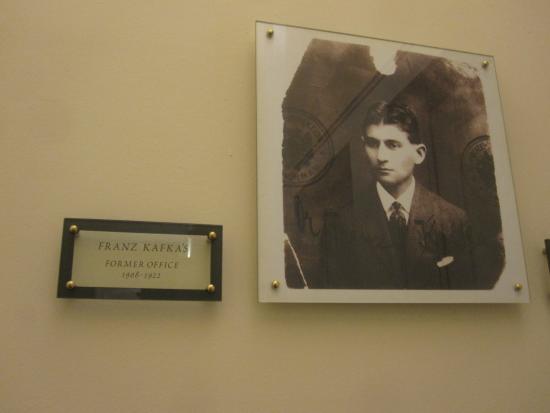
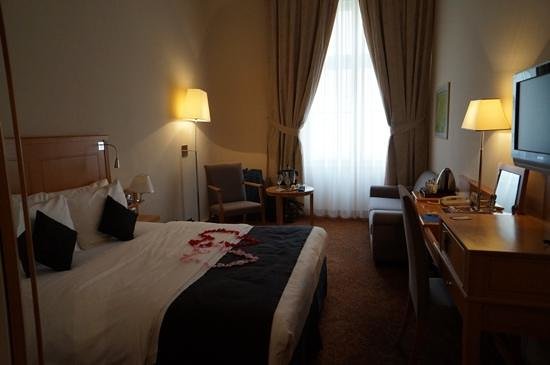
That building is now a fancy hotel, and Kafka’s office is a room for rent. It is even designated The Franz Kafka room, and contains mementos. It is where I plan to stay when next I visit. I hope there is not a long list of folk wishing to spend the night there, too. It even includes a restaurant named after his fiancée, Felice.


Following is some information about the hotel, and some photos of the room.

~~~~~~~~~~~~~~~~~
The hotel is situated in the heart of Prague, next to the Old Town Square, where the famous medieval astronomical clock is mounted on the southern wall of the Old Town City Hall. The Neo-Baroque building was built in the 19th century by Alfonse Wertmuller, a famous architect in Prague. It was formerly the office of the Workers’ Accident Insurance of Kingdom of Bohemia, where Franz Kafka worked as an insurance clerk from 1908 to 1922. His spirit can still be felt in the hotel, as his bronze bust welcomes guests in the lobby in front of the majestic stairs.
hotel-century-old-town
room
~~~~~~~~~~~~~~~~~~~~~~~~~~~

In addition, this is one of the few diary entries I wrote, set in his office building,

 
Excerpt from Kafka In The Castle

16 February 1917

There was a commotion at the office today. It was late morning, and from far below, coming up the stairwell, I could hear a voice bellowing: “Doktor Kafka. Doktor Kafka.” It was a terrible voice, full of blood and darkness.

I got from my desk and went to the door. There were other voices, trying to calm, saying: “He can’t be disturbed.” But the voice was louder, more horrible, close in the corridor.  “Doktor Kafka – for the love of God.”   My secretary wanted me to stay inside, hoped the man would just move along the corridor until the police were summoned.

But – I was curious; the man had my name, and his voice was … terrified.

I opened the door and stood in front of it.  “I’m Kafka,” I said. The man lunged at me, and went to his knees.  “Doktor Kafka?” he said.  “Yes, I’m Kafka.” He reached out, grabbing for my hand.  “Jesus, Jesus, for the love of Jesus – they say that you’ll help me.”

He was a heavy man, and looked as if he had the strength to pull off doors, yet the tears burst from his eyes.  “I can get no work. I fell from a bridge, and my back is twisted and in pain.” He slumped against the wall, looking at my eyes.  “I have a family, Doktor Kafka. A baby not a year old.”  “You were working on this bridge?” I asked.  “Yes.” His voice slid down his throat. “I was helping repair the surface.”  “Then you deserve your insurance. Why can’t you get it?”

He straightened up, and tried to stand. “I have to fill in papers; the doctor can see no wounds; the foreman said I drank; because my brother is a thief, I am not to be trusted.” I held out my hand, and he slowly stood. “I’m telling you the truth, Doktor Kafka.”

“If that is so,” I said, “you’ll get the money due you.”  “I’m so tired,” he said.

I gave instructions to those standing around – no other work was to be done until this man’s case was decided. I took him to my office, where he sat.

He sat – practically without a word – for five hours. I summoned a prominent doctor to look at him. The doctor prodded, and the man screamed. Officials from his village were telephoned. I helped him with the details on the forms. His truth was in his pain. He left our stony building with money in his hand, and his worth restored.

The people who assisted me had smiles on their faces.

A man had needed their help.

You Can’t Take it With You

the-famous-works-of-immanuel-kant-philosophy-and-anthropology-free-audiobook-link
So, it’s like this.
 
Alison Alexandra is going to meet her mentor for the first time in ten years. Her mentor, Bellissima Isabella, is the couturier who started, and managed, Alison Alexandra’s modelling career when she was a teen.
 
They are going to meet in front of the Gucci Museum in Florence. Alison Alexandra assumes they are going to go in and look around but, oh no. Belissima Isabella has nothing but disdain for any other couturier.
 
I knew that when entering the Gucci Museum was going to be suggested, Belissima Isabella was going to decline, saying it was full of “Gorgeous Gucci Garbage”. But, what was missing, was an oath of derision, which she might say a few more times as she struts across my stage in There Was A Time, Oh Pilgrim, When the Stones Were Not So Smooth.
 
So, I am right at the moment of writing the oath, not a thing in mind, and she comes out with “Emanuel God Cunt”. A philosophic twist. I can live with it.
 
I finish my writing, come down to the computer, look at odds and ends, one of which is Linkedin. There is a request from a chap for me to add him to my Linkedin Network.  His first name is Emanuel.
 
Might I suppose God is chuckling along with me?

War And The Army And Kafka

kafka115_v-contentxl

Kafka recorded the beginning of the First World War in his diary this way:

August 2, 1914: Germany has declared war on Russia. Went swimming in the afternoon.

That was it.

But, regardless of his lack of enthusiasm, Kafka believed in the duties of the citizen. He tried to join the army to fight. In fact, he tried to join a number of times. He was always refused because the government deemed his civil/government job was too important for him to relinquish.

But, near the end of the war, when Kafka was so sick he had lengthy periods of leave from his job to recuperate, the army came calling.  Kafka had to appear before authorities with medical proof of his illness.

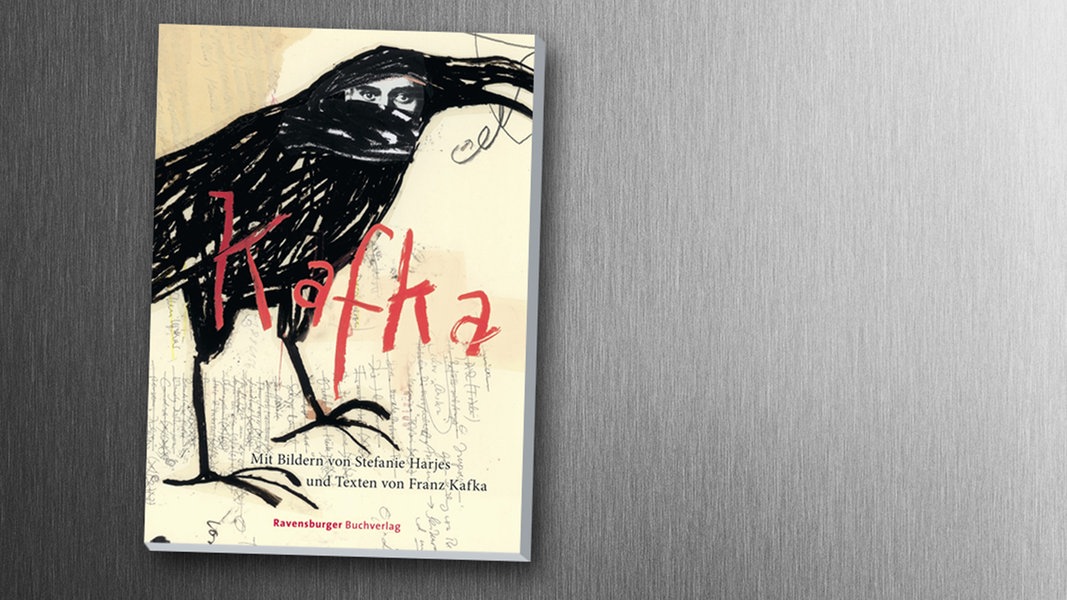
In my novel, Kafka In The Castle, I ‘fill in’ one of his diary entries describing such a situation.

~~~~~~~~~~~~~~~~~~~~~~~~~~~~~~~~~~~~~~~~~~

07 February 1918

I find I must go to Prague at the end of next week. Such knowledge is proof that one should not open one’s mail. The Military yet again wishes to snare me, and I must once again prove that my hide is not worth the effort.

There were time (very rare) when my father would despair. Not his usual anger at the general incompetence and perfidy of the world around him, but a resignation to the belief that things would never get any better.

“If they want to drag me down,” he would say, “Then I may as well join them. I’ll go out into the street and let myself be swept away by the mob. I’ll become part of their common, grubby life, and let them wipe their boots on me.”

That is much as I feel right now. Let the army take me, dress me in their uniform, point me toward the Americans, and have some cowboy shoot me. Going into battle could be no worse than going into Prague.

[Image] https://www.ndr.de/kultur/buch/tipps/kafka115_v-contentxl.jpg

Ship And Sailor Both Await The Danger of Fog

maxresdefault

The sea plays a big part for Alison Alexandra in my manuscript There Was A Time, Oh Pilgrim, When The Stones Were Not So Smooth.  This is at the beginning of a night that is going to last a long time.

~~~~~~~~~~~~~~~~~~~~~~~

There seems to be a touch of mist coming over the ocean as Alison Alexandra looks from the windows of her prow of a ship house on the top of her cliff. Well, she calls it her cliff and no one – yet – has said ‘nay’. But then, she thinks of it as her ocean, so what is someone going to do with that?

She turns the lights out in her prow of a ship room and settles into her comfortable winged chair. The sun is in its last minute of setting and Alison Alexandra concentrates on the positions of the ships settling in for the night. There are always ships that have no space for a berth until the next day. One or two always seem to have to wait until the day after that.

The vagaries of shipping and commerce, and the whims of an erratic sea, can only be predicted with moderate success. The tides and the winds and the atmospheric pressures high and low make merry over and under the endless horizons. They whirl and they twirl and they scud and skip with gay abandon. ‘Catch them and predict them?’ – well, Alison Alexandra knows better than that.

As it is, her sea eye – well-honed after these many years of coastal watching – is certain the touch of mist that kisses the top of the waves in a most flirtatious manner is deciding whether or not to settle in for the night and become mistress to sea and ships and those swabbies who – oh, so quickly – will be told that the watch must be doubled.

No matter that they are within sight of shore and already have their imaginations stirred by what will be offered at fine establishments such as The Tugboat Wharf And Seafood Lounge with its All You Can Eat Beef Buffet and waitresses who are never going to give them the attention they crave but will still be a damn good source to stroke the imagination and then they can hit the streets and hope to find some pliable bodies with whom to hit the sheets if only by the hour.

(Image) https://i.ytimg.com/vi/uDF-z2ZPzRg/maxresdefault.jpg

Who Gets The Bottle Of Wine At The High School Reunion?

red-wine-bottle-vector

I am putting my hand-written manuscript, There Was A Time, Oh, Pilgrim, When The Stones Were Not So Smooth, into the computer. I was coming to the end of my main character’s (Alison Alexandra) high school reunion.

When I type I aim, at the end of day, to be at the end of one of my hand-written pages.

The folk at the table where Alison Alexandra sat, had all trooped up to get the buffet food. When they returned, there was a bottle of wine on the table, with a bow tied around it,  And a card. I was at the bottom of a page.

But I wanted to know who got the wine. So onward I typed.

I’m guessing (hoping)  if it interests me so much to know who got the wine, the reader will give a “Hoot! Hoot! (as did the folk at the table) when the card is read.

++++++++++++++++++++++++

When they reach the food tables, there is not the curiosity from others concerning who is who. Most are intent about filling plates and returning to their tables.

Everyone at their table is getting steak except for Betty, who has opted for the salmon. She also opts to carry Allan’s plate as she sends him on to the bar to get another round of drinks. She looks at Ed and Lee.

“Are you two satisfied with tea and coffee?  Those drinks they are going to bring to the table, carried by sadly inexperienced students.”

“That’s fine with us,” says Lee. “And we can always snag some bottled water.”

Plate in hand they return to their table. In their absence a plate of rolls and butter has been deposited in the middle. There is also a bottle of red wine, with a bow and a note attached.

“Well, well,” says Betty, wanting to immediately open the unaddressed envelope. “I’ve never seen the like of this.”

“A modest but decent bottle,” says Alison Alexandra.

“Maybe you have a secret admirer,” says Betty.

“Maybe you do,” says Alison Alexandra.

Betty Dragger is taken by surprise at the idea and snorts. She then sees Big Stakes Gamble approaching, and clears some space for the drinks he is carrying. He is fast at a sip of his beer before he speaks.

“Who got the wine?”

“We don’t know,” says Betty.

“Then someone should open the card.” He picks up the bottle and hands it to Ed.  “And that sounds like a job for an officer of the law.”

Ed is not sure if a joke is being played, and if it is being played on him. He is as curious as not, so he takes the knife beside his plate and slits open the envelope. He reads the card and laughs.

(Image)https://static.vecteezy.com/system/resources/previews/000/000/624/non_2x/red-wine-bottle-vector.jpg

The Naked Man Roller Skates To The Flatiron Building In New York

featured-flatiron-buildingknyc-untapped-cities1-1

After decades, Macmillan, the publisher that produced my two novels, has left the Flatiron Building in New York. I am surprised that this news causes such a pang. But then, those days were exciting and unique

The first description following, is my blog where I describe my first meeting with my editor. During my first trip to New York. Where I first entered the Flatiron Building

The second article is by an editor at Macmillan, describing what it was like to leave the Flatiron Building and move elsewhere.

++++++++++++++++++++++++++++++++++++++++++++++++++++++++++++++++++++

My friend Google tells me that “over the transom” is still a viable term. In this case it refers to a manuscript accepted by an editor submitted cold – perhaps even from the dreaded slush pile.

At any rate, my manuscript for A LOST TALE was accepted “over the transom”, and I was asked to New York to meet the editor. Although I had experienced and appreciated Montréal,
Toronto, London, Berlin and other large cities by that time, I had not been to New York. Many events of that trip are memorable, but none more than my “lunch” with the editor.

The editor took me to some dark and trendy place for a late lunch. There were not many people there and, restaurant fiend though I am, the food was not my top priority. Discussion of “the work” and proposed changes was more on the menu for me.

However, as I sit across the table from my editor, I can not help but notice a man seated by himself beside the wall. He is tieless and shirtless and, though the lighting is dim, what there is reflects from his naked skin. He sits with a beverage and seems to hum to himself. My editor is discussing both the menu and some confusion he perceives at the beginning of my novel. I note items on the menu unknown to me and am doubly confused.

The shirtless man at the other table increases the volume of his humming and eventually a waiter goes to him and has words. The shirtless man has words back, but they sound like gibberish. At my table the editor suggests something from the menu and I happily comply. There is wine.

Whilst I eat and listen to suggestions, the shirtless man is spoken to by two other waiters. As I (wisely) restrict myself to a second glass of wine, two uniformed policemen enter the restaurant and approach the shirtless man, whose gibberish had increased even more in volume. In the course of a few minutes three other uniformed police officers – one of them female  – arrive on the scene. They are now ranged around the shirtless man and his table. I finally tell my editor what is happening behind him and why I am not concentrating fully upon his suggestions. He turns around.

Two of the officers remove the table from in front of the shirtless man. Two others, one on each side of him, haul him to his feet. It is then that we see his shirtless state continues all the way to his naked feet. The female officer takes the tablecloth from the table and drapes it around him. The four male officers form a circle around the naked, shrouded man uttering his gibberish, and hustle him from the restaurant. The female officer picks up what appears to be a pile of clothes from beneath the table, and a pair of roller skates, and follows them.

I say to my editor that I have never seen anything like that.

My editor concurs.

[Image]https://untappedcities-wpengine.netdna-ssl.com/wp-content/uploads/2015/03/featured-flatiron-buildingknyc-untapped-cities1-1.jpg

****************************************************************************

Bidding Farewell to the Flatiron Building

Kat Brzozowski, in a photo taken from CEO John Sargent’s office on the Flatiron’s 19th floor.

Today’s the first day that Mac Kids is in our new home at 120 Broadway. We spent the past few weeks packing our work belongings in orange crates, preparing to settle into the Equitable Building in the Financial District, trading our beloved triangle for an H-shaped office (because what would Macmillan be without an unusual layout?). I still remember arriving at the Flatiron Building for my first day 10 years ago. I looked up at the building in awe, thinking, “I can’t believe I get to work there.”

Walking through the Flatiron Building was like traveling through a science museum that showcases different ecosystems—the rainforest, the desert, the tundra. In your office on the 7th floor, you’d be stripped down to a tank top, sweating, with the AC blasting even though it was full-on snowing outside. But travel to the 10th floor conference room, and you’d be covered head to toe, wrapped up in an actual blanket, shivering.

The bathrooms alternated by floor—men on even, women on odd—and we all knew which bathrooms to avoid (the ones so small you’d be bumping elbows with your boss on the way out), and the ones that a friend called “destination bathrooms” (11, with its large waiting area; 19, with a gorgeous view of the city). Those bathrooms were worth the elevator ride. And who knows, while you were waiting—which could take a while—you might run into Jill Biden, or Tyra Banks, or Jim Carrey.

At my first job at Macmillan, at Thomas Dunne Books, I worked on the 17th floor in a sectioned-off area we called “the annex,” but which I thought of as Narnia. No one could ever find me, because my desk was accessed through a door that not every floor had. Yes, every floor was different, giving the building a funhouse feeling as you wove left and right, searching for the conference room or the kitchen anew with each floor.

And each company felt as unique and as special as its floor plan. Mac Kids, where I work now, was a wonderland, with framed art crowding the walls, brightly colored board books packed onto shelves next to classics, and a sparkling energy fueled by employees whose early lives were shaped by books. Walk by one office and you may spy a menagerie of life-size zoo animals, painted freehand by a famous illustrator. Where else but the Flatiron can an artist paint on the walls?

There’s no experience similar to working in the Flatiron Building. We’d bemoan the lack of conference rooms, then brag to our friends that we got to work in that building. We’d complain about the fact that we needed our key cards to get from one side of the floor to the other, then we’d pour out of the doors at lunchtime to get burgers at Shake Shack, or a BLT at Eisenberg’s, or a flat white at Birch Coffee, a plethora of delicious (and affordable) options spread out in front of us like a glorified mall food court. We’d tell our authors, “Don’t get your hopes up, it’s not that nice inside,” then see their eyes light up as they took out their phones to snap a shot from the point office, with views that stretched all the way to Times Square, with the Empire State Building and the Chrysler Building so close you felt you could reach out and touch them.

That feeling I had on my first day in 2009 hasn’t gone away. I’ve felt it again and again over the past 10 years, the magic of seeing something from a postcard come to life in front of me. Farewell, Flatiron Building. You’re leaving a triangle-shaped hole in our hearts.

Kat Brzozowski is senior editor at Swoon Reads/Feiwel & Friends.

https://www.publishersweekly.com/pw/by-topic/childrens/childrens-industry-news/article/80191-bidding-farewell-to-the-flatiron-building.html

Jesus Walks At Easter

The Unicorn is mentioned eight times in the Holy Bible. The list is below.

When I have Druids, and their unicorns, go to Jerusalem in my novel A Lost Gospel, to make sure Jesus gets crucified, I feel I am on solid ground. And when one of my druids, Ogma,  has the following experience, I believe it is a symmetry of Biblical proportions.

Unicorns are mentioned in the following places of The Bible:

Numbers 23:22

God brought them out of Egypt; he hath as it were the strength of an unicorn.

Numbers 24:8

Deuteronomy 33:17

Job 39:9-12

Psalm 22:21

Psalm 29:6

Psalm 92:10

Isaiah 34:7

~~~~~~~~~~~~~~~~~~~~~~

From A Lost Gospel

“Are you lost?”

“No.”

Ogma was taken by surprise, but he did not turn toward the speaker. He had no desire to start a conversation, he just wanted to be left to himself.

“Yet you are a traveller to these parts.”

“Yes.”

Ogma knew only too well the interest local people had for strangers in their midst. It was an interest which could easily turn into suspicion. He was alone, and he did not want to have trouble in this unknown land.

“I had business in Jerusalem.” Ogma shrugged. “The desire came upon me to feel earth under my feet, not paving stones.”

“And you find yourself here.”

“I turned from the main road at a whim.”

“What did you in Jerusalem?”

“I do not intrude thus in your life.”  Ogma kept a steady gaze across the field, though he could not keep irritation from his voice.

“Yet you do intrude – for here you are.”

“If I’m on your land, I apologise. I thought it was a common road. There is no barrier in place to warn me otherwise.”

Ogma wondered if it was time to leave the way he had come, or to stay and talk. Despite the words spoken, the other man’s voice displayed no anger, or annoyance.

“Do you find no peace in Jerusalem?”

“I’ve had a troubled time in your grand city.”

Ogma suddenly realised he had things he wanted to say, which he could not discuss with the other druids. He finally turned to the man, wondering if he should explain further.

“By the Gods of eath!” Ogma stood back in fear. “This is not possible.”

“There are no boundaries to what is possible.”

“I saw them hang you up.”

“You saw flesh. And blood.”

“Then what do I see now?”

“More than a man of sorrows.”

“Glarus was right.” Ogma began to move further away, but stopped himself. “I’m not to fear you, or the change you bring.”

“Truth deserves acceptance, not fear.”

“Do you know of my burden?”

The other man raised his arm and pointed. Ogma turned to follow the outstretched hand. He saw the two unicorns standing close together among the trees.

“Have they brought me here?”

“They have led you to a place you sought yourself.”

“You know of Glarus.” Ogma stopped abruptly, and his voice lowered. “The gods I understand believe in trade. Take me instead of her.”

“You care so much?”

“I know the worth of things.” Ogma stared directly at the other man. “It is better to have her alive, than me.”

“No man knows his own worth.” Yeshua touched the small man, then held him close. “My father’s love does not barter.” He released Ogma with a smile. “Return to Jerusalem. You travel with companions.”

“The beasts accompany me?”

“Thou hast heard me from the horns of the unicorns.”


Blog at WordPress.com.

Up ↑