Search

kafkaestblog

It is a whirlwind in here

Category

history

“Say Cheese!”

the-wheel-ready-for-cracking

(image) https://3wheeledcheese.files.wordpress.com/2012/09/the-wheel-ready-for-cracking.jpg

Thank you reality!

In my historical novel trilogy about onion farmers, which stretches  from the 3rd Century to the present day, I have my main characters, the Cannara family from Italy, invent an “onion cheese”.

In the second part of the trilogy, I have the Cannaras take some of this cheese on a trading voyage to China. Theses voyages could last well over a year. I have them forget some of the rounds of their cheese, and they makes a return voyage. To their surprise, the Cannaras find that the length of travel and the motions of the ship have produced superior cheese. This they sell at a high profit.

Immediately following is a current news article about some cheese found on a ship that sank 340 years ago.

Below that is an excerpt from my novel, China Lily.

DE

~~~~~~~~~~~~~~~~~~~~~~~~~~~~~~~~~~~~~~~~~~

Wednesday July 27, 2016

340-year-old cheese discovered at shipwreck site and, man, does it stink

A dairy product, believed to be cheese, has been discovered at the wreck site of The Kronan. The Swedish warship sank before a battle with the Danish/Dutch allied fleet in 1676.

A dairy product, believed to be cheese, has been discovered at the wreck site of The Kronan. The Swedish warship sank before a battle with the Danish/Dutch allied fleet in 1676. (Kalmar County Museum)

Listen 5:22

Divers exploring a sunken 17th-century gunship from Sweden say they have discovered what they believe to be cheese.

“The smell and the texture of the material really points in that direction,” Lars Einarsson tells As It Happens guest host Helen Mann.

“I don’t know if anyone is going to taste it.” – Lars Einarsson

Einarsson, the marine archeologist who heads up The Kronan Project, thinks that the cheese smells like a mix of yeast and Roquefort.

“When it was opened the first time, it was really overwhelming, in a positive way. It was smelling ‘live,’ as opposed to dead organic material, which doesn’t smell very nice. It seemed to be alive.”

The material was found in a tin at the wreck site of The Kronan, the largest ship of its time. It sank in 1676 in the Baltic Sea, which helped preserve the cheese all these years.

The Baltic Sea is a ideal for preservation of the cheese, according to Einarsson. The low salinity, along with the fact that the ship sank in clay, helped seal the pewter canister away like a time capsule waiting to be opened.

lars

Lars Einarsson is a marine archeologist and director of The Kronan Project. (Lars Einarsson)

When asked if anyone would dare bite into the 340-year-old cheese, Einarsson paused.

“I don’t know if anyone is going to taste it. We are quite optimistic about getting an analysis of the chemical makeup of the product though.”

The cheese has been sent to a lab and Einarsson hopes to have the results of what exactly they have within a month. He adds that it may wind up on display some day.

“If it’s possible in terms of preservation, we’ll definitely [put it on display.] But first of all, we have to safeguard the material.”

http://www.cbc.ca/radio/asithappens/as-it-happens-thursday-edition-1.3699151/340-year-old-cheese-discovered-at-shipwreck-site-and-man-does-it-stink-1.3697365?cmp=rss

~~~~~~~~~~~~~~~~~~~~~~~~~~~~~~~~~~~~~~~~~~~~~~~~~~~~~~~~~~~~~~~~~~~~~~

~~~~~~~~~~~~~~~~~~~~~~~~~~~~~~~~~~~~~~~~~~~~~~~~~~~~~~~~~~~~~~~~~~~~~~

Excerpt from China Lily:

Just as he did on his last two voyages, Cepa will also bring a few wheels of the onion cheese back to Europe. He has established an authentic pedigree, with the local bishop stamping a date on the sealing wax of the cheese. Assuming there has been no damage by seawater (which has happened to a few of the wheels); the “onion cheese” has such renown the Cannara’s joke that they can almost sell it for its weight in gold.

The “ocean cheese” came about through an accident. On the first voyage Cepa had taken, some of the wheels of onion cheese had been swamped by seawater. The storm was so rough their wax had gotten chipped and cracked. Cepa instructed that they just be thrown overboard. However, before that happened, other crew members shifted cargo and the cheese was shoved into a corner and hidden. Other goods, purchased at different ports, kept obscuring the cheese. When they returned to Europe the cheese wheels were revealed. In the process of throwing them into the harbor, Cepa discovered a half dozen wheels in the middle had not actually been damaged.

A couple of months later, when the Cannaras decided to cut open one of the wheels, they found the cheese had acquired a piquancy and an oddly smoother texture. Speculation was that the motion of the ship, the salt in the air, and the additional years of ageing made the essence of onion permeate the cheese more broadly.

Cepa tried half the wheel on the extended family. The other half he proportioned out to the three medicinal bathing lodges the Cannaras owned, scattered through the foothills of the Alps. He had thought of just using it in Cannara taverns, or even as a supplement to the mid-meal at some of their businesses. The response he received from both the family and patrons of the spas changed his mind.

Even though the onion cheese had been touted for its “medicinal properties” at the spas, and promoted as an “oriental delicacy” elsewhere, the enthusiasm with which it generated proved that everyone reveled it its taste. Cepa was well-aware that part of the family lore concerned an Enaiy of centuries ago who had tried making cheese under water. He wondered if there was any part of the process that might be similar to the sea voyage. Perhaps the amount of additional time was part of her attempt, or bring rocked by the waves. He had no idea if the Cannara’s current recipe for onion cheese had anything to do with her underwater process.

His “ocean cheese” had been so well received that the Cannara family put a small sample on display to taste. Then they began to auction it off. Because most of those who used their spas were wealthy, or nobles, or rulers of the church, members of this social strata had already heard of the cheese. It was as rare as spice. It only appeared in small quantities every few years. Having no way to calculate a production cos, the Cannaras started at the base price for their regular onion cheese. Those of wealth and appetite took care of the rest.

Kafka Sees His History In The Mirror [from: Kafka In The Castle]

angelo-decorative-corner-silver-leaf-bevelled-mirror-deknudt-mirrors-9166-0-1430262718000

04 March 1917

I dreamed I was a prophet. The prophet Amshel, which is my Jewish name. And, I could talk to God. And I was looking at myself in the mirror.

And I was looking back at me. I mean, Franz was in the mirror, looking back at me – the me of Amshel – who was looking in the mirror. Except, I was as much me looking out, as I was me looking in.

The wall behind the prophet was painted red, while the one behind Franz was of brown wood. They both could raise their fists at each other, and sometimes did. In unison, of course. That was the law.

“Certainly, you may speak to God,” said Franz. “What is there in that? Everyone speaks to God – in sentences, in actions, with their lives. No one is more talked-to in the Universe than God. But what a prophet needs, is to have God speak back.”

And then God spoke, from somewhere behind the mirror, but He did not speak to Amshel. He spoke to Franz.

“You are on the wrong side,” said God.

“Speak to me,” said Amshel.

“Wrong side of what?” asked Franz.

“Of the mirror,” answered God.

“Don’t speak to him,” shouted Amshel. “He is from the world of vipers.”

And Amshel raised his fist, but Franz had to hold up his fist in turn.

“I am not the prophet you seek,” said Franz, and pointed his finger at the mirror. “There is your prophet.”

And Amshel was also pointing toward the glass. “Not him – you don’t want him.” He then turned his hand toward himself. “I’m the one you want.”

But Franz was just as vehement, as his thumb arched toward his own chest. “Not me.” For emphasis, he placed his hand over his heart. “In this, God, you have erred.”

And his words echoed those of Amshel, who also had his hand upon his heart. “In this, God, you have erred.”

And the two faces stared at one another, their fingers clutching at the garments they wore.

But God was silent.

DE

(image) http://www.enidhuttgallery.com/images/_lib/angelo-decorative-corner-silver-leaf-bevelled-mirror-deknudt-mirrors-9166-0-1430262718000.jpg

Postcards From The Past Without Pictures

ww1postcards02


Dear Eustice:

My mind confronts so many intangible truths that you sometimes seem – or is it just hope on my part – to be my only peg of reality. Have you noticed that whenever we finally believe we know the reason for something which happens, it often occurs that the real reasons are exactly the opposite of what we supposed. Everything walks a line – as narrow as those upon this page – between profound revelation and mindless absurdity. As I look through my window, the shadows cast through the trees on the next building, take the shape of a French poodle carrying a parasol. Is even Nature absurd?

Yours,

Margot
~~~~~~~~~~~~~~~~~~~~~~~~~~


Dear Margot:

Nature is nothing but reality, only the intangible can be absurd. As I’ve said too many times (and why do I repeat myself yet again) you spend too much effort – and wasted effort, for how can it be other – on futile quest and query. The only truth to be found is in sour milk or pleasant fornication – these things are real, these things exist. Absurdity is kittens playing or the Prime Minister’s latest speech. These things we look at with amusement or contempt – we know not to expect much from either. Quit you silly endeavours and join the world which surrounds you, not the one which your head surrounds. All important answers can be found between someones legs.

Yours,

Eustice


~~~~~~~~~~~~~~~~~~~~~~~~~~~~~~~~~~


Dear Eustice:

Ideas and questions are what make us more than the rutting animals you seem to exemplify. I do not claim that I shall ever reach Plato’s perfect bed, but neither would I wish to remain in your oft-used and no doubt soiled one. We are meant (I am quite certain of this) to strive to new understanding, new revelations about ourselves and our place in this world. The sole function of our body is to be a vehicle for transporting our mind, and keeping it alive. My `quest and query’ as you put it (and, by the way, did you steal that phrase – it sounds like the title of one of those pretentious little magazines you read) is both proper and noble. I really do wish you would utilize the gifts given you, and not waste so much time in idle and – it must be said – repetitious pursuits.

Yours,

Margot


~~~~~~~~~~~~~~~~~~~~~~~~~~~~~~~~~~~~~~~


Dear Margot:

One of life’s meaner tricks is to allow us all a different set of beliefs. Cows, cats and dragonflies are content with their uniform outlook on life. Their needs are simple (if keeping alive can be called simple), and they eat, drink, keep warm, and yes, cheerfully reproduce with little thought of anything else. If you wish to assume there are greater endevours in this existence, then you should also assume that only saints and angels can fathom them, and not spend so much time on a chore for which you are not equipped. Grand thoughts may be fine for the likes of Plato, but my perfect bed will have three beautiful partners in it, who are completely willing to whatever I suggest. I think if you study our bodies more closely, you will see what it really is their function to produce. You could do with stimulation to more than just your mind.

Yours,

Eustice.

P.S. Moira sends her love


DE

(image) http://www.nzeldes.com/Miscellany/images/WW1Postcards02.jpg

To Find Rest In The Graveyard

(image)

I http://images.nationalgeographic.com/wpf/media-live/photos/000/227/cache/saint-magnus-cemetery-richardson_22760_600x450.jpg

I enjoy graveyards, and peruse them with vigour. It’s true I don’t plan to spend the rest of my life in them, but, after that …

So, I have many tales of cemeteries to tell. Hardly any are scary because, contrary to popular depiction, graveyards are not haunted. Unless one happens to die in one (or – worse yet – die after being buried in one), there are no lingering spirits to haunt. Graveyards are a place, however, to go and contemplate those buried there. I am planning for myself a grand mausoleum.

While researching my novel about Franz Kafka, I went to Prague. In those days it was still under communist subjugation, and travel in and out of Czechoslovakia, to say nothing of travelling the country, was complicated and dangerous. I was fortunate to have arrangements to stay with a Czech academic and his nuclear scientist wife while in Prague. They had a social standing which facilitated an easier visit.

Unknown to me upon arrival, the academic was an amateur historian. When he found the major thrust of my visit concerned Kafka, he was full of places to visit. Many of them I did not know about, and others I doubt I would have found on my own. For instance, he took me to the small house where Kafka had lived on Alchemist Lane, which eventually became the setting for half of my novel. Even though Kafka was in disfavour at the time, the house was noted for the fact he lived there, and it was on tourists lists. In a Kafkaesque twist, it was even then a bookstore, but none of his books were allowed on the shelves.

One of the places I was taken was to Kafka’s grave. It is situated nowhere near where Kafka lived his life, but is in a huge Jewish graveyard on the outskirts of the city. It took nearly an hour on the subway to reach the area. And then a walk to the graveyard itself. And then a walk through the graveyard, though the way to Kafka’s grave was signed. I would never have thought of trying to get there myself.

Kafka is buried with his mother and father (though, literally, vice versa, as he died first). It is only years after the fact that I read about the drama of his death, and the drama at the graveside. His young lover, Dora, who had spent the last year of his life with him, attempted to leap into the grave. She had to be restrained by Kafka’s best friend, Max Brod.

I lingered a long time – perhaps a half hour – by the grave. In the Jewish tradition I left a stone upon the gravestone. In my own twist, I also left a pen. And, because there were few about, and I was so moved, I lay down upon the grave itself.

DE

When The Titanic Sank The Dead Came To Halifax

Halifax is significant to the Titanic, and vice versa. It is the port where 209 of the victims from the Titanic were brought after being retrieved. 150 of these bodies were eventually buried in Halifax.   I live a short city bus ride  from one graveyard where many Titanic victims are buried.  I am also a longer bus trip to another graveyard where more of the dead are buried. I usually visit each once a year.
When cruise ships come to Halifax, one of the ‘tours’ offered the passengers is a visit to the Titanic graveyard. I assume the irony of this is lost, but I do wonder about the ‘tempting fate’ aspect of such an excursion.
One year I went to a Titanic “parade” down on the waterfront. The event started one hour late. The horse-drawn “hearse” was really a waggon from a local farm. The candles were  fake electric. Still, the team of Percheron horses was wonderful, and the folk in period costume were well done.
The ‘undertaker’ driving the team had a black frock coat and black top hat but – alas – no black riband around the hat. There was a plain, grey wooden box in the back.
Whatever the reason, a half dozen present-day undertakers from Snow’s Funeral Home (the funeral home which had tended to the actual Titanic victims) marched behind the waggon.
As a macabre aside (and I generally favour the macabre, but I found this creepy) there were meals to be had in some of the downtown restaurants which featured the menu of the last meal eaten on the Titanic.
One of these restaurants was The Five Fishermen. At the time The Titanic sank, Snow’s Funeral Home was in the building The Five Fishermen now occupies. So – literally – the coffins were once stacked in the same room where present day patrons were chowing down on The Titanic’s last meal.
I did learn one new thing. One of the people crowded around the ‘hearse’ opined  there would have been no women undertakes in 1912. The group following the waggon did have one woman. A member of the real undertaker group said that was not true. Indeed, two women embalmers from the city of Saint John (a port city in the adjoining province of New Brunswick) were brought in by train to help with the vast numbers of dead.
This memorial parade took nearly three hours, and I did not stay for the events happening later in the Parade Ground. I later read that the memorial bells for 12:15 were themselves an hour late. Anyway, I go by the day of the week and not the date, so for me the Titanic hit the iceberg on a Sunday night and sank on a Monday morning. That is how all those people would have been thinking about it.
DE

Nothing Finer Than A Diner / Cash Only

I http://media1.fdncms.com/thecoast/imager/ardmore-tea-room/u/zoom/1058341/ardmore5.jpg

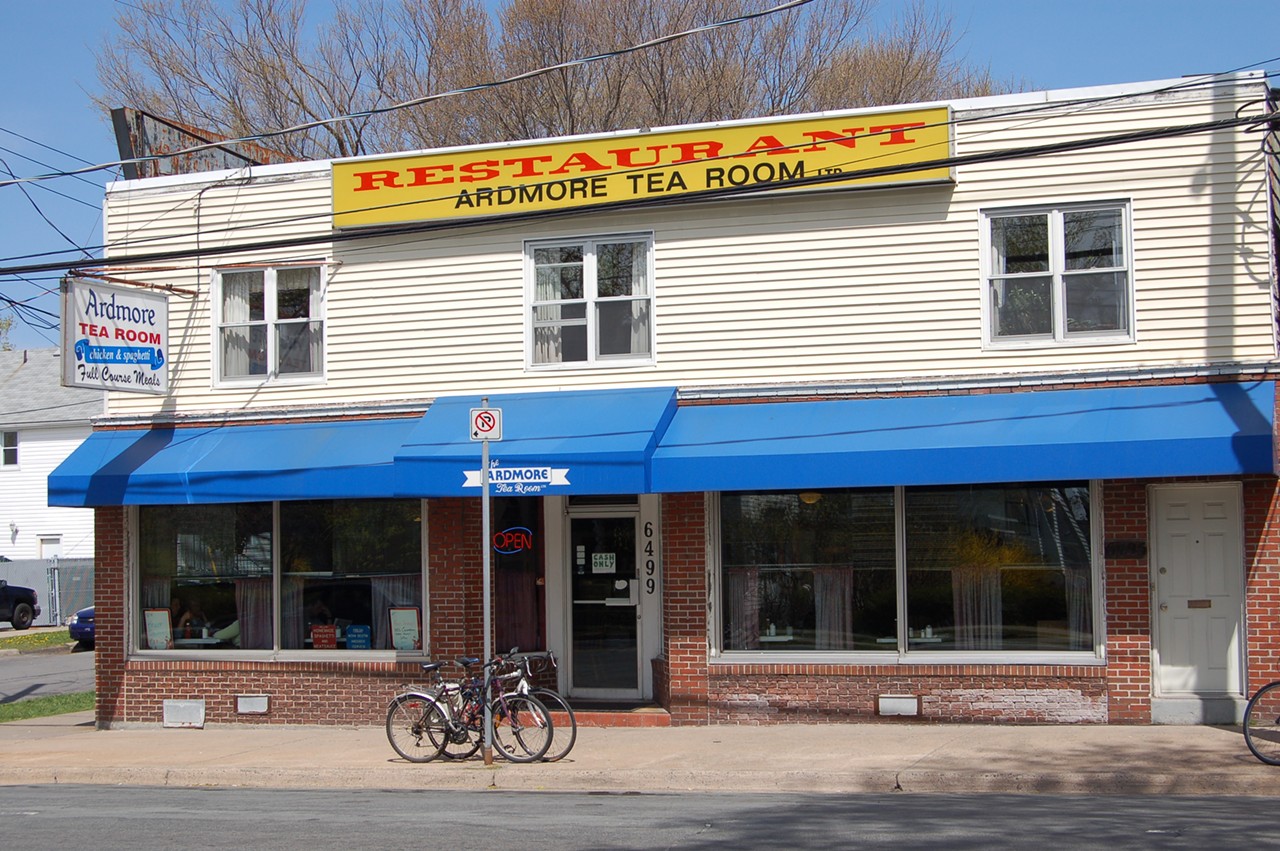
I’ve lived long enough that all of my favourite restaurants are gone except two. Don’t worry, I still manage to eat out – I adapt.

Of those two, one is the long-lasting Ardmore Tea Room. And if I didn’t enjoy this place enough already, when I dined there yesterday I was asked “Would you like fried onions on your hash browns?”  I was tempted to answer “Is The Pope Argentinian?” but, instead, I just gleefully said “Yes!” Gleeful – in part – because they were accompanying Eggs Benedict. {You can note a bit of food = religion theme.}                                


As far as I know the Ardmore has been in the same location, and has been there for decades. It opens at 5:00 AM and closes at 8:00 PM. You don’t open this early in the morning if you don’t get steady customers. People on their way to work, and people coming home from work. A restaurant of the people, it is obvious.

The seating is at booths, and I have never been there when at least half of the booths were not occupied. The age range of the diners covers the decades, and I’d guess their economic backgrounds are just as diverse. I’ve never seen anyone encouraged to depart as soon as the check was paid, and as far as I know the coffee is bottomless.

By the way – the food is great!

There is an array of diner staples, plus dinner selections ranging from lasagna to chipolte chicken wraps. You can get shakes and sundaes. And rice pudding.

$Cash$ only – no credit cards.

As I sat over my third coffee and empty plate, listening to the murmur of many conversations and bursts of laughter, I finally realized what I had noticed during my meal. Noticed by its absence, so it took a while to register.

Not one person was using their cell phone.

DE

Kafka Goes To The Movies

ever watching

Although Kafka disliked most technology, he did love to go to the cinema. He also had a great fondness for theatre and actors  (and particularly actresses), though he does not seem to have written any plays.

In the Prague of Kafka’s day, various charities were associated with particular cinemas.  When one paid for a ticket, a portion of the price went to the charity associated with the cinema. You could help the hungry, the homeless, people with medical needs.

Kafka (being, after all, Kafka) particularly enjoyed attending the theatre for the blind.

The Bluenose

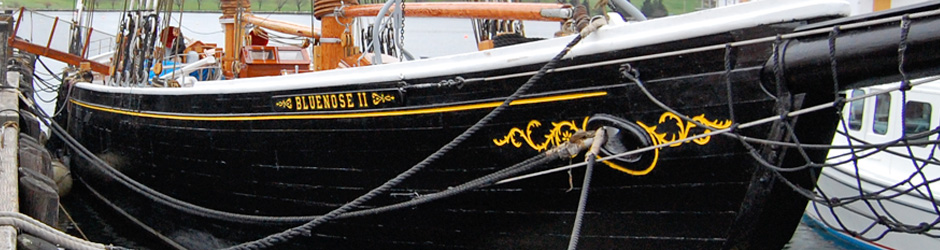
 A number of years ago, I was seated on a bench in Halifax, watching a cruise ship prepare to leave.  I had noted a tall-masted sailing boat pass, but was more immersed in the huge ship leaving port. Suddenly a man was at my back, asking me to move so I would not get struck in the head.
I turned to see the sailing boat – The Bluenose – coming alongside. It edged toward the dock, closer and closer, and then a crew member on the bow shouted to me.  He asked if I would grab a rope when it was thrown. I agreed, happy to do so. I immediately  had the bow line in my hands and at my feet.

They shouted down to me and asked that I put it over the ‘second’ post. This proved to be quite a chore for something thicker than my arm and heavy in weight.  It took a couple of minutes, but I slipped it over. I jumped back. It was a taut rope indeed.

DE

Death Masks and Death

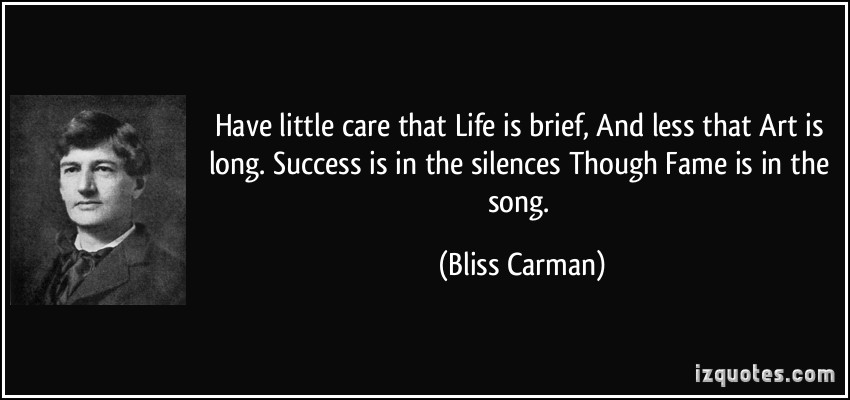
Bliss Carman, whose death mask it was, and who supplies an appropriate quote.

I took advantage, for my workshop on the Supernatural, to take my students on a field trip to see the death mask of a historically known poet, conveniently placed in a near-by building.

None of them had even heard of ‘death masks’, let alone seen one. I invited them to incorporate the idea of a death mask into their writing exercises. Some did, some did not. However,  it’s possible this visit to death elicited the following story from one of my students. If any do take a look here, they’ll see that I said what I meant about writers stealing all and sundry.

My student and her husband had purchased a new house. Cleaning and renovations eventually took them to the back loft area, which was piled high with decades of accumulated detritus from a long life. They cleared out beds and boxes and newspaper piles and magazines and bundles of clothes and on and on. Anyone who has had to clear out a house knows what this is like.

Near the end of this process, my student noticed a “clump of something” on one of the wooden beams in the ceiling of the loft. Getting ladder and flashlight, her husband climbed to see what it was.  He did not nearly fall from the ladder – that’s hyperbole – but he was definitely taken aback. It was the end of a number of knotted bed sheets.

DE

Create a free website or blog at WordPress.com.

Up ↑