Search

kafkaestblog

It is a whirlwind in here

Category

history

100 Years Ago Love Goes So Terribly Wrong For Kafka

dopis_felice

When I wrote my novel, Kafka In The Castle, filling in all of Kafka’s missing diary entries,  after a few months of writing, I found something very interesting. The day/month/year I was writing about, mirrored the day/month/year in which I was writing.


For example, if the 03 of July was a Friday in my writing year, it was also Friday, 03 July in 1917.


It was an exciting surprise, and made (I think) for more immediate writing.

When Kafka became so ill he he took leave from his employment, he stayed with his sister Ottla in a village, hours from Prague. The following recounts the visit of his fiance,Felice.


Here is 23 &24  September from Kafka In The Castle.

~~~~~~~~~~~~~~~~~~~~~~~~~~~

23 September 1917

The trials of Felice. The trials of Franz. As they are put together in this obscure little village – with animals and harvest and the clatter of waggons without.

Because of the war, her train journey an ordeal of thirty hours. Only to reach this destination. This lover who doesn’t …even have the grace to love another.”

That is something F. can understand.


24 September 1917

The two days Felice spent here a trial of misery. A trail of misery. Even – I suspect – when she slept.

It is fortunate that I am ill, for it lets her see me in life, the way I am in spirit. The`me’ she would have to fight against. The `me’ which is always opposed to her.

We shared quiet meals, grateful and annoyed by Ottla’s constant chatter. As good a hostess as possible to this strange, sullen couple.

Ottla must have been thankful that her chores took her away as often as they did. I had no such excuses, yet could offer nothing in their place.

F. and I were truly left to each other, and any thoughts she might still have about us getting married must surely be removed.

When we did talk, it was about the change in seasons, the harvest (she took an interest), her work in Berlin. About my health when I seemed to tire (my weariness not all caused by being sick).

We rarely held hands on our walks – just briefly, in the minutes as we returned.

The few kisses were perfunctory.

Not even for memories of things past.

100 Years Ago: Kafka On The Move from “Kafka In The Castle”

cgwaytuxiaasez_

[The Swiss Girl]

12 September 1917

Max came to the station with me this morning, which was kind of him.

He was not in as good spirits as was I, for he does not have the joy of escaping Prague to assuage our parting.

I obviously did not help matters when I pointed to the two men carrying my things, and said that they could be carrying my coffin.

He did not even attempt a forced smile.

Or force an attempted smile.

My possessions were bundled into the baggage car, and I was prepared to be folded away there too.

But they allowed me a compartment, and as we parted, I shook the empty hand of Max.


13 September 1917

This might even be the type of place for the Swiss girl. Unfettered – perhaps singing.

I’ve had the strongest desire to be with her this morning.

Maybe I had a dream.

The strongest desire to contact her – regardless of what we promised.

But – after all these years – I probably could not find her, even if I tried.

And I have no idea who I might find if I succeeded. Not the girl of memories.

And who, anyway, would she find?

What look would cross her face and still her song?

Because – I have become me.

DE

The Funeral Ends For A Dead Princess

From Being Famous:

He wonders where Diana is.

If the whole context of this service is correct, and her Spirit Everlasting is afloat in some other world, does she have the slightest interest in these proceedings? Do you care what is on the plate after you have eaten the meal?

Is it – as he hopes – an all new wonderful adventure?

ST is returned to the present by the familiar words of The Lord’s Prayer. He is actually reciting  “Give us this day our daily bread” before he realizes what he is doing.

Stopped in place and time.

He could be a child again (perhaps he is) wondering what `trespasses’ are. He could be the aware young man, wondering why God would have a penchant to lead us into temptation. And he could be as he now is, wondering if this was the only way for a troubled young woman to be delivered from evil.

ST is fully attentive to the final hymn, and The Commendation of the Dead to the Lord.

He suspects it is an all-or-nothing package: that Diana and Jesus and God are present and appreciative to what is happening around him; or that he and everyone else are just singing and praying to the empty rafters. He fears his faith has skidded to the unstable foundation of hope.

The cortege prepares to leave the Abbey. Although the choir sings as the procession slowly moves to the west end of the church, it is really silence which hangs over this vast array of people. Again the casket with its ruptured body wend their way down the aisle, the flower arrangement an almost dull glow in this final, sombre setting.

“Weeping at the grave creates the song.”

Or so the song goes.

Then there is the final minute.

The minute of silence.

Observed by the Nation.

Observed by ST.

Observed -perhaps- as a minute’s pause in the enormous expanse of Eternity by a dead princess.

(image)http://www.westminster-abbey.org/__data/assets/thumbnail/0006/90933/Diana-fun-1997-outside-72.jpg


One Hundred Years Ago: Kafka & Summer & Freedom

original

Excerpt from my novel, Kafka In The Castle:

~~~~~~~~~~~~~~~~~~~~~~~~~~~~~~~~~

September 1917

Even though I wait for  the summer to be over, I am always surprised by the abrupt transition.

One Wednesday it can be uncomfortable to walk the streets in the afternoon, but by the weekend it seems I should put the windows down at night.

Now, I have these other desired passages thrust suddenly upon me, but for all my longing I am woefully unprepared.

I am back in my parent’s apartment, but it is only for another week. Then, I am going to Zürau to be with Ottla.

I have been granted three months leave from the Institute.
The Director is most concerned about my state, and speaks of my invaluable contributions. He seems to mean it. Would not hear talk of my resignation.

So, I get to follow Ottla out of Prague – almost with carte blanche.

And there is nothing more to be done with Felice. I may have written her my last letter. What good is a tubercular for a husband?

But – to be with Ottla. To be out of Prague.  To get away from Prague!

DE

(image)data.whicdn.com/images/168943871/original.jpg

History Follows The Footsteps Of Franz Kafka 100 Years Later

kafka

(Franz Kafka, and his sister, Ottla, in Zürau)

A hundred years ago, in the Autumn of 1917, Kafka started his stay in the small village of Zürau (as it was then known) a few hours train ride from Prague. He was there from September 1917 to April 1918, living with his sister Ottla, who was managing a farm. It was in this time he wrote the book which became known as The Zürau Aphorisms.

The Village is now called Sirem, and this month a permanent photographic exhibition has opened in a local house.

Here is a news article about the event, followed by the first of my fictional diary entries about Kafka’s stay in the village. Time certainly marches on

DE

New Kafka exhibition opens in Czech village where he stayed

ČTK |

21 August 2017

Sirem, North Bohemia, Aug 19 (CTK) – A new exhibition on Prague-born Jewish German writer Franz Kafka (1883-1924) focused on his travelling has opened in Sirem village, where he stayed 100 years ago.

The permanent photographic exhibition shows less known sides of the writer. It presents him as a man in a good shape who liked rowing and preferred vegetarian diet.

Kafka arrived in Sirem in the summer of 1917 after he was diagnosed with tuberculosis.

“His relatives thought that he would choose some sanatorium, but he went to see his beloved sister Ottla who was running a farmstead in Sirem,” journalist Judita Matyasova, one of the display authors, told CTK.

She and photographer Jan Jindra were travelling to follow in the footsteps of Kafka for 14 years.

Kafka liked Sirem, the then German village, so much that he stayed there for eight months, which was the longest time he ever spent in the countryside.

Some literary historians are of the view that Sirem inspired Kafka’s novel The Castle (1926).

Kafka’s fans started visiting Sirem in the 1990s.

The new display is installed in a former oast of a farmstead. The first floor houses photographs taken during the trips of Matyasova and Jindra to the places where the writer stayed.

“This was a detective’s work. We were searching for how the sites looked like when Kafka visited them… and what he was doing there,” Matyasova said.

Works by young photography students inspired by Kafka’s short story The Burrow are displayed on another floor.

People can also visit the information centre near the church in Sirem to see old photographs of the village from the time when Kafka stayed there.

“(Former Czech president) Vaclav Havel also visited the village. He wanted to shoot a film inspired by Kafka’s novel The Castle together with Milos Forman,” Matyasova said.

The new exhibition is opened from 13:00 to 17:00 on weekends only.

A mini-brewery to make beer from a local hops sort might be opened nearby in the future, said David Herblich, whose parents own the farmstead where the Kafka display is situated

http://praguemonitor.com/2017/08/21/new-kafka-exhibition-opens-czech-village-where-he-stayed

~~~~~~~~~~~~~~~~~~~~~~~~~~~~~~~~~~~~~~~~~~~~~~~~~~~~~

Excerpt From: Kafka In The Castle

QUARTO XII


16 September 1917

Sunday dinner is certainly different here. The food – of course. More staple perhaps, but also fresher and richer. But the atmosphere is free. No etched pattern to follow; no dullness of similar fare and similar talk; no tension bubbling underneath because of what father was going to say. Ottla laughs because something is funny, not because she’s prodded by family expectation. I have often thought that our dread of the Sunday dinner started sometime on the Monday morning.


17 September 1917

A whole week away from the office. F. will soon pay a visit.


20 September 1917

Dreamed a mixture. I walked – a desolate figure trudging the vast Steppes. Yet I rode wildly – a madman with my forehead pressed against the compartment window. And I saw myself as the train raced by, outlined by the yellow light of the coach; and then a slender body turning to stare at the racing train. We both hollered, but noise and distance obscured our voice. The vast Steppes turned into a castle, but the castle was displayed in the photos of a magazine, which I held on my lap in the flickering light of the compartment, as the train became engulfed  by the large buildings on either side of the tracks. In the magazine there was a railway at the base of the castle, and as I looked out the window the stone walls filled the frame, each giant block wedged securely to the others, their facing protruding and rough. It was as if the train had entered a tunnel, except there was still light from the distant sky.

I turned a page, and had to squint to see the pictures. Along the whole bottom of the magazine pages, a train obscured part of the castle wall, almost becoming a part of the stones. Black and white, light and shade, blending into a sepia which smudged all the details. Was there a figure in the window?


23 September 1917

The trials of Felice. The trials of Franz. As they are put together in this obscure little village – with animals and harvest and the clatter of waggons without. Because of the war, her train journey an ordeal of thirty hours. Only to reach this destination. This lover who doesn’t “even have the grace to love another.” That is something F. can understand.


24 September 1917

The two days Felice spent here a trial of misery. A trail of misery. Even – I suspect – when she slept. It is fortunate that I am ill, for it lets her see me in life, the way I am in spirit. The`me’ she would have to fight against. The `me’ which is always opposed to her. We shared quiet meals, grateful and annoyed by Ottla’s constant chatter. As good a hostess as possible to this strange, sullen couple. She must have been thankful that her chores took her away as often as they did. I had no such excuses, yet could offer nothing in their place. F and I were truly left to each other, and any thoughts she might still have about us getting married must surely be removed.

When we did talk, it was about the change in seasons, the harvest (she took an interest), her work in Berlin. About my health when I seemed to tire (my weariness not all caused by being sick). We rarely held hands on our walks – just briefly, in the minutes as we returned. The few kisses were perfunctory. Not even for memories of things past.


26 September 1917

Two weeks away from the Institute. I should – for would not a normal man? – miss something. I’ve taken to feeding the animals.


27 September 1917

In Prague, I often wondered what to do with many of the empty hours. I would lie on the cot, or sit at the table, or walk the streets, but the boredom and despair clung to me like a tattered garment. There were many such days – many long afternoons with the dread of the torpid Sunday dinner damning the course of the day. But here in Zurau, though I spend hours just reclining in the fresh air (as I am supposed to do), often not even looking at the books which I have at my side, I feel comfortable and content. I suppose that I can not go without thought, but I find I can not even tell Ottla (for she asks me) what it is my mind has been doing over the course of the hours. Of its own volition, it must go to those places unknown to me.


30 September 1917

There was a knocking at the window this morning. A polite and concise rap rap rap. It awoke me while the room was barely light. Who could want me so early? And then again, an insistent rap rap rap. I was confused, wondering where I was. The panic of Prague weighted down the covers, and I was sorry I had opened my eyes. The room, the smells – even the bed – was not familiar, so I was both bothered and assured by the strangeness. When I realized I was not in Prague – for who could knock on my third floor window – I remembered I was in Zurau, where things were different. Here my window looked onto a yard, and anyone could  be at it. Was there something wrong? Was Ottla after my help? I even wondered, as I searched for my slippers, if her young man had somehow arranged leave from the army, and after much travail had managed to reach the wrong room. I could understand that very well.

I walked hesitantly over to the window, and cautiously pulled back the curtain. Such a commotion ensued that I stepped back in some fright. A bird flew immediately past the glass, its wings frantic as it screeched in agitation. It had been perched on my window ledge, pecking away at the frame. Ottla says it may have been after insects or grubs settled in for the winter.  “Insects in the walls of the house?” I asked.  “Yes.” She was quite matter-of-fact.  “It is a warm place for them during the cold months.”  I was not inclined to argue with the logic, but neither had I thought I would be existing in such close proximity with the tenants of nature. Houses for warmth and bugs for food. It is a blend of the base and the subtle which I can appreciate. Much – I like to think – as does the annoyed bird.

When The Army Wanted Kafka As A Soldier

franz-kafka-cocuklugu

Kafka recorded the beginning of the First World War in his diary this way:

August 2, 1914: Germany has declared war on Russia. Went swimming in the afternoon.

That was it.

But, regardless of his lack of enthusiasm, Kafka believed in the duties of the citizen. He tried to join the army to fight. In fact, he tried to join a number of times. He was always refused because the government deemed his civil/government job was too important for him to relinquish.

But, near the end of the war, when Kafka was so sick he had lengthy periods of leave from his job to recuperate, the army came calling.  Kafka had to appear before authorities with medical proof of his illness.

In my novel, Kafka In The Castle, I ‘fill in’ one of his diary entries describing such a situation.

DE

~~~~~~~~~~~~~~~~~~~~~~~~~~~~~~~~~~~~~~~~~~~~~


07 February 1918

I find I must go to Prague at the end of next week. Such knowledge is proof that one should not open one’s mail. The Military yet again wishes to snare me, and I must once again prove that my hide is not worth the effort.

There were times (very rare) when my father would despair. Not his usual anger at the general incompetence and perfidy of the world around him, but a resignation to the belief that things would never get any better.

“If they want to drag me down,” he would say, “Then I may as well join them. I’ll go out into the street and let myself be swept away by the mob. I’ll become part of their common, grubby life, and let them wipe their boots on me.”

That is much as I feel right now. Let the army take me, dress me in their uniform, point me toward the Americans, and have some cowboy shoot me. Going into battle could be no worse than going into Prague.


Trump And A Nazi Walk Into A Bar

virginia-torch-protest-salute

~ Willkommen, Mein Führer.

~ Now cut that out.

~ But we are at your service.

~ You good old boys are giving me a bad name.

~ We support you in your Holy Crusade.

~ To make America great again?

~ If those are the code words you want to use.

~ The words are broad … and vague.

~ You should be more exact.

~ Like ‘living space’?

~ The Volk liked that phrase – they understood we needed land.

~  Old times. Today they understand ‘the wall’. Believe me.

~  We’ll help you build your wall.

~  By driving cars into people?

~  There’ll always be the crazies.

~ Don’t I know it.

~ We can’t keep tabs on everyone.

~ Don’t I know it.

~ We’ll sacrifice the schmuck.

~ Yeh – but. Tell me this one thing.

~ What?

~ Torches?

~ What?

~ Did you morons really have to use torches?

DE

(image)https://static.independent.co.uk/s3fs-public/styles/article_small/public/thumbnails/image/2017/08/12/09/virginia-torch-protest-salute.jpg

Trump And A Soldier Walk Into A Bar

1492068958122

~ Good Day to you, Mr. President.

~ Take it easy, soldier.

~ Sir.

~ You know – at ease.

~ Yes, Sir.

~ What can I get you?

~ I’m not allowed to drink on duty, Sir.

~ I’m your Commander-in-Chief. I can allow it.

~ You’d have to order me, Sir.

~ Would that work?

~ I don’t know, Sir. That’s above my pay grade.

~ Not above mine.

~ No, Sir.

~ I have billions.

~ Yes, Sir.

~ Billions and billions and billions.

~ Yes, Sir.

~ I could pay you to drink.

~ I couldn’t take pay, Sir.

~ It would be a bribe?

~ No other word for it, Sir.

~ So – what do you think of the cross-dressers?

~ Pardon me, Sir?

~ You know – cross-dressers in the military.

~ We’re all cross-dressers in the military, Sir.

~ What?

~We take off our civvies and put on a uniform. Sir.

~ Then that isn’t it.

~ No, Sir.

~ Gotcha. It’s the transgenders.You know them?

~ In truth, I don’t, Sir. Those uniforms keep things private.

~ But you must wonder about them.

~ Not for a second, Sir.

~ You don’t care what’s between their legs?

~ No, Sir.

~ That doesn’t sound natural.

~ Sir, as long as they carry a gun and got my back – I don’t care what’s between their legs.

DE

(image)a57.foxnews.com/images.foxnews.com/content/fox-news/us/2017/04/13/ap-fact-check-do-trump-mar-lago-trips-cost-3-million/_jcr_content/par/featured-media/media-2.img.jpg/876/493/1492068958122.jpg?ve=1&tl=1

A Hotel In Prague Where Once Kafka Worked

I have visited Prague for my novel, Kafka In The Castle, and visited many of the places that were part of  Kafka’s life. One such place – the small house where he wrote a whole book of short stories – became a setting for a third of my novel.

However, the place where he was employed and toiled  for so many years, The Workers’ Accident Insurance Institute for the Kingdom of Bohemia in Prague, I only saw at a distance across a Square. It was not a happy place for Kafka, though he was very successful at his employ, and rose to an administrative position of importance. It was not really much of a setting for my novel.

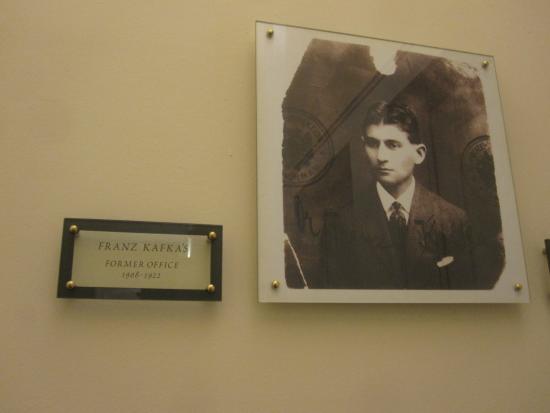
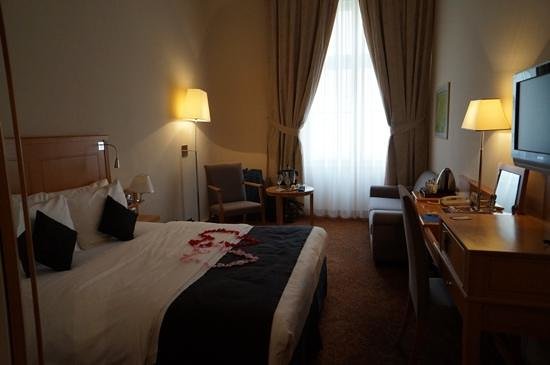
That building is now a fancy hotel, and Kafka’s office is a room for rent. It is even designated The Franz Kafka room, and contains mementos. It is where I plan to stay when next I visit. I hope there is not a long list of folk wishing to spend the night there, too.

Here is some information, and some photos of the room.

In addition, is one of the few diary entries I wrote, set in his office building, for Kafka In The Castle.

DE
~~~~~~~~~~~~~~~~~
The hotel is situated in the heart of Prague, next to the Old Town Square, where the famous medieval astronomical clock is mounted on the southern wall of the Old Town City Hall. The Neo-Baroque building was built in the 19th century by Alfonse Wertmuller, a famous architect in Prague. It was formerly the office of the Workers’ Accident Insurance of Kingdom of Bohemia, where Franz Kafka worked as an insurance clerk from 1908 to 1922. His spirit can still be felt in the hotel, as his bronze bust welcomes guests in the lobby in front of the majestic stairs.
hotel-century-old-town
room
~~~~~~~~~~~~~~~~~~~~~~~~~~~
Excerpt from Kafka In The Castle

16 February 1917

There was a commotion at the office today. It was late morning, and from far below, coming up the stairwell, I could hear a voice bellowing: “Doktor Kafka. Doktor Kafka.” It was a terrible voice, full of blood and darkness. I got from my desk and went to the door. There were other voices, trying to calm, saying: “He can’t be disturbed.” But the voice was louder, more horrible, close in the corridor.  “Doktor Kafka – for the love of God.”   My secretary wanted me to stay inside, hoped the man would just move along the corridor until the police were summoned. But – I was curious; the man had my name, and his voice was … terrified.

I opened the door and stood in front of it.  “I’m Kafka,” I said. The man lunged at me, and went to his knees.  “Doktor Kafka?” he said.  “Yes, I’m Kafka.” He reached out, grabbing for my hand.  “Jesus, Jesus, for the love of Jesus – they say that you’ll help me.”  He was a heavy man, and looked as if he had the strength to pull off doors, yet the tears burst from his eyes.  “I can get no work. I fell from a bridge, and my back is twisted and in pain.” He slumped against the wall, looking at my eyes.  “I have a family, Doktor Kafka. A baby not a year old.”  “You were working on this bridge?” I asked.  “Yes.” His voice slid down his throat. “I was helping repair the surface.”  “Then you deserve your insurance. Why can’t you get it?” He straightened up, and tried to stand. “I have to fill in papers; the doctor can see no wounds; the foreman said I drank; because my brother is a thief, I am not to be trusted.” I held out my hand, and he slowly stood. “I’m telling you the truth, Doktor Kafka.”  “If that is so,” I said, “you’ll get the money due you.”  “I’m so tired,” he said.

I gave instructions to those standing around – no other work was to be done until this man’s case was decided. I took him to my office, where he sat. He sat – practically without a word – for five hours. I summoned a prominent doctor to look at him. The doctor prodded, and the man screamed. Officials from his village were telephoned. I helped him with the details on the forms. His truth was in his pain. He left our stony building with money in his hand, and his worth restored. The people who assisted me had smiles on their faces. A man had needed their help.

Blog at WordPress.com.

Up ↑