
Happy Anniversary with WordPress.com!
You registered on WordPress.com 11 years ago.
Thanks for flying with us. Keep up the good blogging.
Happy Anniversary with WordPress.com!
You registered on WordPress.com 11 years ago.
Thanks for flying with us. Keep up the good blogging.
In Kafka In The Castle, I fill in the ‘missing’ diary entries from Kafka’s real diary. He either did not fill in these days himself, or he destroyed them. There are some estimates that Kafka destroyed 70% – 80% of everything he wrote.
*********************************
15 January 1917
Dreamed that I never dream.
“That can’t be true,” said AB, dropping the papers she held. “Everybody dreams.”
“It never happens to me,” I insisted. “And what’s more, I don’t really believe that anyone else dreams, either.”
“Of course people dream,” said AB, dropping bunches and pots of flowers on the floor. “I dream all the time. I’m full of dreams every night.”
“Even tonight?” I asked, excited, because I had some power, some type of knowledge, although I didn’t know what it was. “Tonight,” she repeated. “Especially tonight,” she said, dropping bowls of snow on the floor. “It is right now, right here.” Her voice was also full of excitement. “I am dreaming about you.”
“Me?” I said. “You can’t be dreaming about me. I’m right here – I’m not in your dream.”
“Not only are you in my dream,” she said, dropping automobiles and tram cars on the floor, “but you’re talking in your usual obstinate way. You’re cross, and you’re silly, and you’re shaking your hands at me.”
“I’m doing no such thing,” I said, wringing my hands and starting to yell.
“You’ve taken your absurd thoughts,” she said, dropping pieces of Prague on the floor, “and you’re forcing me to be part of them.”
“Even if it’s true – all true,” I said, trying to sweep Prague into the river, “it still isn’t me. You’re the one having the dream.”
AB snatched the broom out of my hand, and dropped it to the floor. “Then try to wake me,” she said.
16 January 1917
I have the feeling, that what I really am doing at the office, is committing suicide. And doing a good job.
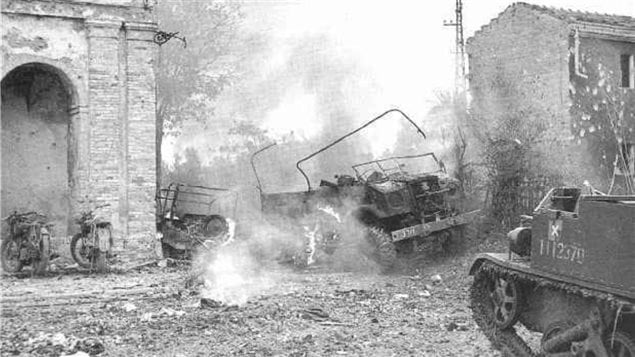
My father, Byron Caleb Estey, served in the Canadian Army for the entirety of the Second World War. He was 31 when he signed up, and was a decade or more older than most of the soldiers he served with. At the end of the war, he was offered an instant promotion from Corporal to Sergeant Major.
He declined. He had had enough.
He was with the 90th Anti-Tank Battery. He was the member of the crew who calculated the coordinates to aim the gun and destroy targets. He did this up through Sicily and Italy, except for those times when he grabbed his rifle to shoot at soldiers shooting at him.
I imagine I could write pages repeating the anecdotes he told – and maybe some day I will. He didn’t talk all that much about the war, and when he did, I’d guess 80% of his stories were humorous. The other 20% were not.
I regret not discussing his war experiences more with him, but he did not encourage it. I once asked how close he got to the German soldiers. He said, close enough to kill them.
He hated Germans and Japanese all of his life. I understand that this is not the way of most soldiers. They mellow. They come to understand that soldiers on the other side were doing a job, just as they were. My father was not one of these. Those 20% of his stories explained his attitude to me.
He fought in – arguably – the most horrific and bloodiest battle in the war, the Battle of Ortona over Christmas week of 1943. He marched over piles of bodies, and crawled over piles of bodies. Such were the details he would tell. He didn’t speak of his feelings, or use words like “horror”.
On Remembrance Day he would march in the community parade. He rarely lingered for a meal or beer or camaraderie at The Legion. He did not seem affected by the memorial event, and did not talk any more or less about his experiences just because it was 11 November.
Because his tales were more funny than not, I’ll close on what might have been his last funny story.
At his death, the Royal Canadian Legion wanted to conduct a small ceremony at the funeral parlour. They requested that his medals be pinned to his chest. But, the medals could not be found. This was odd, because they were important to him, and he always wore them for the Remembrance Day parade.
It is excessive to say that the whole house was searched – but not by much. Drawers, shelves, boxes, closets, clothes, were repeatedly searched. Nothing. The Last Post was played over a Veteran with no medals.
Months later, when the house was being sold and possessions were being removed, his clothes were searched before being given away. In the side pocket of a jacket he never wore were the medals, all spiff and shiny.
He would have smiled at that.
Dale Estey

Congratulations! Your site, kafkaestblog, passed 50,000 all-time views.
10/24/2025
As the Lighthouse Keeper on Partridge Island,
I have to make a monthly inspection
Along the shore of the whole island.
Of course, I make reports, and haul the
Moveable trash off the shore, and put it
Above the tide line (which is high),
So it won’t set sail again.
All this is true,
But,
What I’m really supposed
To report,
Are the bodies I find.
There are generally three or four a year,
Mostly beyond recognition.
I can spread out this chore if I desire,
But – generally – I prefer to do it over a
Couple of days.
Paw, my cat/kitten,
Black as deep tide pools
With one white mitten,
Always wants to come along.
He always regrets it,
When we reach the ocean tip,
Where he is surrounded,
On three sides,
By water.
He doesn’t like that.
And he always complains,
But he soldiers on.
Today was no different.
Although the day was beautiful,
With clear sky and pleasant wind,
The ocean had an odd, opaque shimmer.
It was like looking at the coated side
Of a mirror.
Paw – who has been known to step
Over a dead body to see what
Was on the other side –
Avoided the shore,
And stayed above the
High tide mark.
I guess he didn’t want to see
Something he couldn’t see.
He was impatient for me to haul ass.
And he let me know it.
{I’m The Lighthouse Poet Laureate of Partridge Island /1821 – 2025 / A lot of stuff have I seen / A lot of stuff to report}
DE BA UE
Paw, the cat/kitten,
Black as agate
With one white mitten,
Is turning into Narcissus.
He is gazing at himself
In a quiet pool of water,
Becalmed along the shore
Of Partridge Island.
He does – sometimes – look
Into the mirror,
And lingers.
I assume he sees
What I see.
But I know cats,
And many of the other animals,
Also look with their noses,
And ears.
Perhaps that is why
He gazes so intently,
Not being able to recognize
What he sees.
I’m The Lighthouse Poet Laureate of Partridge Island /1821 – 2025 / A lot of stuff have I seen / A lot of stuff to report. DE BA. UEL
Why – yes – yes, this is heaven on earth. Let the music soar.
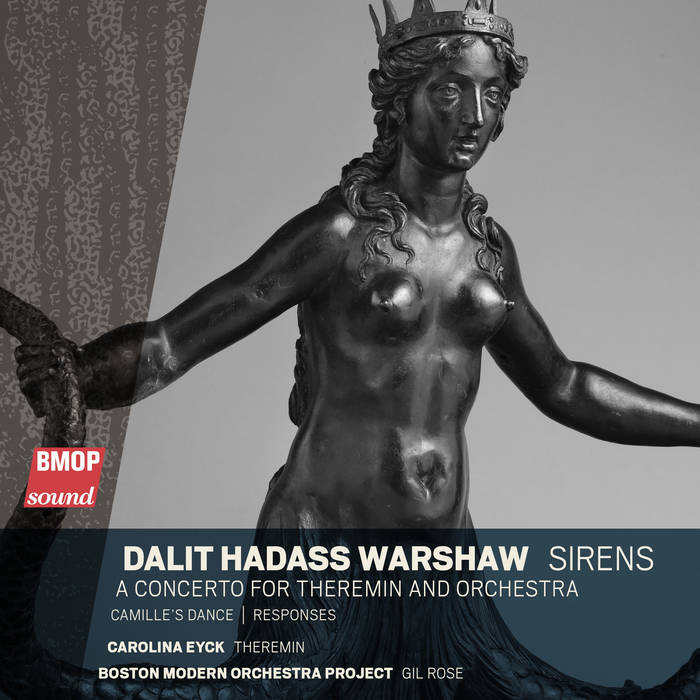
Dalit Warshaw
Sirens
Carolina Eyck, theremin
Boston Modern Orchestra Project, Gil Rose, conductor
Dalit Warshaw (b. 1974) is a multi-threat artist. As a composer and pianist, she has created a distinguished career. Her first orchestra piece was commissioned when she was eight years old, and this prodigious distinction has been followed by a body of work that encompasses music for orchestra, chamber ensembles, vocalists, choruses, and Letters of Mademoiselle (2018), a staged song cycle for the talented soprano Nancy Allen Lundy.
The theremin has become an important part of her work. Warshaw has performed the instrument in high profile settings, including appearances with the New York Philharmonic. Sirens is a recording of her theremin concerto and two other orchestral pieces, performed by the Boston Modern Orchestra Project, conducted by Gil Rose.
Responses (2016) is a triptych that reflects upon three of Brahms’s Intermezzos, piano repertoire that Warshaw has studied. Originally composed for solo piano and performed by Warshaw, it has been transformed into a work for large forces that sounds idiomatic in its instrumental writing. Indeed, Warshaw’s orchestration deftly captures both the sehnsucht of romanticism and her own aesthetic, which encompasses both neo-classical and mainstream contemporary classical elements. While the pieces themselves are earnestly serious (as was Brahms in his later years), one can have a bit of fun with the following listening game: without hunting down program notes, see if you can figure out from which intermezzo each movement takes its inspiration.
Camille’s Dance (2000) is named after visual artist Camille Claudel, whose sculptures La Valse and La Fortune grace the cover and interior of the BMOP recording’s booklet. It is a stirring piece, rife with dissonant harmonies and muscular gestures that epitomize the striking characters depicted in Claudel’s sculptures, as well as her fraught relationship with Auguste Rodin.
The soloist for Sirens is the thereminist Carolina Eyck. It is a three movement work that is inspired by Clara Rockmore and, of course, by the singing duo of temptresses found in Homer’s Odyssey, seen through the vantage point of Franz Kafka’s parable “The Silence of the Sirens.” The theremin was taken seriously as an instrument in part because of Rockmore’s advocacy. Eyck has explored an expansion of its capabilities with the Etherwave Pro instrument, which has an extended bass range. She also uses octave pedals to further extend the theremin’s compass.
Rockmore’s first instrument was the violin, and her theremin performances reflected this; several of the pieces in her repertoire were transcriptions of violin repertoire. Thus, the opening movement of Sirens is titled “Clara’s Violin,” which includes thematic material based on her life story and also themes that are ciphers of names: Clara, Leon Theremin, her partner and the inventor of the eponymous instrument, and the KGB, whose agents hounded and even kidnapped Theremin. One needn’t know any of this to appreciate the abundant vitality and craft of the movement. Warshaw’s own experience as a thereminist and her close collaboration with Eyck have yielded a versatile and challenging solo part that belies the notion of the instrument as being limited to special effects and transcriptions.
The second movement uses the Kafka story as a touchstone, with a stirring duo between theremin and piano that reminds us of the two-against-one scenario that Odysseus endured. The third movement is a wild ride with glissandos galore, a theremin specialty, set alongside a fugue that once again employs ciphers of names as its thematic material: “Theremin” as its subject, with “Clara” and “Dalit” used as two countersubjects. The combination of these two elements shows Eyck and her bespoke electronics to best advantage. It also highlights the extraordinary facility of BMOP’s musicians. Careful preparation and the dynamic leadership of Rose are clear in the performances of all three of the programmed pieces, but the jubilation with which the concerto is rendered makes it a strong finale to a thoroughly engaging recording. Recommended.
-Christian Carey
Interview with composer Dalit Warshaw
wmht.org/blogs/classical/dalit-warshaw-on-sirens-concerto/
AND LISTEN:

In my novel, Kafka In The Castle, I fill in the missing entries of his actual diaries. There are many days to fill, as he either did not write during these days, or he destroyed the record.
Kafka did have occasion to ponder Friday 13th. The date was connected to “The Swiss Girl”, whom he met at a resort. She was eighteen and he was thirty-four. It is unclear how intimate their relationship became.
Twice, I give him a brief recognition of Friday 13th. In reality, The Swiss Girl haunted him (pleasantly) all his life.
**************************************
13 April 1917
I almost wrote down the year as 1913. That was the year I met the Swiss girl. And I remember her joking about, and how we had missed it by just a day. She was superstitious – Christians seem to be. I wonder what precautions she is taking today. It will be three years and seven months since I saw her. Yet some of the things we did could have happened last week. I think that memory must be made of rubber. You can sometimes pull it toward yourself – and sometimes it snaps away like a shot. Causing as much pain.
13 July 1917
Friday the 13th again. What better time to think of the Swiss girl, than with F. I don’t know if such memories help sustain me, or if they revel how intolerable the future can sometimes be. I can not imagine the Swiss girl’s face across the table from me, nor her voice singing one of her quiet songs. If I must be trapped, then why can’t I be trapped in the past?
[The Swiss Girl ~ Gerti Wasner] p8.storage.canalblog.com/89/52/207513/106933578_o.gif
Franz Kafka died on 03/06/1924. He was a young man – a month short of his 41st birthday. However, his death was preordained years earlier. In my novel, “Kafka In The Castle“, I fill in the missing days of his diary. These are the entries I imagine concerning the days he actually found out his fate.
*******************
04 September 1917
A death sentence.
05 September 1917
Max is saying all the right things. All the nice things. And he is saying them all in the right way. An earnest, matter-of-fact truthfulness which sounds plausible. If he does not tread from a very narrow path. Sometimes I find myself a part of his hopeful speculations. And sometimes I find that I am trying to keep his spirits up. If he is going to all this trouble, then shouldn’t I do my part? But: it isn’t his blood. And anyway – he was the one who insisted on the specialist. Chose the renowned Dr. Pick. And heard – almost as soon as myself – the verdict. Tuberculosis. Tuberculosis engaged in both lungs. Like a preparation for marriage. The engaged man now flirting with another lover. And planning a marriage which will be far more permanent that any I could have had with Felice.

 kafkaestblog