Search

kafkaestblog

It is a whirlwind in here

Category

Canada

My Father, Byron Caleb Estey, Served In The Canadian Army For The Entirety Of The Second World War

151221_ce0h0_rci-m-burning_sn635

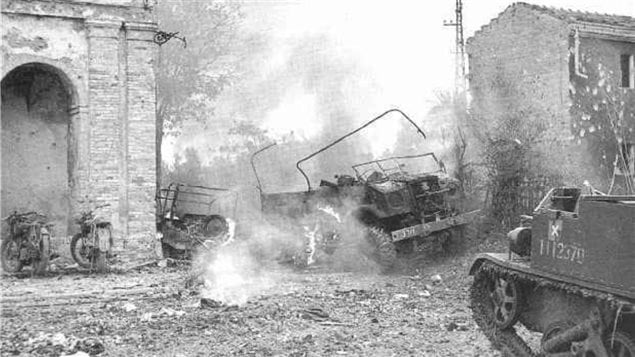
My father, Byron Caleb Estey, served in the Canadian Army for the entirety of the Second World War. He was 31 when he signed up, and was a decade or more older than most of the soldiers he served with. At the end of the war, he was offered an instant promotion from Corporal to Sergeant Major.

He declined. He had had enough.

He was with the 90th Anti-Tank Battery. He was the member of the crew who calculated the coordinates to aim the gun and destroy targets. He did this up through Sicily and Italy, except for those times when he grabbed his rifle to shoot at soldiers shooting at him.

I imagine I could write pages repeating the anecdotes he told – and maybe some day I will. He didn’t talk all that much about the war, and when he did, I’d guess 80% of his stories were humorous. The other 20% were not.

I regret not discussing his war experiences more with him, but he did not encourage it. I once asked how close he got to the German soldiers. He said, close enough to kill them.

He hated Germans and Japanese all of his life. I understand that this is not the way of most soldiers. They mellow. They come to understand that soldiers on the other side were doing a job, just as they were. My father was not one of these. Those 20% of his stories explained his attitude to me.

He fought in – arguably – the most horrific and bloodiest battle in the war, the Battle of Ortona over Christmas week of 1943. He marched over piles of bodies, and crawled over piles of bodies. Such were the details he would tell. He didn’t speak of his feelings, or use words like “horror”.

On Remembrance Day he would march in the community parade. He rarely lingered for a meal or beer or camaraderie at The Legion. He did not seem affected by the memorial event, and did not talk any more or less about his experiences just because it was 11 November.

Because his tales were more funny than not, I’ll close on what might have been his last funny story.

At his death, the Royal Canadian Legion wanted to conduct a small ceremony at the funeral parlour. They requested that his medals be pinned to his chest. But, the medals could not be found. This was odd, because they were important to him, and he always wore them for the Remembrance Day parade.

It is excessive to say that the whole house was searched – but not by much. Drawers, shelves, boxes, closets, clothes, were repeatedly searched. Nothing. The Last Post was played over a Veteran with no medals.

Months later, when the house was being sold and possessions were being removed, his clothes were searched before being given away. In the side pocket of a jacket he never wore were the medals, all spiff and shiny.

He would have smiled at that.

Dale Estey

After Margaret Atwood’s Memorable Memoir, Can I Be Far Behind?

I have shared this tale before, and feel encouraged to do so again. It is an odd milestone in my own writing odyssey, and when Margaret Atwood achieves a profound feat, as her new memoir reveals, I do take note. I have about forty pages of my own memoir done, and years to go before I sleep.

*******************************

It was not my intent to piss off Margaret Atwood.

The opposite, in fact. I wanted her to know she was an inspiration.

She was giving a reading at the University of New Brunswick in my student days. I attended, but there was quite the gathering and she was whisked away at the end. However, I overheard there was a ‘gathering’ in her honour. Invitation only, of course. Academia and literati.

I crashed the party (that was the term used by the professor who clapped his sturdy hand upon my shoulder but – happily – did not thrust me into the night).

But Ms. Atwood was kept deep in many a learned conversation and I had no opportunity to converse. I did, however, overhear where she would be spending next afternoon – the historic University Observatory.

Next day I knocked upon the Observatory door.

It was not a cheerful Margaret Atwood who answered, and answered with alacrity.

She asked my name.

She asked my business.

And she asked how the hell I knew where she was. She had stolen the day to do some writing. Some ‘real’ writing, in this window-of-opportunity grudgingly offered on the book tour.

At least I was there to praise Atwood and not to bury her with some essay question.

Nor had I a manuscript to hand to her.

I might not have garnered a smile, but her curt thank you was reward enough.

For me, at least.

DE

What Was The Result After A Month Of A Postal Strike In Canada?

When mail delivery resumed, in the two weeks since that time, I have received six (6) pieces of mail. Four (4) of them were filers (for pizza, etc); one (1) was a plea from the Red Cross; and one (1) was a Credit Card statement.

I do not want Postal Delivery to homes stopped, but I wonder if daily delivery should be reduced.

DE

2025 Commonwealth Day and Canada

It is positive for Canada to be part of The Commonwealth.

With dangerous (and Rogue) Countries putting too heavy a foot on the balance of power in the World, organizations of countries which are less powerful, offer more protection than standing alone.

This Commonwealth has evolved from an Empire, so it has gone from bad to better. Being led by a Monarch who rules only by the will of the people, leads to safety, common ground, and an equality among all the participants.

As of last year, the total population of the Commonwealth was over 2.4 billion people. Lets stack that up against Dangerous and Rogue nations. It comes to a reasonable balance.

Enjoy some “foreign’ culture and eat some different food.

Hold out your hand to an ally.

Dale Estey

The King and Ukraine and Trump and Putin (the Puppet Master) and Canada

I am troubled by the invitation from King Charles given to Trump. 

I believe it was orchestrated by the British government, but still, it is disrespectful and insulting. However, the invitation – and gracious greeting – by the King to the President of Ukraine, Volodymyr Zelensky, (in his working attire) is a brilliant countermeasure. I don’t know if this is His Majesty’s “soft power”, or if the government exercised a wonderful display of juggling. Regardless, I extend my praise and great thanks.

But, it is best to be patient with Royalty. 

His Majesty, King Charles III of Canada, received the Prime Minister of Canada at the same private residence where he welcomed President Zelensky.

I will happily concede the invasion of a sovereign state and ally, by a murderous thug, does take precedence over the wild blustering from Trump and his repulsive Vice president.  It is best to first deal with the ultimate source of power in the current USA.

Interesting times, anyone?

DE

Happy Birthday, Princess Anne The Princess Royal. Hip Hip Hooray!

The Sergeant Major barks more commands. This is a full-bore Military event. There are no civilian dignitaries present, although there are plenty of civilians.

       The Princess Royal is not going to inspect troops. She stands in silence, looking at a stand of trees and masses of people. Fred wonders what she is pondering. She thinks it has something to do with hearing ‘God Save The King’. The Princess Royal has helped bury two of them – and a Queen.

       “Sergeant Major?”

       “Ma’am.” The Sergeant Major is startled, but never too startled for words.

       “Put them at ease.”

       Even a Sergeant Major can not be prepared for everything, but the Sergeant Major acts immediately to the unexpected and strange request. He bellows his exact and time-worn orders, and both troops and band return to at-ease positions.

       “Fred, let’s take a look at this Memorial.”

       “Yes, Ma’am.”

       The Princess Royal gestures for both her Aide-de-Camp, and the General waiting in the wings, to accompany them. Fred knows HRH desires this event be as simple as possible, but she doubts local officials anticipated anything this simple. Even the couple thousand standing on the grass, walkways, and among the trees, sense this is a unique event. There is barely a murmur.

       Winnifred Mayhew Cudgel feels that something should be said. They should be seen to be talking. Such silence is, quite frankly, weird.

       “This is all for a horse?” Fred knows the answer, but doesn’t know what The Princess Royal really thinks.

       “Oh, so much more.” She looks at Fred. “A horse of hope. At war’s end, a horse of triumph.”

       Fred now knows what is going on. The horse, named Princess Louise after the regiment that found her, had been wounded on a battlefield in Italy. It had been found in a field standing beside its dead mother. Members of the regiment, so many of them farm boys from the country, spirited the horse away. Tended to its wounds. Fed and watered it. Put it into an enclosed truck and took it wherever they went.

       Officers pretended to know nothing.

       At war’s end, Princess Louise, alive and healthy, was put on a ship and ended in New York. From New York she was transported to Saint John, and from Saint John twenty miles away she ended her trip in Hampton, where she got a bale of hay, a bag of oats and was made a ‘naturalized Canadian’. She was given the “. . .  God-given right to trample and eat from any and all vegetable gardens.” She died at 29 in 1973, and is buried at The Princess Royal’s feet.

       “A mascot,” says Fred.

       “And, I think, a friend.” The Princess Royal chuckles. “They say she liked some whiskey and beer.”

       “Sounds like a good life.”

       “Eventually – yes.”

       The Princess Royal’s Aide de Camp approaches, accompanied by an older man.

       “Your Royal Highness, this is Mr. Finton. He looked after Princess Louise the last years of her life.”

       “I’d call her Lou.”

       “Hello, Mr. Finton.” The Princess Royal extends her hand. “Pleased to meet you.”

       “But always Princess Louise around other people.”

       “I understand.”

       “She was special.” Mr. Finton glances at Fred, glances at the Aide de Camp. “There was always respect paid.”

       “That is appreciated.”

       “I have something for you.”

       “Oh, yes?”

       Fred and the Aide de Camp look far more surprised than The Princess Royal. This was not part of any plan. Winnifred Mayhew Cudgel likes to create surprises – likes to spring them for effect – but she doesn’t enjoy them.

       “I understand you like horses.”

       “I do.”

       “Then Princess Louise would feel good if you have this.”

         Mr. Finton reaches toward an inside pocket of his jacket. Fred notices members of the Security Detail tense up and move closer. The Aide de Camp immediately puts himself between The Princess Royal and the man. Fred remembers that she is to duck and cover. Endeavour has told her often enough. And to roll. He has even made an interesting game out of it.

       Mr. Finton takes out a hand-sized package, wrapped in brown paper. There is twine around it, tied into a neat bow at the top,

       “I hope that you will like this, your Royal Highness. I think you can get nothing more personal.”

       Unexpected gifts are not to be given, and certainly not to be received. It could be dangerous. It could be insulting. It could be embarrassing. The Princess Royal does not hesitate to take it in her hands.

       But then, she gives it directly back.

       “Perhaps you will undo it.”

       “Yes, your Royal Highness.”

       Mr. Finton retrieves the package without looking at her. He is slow to untie the knot, but pays attention to no one around him. Perhaps he has forgotten them. The hundreds of people have gone silent. The only sound is the breeze through the trees.

       Holding the twine in one hand, he hands back the package.

       “I apologize for any inconvenience.”

       “Think nothing of it.” She looks directly into his eyes. “These gloves were not made for untying string.”

       The Princess Royal takes the package and opens up the brown paper. Inside is a commercial blue jeweller’s box, with a store name and the image of a diamond imprinted on it.

       “Are we to be engaged?”

       Mr. Finton is momentarily at a loss, then barks out a deep laugh.

       “Lord love a duck.” He shakes his head. “No, no, no.” He covers his mouth as another laugh escapes. “It’s the only decent box I could find.”

       “My husband will be glad to hear that.”

       The Princess Royal shifts her shoulder bag, then opens the box.

       “My God.” The Princess Royal laughs. “Straight from the horses’ mouth.”

       “It was one of her favourites.”

       The Princess Royal takes it from the box. She shows it to Fred.

       “It’s a mullen.”

       “Ma’am?” Winnifred Mayhew Cudgel is at a loss for words – an unusual state for her to be in. She has seen nothing like the object in her life.

       “A horse’s bit, held inside the animal’s mouth to control the reins.”        “I tried a number over a co

of years.” Mr. Finton rubs the metal. He glances at Fred and then looks at The Princess Royal. “I could tell this was the most comfortable.”

       “Did you ever ride Princess Louise, Mr. Finton[?’

       “I wasn’t supposed to.”

       “But?”

       “I was to exercise her every day. She was stabled out at a farm, some miles from here. Big pasture. Just walking seemed to be a bore.”

       “For you?”

       “Well – yes.” Mr. Finton pauses. “But, I think, for both of us.” He speaks quickly. “And I knew some of the soldiers had ridden her in Italy, when she was healed.”

       “Did she like it?” Fred is curious.

       “Yes.” Mr. Finton turns to her. “Absolutely.” He looks back to The Princess Royal. “Always gave me a nudge every day after that.” He has a smile on his face. “Always a gentle ride, mind. She was no filly.”

       “My mother liked to keep riding.” The Princess Royal smiles. “She was no filly, either.”

       “She was a great woman.” Mr. Finton bows his head.

       “Yes.” The Princess Royal puts the mullen back into the box. “She was.”

       The Princess Royal steps forward a few steps to look closely at the memorial. She has complete interest in what she reads, but this is also the signal that the event is coming to a close. Her Aide de Camp and the security detail prepare to leave. Discrete orders are spoken into microphones. Some car engines start on the street.

~ Dale Estey
When I Dined With An Olympic Silver Medal Winner

I once had the privilege to dine with two of Canada’s preeminent artists. I say privilege and not pleasure, because I soon realized I was out of my depth. I was more apprehensive than not concerning the conversation, and decided I’d best resort to asking a series of not too stupid questions.

This is not casting any negative aspersions upon my hosts. They were both charming and witty. And kind. And the meal was great.

I had been asked to supper by Helen Weinzweig, a formidable author who took fiction into unexpected directions. We were both among the instructors at a week-long writing workshop. I had been asked to say a few words of thanks to her at the end of a reading. Her noted book at the time was entitled “Basic Black With Pearls” which, according to the New York Review Books, is ” . . .recognized as a feminist landmark”. Helen  and I got along very well, so I figured I could slide into a bit of gaucheness with her. During my thanks, I presented her with the best string of pearls that one could purchase at Zellers. And made sure they were in a black box. She did a double take, no doubt to make certain they were fake (though I like to think she had a fleeting thought they might be real).

Her husband, John Weinzweig, was a well-established composer of classical music. His compositions were cutting edge, and often did not fit comfortably into the conventional ouvre. I’m guessing neither one of them had a mundane thought or opinion. There were certainly none presented that night. Which was both a joy and a trial to me.

Oh – and the food was great.

However, it was only yesterday that I found out John Weinzweig won a silver medal at the Olympics. In 1948. A Silver Medal for Music. Specifically for Instrumental and Chamber Music, with his piece ‘ Divertimento No. 1 . As it turned out, 1948 was the last year such “Art” medals were awarded.

I do like to think that, if I had known at the time, I would not have been gauche enough to ask to see it.

DE

Am I Looking Back To Sea?

I had the dream again.
Not a bad dream,
But an odd dream.
I have it often.
I’m on shore, and looking at
The Lighthouse
On Partridge Island.
And
As I sit there,
I wonder what I am doing
On the Island.
(You’d think I could have
Dreamed up a spyglass).
However, now awake,
I plan to turn my dream 
Into reality.
I made everything right

At the Lighthouse.
And I made sure Paw, my cat/kitten,

Black as night

With one white mitten,
Was played with, and fed.
I walked him to my dorey
So he’d know I would be away,
And
Away I went.

It’s a peaceful row,
The sea is calm,
The distance isn’t great.
The biggest chore

Is climbing up
From the rocky shore,
To settle into the comfort
Of the trees.
But, I did,
And I did.
I sat upon
A grassy perch
And looked back
With my spyglass.
What did I expect to see?
What revelation did I hope?

Well – yes – I wanted to see

Paw, my cat/kitten.

And he did not disappoint,
Though he revealed no secrets,

He did the same damn fool
Leaps, and bounds, and rushes
From place to place.
I spied no secret trysts.
I was, however, myself
Taken by surprise,
When Michael, the Mi’kmaq Indian,
Approached my seating place.
He used no stealth,

For I would have never heard him.
He asked no questions.
I handed him my spyglass.
He adjusted it, and peered.
Many minutes passed.
He handed it back to me.
“Wild cat,” he said,
“Got Glooscap in him.”

I’m The Lighthouse Poet Laureate of Partridge Island /1821 – 2024 / A lot of stuff have I seen / A lot of stuff to report}

DE BA. UEL

Why Are The Crows Again On The Crow Tree?

Four houses down the hill, on my side of the street, a HUGE tree grows in a backyard. For many years it was a resting rook for flocks of crows on their daily migration.


The crows would leave the other side of the harbour around dusk. They would fly to their evening rookery on a university campus on this side of the harbour. I’d guess 5 miles (8.04672 kilometers) – as the crow flies. They would return between seven and nine the next morning, making another stop in The Crow Tree.
I estimate there were around two hundred crows, taking their ease for twenty minutes or so. There was some flying and fluttering around The Crow Tree, but generally they settled and stayed on the branches.

Other birds steered clear.

Then, about three years ago the university, which was the crows’ destination, decided to construct some additional buildings. This meant the removal of trees. Lack of trees meant that the crows would have to go elsewhere. So much for higher learning.

And, indeed, over the months, the crows visiting The Crow Tree diminished, and eventually stopped. I researched the situation and found out that “my” crows were just one cohort of a murder that could reach two thousand. And I found out that not all the crows stopped using the university for their evening roost. There were obviously enough trees for some of them.

But “my” crows stopped.

That is, until two weeks ago.

One morning, around 70 – 100 crows settled into The Crow Tree. It was a great surprise. They stayed an hour or so. With such few numbers, they were neither raucous nor flighty.  They murmured among themselves, but I could not decipher what they were talking about. And then they went on their way. They did not make a return evening flight, and I have not seen them since.

Was it some sort of reunion?


DE

Blog at WordPress.com.

Up ↑