Search

kafkaestblog

It is a whirlwind in here

Category

author

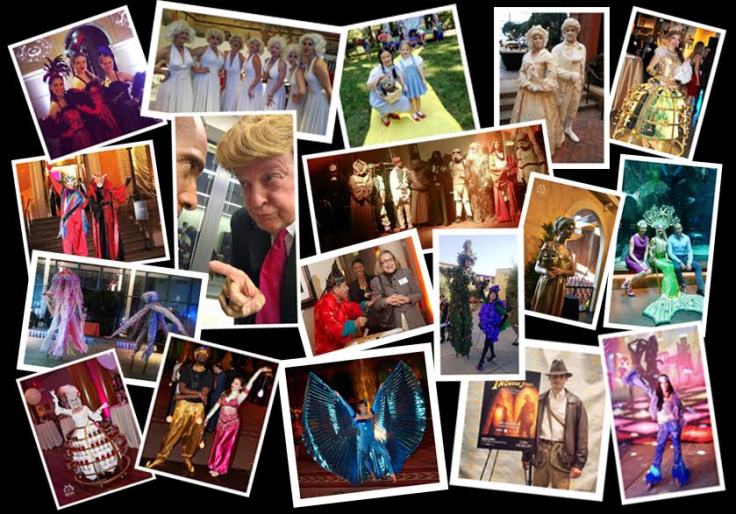
Second Bananas And Also-Rans Complete The Picture

20152bcollage

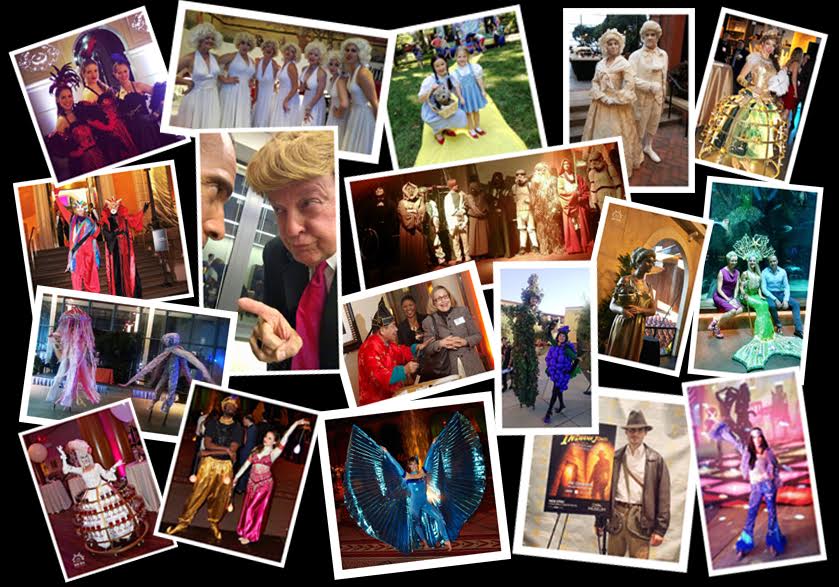
My onion novel, CHINA LILY, spans decades. My main family, the Cannaras, travel the globe (of their time, which is the Fourteen hundreds). Lots of time on ships. Lots of time on horseback.

In their distant locations over their diverse times they meet different people. These people fill the chapters they are in, but then they are gone. They are really secondary characters to the novel, but nothing could be accomplished without them. In their own time frame they are front-and-center.

This same situation happened in my *thriller*. The time frame was much different (squeezed into a few days). And the location was one city until near the end. But the nature of the immediacy and the surprising twists of plot and the intense action called upon the use of many secondary characters. They were figuratively press-ganged into action. They did their bit and were not called upon again. Louie-the-dog was to be a secondary character with a ‘walk on’ part. He stayed.

I am having a growing fascination for these secondary characters. They have to be developed within paragraphs instead of chapters. Their dialogue and thoughts have to be concise and unique from the start. They possess a freedom of action the main characters do not have. They are not loaded down with baggage. They are a challenge to write and difficult to rein in. They are generally saucy and rarely ponder their lot. Yet they must be real and not just plot devices. They have to be taken at face value and accepted quickly. They must stand out in the background.

A novel of only secondary characters – hmmmm . . .

DE

[image] https://3.bp.blogspot.com/-vZSuKHVPTpI/VsNpi-m3ekI/AAAAAAAAU7I/8JA_0K9LM_g/s1600/2015%2Bcollage.jpg

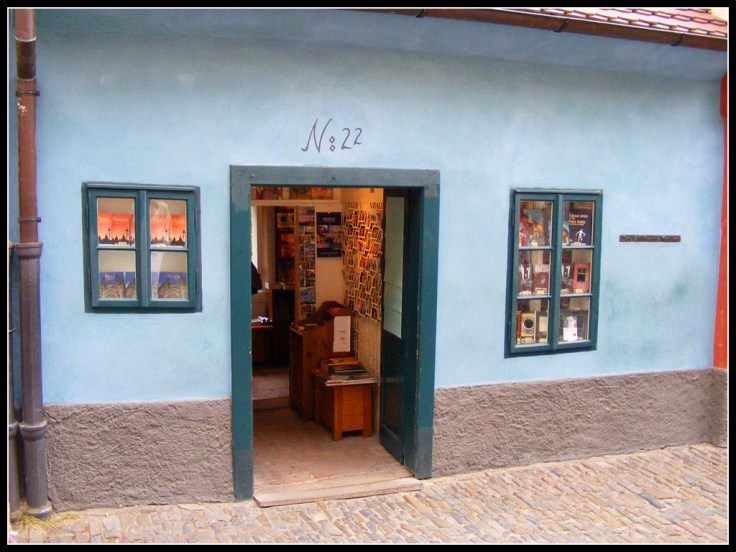
Franz Kafka Turns Words To Gold On The Golden Lane

3848764367_a7b9e65ed5_o

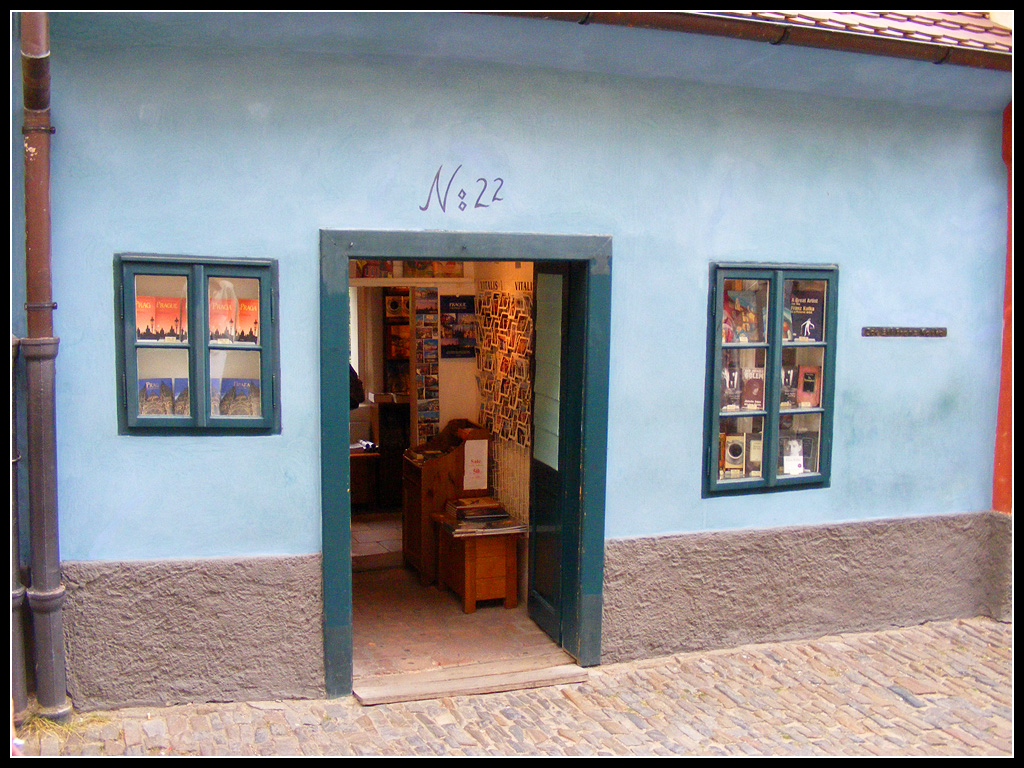
[Kafka’s house on The Golden Lane]

A burrow offers security and comfort.  Kafka found both in his sister’s tiny house on the Golden Lane.

The Golden Lane is a narrow, dead-end yet massively historic lane, hugging an interior wall of the huge Prague Castle. Centuries ago the small buildings along the lane housed workers of the Castle, including some resident alchemists. Thus the name.

Ottla – Kafka’s sister – had rented it so she could spend time with her lover, and not be bothered by parents and comments. Her lover was not only a Christian, but he was soon going to leave to fight in World War I. Time was precious. However, she rarely had opportunities to use it other than the weekends, so she offered Franz the use of the tiny house for most of the time. And use it he did, though he never stayed the night.

Through fall, winter and spring Kafka wrote a whole book of short stories there. For a single block of time, it was one of his most creative periods.

When I visited, under the Communist rule of the time, it had been converted to a book store. Of course (which he would have appreciated) there were no books by Kafka for sale. Today he is displayed in the windows.

It was only when I went thorough the small rooms, and looked out the window into The Stag Moat, that I realized how important the house would become in Kafka In The Castle, my novel about Kafka. It was cozy – even with the space cramped by tourists. It had been little altered. I could easily imagine Kafka looking through the same glass and walking through the same doorways. No doubt stooping because he was tall. Research met reality.

One of the last stories Kafka wrote, during his final year in Berlin, was called The Burrow. A version exists and is published, though a longer version is supposed to be among his ‘missing’ papers. In it a tiny animal keeps incessantly burrowing to keep away from an enemy. A vague noise convinces the animal to burrow deeper. Yup – that’s Kafka.

DE

(image) https://farm3.staticflickr.com/2645/3848764367_a7b9e65ed5_o.jpg

A Dream Of Death After Life [from: Kafka In The Castle]

wagon2-344181058_std

21 March 1917

Dreamed I was standing in a galleria with him. In a town in Northern Italy. We could see across the rooftops, to a plain slipping gently toward the foothills of the mountains. The day was clear – a cool spring morning – and the touch of sun was welcome on our skin.

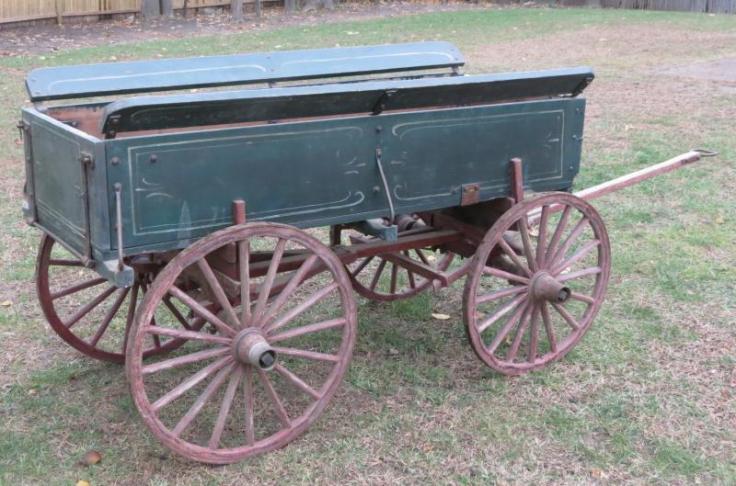
He pointed to a laden waggon passing beneath us. A curtain of dust rose from its wheels as it squeezed through a narrow lane. We watched it for awhile, then he turned to me, his body a silhouette against the vivid sky.

“I enjoyed my funeral. I wish we could have talked about it after – it was one of those things to share.”

“We did share it,” I pointed out. “I was there.”

“But I was not,” he said.

Then he eased himself over the balcony, and without effort, we were sitting in the back of the waggon, perched upon boxes and equipment. We rattled out of the village toward the countryside.

“I loved the outdoors,” he said. “I still remember my last walk in the fields.”

We moved slowly through the country side, the waggon rarely being jostled along the rutted road. The teamster must have been an expert, but he never turned his face to us. Intent upon his business, I suppose.

“You forget that I am dead; for which I thank you.”

“Sometimes I do,” I replied.

“It is at those times, I sometimes think I’m still alive.”

He occasionally pointed to things behind me. Once there was a rabbit. The countryside spread endlessly, without another person in sight. I mentioned this, and he nodded.

“It will be crowded at our destination. But I’ll want to meet my wife.” He then leaned toward me, across the waggon. “You helped me, you know – in our final dance.” He smiled, then sighed, then pointed beneath me.   “My destination is close, I must return.”

I looked down, and saw I was sitting on a coffin – the polished brown one of his funeral. I moved, then bent over, prepared to open it. His fingers touched the wood beneath my hand.

“No. Do not look. You would not like what you found.” His smile seemed forced, there were more teeth showing than usual. “I embrace my new world. But for you, I am well and truly dead.”

DE

(image) http://whitesauctions.com/yahoo_site_admin/assets/images/WAGON2.344181058_std.jpg

Author Interviewed About Elephant And Writing

Dale Estey – The Elephant Talks to God

by

What is your most recent book? Tell us a bit about it.

The Elephant Talks to God is a book of short stories where my Elephant takes his queries and comments directly to God. God not only listens (as God does to us all) but enters into conversation with the Elephant, answering his questions. The stories eventually ended because the Elephant began asking questions the author could not answer. This book is not typical of my novels, the first being a Fantasy set in World War Two and published on two continents, the second a Thriller leading to my first translated work.

Tell us about yourself.

I am from Atlantic Canada, where I have lived all my life. My mother was a British War Bride and my father came from United Empire Loyalist stock. The Estey ancestry goes back to medieval Italy and the House of D’Este. I am interested in, and directed by, all this heritage. I have been writing for over thirty years.

What inspired you to write this book?

My mother gave me an elephant figurine as part of a Christmas gift. While struggling for a subject for a short story, I looked around my room and stopped at the elephant. It was to be a one-off story. The Elephant (and God) had other ideas.

How did you choose the title?

I wanted the most straight-forward title of such a weighty character and subject matter.

How did you know you wanted to be a writer? How did you get started?

I had no interest in writing, books, reading or any of the arts until Grade Eleven. Within the space of a week (for no obvious reason – I say that God cuffed me on the back of the head) I started writing “funny” short articles. The first of them which I remember (and it may indeed be the first) was about a classroom pencil sharpener which chewed up my pencil. I would do one or two of these funny articles a month. They started to get published in the regional newspaper, The Daily Gleaner.

Do you have any writing rituals?

My writing rituals slide around and some disappear over the years. The bulk of my manuscripts are done long hand with a BIC black ink pen. I usually write in the morning. I use binders and write on alternate lines on both sides of the page. I do now write thriller/adventure books on the computer, for I find that medium enhances the speed of such stories.

How do you come up with the names for your characters?

When stuck for a character’s name, I go to a Gazetteer. Most of the time the character appears with name intact. I have three novel manuscripts where the central character has no name but just initials.

Did you learn anything from writing and publishing this book? What?

Every day I write I learn something about writing. The Elephant showed me I can sustain humour.

If you were doing it all over again, what would you do differently?

I know what I should have done differently, but I doubt I would do it. I would have concentrated more on the career aspect, promotion and name recognition. But that might mean I would have written one less novel. Not worth the trade-off.

What types of books do you like to read? Who are your favorite authors? Why?

I prefer reading books where all the elements (character, plot, description, philosophy) blend seamlessly. Writers whom I enjoy who accomplish this are John le Carré, Thomas Mann, Thomas Hardy, Mavis Gallant, Alan Bennett, Robert Hass, Alice Munro, Saul Bellow.

Are you working on your next book? What can you tell us about it?

I am working on a thriller centred around NATO. Internet chicanery is at the core of the intricate plot. One central character is a guard/attack dog named Louie. His name came from a real dog I heard being called to in a dog park. Louie is a Cane Corso.

What is the best advice you could give other writers about writing or publishing?

*BEST* advice for a writer – write regularly. Work time into a schedule to make it possible to write a number of times a week – same time/same place if possible. Publishing venues are so broad these days that it is best to take a long time and study them all. Then chose an avenue that is comfortable (and understandable).

Who is the perfect reader for your book?

Perfection is over-rated. Enter my books and you won’t be disappointed.

Where can readers learn more about you and your book?

http://DaleEstey.com

Amazon.com

http://books.google.com/books/about/The_Elephant_Talks_to_God.html?id=Cj5sAAAACAAJ

https://www.facebook.com/profile.php?id=100000411133160

http://twitter.com/#!/DaleEstey

Interview at:

http://www.sellingbooks.com/
Perhaps my creative stream is bubbling away

Perhaps my creative stream is bubbling away.

Blog at WordPress.com.

Up ↑