Search

kafkaestblog

It is a whirlwind in here

Author

Dale Estey

I owe my life to Hitler, though I never met the man. My father was paid to stop Hitler, so there is no conflict of interest. I was given a thunk on the back o' the head by God when I was fifteen, and within a week began to write. I haven't stopped. My first novel was accepted 'over the transom'. My first editor/author luncheon in New York included a naked man with roller skates at the next table. For the sake of research I have lain on Kafka's grave, but I did not weep. I wish upon my own gravestone the phrase "Thank God He Didn't Die A Virgin". There is truth in every truth - so watch out. My published novels include the popular fantasy A Lost Tale and the thriller The Bonner Deception. I also have two editions of humorous and spiritual short stories, The Elephant Talks to God, which are appreciated by both young and old. My manuscripts range from stories about unicorns and druids in the 'Passing Through Trilogy' to the 9/11 destruction of New York. I have filled in the missing diaries of Franz Kafka; recounted the first person dementia of a serial killer; explored the outrageous lifestyle of the famous; and listened in while an elephant and God converse. I currently switch my attention between the saga of a family of onion farmers, from Fourth century Italy to the present day, and a contemporary NATO thriller. I live in Canada and make Nova Scotia my home. I prefer to travel by train, but embrace the computer age with passion. I am always on the hunt for unique onion recipes.

An Elephant Tale For Christmas Eve

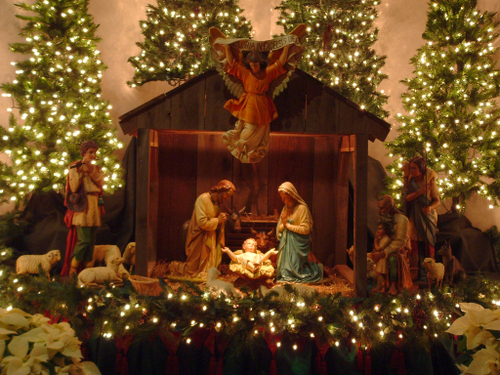
creche2b1

The Elephant was not oblivious to the

Christmas season, and wanted to pay his

respects. He travelled to the special clearing

where a cloud waited for him.

“It’s your Son’s birthday and I want to congratulate him.”

“Thank you.” The cloud descended further.

“It is a grand time.”

“I’d like to …” the elephant hesitated.

“Yes.”

“You sent your son for us to see, so we

would believe.”

“Yes.”

“Well, I want to …”

“Spit it out,” said God. “You’re fired up.”

“I want to see you.” The elephant spoke

quickly. “I don’t have to see you, you know

that.  I believed even before you talked to

me. But I want to see you; it would mean so

much. I wasn’t around for the Baby, but

cows and sheep and things got to see Him. I

can’t explain, but …”

“Go home,” said the cloud.

“You’re not angry with me?” said the

elephant.

“No.” The cloud started moving away. “It’s

an honest request.”

“Thank you for coming to see me,” said the

elephant.

“Sing some carols.” The voice was distant. “I

like them.”

The elephant turned and started through

the woods. He ignored the tasty leaves

within easy reach, and the rich grass near

the brook. He wanted to get home as quickly

as possible, so he could join the singing at

the Mission he knew was happening later in

the evening.

He trotted along the trail, snapping a branch

here and there in his haste, when he noted

the stillness, the hush which had overtaken

the forest. He slowed down and then

stopped in his tracks.

He turned his head, his small eyes squinting

into the brush. There was movement

coming toward him, and when the trees

parted, he went to his knees with a gasp.

Tears rolled from his eyes, and the golden

trunk touched his own, and gently


wiped them away.

(Image) 3.bp. blogspot.com/-Cu2l0Z3a5RY/UNX-AVe2xcI/AAAAAAAABfo/xse8jdvJsLo/s1600/creche%2B1.png
Will The Shortest Day Of The Year Impress The Cat?

It’s the shortest day

Of the year,

As old Sol

Shifts his ass

Over the Equator.

Then the days

Get longer,

And the weather

Gets warmer.

Hah hah / Hah hah.

I told this to

Paw, the cat/kitten,

Black as black ice,

With one white mitten.

And,

If he didn’t laugh outright,

He at least

Smiled.

(I’m The Lighthouse Poet Laureate of Partridge Island /1821 – 2025 / A lot of stuff have I seen /A lot of stuff to report}

DE BA. UEL

In The Storm, Did The Cat, Disappear Just Like That?

If my cat/kitten,
Black as coal,
With one white mitten,
(I call him Paw)

Was not black as coal,
He’d be lost to me,
And to the ages,
In these drifts of snow
Covering Partridge Island,
After the storm,
From down the coast,

That left us so white.
I kept him in while
It raged,
Which he took to kindly.
But I let him loose,
The next afternoon,
Because a cat/kitten
Got to learn the

Ways of the world.
He took to the huge drifts,
Like a fish to water.
And when he tried to
Chase a rabbit,
I laughed myself silly.
And, (I bet),
So did the rabbit.

(I’m The Lighthouse Poet Laureate of Partridge Island /1821 – 2025 / A lot of stuff have I seen / A lot of stuff to report} DE BA. UEL

Kafka Walks The Charles Bridge In Prague And Ponders The World

In my novel, Kafka In The Castle, I fill in the lost diary entries that he either ignored, or destroyed.

Kafka made this walk hundreds of times (and I managed a few, myself).

The following is the entry I made of Kafka crossing the Bridge, and what he pondered.

Excerpt From Kafka in the Castle

~~~~~~~~~~~~~~~~~~~~~~~~~~~~~~~~

29 August 1917

I strolled the Charles Bridge a long time tonight, before coming on to the castle. I have the feeling that the river air helps my lungs.

I also like the city lights reflecting from the racing water. And the occasional boat, lanterns stern and bow.

I have once or twice steered my own boat through the dark, the flickering light dripping through the gloom before me. If I could have reached the sea while it was still dark, I would have tried to do so. But I was younger then. And could breathe deeply.

Fantasy fuelled this escape, from my Moldau island and then along the Elbe, through Dresden, Magdeburg and Hamburg, to the freedom of Helgoland Bay. Further into the North Sea, if I wanted. Perhaps to Iceland, where I could become lost in the snow and white.

All this, from my perch upon the Charles Bridge, as I strolled from side to side, and one end to the other. My last smile reserved for the statues staring down on me.

Their stony expressions etched upon their faces, as is mine to me.

Cyber Monday Takes Over From Black Friday And Still My Master Delete Finger Keeps Tap Tap Tapping

Perhaps – if just once – some grubby commercial venture offered to pay me for their questionable goods, I would relent. But it ain’t happened, so it’s delete delete delete. Sore (yet soaring) finger.

Bring me some ice!

DE

I Have A Sore Finger Deleting “Black Friday” Emails – But It’s Been Worth It

The trouble is – I bet there will still be some hanging around for tomorrow.

I shall persevere.

My Father, Byron Caleb Estey, Served In The Canadian Army For The Entirety Of The Second World War

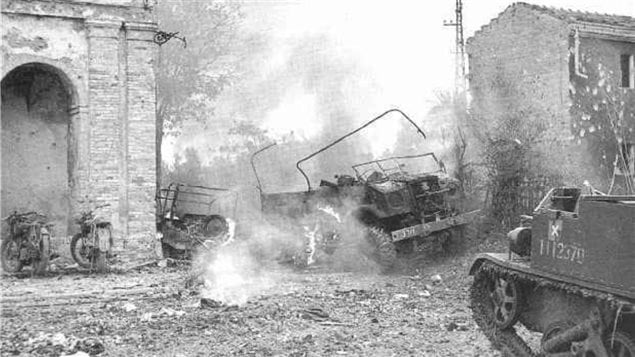
151221_ce0h0_rci-m-burning_sn635

My father, Byron Caleb Estey, served in the Canadian Army for the entirety of the Second World War. He was 31 when he signed up, and was a decade or more older than most of the soldiers he served with. At the end of the war, he was offered an instant promotion from Corporal to Sergeant Major.

He declined. He had had enough.

He was with the 90th Anti-Tank Battery. He was the member of the crew who calculated the coordinates to aim the gun and destroy targets. He did this up through Sicily and Italy, except for those times when he grabbed his rifle to shoot at soldiers shooting at him.

I imagine I could write pages repeating the anecdotes he told – and maybe some day I will. He didn’t talk all that much about the war, and when he did, I’d guess 80% of his stories were humorous. The other 20% were not.

I regret not discussing his war experiences more with him, but he did not encourage it. I once asked how close he got to the German soldiers. He said, close enough to kill them.

He hated Germans and Japanese all of his life. I understand that this is not the way of most soldiers. They mellow. They come to understand that soldiers on the other side were doing a job, just as they were. My father was not one of these. Those 20% of his stories explained his attitude to me.

He fought in – arguably – the most horrific and bloodiest battle in the war, the Battle of Ortona over Christmas week of 1943. He marched over piles of bodies, and crawled over piles of bodies. Such were the details he would tell. He didn’t speak of his feelings, or use words like “horror”.

On Remembrance Day he would march in the community parade. He rarely lingered for a meal or beer or camaraderie at The Legion. He did not seem affected by the memorial event, and did not talk any more or less about his experiences just because it was 11 November.

Because his tales were more funny than not, I’ll close on what might have been his last funny story.

At his death, the Royal Canadian Legion wanted to conduct a small ceremony at the funeral parlour. They requested that his medals be pinned to his chest. But, the medals could not be found. This was odd, because they were important to him, and he always wore them for the Remembrance Day parade.

It is excessive to say that the whole house was searched – but not by much. Drawers, shelves, boxes, closets, clothes, were repeatedly searched. Nothing. The Last Post was played over a Veteran with no medals.

Months later, when the house was being sold and possessions were being removed, his clothes were searched before being given away. In the side pocket of a jacket he never wore were the medals, all spiff and shiny.

He would have smiled at that.

Dale Estey

After Margaret Atwood’s Memorable Memoir, Can I Be Far Behind?

I have shared this tale before, and feel encouraged to do so again. It is an odd milestone in my own writing odyssey, and when Margaret Atwood achieves a profound feat, as her new memoir reveals, I do take note. I have about forty pages of my own memoir done, and years to go before I sleep.

*******************************

It was not my intent to piss off Margaret Atwood.

The opposite, in fact. I wanted her to know she was an inspiration.

She was giving a reading at the University of New Brunswick in my student days. I attended, but there was quite the gathering and she was whisked away at the end. However, I overheard there was a ‘gathering’ in her honour. Invitation only, of course. Academia and literati.

I crashed the party (that was the term used by the professor who clapped his sturdy hand upon my shoulder but – happily – did not thrust me into the night).

But Ms. Atwood was kept deep in many a learned conversation and I had no opportunity to converse. I did, however, overhear where she would be spending next afternoon – the historic University Observatory.

Next day I knocked upon the Observatory door.

It was not a cheerful Margaret Atwood who answered, and answered with alacrity.

She asked my name.

She asked my business.

And she asked how the hell I knew where she was. She had stolen the day to do some writing. Some ‘real’ writing, in this window-of-opportunity grudgingly offered on the book tour.

At least I was there to praise Atwood and not to bury her with some essay question.

Nor had I a manuscript to hand to her.

I might not have garnered a smile, but her curt thank you was reward enough.

For me, at least.

DE

It’s A Hell Of A Halloween On Partridge Island

Sister Darling,

Of The Rarified Church of the World (reformed),

Leapt from a fishing boat,

Onto the dock of the

Partridge Island Lighthouse,

Wearing a large, silver cross

Around her neck.

“Isn’t that Papish?” I asked.

“We’re going to need all the help

“We can get,” she answered,

Looking around.

“Where’s Paw?”

Paw, the cat/kitten,

Black as Satan

With one white mitten,

Made his appearance

From the bushes beside the path.

“Hop on,” she patted her shoulder,

“If we ever needed a black cat,

“Tonight is the night.

Paw sprang to her shoulder.

“To the point,” she said,

“To the tip of the Island.”

“What’s the matter?” I asked.

“You know what’s the matter.”

She took the time to jab me in the chest.

“You’ve been feeling it,

“Heading toward us.

It’s true – I have.

All Hallows’ Eve, 

With a ship of

Disparate and  dangerous souls,

On the tide coming toward us.

As we hastened toward the outer

Tip of the Island, in half the time

It would usually take,

We acquired a flock of chattering

Crows, making a number more 

Than any murder would demand. 

We reached the water

In the setting, slanting sun.

The crows flocked 

Over our heads, scaring

The seagulls away.

A full-rigged sailing ship,

Wrapped in streaming fog, 

Made its approach.

“We must enter the water.”

Paw did not take kindly to that,

But he stayed perched where he was.

Sister Darling walked out until

The ocean was at her knees.


“Stand thee behind me, poet,

We will share the cat.”

Paw had his front feet on her shoulder,

And his back feet on mine.

He ignored the circling crows.

Then Sister Darling said such prayers, 

That human beings are not supposed to hear.

She repeated them, yelling into the wind.

Even the crows fell silent.

Paw chattered and sputtered and mewed.

My own prayers fell like curses.

Sister Darling held her cross

In front of her like a shield.

The Ghost ship, which had risen

From Davy Jones’s locker,

On this night when the Dead roam,

Became shrouded in smoke and flame,

Its sails engulfed in fire.

Paw dug his claws into my shoulder

And howled.

The ship returned to the depths of the sea.

Sister Darling seemed near to fainting.

I held her close.

Paw, the cat/kitten, draped himself

Around her neck.

The crows went on their way.

I’m The Lighthouse Poet Laureate of Partridge Island /1821 – 2025 / A lot of stuff have I seen / A lot of stuff to reportDE BA. UEL

Blog at WordPress.com.

Up ↑