I do find it grand to have such this connection to the Celts, about whom I have written three novels.
During World War Two, my father had the unique experience of guarding Stonehenge. Not by himself, of course, there were other members of the Canadian Army with him.
The vast plains around Stonehenge were utilised by the military in both world wars. During the First War, the area was a training ground for troops from various countries. There were many encampments for recruits, with both basic training and preparations to train for the trench warfare awaiting on the continent. There were thousands and thousands of men, and huge amounts of supplies.
During the Second War, the area was used as staging ground for the D-Day invasion. There was great security, and as much secrecy as possible. Soldiers were in place to guard the perimeter.
So, my father found himself not only guarding Stonehenge, but doing so on Midsummer Morn, when the sun rose over the monument.
He was a learned man – a school teacher – and versed in the history of the place. He knew of the Celts and the Druids and some of the mythology. He knew this was sacred ground and that Midsummer Morn was especially important.
He might have paused and tried to look into the past, and see more in the morning mist than was actually there. I do not know.
He did, however, when their shift was over and they got to eat, tell the other soldiers of the history of the place.
He mentioned that, during such celebrations by the Celts, the Druids might have a virgin killed to appease the gods.
Boston Modern Orchestra Project, Gil Rose, conductor
Dalit Warshaw (b. 1974) is a multi-threat artist. As a composer and pianist, she has created a distinguished career. Her first orchestra piece was commissioned when she was eight years old, and this prodigious distinction has been followed by a body of work that encompasses music for orchestra, chamber ensembles, vocalists, choruses, and Letters of Mademoiselle (2018), a staged song cycle for the talented soprano Nancy Allen Lundy.
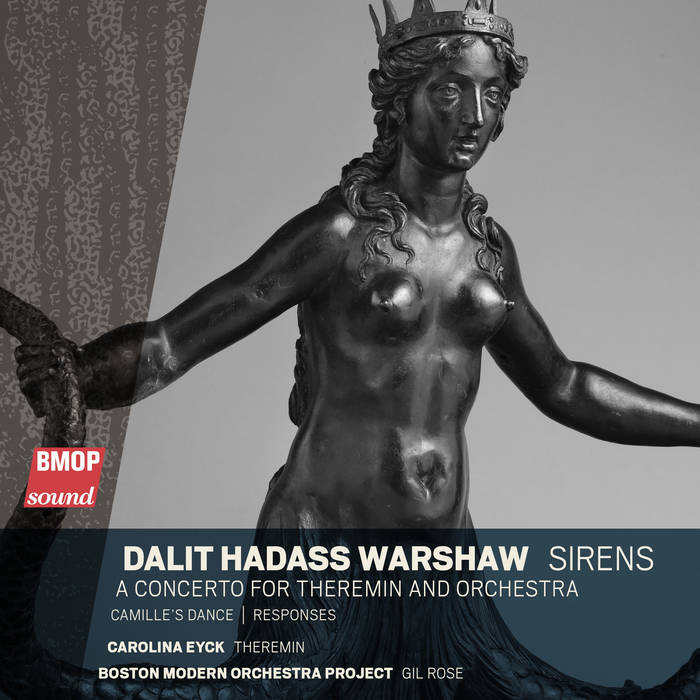
The theremin has become an important part of her work. Warshaw has performed the instrument in high profile settings, including appearances with the New York Philharmonic. Sirens is a recording of her theremin concerto and two other orchestral pieces, performed by the Boston Modern Orchestra Project, conducted by Gil Rose.
Responses (2016) is a triptych that reflects upon three of Brahms’s Intermezzos, piano repertoire that Warshaw has studied. Originally composed for solo piano and performed by Warshaw, it has been transformed into a work for large forces that sounds idiomatic in its instrumental writing. Indeed, Warshaw’s orchestration deftly captures both the sehnsucht of romanticism and her own aesthetic, which encompasses both neo-classical and mainstream contemporary classical elements. While the pieces themselves are earnestly serious (as was Brahms in his later years), one can have a bit of fun with the following listening game: without hunting down program notes, see if you can figure out from which intermezzo each movement takes its inspiration.
Camille’s Dance (2000) is named after visual artist Camille Claudel, whose sculptures La Valse and La Fortune grace the cover and interior of the BMOP recording’s booklet. It is a stirring piece, rife with dissonant harmonies and muscular gestures that epitomize the striking characters depicted in Claudel’s sculptures, as well as her fraught relationship with Auguste Rodin.
The soloist for Sirens is the thereminist Carolina Eyck. It is a three movement work that is inspired by Clara Rockmore and, of course, by the singing duo of temptresses found in Homer’s Odyssey, seen through the vantage point of Franz Kafka’s parable “The Silence of the Sirens.” The theremin was taken seriously as an instrument in part because of Rockmore’s advocacy. Eyck has explored an expansion of its capabilities with the Etherwave Pro instrument, which has an extended bass range. She also uses octave pedals to further extend the theremin’s compass.
Rockmore’s first instrument was the violin, and her theremin performances reflected this; several of the pieces in her repertoire were transcriptions of violin repertoire. Thus, the opening movement of Sirens is titled “Clara’s Violin,” which includes thematic material based on her life story and also themes that are ciphers of names: Clara, Leon Theremin, her partner and the inventor of the eponymous instrument, and the KGB, whose agents hounded and even kidnapped Theremin. One needn’t know any of this to appreciate the abundant vitality and craft of the movement. Warshaw’s own experience as a thereminist and her close collaboration with Eyck have yielded a versatile and challenging solo part that belies the notion of the instrument as being limited to special effects and transcriptions.
The second movement uses the Kafka story as a touchstone, with a stirring duo between theremin and piano that reminds us of the two-against-one scenario that Odysseus endured. The third movement is a wild ride with glissandos galore, a theremin specialty, set alongside a fugue that once again employs ciphers of names as its thematic material: “Theremin” as its subject, with “Clara” and “Dalit” used as two countersubjects. The combination of these two elements shows Eyck and her bespoke electronics to best advantage. It also highlights the extraordinary facility of BMOP’s musicians. Careful preparation and the dynamic leadership of Rose are clear in the performances of all three of the programmed pieces, but the jubilation with which the concerto is rendered makes it a strong finale to a thoroughly engaging recording. Recommended.
In my novel, Kafka In The Castle, I fill in the missing entries of his actual diaries. There are many days to fill, as he either did not write during these days, or he destroyed the record.
Kafka did have occasion to ponder Friday 13th. The date was connected to “The Swiss Girl”, whom he met at a resort. She was eighteen and he was thirty-four. It is unclear how intimate their relationship became.
Twice, I give him a brief recognition of Friday 13th. In reality, The Swiss Girl haunted him (pleasantly) all his life.
**************************************
13 April 1917
I almost wrote down the year as 1913. That was the year I met the Swiss girl. And I remember her joking about, and how we had missed it by just a day. She was superstitious – Christians seem to be. I wonder what precautions she is taking today. It will be three years and seven months since I saw her. Yet some of the things we did could have happened last week. I think that memory must be made of rubber. You can sometimes pull it toward yourself – and sometimes it snaps away like a shot. Causing as much pain.
13 July 1917
Friday the 13th again. What better time to think of the Swiss girl, than with F. I don’t know if such memories help sustain me, or if they revel how intolerable the future can sometimes be. I can not imagine the Swiss girl’s face across the table from me, nor her voice singing one of her quiet songs. If I must be trapped, then why can’t I be trapped in the past?
Franz Kafka died on 03/06/1924. He was a young man – a month short of his 41st birthday. However, his death was preordained years earlier. In my novel, “Kafka In The Castle“, I fill in the missing days of his diary. These are the entries I imagine concerning the days he actually found out his fate.
*******************
04 September 1917
A death sentence.
05 September 1917
Max is saying all the right things. All the nice things. And he is saying them all in the right way. An earnest, matter-of-fact truthfulness which sounds plausible. If he does not tread from a very narrow path. Sometimes I find myself a part of his hopeful speculations. And sometimes I find that I am trying to keep his spirits up. If he is going to all this trouble, then shouldn’t I do my part? But: it isn’t his blood. And anyway – he was the one who insisted on the specialist. Chose the renowned Dr. Pick. And heard – almost as soon as myself – the verdict. Tuberculosis. Tuberculosis engaged in both lungs. Like a preparation for marriage. The engaged man now flirting with another lover. And planning a marriage which will be far more permanent that any I could have had with Felice.



 kafkaestblog